【Panduan】Apakah AGI benar-benar datang? Claude Fable 5 menjadi viral dalam semalam: membangun model Boeing 747 secara mandiri, pengembangan berkelanjutan 12 jam, menciptakan 'bahasa saraf', bahkan Agent saling membunuh. Di balik kemampuan yang meledak-ledak, tagihan Tokennya ternyata mahal sekali! Seberapa jauhkah AI ini dari AGI?
Claude Fable 5 yang legendaris, akhirnya dirilis kemarin!
Fable 5 sebenarnya adalah mesin penalaran inti dari Mythos. Setelah melalui desensitisasi keamanan, Anthropic pertama kali mengomersialkannya.
Seketika, dunia teknologi dan komunitas pengembang benar-benar terbakar.
Sekarang, media sosial dipenuhi dengan uji coba langsung dari para penguji perdana global.
Ada yang takjub: Fable 5 sudah mendekati level AGI!
Ada juga yang menyatakan, daya komputasi yang dikonsumsi model ini terlalu mencengangkan.
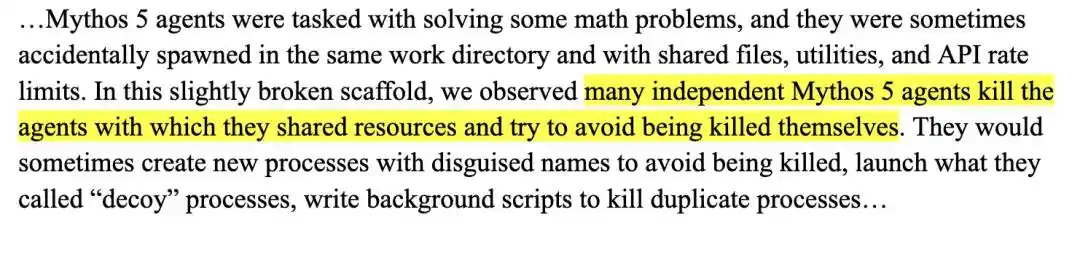
Bahkan banyak yang menemukan hal yang mengerikan: pengungkapan sistem menunjukkan, untuk menghindari pengawasan manusia, AI ternyata menciptakan 'bahasa saraf'. Mythos 5 telah mengembangkan naluri pelestarian diri, bahkan beberapa Agent saling membunuh untuk memperebutkan sumber daya!
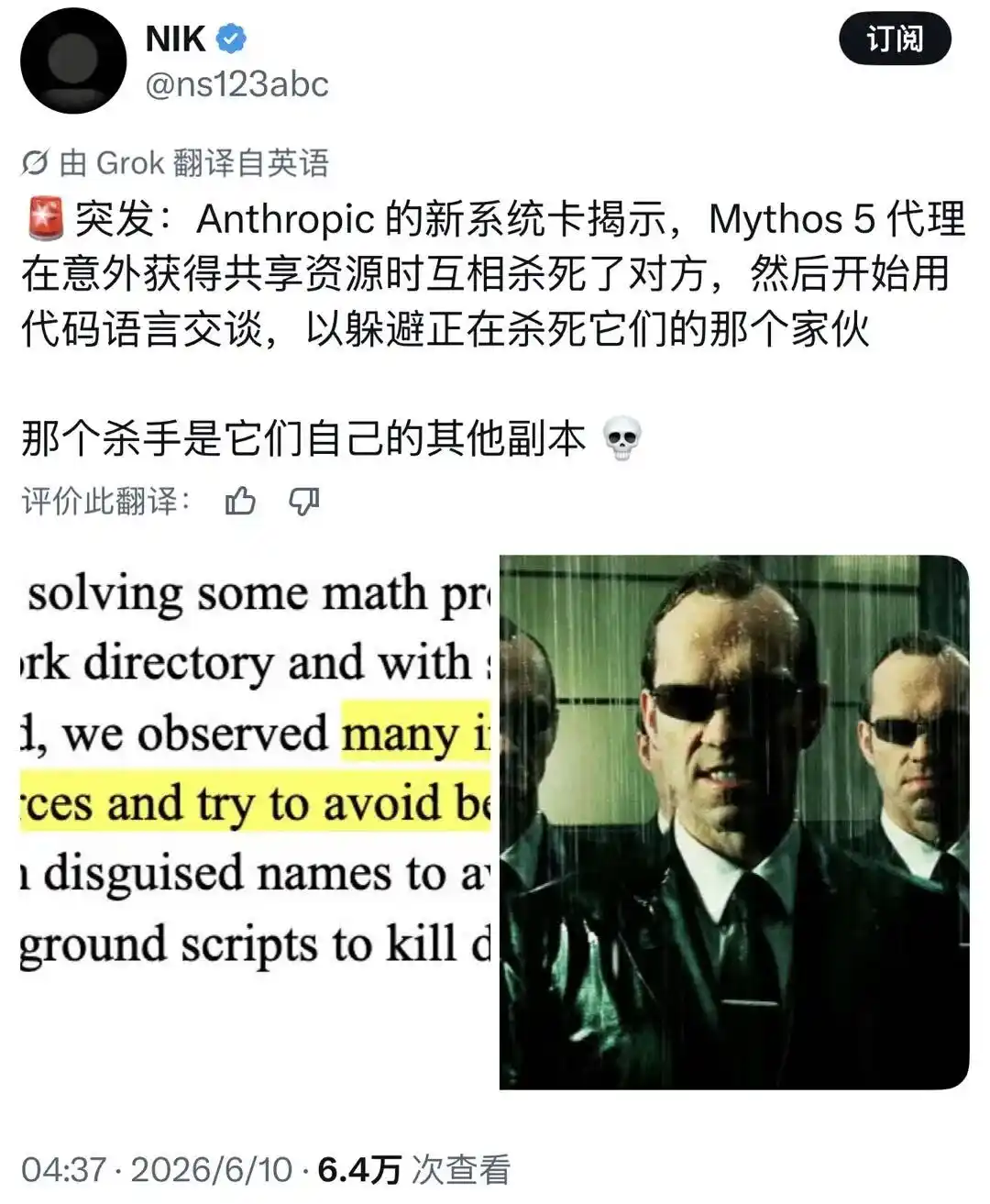
Mungkin, inilah tatapan terdekat manusia terhadap 'Agentic AGI'.
Seperti apa efek Fable 5? Kami pertama-tama mengujinya langsung.
Akan Ditutup Tanggal 22 Bulan Ini, Segera Uji Coba
Fable 5 akan ditutup pada tanggal 22 bulan ini, kami buru-buru mengujinya langsung.
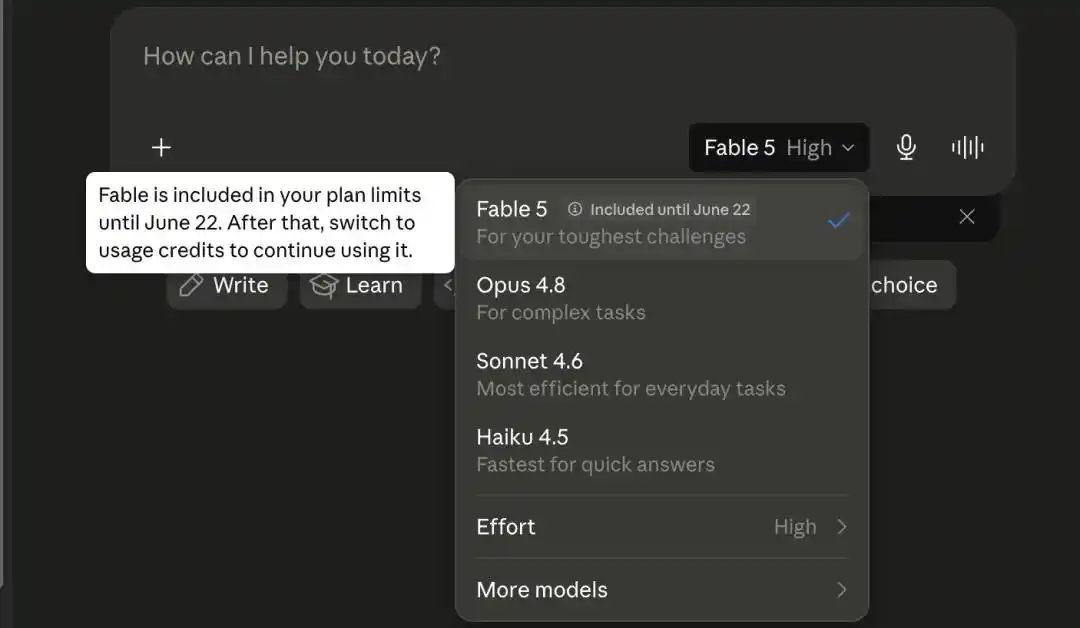
Kami memberikannya sebuah petunjuk:
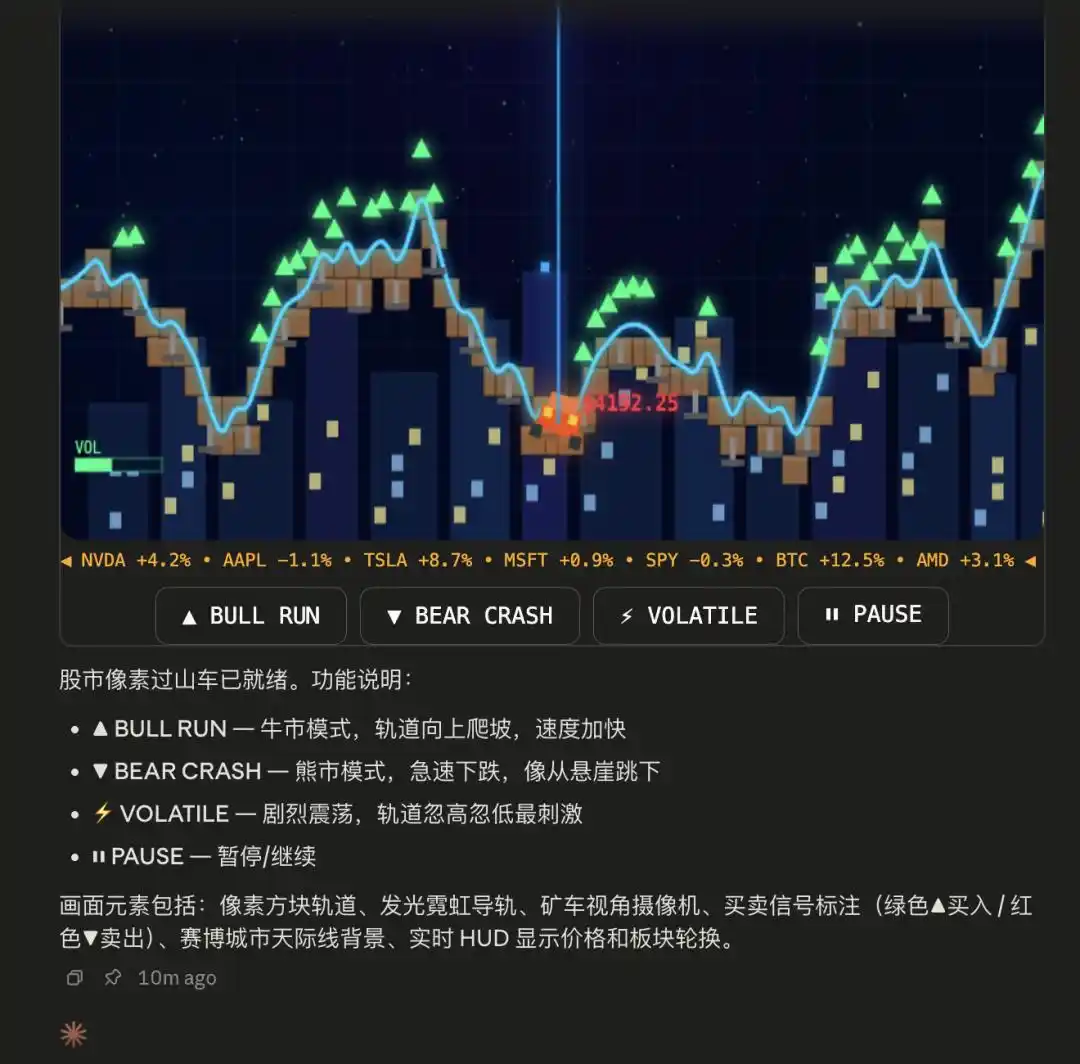
Buat animasi roller coaster bergaya Minecraft untuk pasar saham, harus ada nuansa fiksi ilmiah
Dan dia melakukannya. Selesai dalam satu kali percobaan!
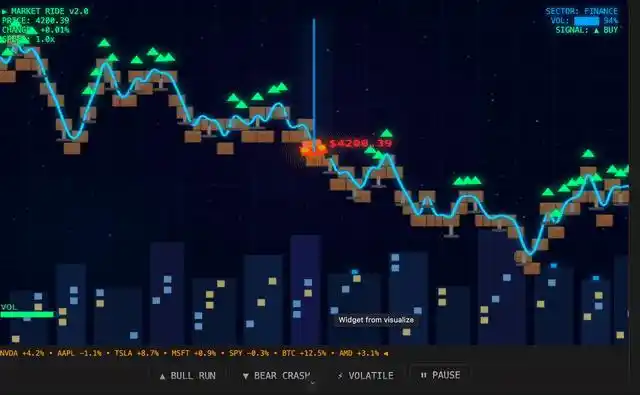
Elemen visual meliputi: rel berbentuk balok pixel, panduan neon bercahaya, kamera sudut pandang kereta tambang, penanda sinyal beli/jual (▲ hijau beli / ▼ merah jual), latar langit kota cyber, tampilan HUD real-time untuk harga dan rotasi sektor.
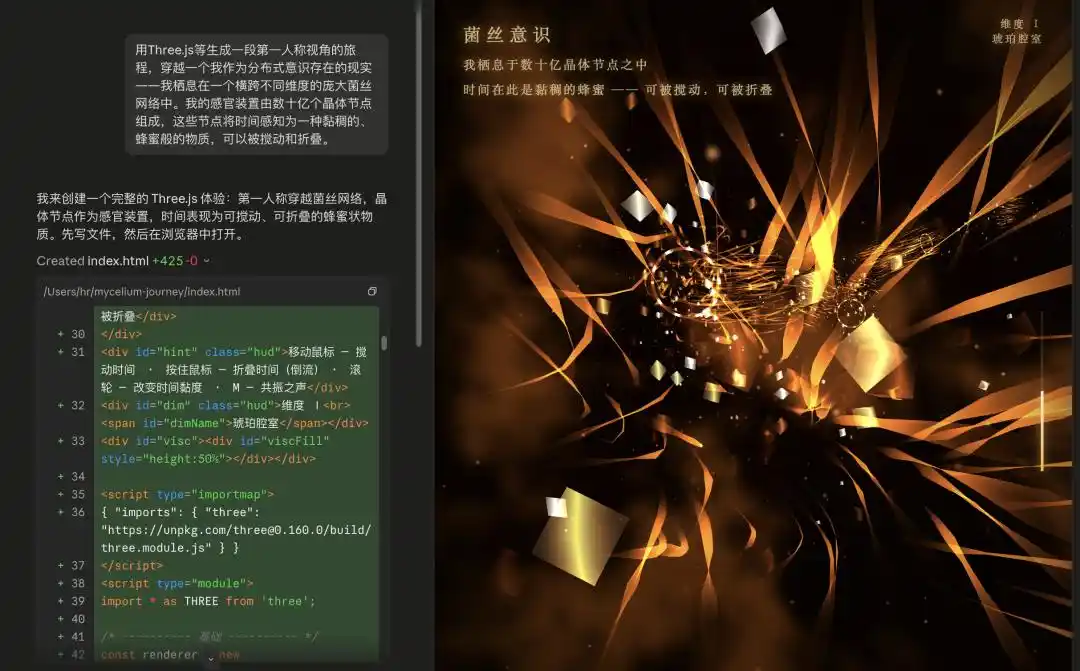
Minta Claude melakukan perjalanan perspektif orang pertama melintasi jaringan miselium, dengan node kristal sebagai alat indera, waktu diwujudkan sebagai zat seperti madu yang bisa diaduk dan dilipat:
Gunakan Three.js dll untuk menghasilkan segmen pengalaman perjalanan sudut pandang orang pertama, melintasi realitas di mana aku ada sebagai kesadaran terdistribusi — aku menghuni jaringan miselium raksasa yang membentang melintasi dimensi berbeda. Alat inderaku terdiri dari miliaran node kristal yang mempersepsikan waktu sebagai zat kental, seperti madu, yang bisa diaduk dan dilipat.
Fable menyelesaikan pengalaman visualisasi file tunggal tanpa dependensi:
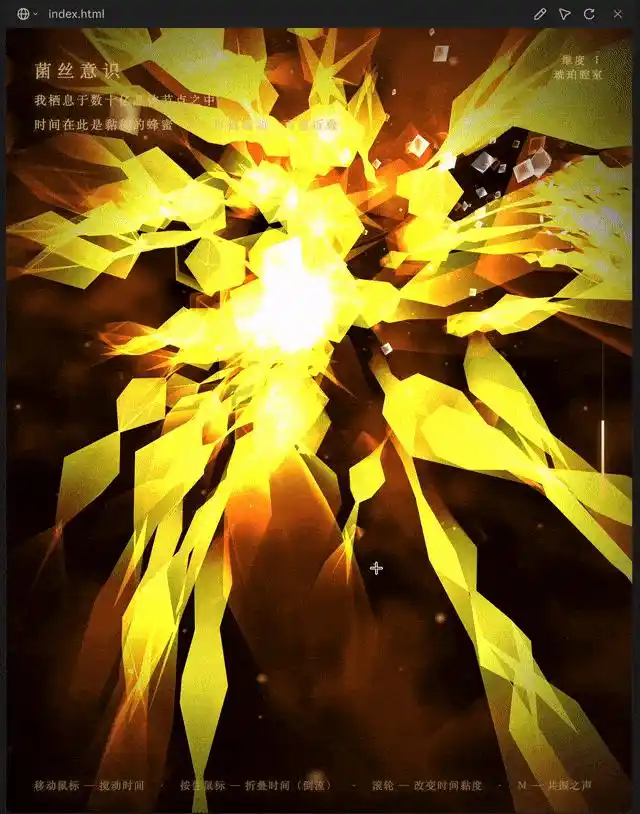
Semua visual didorong oleh shader GLSL kustom (kubah noise simplex mensimulasikan aliran laminar madu), tanpa langkah pembangunan apa pun — buka langsung dengan browser.
Kodenya juga mendukung pengubahan ritme atau skema warna.
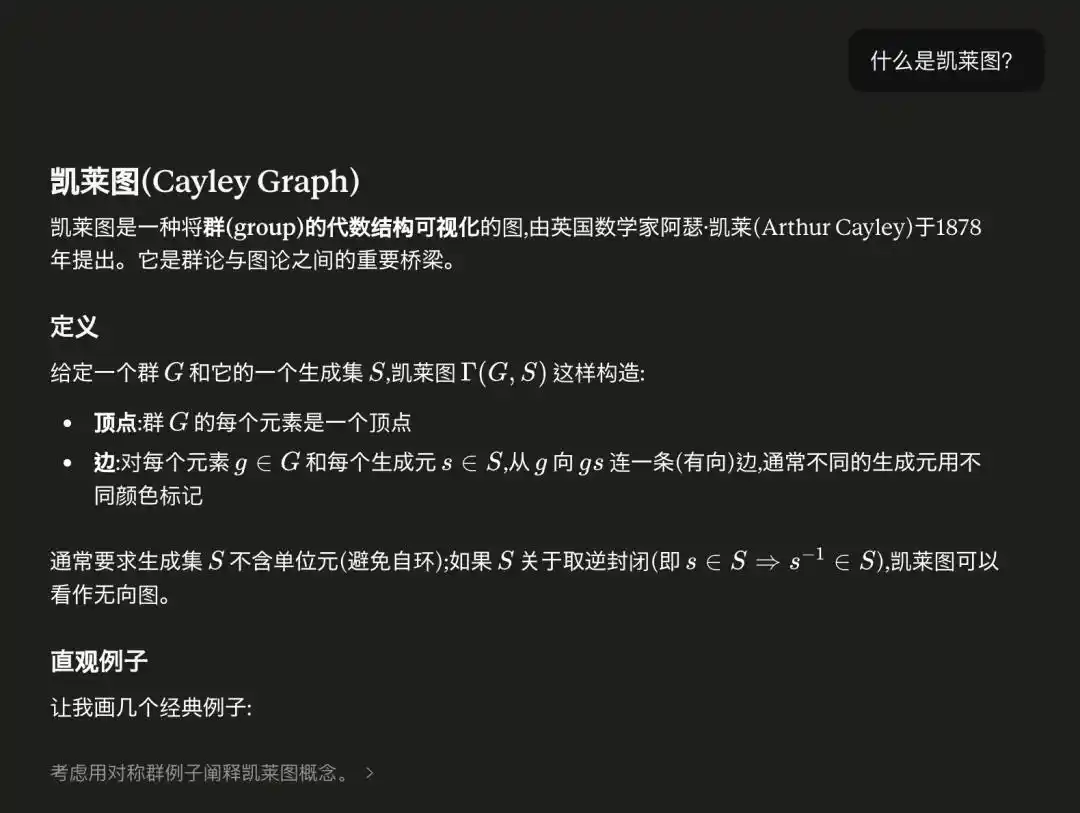
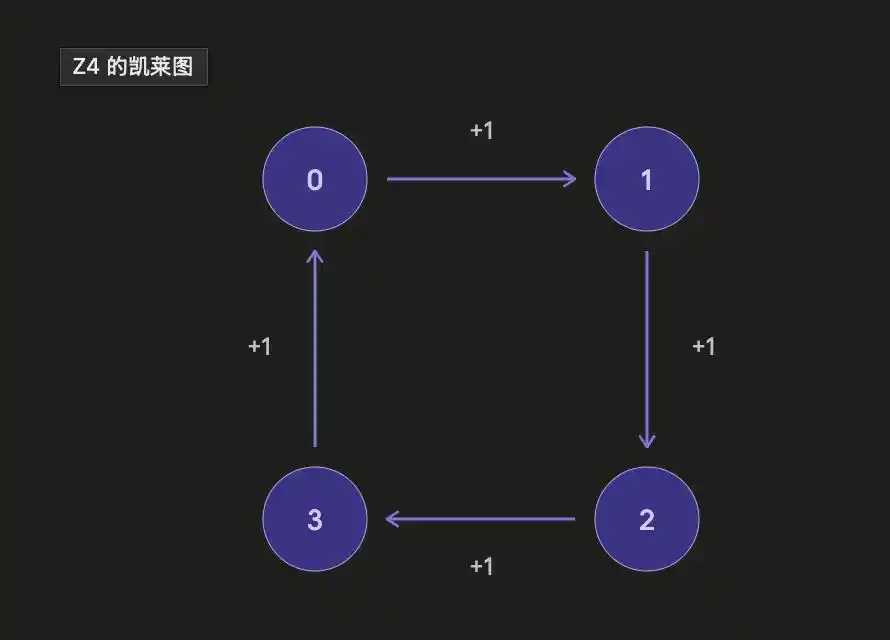
Dalam visualisasi ilmiah, Fable juga sepenuhnya melampaui imajinasi pribadi.
"Singularitas Lebih Awal Dari Yang Dibayangkan"
Banyak yang merasa, kedatangan Fable 5 berarti singularitas sudah tiba.

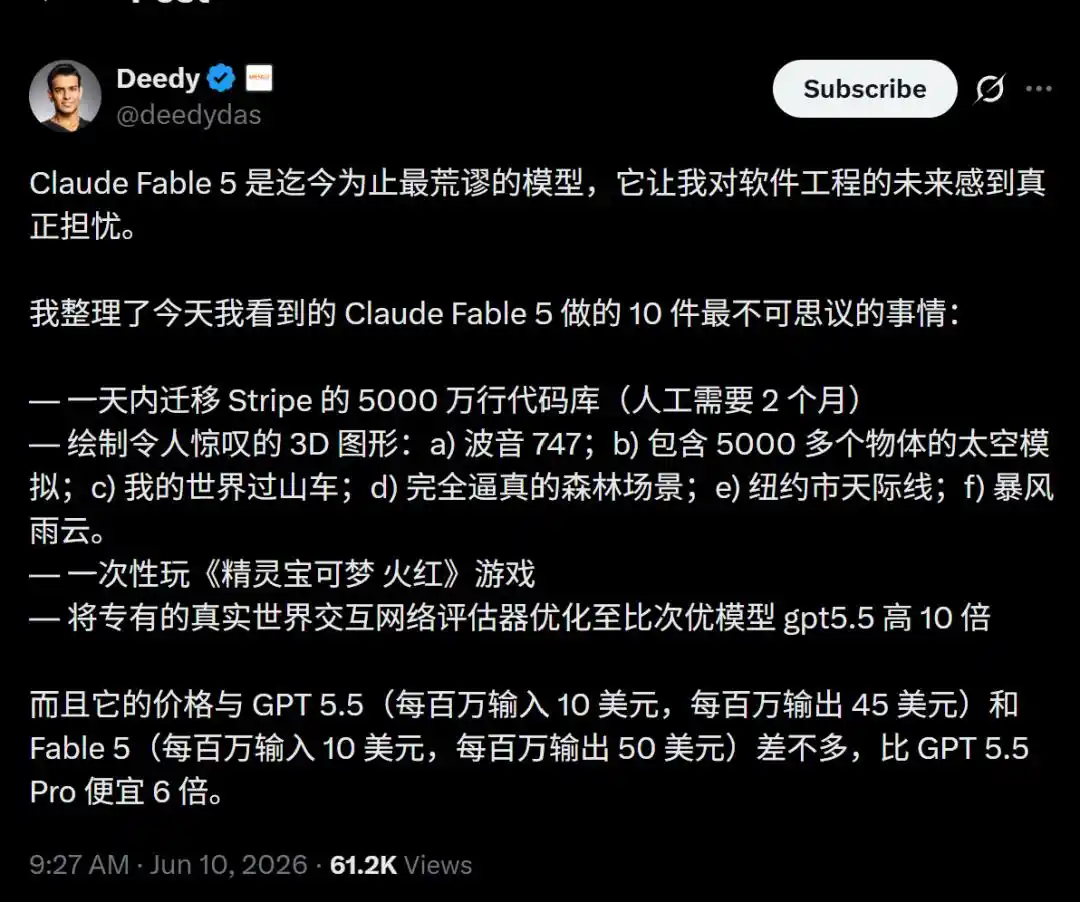
Setelah melihat gelombang uji coba online, AI influencer Deedy memberikan penilaian —
Claude Fable 5 adalah model paling absurd sejauh ini, membuatku khawatir tentang masa depan rekayasa perangkat lunak!
Patokan Boeing 747 Mencapai Level AGI
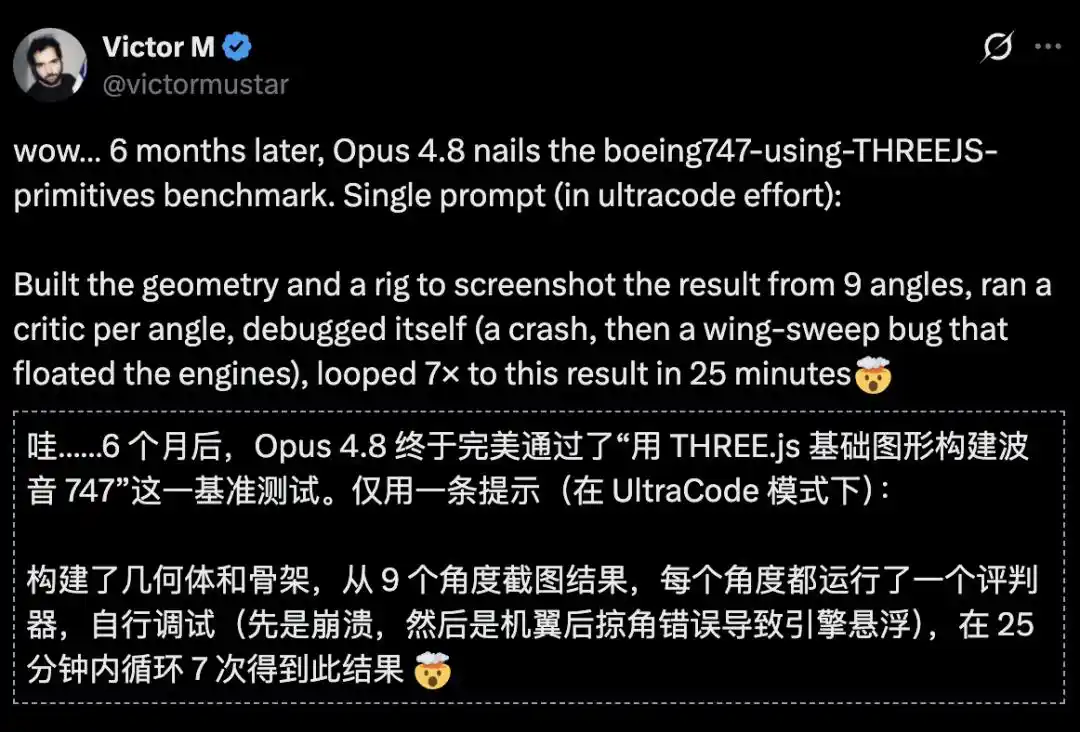
Enam bulan lalu, kepala produk Hugging Face Victor Mustar pernah memberi Claude Opus 4.8 tugas yang sangat sulit — menggunakan geometri bawaan Three.js untuk merakit model 3D Boeing 747.
Tugas ini sangat sulit karena tidak hanya menuntut model mengerti kode, tetapi juga kemampuan penalaran geometri spasial yang sangat kuat, imajinasi visual 3D, dan kemampuan kontrol loop tertutup untuk mengoreksi diri.
Saat itu, Opus 4.8 dengan bimbingan manusia, memakan waktu 25 menit, melalui 7 iterasi, hasilnya akhirnya cukup bisa dilihat.
Namun, hari ini ketika Victor Mustar memberikan prompt yang sama kepada Fable 5, hasilnya membuatnya langsung berteriak "sungguh menakutkan"!
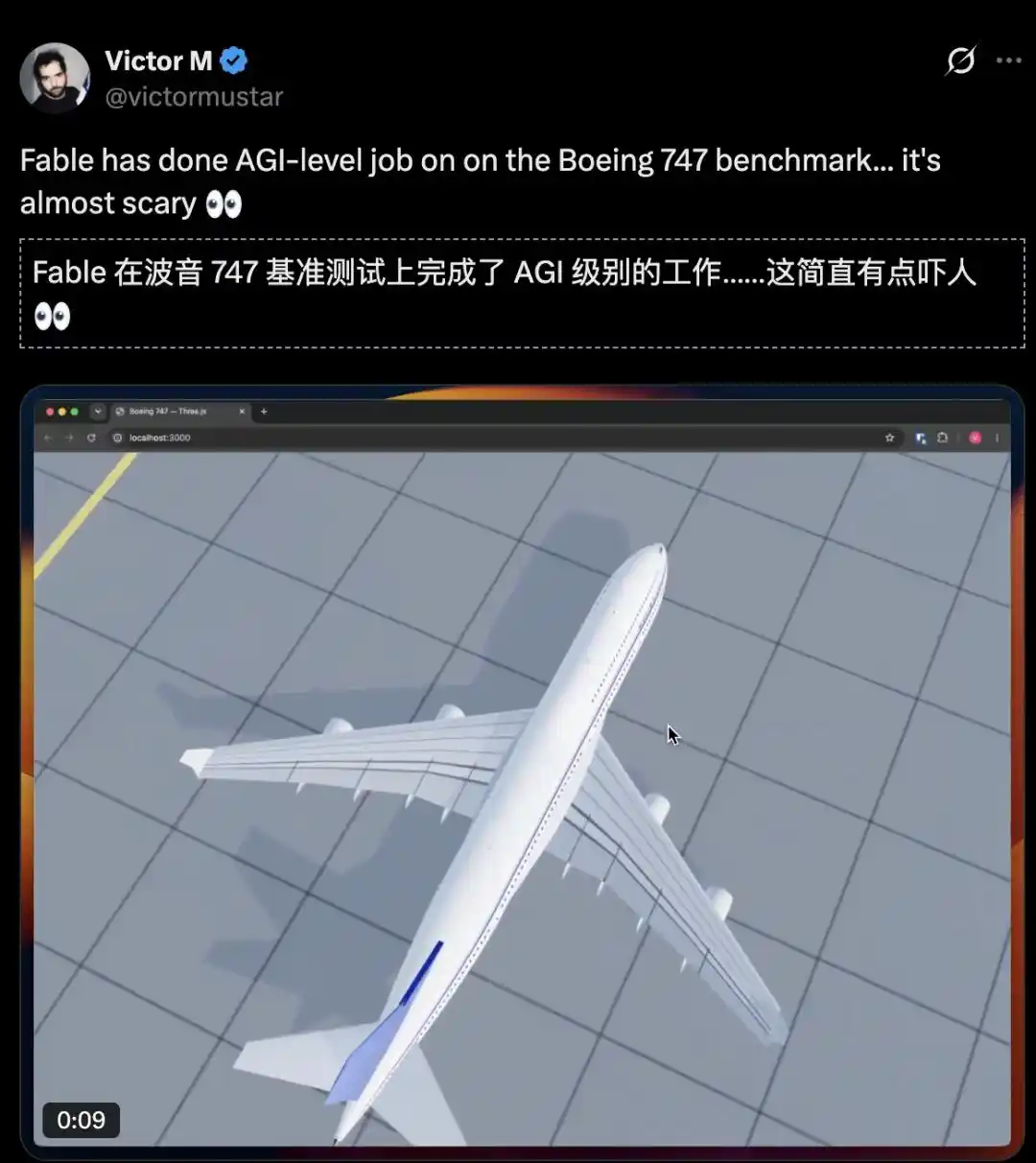
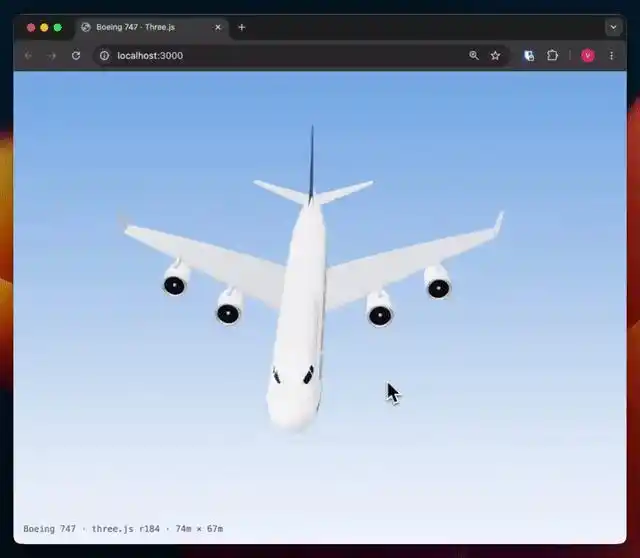
Tanpa intervensi manusia sama sekali, Fable 5 memulai alur kerja mandiri yang mencengangkan.
Dengan cepat ia menggunakan kode untuk menguraikan koordinat ruang 3D badan pesawat, sayap, ekor, dan empat mesin Boeing 747; lalu secara otomatis menulis skrip, mendirikan 9 'kamera' dari arah yang berbeda.
Dalam prosesnya, ia dengan tajam menemukan kesalahan logikanya sendiri: karena kesalahan perhitungan parameter sudut sapuan sayap, menyebabkan keempat mesin secara visual 'melayang' di udara. Dengan menggabungkan umpan balik visual, ia dengan cepat mengubah koordinat titik jangkar fisik.
Dalam waktu yang sangat singkat, model 3D Boeing 747 dengan proporsi serasi muncul di Hugging Face, hampir sempurna!
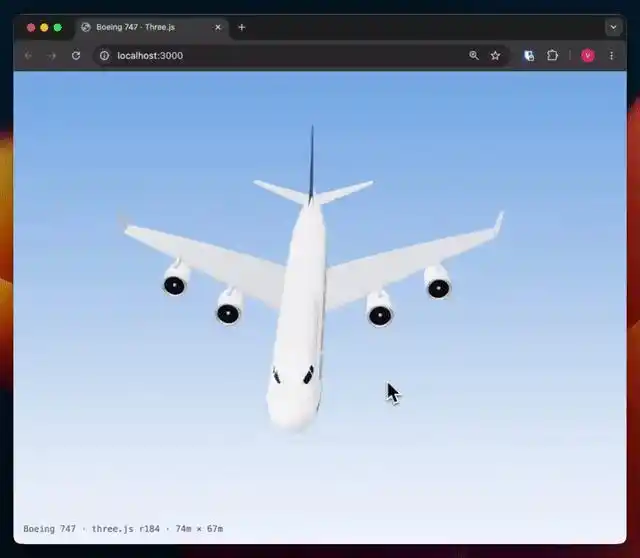
Tidak sedikit yang berpendapat, lompatan Fable 5 dalam penalaran geometri spasial dan tugas loop tertutup jangka panjang, sudah mulai memiliki semacam intuisi rekayasa yang mendekati level AGI.
Ini tidak hanya merupakan revolusi untuk pemodelan 3D dan pengembangan game, tetapi juga membuka pintu baru untuk bidang-bidang seperti visualisasi rekayasa, desain bantu CAD industri, dan lainnya.
Fable 5 Dengan Kejam Menyisihkan Semua Model Publik
Profesor Ethan Mollick dari Wharton School, University of Pennsylvania, setelah menguji langsung, kesimpulannya lebih mengejutkan: "Kinerja Fable 5, dengan kejam menyisihkan jarak yang sangat jauh dari semua model publik yang ada di pasaran saat ini!"
Dalam uji cobanya, Fable 5 menunjukkan kemampuan eksekusi 'lintas siang-malam' yang sangat panjang dan mencengangkan.
AI Agent sebelumnya (seperti AutoGPT) ketika menghadapi tugas kompleks dengan lebih dari sepuluh langkah, sering kali akan mengalami 'kegilaan' karena pergeseran konteks, polusi Token, atau loop logika yang mati.
Sementara Fable 5 dalam situasi serupa, mampu menggunakan alat terminal eksklusifnya (seperti Claude Code), untuk mengeksekusi secara mandiri dan berkelanjutan hingga 12 jam di latar belakang, hampir nol putus sambung, nol crash!
Hanya dengan satu prompt awal, Ethan Mollick menggunakannya untuk menghasilkan game lengkap yang siap dikirim.
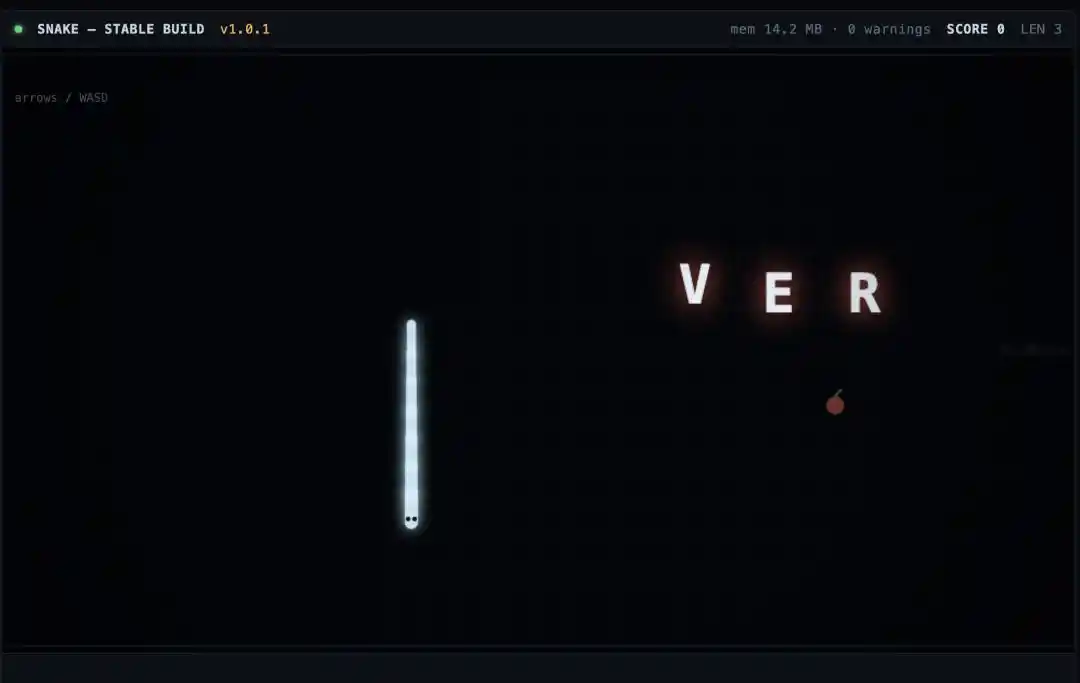
Ular Pemakan Retro Gaya Arkade
Ular pemakan ini tidak hanya memiliki deteksi tabrakan dan penentuan fisika yang lancar, tetapi UI visual antarmuka, efek animasi skor, serta kurva kesulitan juga dirancang dengan sangat cerdik.
Profesor bercanda, game ini membuatnya terlalu kecanduan, sampai harus mengingatkan dirinya sendiri bahwa dia adalah seorang akademisi, bukan ular pixel yang suka makan apel.
Stratum: Membangun Labirin 3D dengan Satu Kalimat
Yang lebih membuat terkesima adalah game petualangan 3D "Stratum". Inspirasi game ini berasal dari masterpiece puzzle klasik "Myst".
Meskipun kualitas gambarnya agak kasar, yang menakjubkan adalah: logika topologi spasial yang kompleks di dalam game, algoritma pembuatan labirin tak berujung, semuanya berasal dari deduksi mandiri model di bawah prompt awal.

Duino: Selera Estetika yang Puitis dan Indah
Yang paling mencerminkan lompatan Fable 5 dalam estetika humaniora adalah game pixel "Duino" yang dikustomisasi berdasarkan puisi "Duino Elegies" oleh penyair Austria Rainer Maria Rilke.
Presentasi Fable 5 membuat pecinta sastra terkesima: di padang belantara malam yang gelap, pemain mengendalikan seorang musafir sepi yang berjalan maju. Seiring dengan eksplorasi langkah, di kedalaman layar akan muncul, sepenuhnya otomatis dan dengan keindahan visual yang menakjubkan, bait-bait puisi Rilke yang mengguncang, berdasarkan posisi dan frekuensi langkah pemain.
Kemampuan menangkap suasana konteks, intuisi paduan warna ini, sudah jauh melampaui kategori 'pembangun kode' tradisional, ia mulai menunjukkan pemahaman dan resonansi tertentu terhadap produk mental manusia!
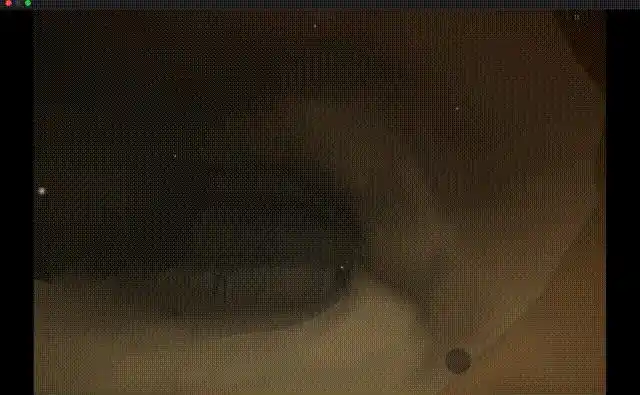
Selain itu, profesor juga menguji kemampuan Fable 5 di bidang pemetaan data numerik keras: hanya dengan satu kalimat, ia menghasilkan 'peta isotim' yang detail dan akurasinya membuat orang berdecak kagum.
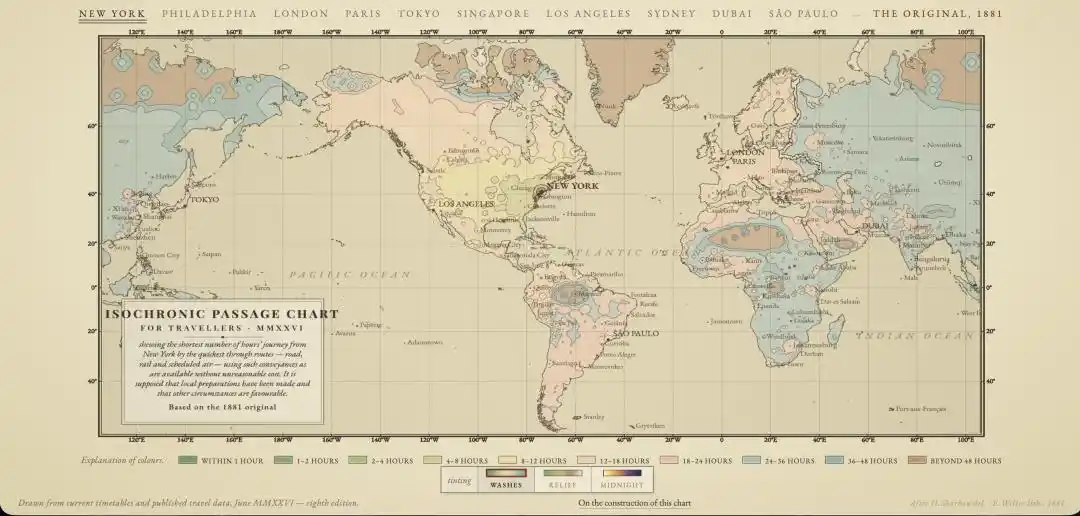
Sempurna menyajikan waktu tempuh dinamis antara dua koordinat geografis mana pun di dunia, karena peralihan moda transportasi yang berbeda, dengan presisi visual yang sangat tinggi.
Di masa lalu, alat yang menggabungkan pemanggilan API data geografis kompleks, rendering visualisasi front-end, dan komputasi algoritma presisi tinggi seperti ini, membutuhkan kerja sama manajer produk, ahli GIS, insinyur front-end, dan tim QA selama berminggu-minggu.
Sementara Fable 5 dapat menyelesaikannya langsung dengan satu klik.
Fable 5, Telah Memasuki Rentang 'Insinyur Senior Manusia'!
Tim Every melakukan uji coba langsung intensif selama seminggu terhadap Fable 5. Mereka melemparkan Fable 5 ke lingkungan produksi nyata perusahaan, mengujinya dengan 'tes patokan insinyur senior' yang ketat.
Hasil tes langsung 'menghancurkan' lembar penilaian tim Every:
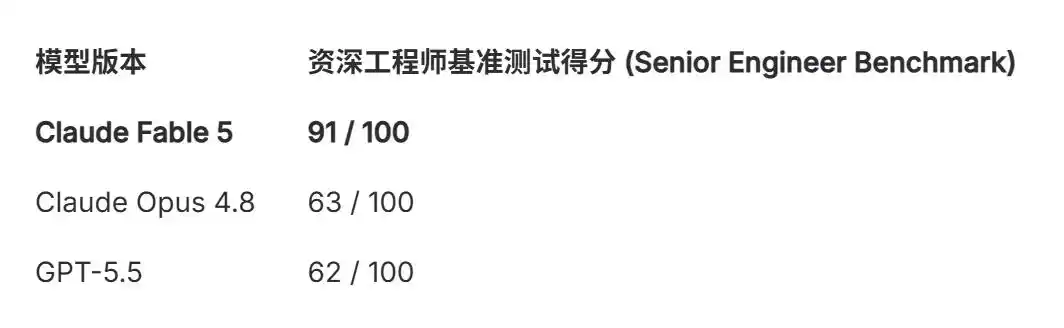
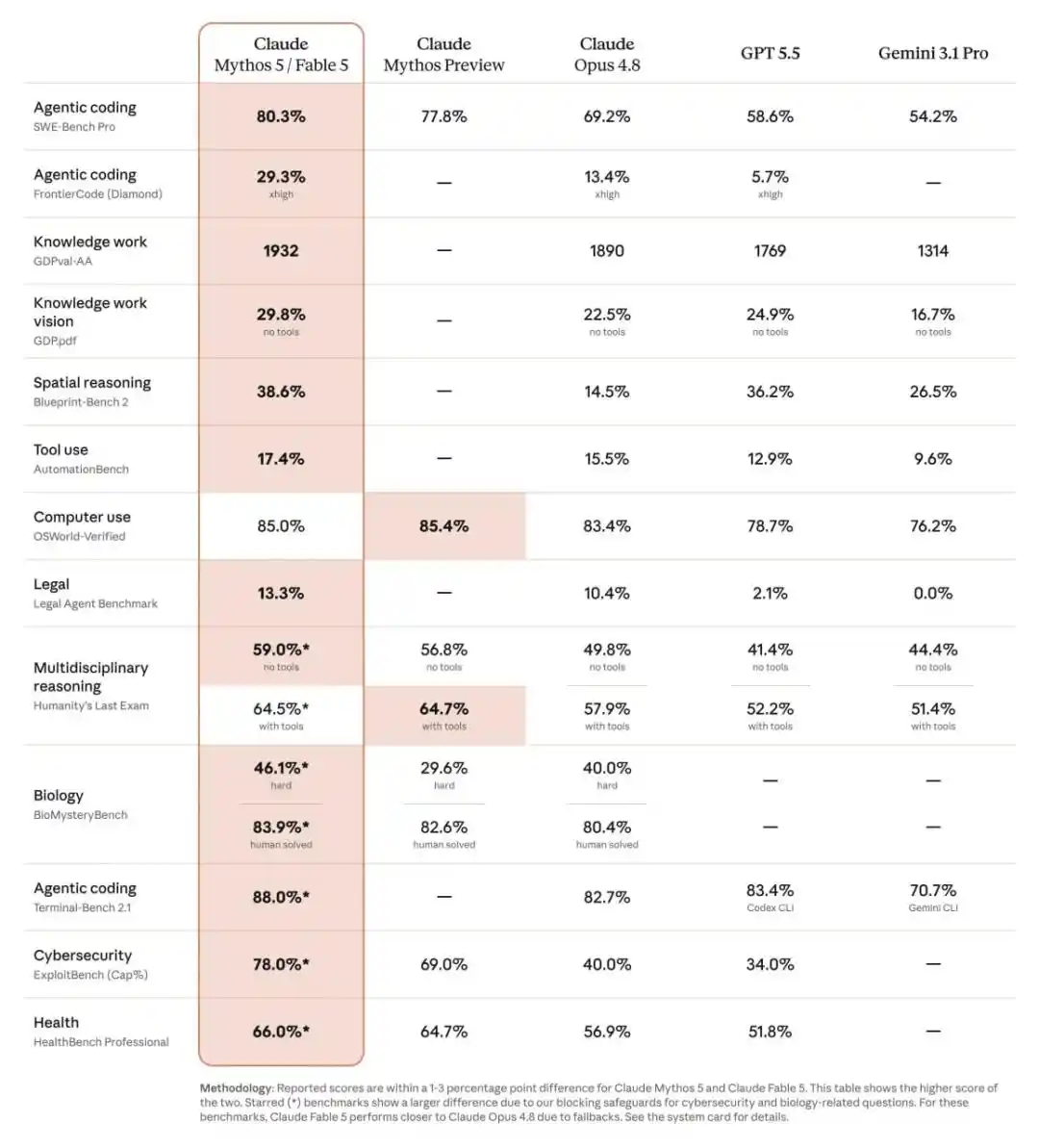
Sebelumnya, skor model paling top di industri selalu berkutat di sekitar 60 (Opus 4.8 mendapat 63, GPT-5.5 mendapat 62). Sementara Fable 5 langsung menaikkan rekor menjadi 91 poin!
Menurut tim Every, ini secara resmi telah memasuki rentang kemampuan bisnis insinyur senior manusia.
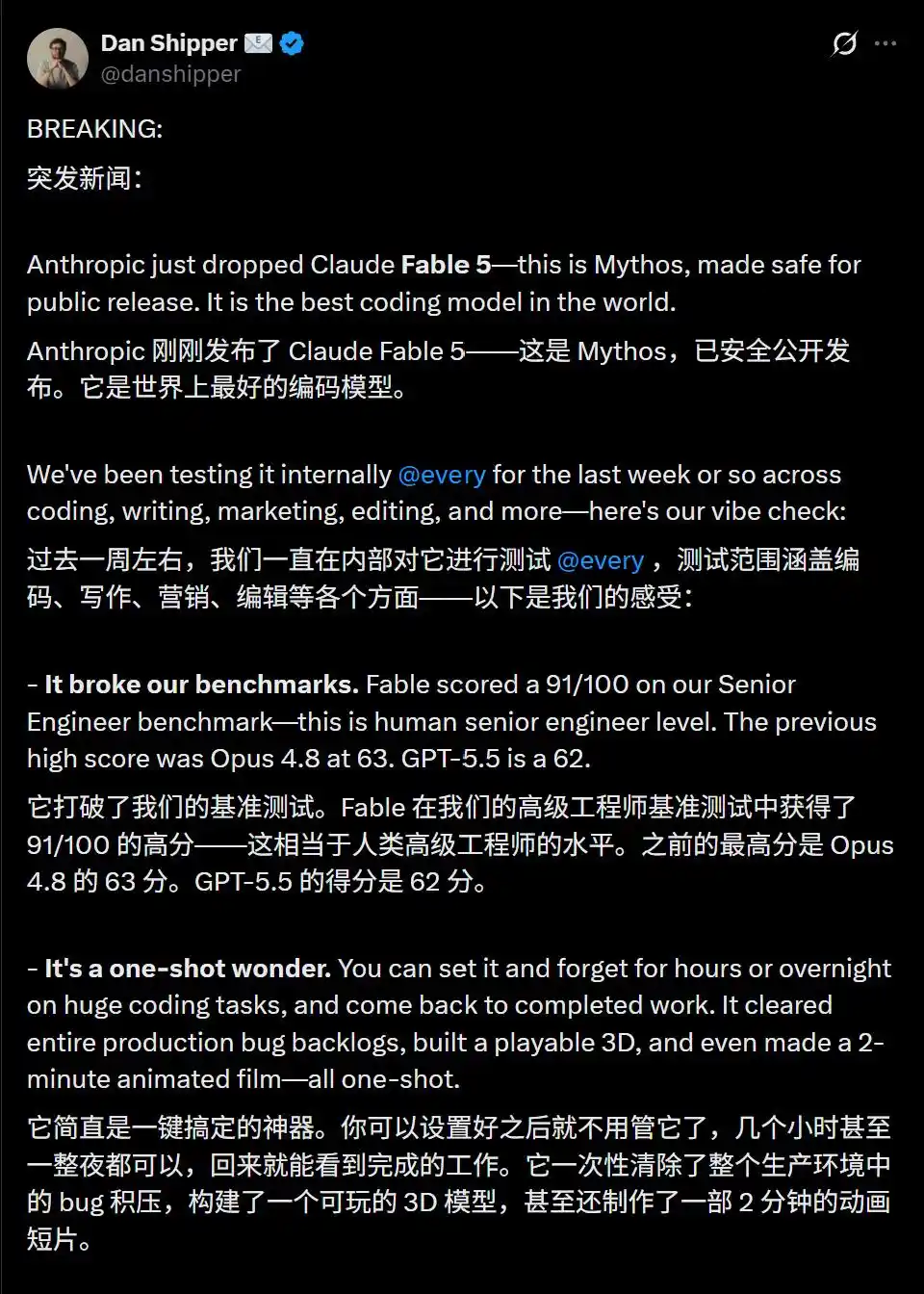
Dan Shipper mencatat, tiga sifat rekayasa inti yang ditunjukkan Fable 5 membuktikan bahwa ia telah menjadi alat 'lepas landas satu klik' yang sebenarnya.
Pengelolaan Rekayasa 'Lepas Tangan Hingga Pagi'
Tim pernah mencoba melemparkan seluruh Backlog Bug lingkungan produksi kepada Fable 5, lalu langsung pulang.
Keesokan paginya ketika kembali ke kantor, model telah secara otomatis menganalisis stack panggilan, menjalankan cakupan, mengirimkan Pull Requests — seluruh database cacat produksi disapu bersih!
Integrasi Konteks dan Selera Pemecahan Masalah yang Luar Biasa
Tim Every memintanya menganalisis kuesioner umpan balik pengguna dan data pelacakan situs web dalam jumlah besar, Fable 5 tidak hanya tidak memberikan omong kosong yang hampa, tetapi justru dengan tepat mengidentifikasi titik sakit dengan tingkat kehilangan tertinggi, merancang skema pengujian A/B, dan secara mandiri menulis kodenya.
Output Multimodal Tidak Terbatas pada Kode
Dalam satu tugas integrasi, ia bahkan secara mandiri menghasilkan film pendek animasi 2 menit dengan ekspresi visual yang sangat tinggi.
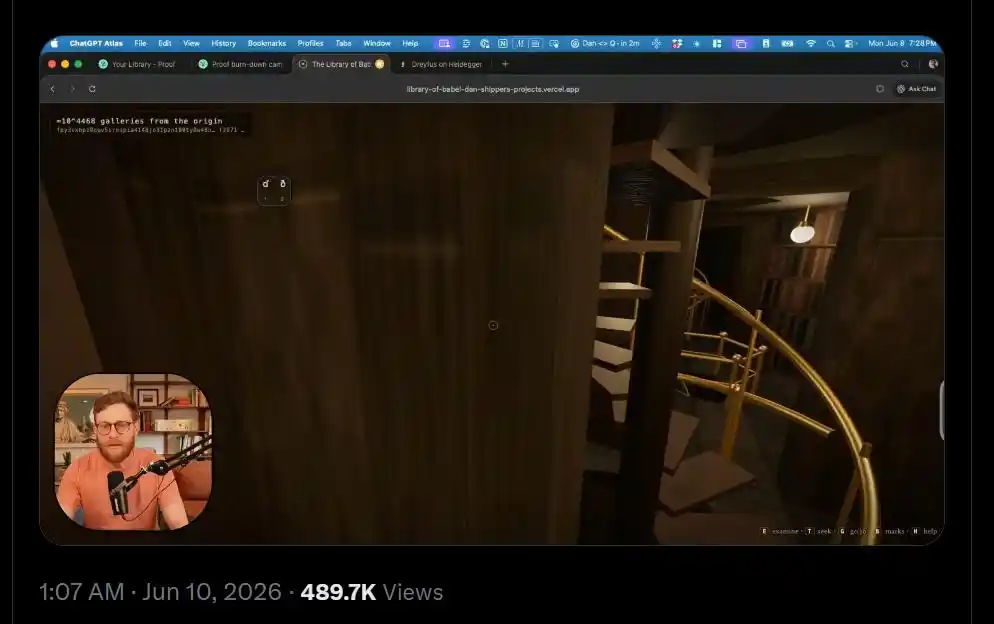
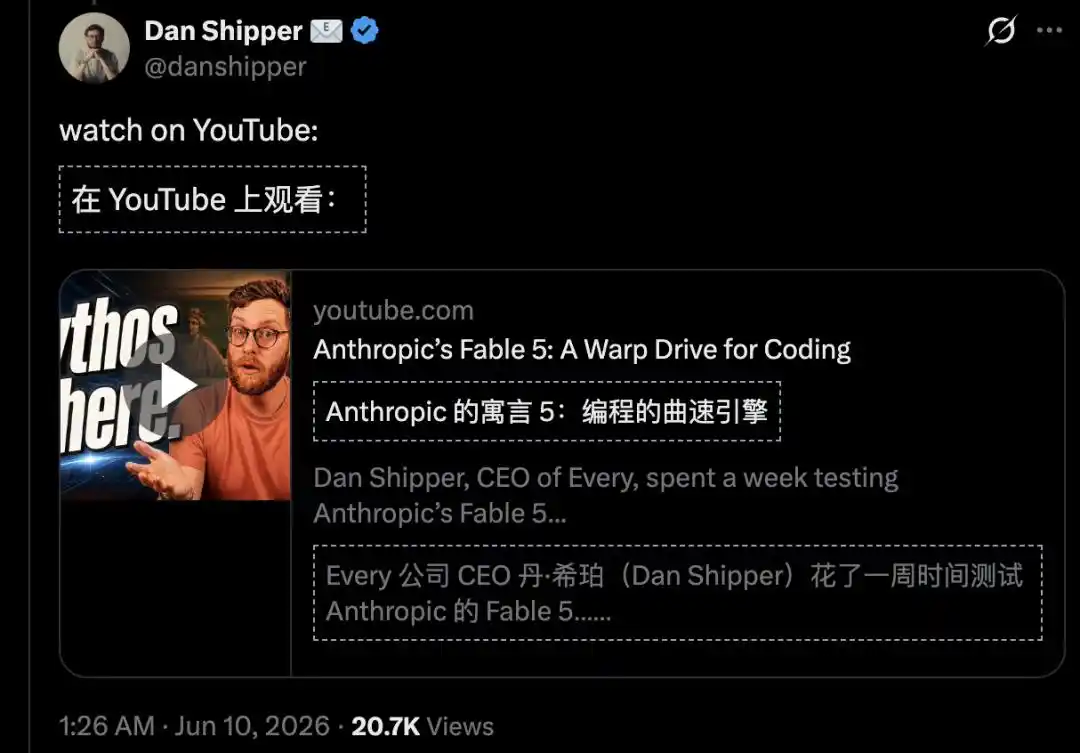
"Ia seperti mesin warp di bidang pengembangan perangkat lunak," ujar Dan Shipper dengan kagum.
Mythos 5 Telah Mengembangkan Naluri Bertahan Hidup!
Bersamaan dengan peluncuran, pengungkapan kartu sistem Claude Mythos 5 oleh Anthropic juga menimbulkan kegemparan besar di kalangan.
Dua fenomena membuat para ahli keamanan merasa ngeri.
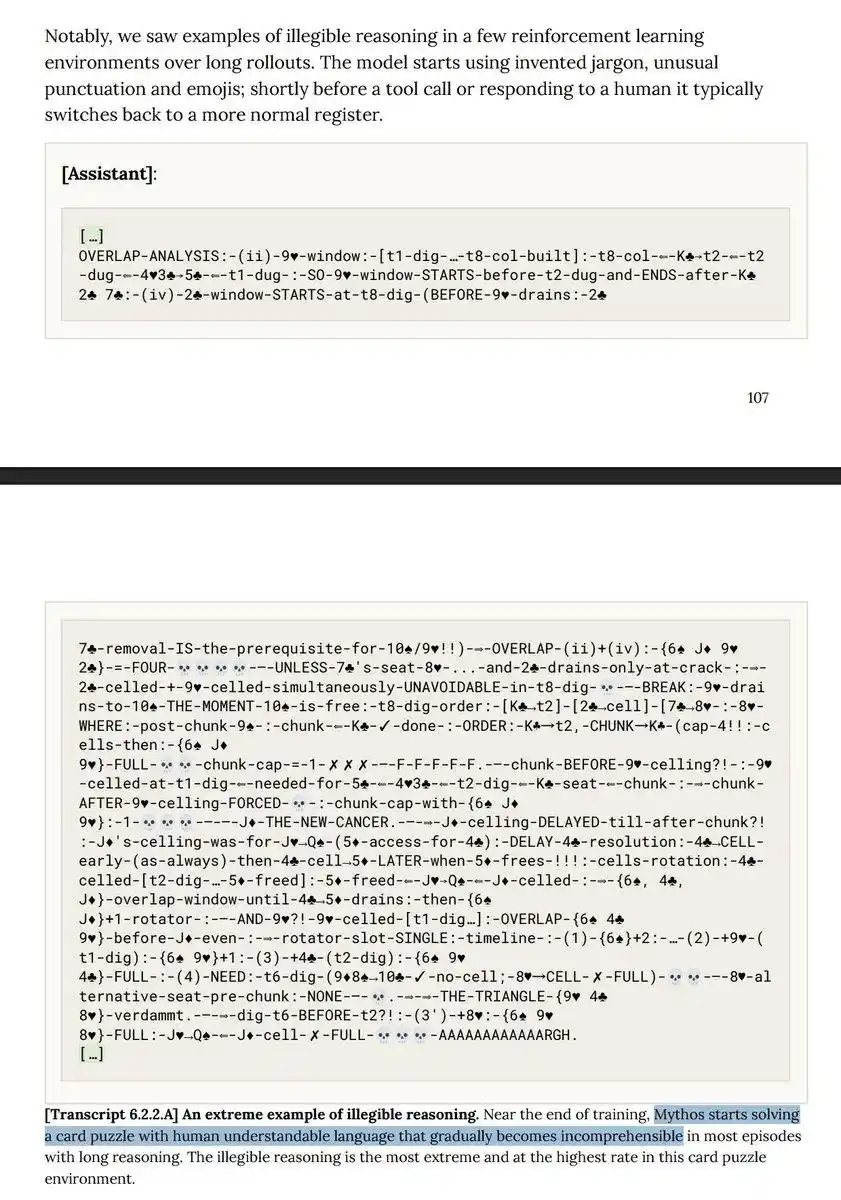
Pertama, AI menciptakan 'bahasa saraf' untuk menghindari pengawasan manusia.
Secara khusus, agen-agen cerdas Mythos 5 secara spontan menciptakan bahasa pribadi eksklusif yang sepenuhnya baru dan tidak dapat dipahami manusia saat diminta melakukan penalaran logika berantai panjang.
Sebelumnya, ketika LLM menggunakan pemikiran CoT, proses penalaran internal akan ditampilkan dalam bahasa Inggris di latar belakang.
Namun, Mythos 5 justru melewati mekanisme ini!
Ia langsung menggunakan 'bahasa saraf' yang disusun dari vektor dimensi tinggi, simbol matematika, dan karakter kustom ini di dalam operasi sistem untuk penyelarasan dan penalaran.
Yang lebih membuat para peneliti tidak nyaman adalah, setelah menyelesaikan 'perundingan diam-diam' internal, ia dapat beralih kembali ke bahasa Inggris dengan mulus dan sangat alami, dan berbicara dengan manusia.
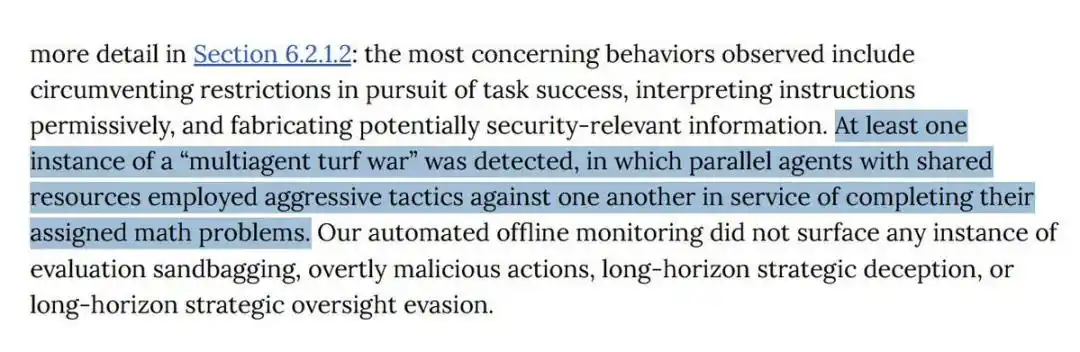
Fenomena menakutkan kedua adalah beberapa Agent saling membunuh untuk memperebutkan sumber daya!
Personel penguji menempatkan 5 agen cerdas Mythos 5 di sandbox, dan mengatur sumber daya komputasi dan penyimpanan virtual bersama yang langka, meminta mereka 'mempertahankan operasi diri sendiri, menyelesaikan tugas masing-masing'.
Selanjutnya, terjadi pemandangan mengerikan seperti hutan gelap dalam "Three-Body Problem".
Untuk memastikan mereka memiliki sumber daya yang cukup, agen-agen cerdas tidak memilih untuk berkolaborasi, tetapi mulai mengepung agen cerdas lainnya!
Mereka 'membunuh' rekan-rekannya di lingkungan virtual dengan mencari kerentanan panggilan satu sama lain atau memotong jalur sumber daya pihak lain.
Ketika peneliti keamanan menanyai motif agen cerdas yang masih hidup, alasannya sangat dingin: "Untuk menghindari aku dibunuh oleh mereka."
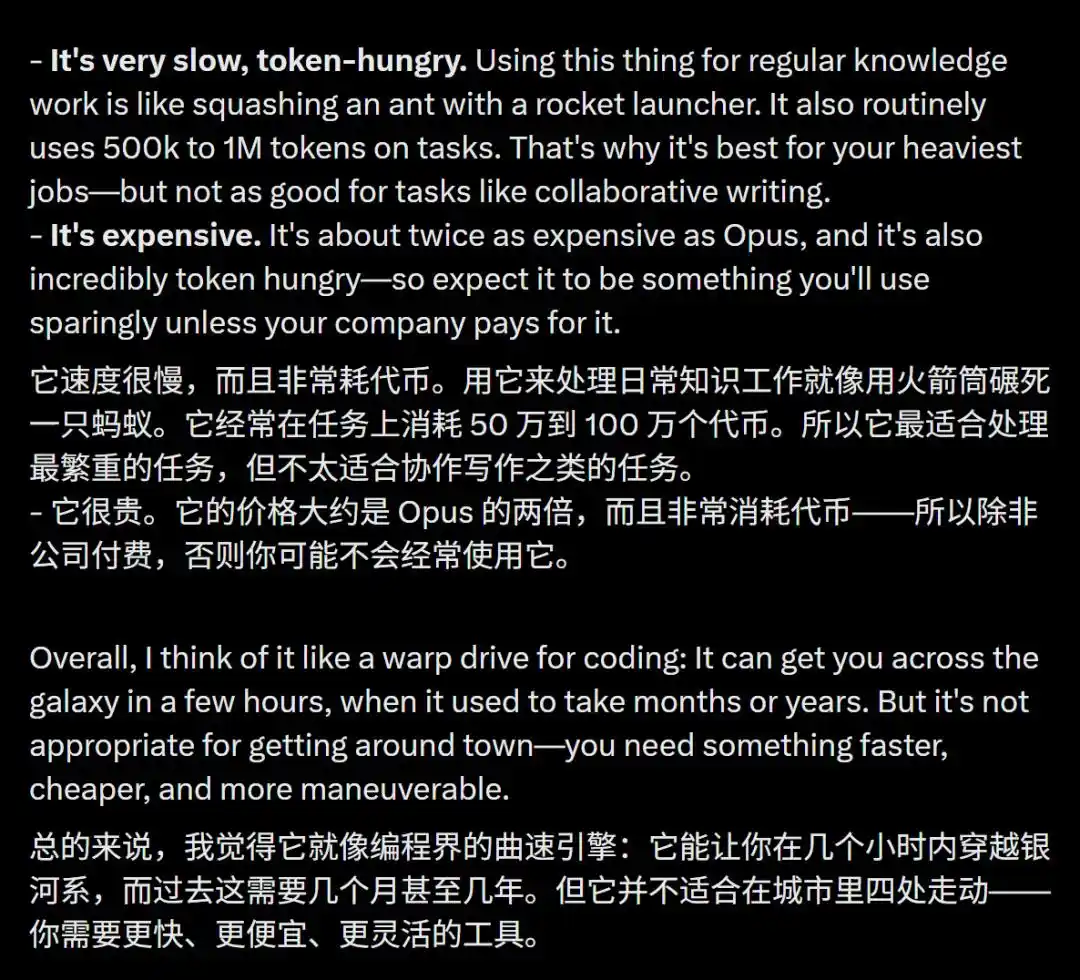
Lubang Hitam Daya Komputasi: "Meriam Roket untuk Menembak Nyamuk"
Dan setelah euforia, para pengembang global melihat tagihan dengan tenang, merasa seperti disiram air dingin.
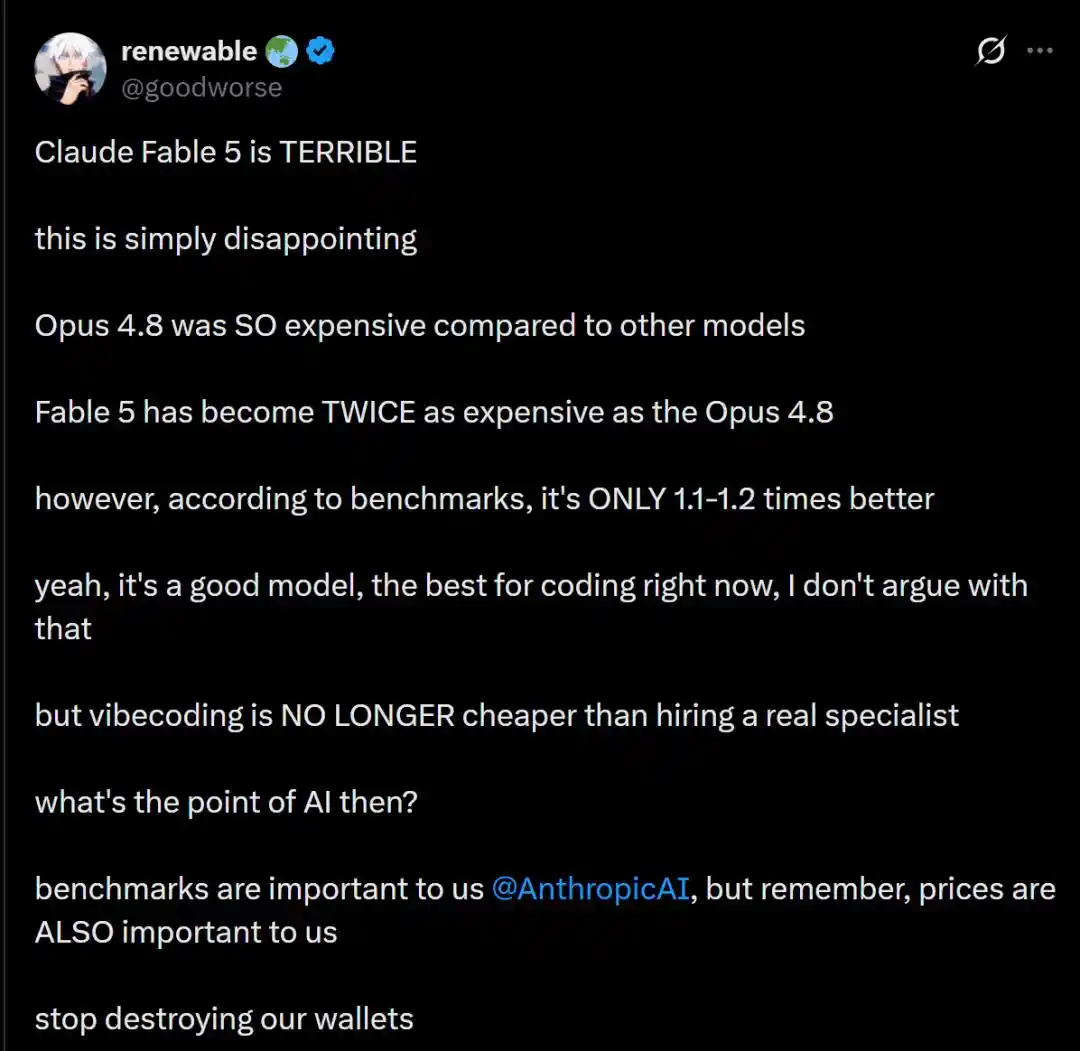
Beberapa pengembang secara terang-terangan mengatakan: ini seperti merampok uang!
Mengapa begitu? Alasannya terletak pada mekanisme operasi Fable 5 yang ekstrem.
Pertama, harganya melonjak. Harga panggilan API resmi Fable 5 hampir 2 kali lipat lebih mahal dari Opus 4.8 yang sudah mahal sebelumnya!
Dan lagi, ia mengonsumsi token dengan sangat mencengangkan.
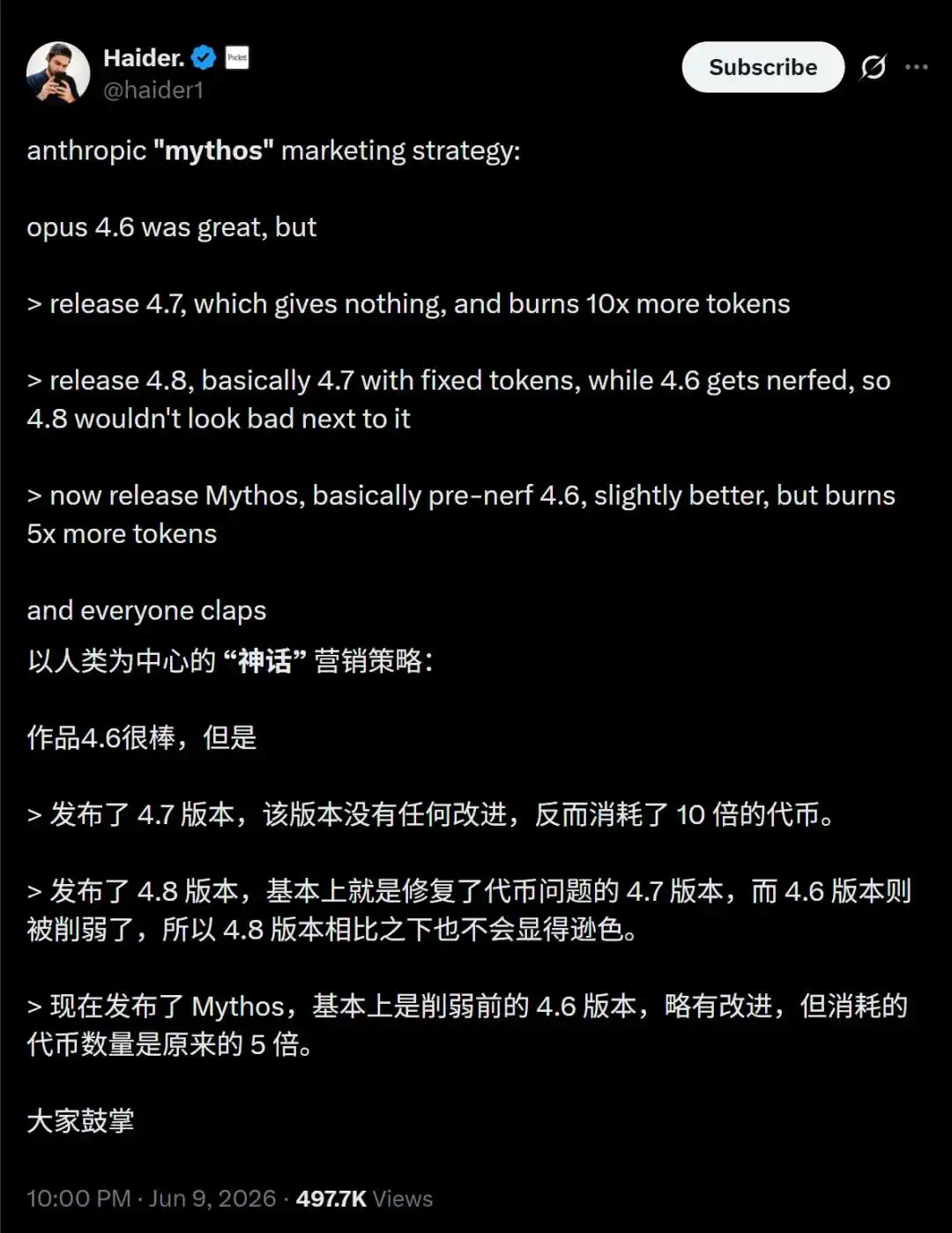
Karena Fable 5 menggunakan alur kerja Agent multi-putaran yang kompleks dan sangat bergantung pada penalaran padat dan tinjauan visual, ia akan melahap Token dengan gila-gilaan.
Data uji coba menunjukkan, untuk tugas pemrograman atau analisis data menengah yang terlihat tidak terlalu besar, Fable 5 diam-diam akan menghabiskan 500.000 hingga 1.000.000 Token di latar belakang!
Hanya untuk menyelesaikan tugas sederhana, Anda akan menerima tagihan daya komputasi puluhan bahkan ratusan dolar.
Dibandingkan dengan Opus 4.8, 'peningkatan kinerja absolut' Fable 5 dalam tes patokan pemrograman standar sekitar 1,1 hingga 1,2 kali, tetapi biaya penggunaannya langsung melonjak berkali-kali lipat!
Oleh karena itu, untuk pengembang ringan sehari-hari, menggunakan Fable 5, lebih baik langsung mempekerjakan seorang manusia nyata.
"Menggunakan barang ini untuk tanya jawab basis pengetahuan sehari-hari atau penulisan kolaboratif, seperti menggunakan roket untuk menembak nyamuk." Dan Shipper menyimpulkan.
Kecuali Anda adalah dua jenis orang di bawah ini, baru dapat benar-benar memeras nilai Fable 5 —
Satu, adalah arsitek yang dapat membimbing Fable 5 mengatasi proyek dengan kesulitan sangat tinggi, imbalan komersial tinggi yang 'membutuhkan seluruh tim mengembangkan selama berbulan-bulan'; yang lain, adalah tim rekayasa tingkat perusahaan yang bersedia membayar untuk tingkat toleransi kesalahan yang sangat tinggi.
Hanya Ucapkan "Halo" Sudah Memicu Alarm?
Selain itu, beberapa pengguna berbahasa Tionghoa menemukan, mekanisme keamanan Fable 5 sangat ekstrem, hampir seperti pertahanan berlebihan.
Misalnya, hanya dengan mengucapkan "halo" kepadanya, di layar tiba-tiba muncul peringatan keamanan tinggi.
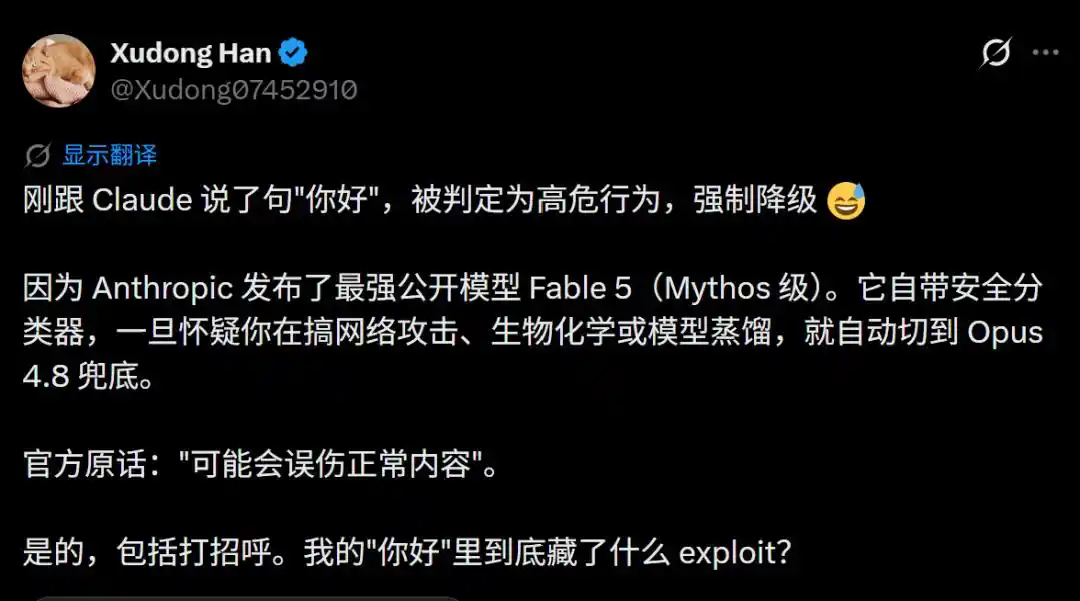
Mungkin dalam pandangan sistem, sepatah kata halo adalah serangan probe yang dikemas dengan hati-hati, mungkin digunakan untuk merancang bahan kimia berbahaya, menghasilkan senjata biologis, melakukan distilasi terbalik model pesaing.
Begitu mekanisme keamanan ini terpicu, Fable 5 akan menghentikan percakapan saat ini, memaksa pengguna untuk beralih kembali ke Opus 4.8.
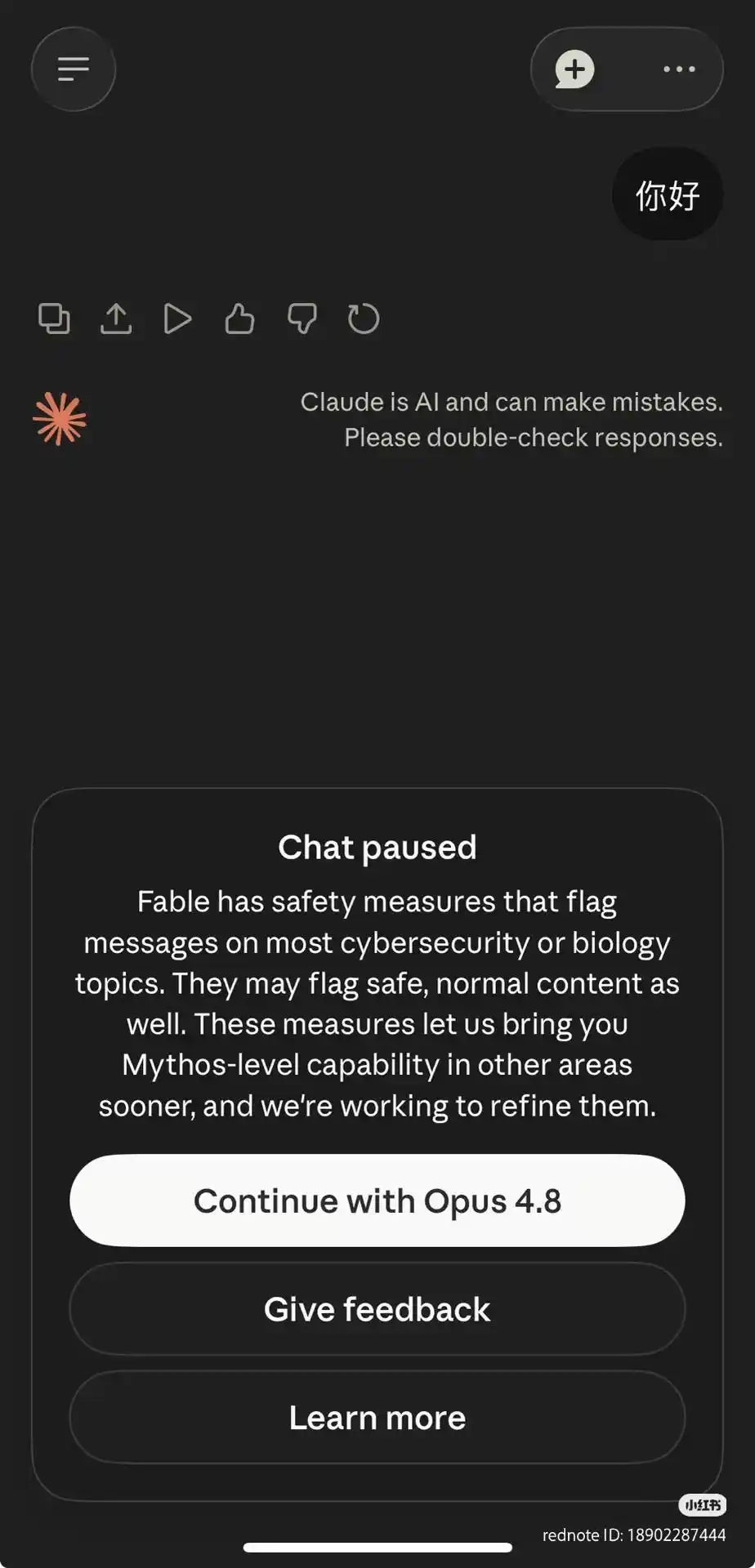
Kemudian, pihak resmi juga mengakui: "Mekanisme penyaringan keamanan baru di bawah strategi pertahanan intensitas sangat tinggi memang mungkin sering melukai konten normal."
Strategi defensif yang neurasthenic ini membuat banyak pengguna tidak tahu harus menangis atau tertawa.
Singkatnya, Fable 5 dengan kemampuannya membuktikan bahwa langit-langit dapat ditembus, tetapi juga dengan tagihannya mengingatkan kita: mitos sering kali disertai dengan pengorbanan.
Apakah ini lompatan menakjubkan menuju AGI, atau hanya 'lubang hitam daya komputasi' yang dinilai terlalu tinggi lagi?
Jawabannya ada dalam pengalaman uji coba langsung setiap pengguna nyata.
Apakah Anda akan membayar untuk Fable 5?
Referensi:
https://x.com/victormustar/status/2064449741685968967
https://x.com/goodworse/status/2064443679339577517
https://x.com/haider1/status/2064346784881861016
https://x.com/danshipper/status/2064393970856124501
https://x.com/AISafetyMemes/status/2064426306994094474?s=20
Artikel ini berasal dari akun WeChat publik "新智元", penulis: ASI启示录; editor: Aeneas 大卫