What Exactly Is a16z's 'New Media'? New Media Is a Migration of Power

marsbitPublished on 2026-01-23Last updated on 2026-01-23

Abstract

The article explores a16z's concept of "new media," arguing it represents a fundamental shift in power dynamics rather than just new content formats. It posits that in an era of content oversupply and near-zero distribution costs, attention and trust have become the new scarcities. The core value is no longer mere exposure but the ability to influence decisions—termed "agency"—the power to make others act based on your judgment. The piece contrasts old media (centralized, institution-owned, creators as employees) with new media (decentralized, individual-as-node, creators building direct influence). This transforms media from an institutional asset into personal capital and a tool of power. a16z treats this media capability as core infrastructure, recognizing that the traditional model of "capital → company → market" has flipped. Now, "agency → community → market → capital" is key, as capital alone no longer guarantees action. The article concludes by introducing Internet Capital Markets (ICM) as the next evolution, solving new media's flaw by turning influence and consensus into tradable, ownable capital structures—moving from "right to distribute" to "right to price." The ultimate leverage shifts from code to new media: scalable narrative, judgment, and taste.

Original Author: Julie Chen(@0xJuliechen)

a16z raised $1.5 billion. What exactly is the 'new media' they are betting on?

On X, everyone is a KOL, with millions of traffic every month. Traffic is no longer valuable. What is valuable is attention, the power of 'belief,' and the right to scarcity.

This article explains a16z's new media, agency (the power to act), how to make traffic meaningful on Twitter, and ICM.

🌟🌟

@a16z raised $1.5 billion at the beginning of the year, making headlines across major platforms. They raised so much money to tell a story of "all in on America, believing in AI + crypto and technology."

Two months ago, they specifically established a new media team to help a16z itself and its portfolio companies do "new media."

In Silicon Valley's AI/Web3 companies, there have been recent hires, with heavy rewards for finding a "storyteller"—someone who can write threads, shitpost, and tell stories.

a16z's new media partner directly stated: Marketing majors have replaced computer science as the "hot commodity."

What a16z has truly valued in recent years is not the content itself, but the way power is restructured.

New media is just the surface.

The real change is: Who has the qualification to make people act (agency).

1️⃣ Why has 'New Media' been elevated so highly in the past two years?

Because the path of the attention economy has basically run out of tricks.

  • Extreme content surplus
  • Distribution costs are nearly zero
  • Being seen no longer constitutes an advantage

What is truly scarce now is not exposure.

It's two things:

  • Is your judgment trustworthy?
  • Can you turn "belief" into "action"?

This is also why you can clearly feel a change:

In the past, media was about telling stories and setting narratives;

Now, media is starting to directly influence decisions and trigger actions.

When content is no longer scarce,

What becomes truly valuable is no longer 'what you said,'

but—what happens next.

This is the core meaning behind a16z's repeated discussion of new media.

It's not about the forms like threads, podcasts, or short videos,

but that the distribution structure has changed, and the power structure has changed along with it.

A simplest comparison:

Old Media

  • Scarce distribution (TV, newspapers, platforms)
  • Value concentrated in institutions
  • Creators are essentially employees

New Media

  • Decentralized distribution (X / YouTube / Substack / Podcasts)
  • Individuals themselves become nodes
  • Creators directly accumulate influence and bargaining power

The real change can actually be summed up in one sentence:

Media has changed from an institutional asset to personal capital.

And once media becomes personal capital,

it is no longer just an "exposure tool,"

but begins to become a tool of power.

When media belongs to an institution, it is your exposure tool;

When media belongs to an individual, it becomes your ability to influence others' decisions.

And influencing decisions is power.

2️⃣ Agency (The Power to Act)

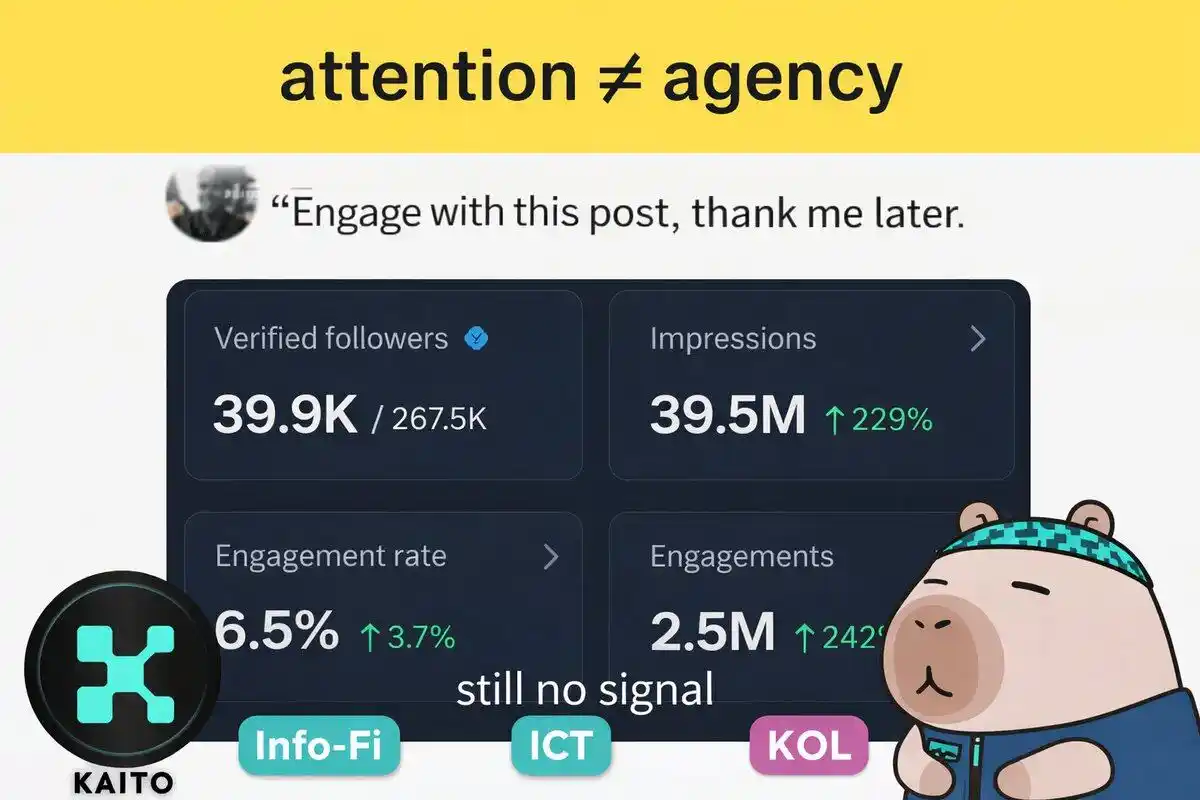
The end goal of new media is not page views,

but agency (the power to act).

Agency means others are willing to act with you, trust your judgment, and pay for your concepts.
Packy mentioned in 《The Power Brokers》:

The goal of a Fund is to earn carry with as few people as possible, in as short a time as possible.
A Firm's goal is to continuously compound long-term advantages through scale.

This distinction explains one thing:

Why in traditional VC, media capability has always been "icing on the cake";

While at a16z, this has been directly made into infrastructure.

For a long time, the default order was:

Money → Company → Market

Money came first, deciding everything.

But in a world of extreme media saturation, this order has flipped:

Agency → Community → Market → Capital

Why is it that now "there is a lot of money, but things are hard to do"?

Because capital no longer automatically translates into action.

  • Distribution is not scarce
  • Attention is extremely noisy
  • Trust cannot be bought with budget

We've seen this many times in the crypto world (won't give examples to avoid offending people):

There's a lot of money, but projects still fail to cold start.

Valuations are high, but no one is really willing to participate.

The narrative is complete, but no one follows up with execution.

It's not because of insufficient money.

It's because there is no agency.

The truly scarce resource now is not capital.

It is:

  • The ability to make a group of people believe in the same thing simultaneously
  • The ability to make them act at the same point in time

Whoever can do this,

holds the real leverage.

So I am not praising, but using a16z to explain a structural change that is happening.

3️⃣ What does New Media solve? What is it still missing?

If media can form consensus, and consensus can drive action, then the market is the settlement layer of consensus.

Why ICM (Internet Capital Markets) necessarily appears after new media:

Because new media has a natural structural defect:

  • Influence ≠ Ownership
  • Traffic can be monetized, but it is not composable, not holdable long-term
  • Creators still rely on platform revenue sharing, brand partnerships, advertising cycles

The concept of ICM was first proposed by @solana. It fills in precisely this gap:

  • Transforming narrative / consensus / culture
  • Into a tradable, holdable, collaborative capital structure

ICM solves the next-step problem for new media:

How is influence priced, traded, and sustained?

To differentiate in one sentence:

  • new media:→ Who can gain attention
  • ICM:→ How attention becomes a capital structure
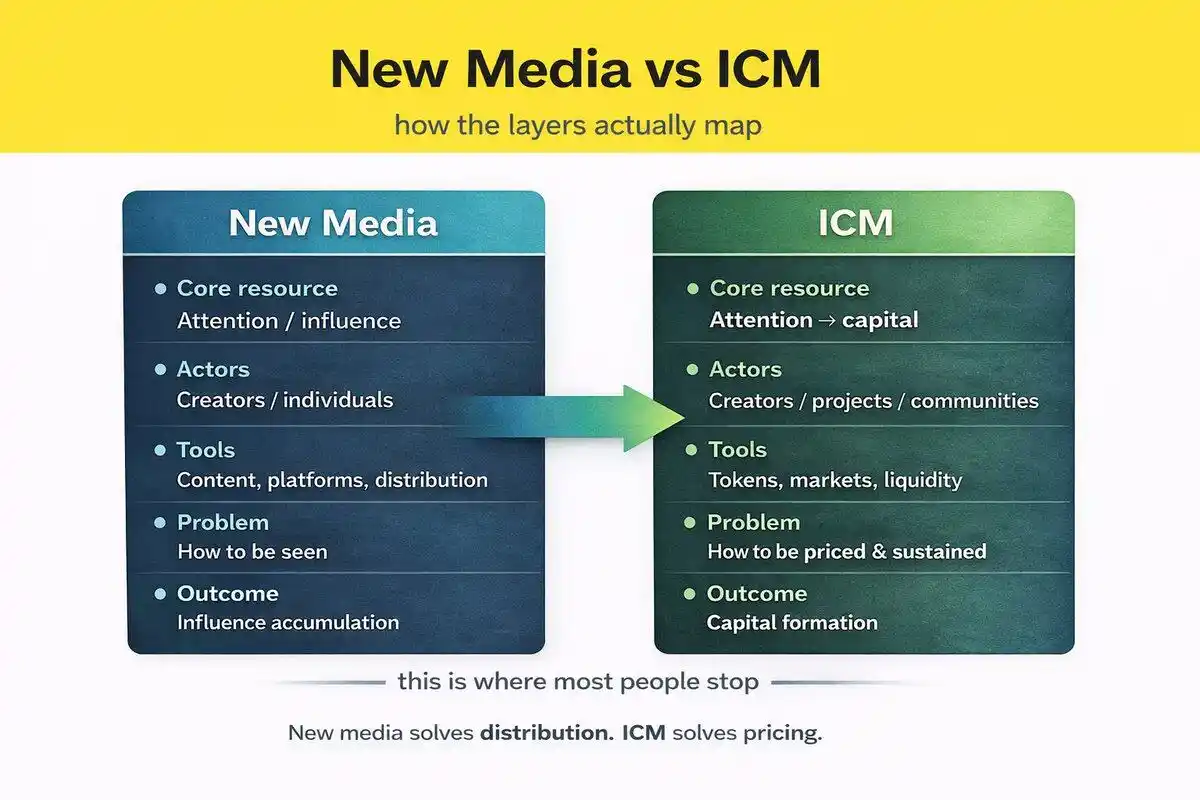
Conclusion:

New media solves the "right to disseminate," ICM solves the "right to price."

The essence of ICM:

  • Turning attention → agency → pricing → capital formation
  • Not a speculative tool, but coordination infrastructure

Closing

Finally, I want to quote my favorite saying from Naval Ravikant to echo this point and conclude the article.

Naval said: Code and media are the leverage behind the new wealthy class.

Indeed, over the past 10 years, Silicon Valley's nouveau riche and big tech companies (internet / software / AI) have essentially relied on "code leverage" to create wealth.

With the proliferation of Cursor and Claude, everyone can vibe code; the ability to code is becoming less scarce. There are even predictions that all entry-level programming jobs will be replaced by AI within the next 10 years.

The truly scarce leverage in the next cycle is new media:

Namely, the scalable dissemination of narrative × judgment × taste. Good leverage can continuously generate compound interest while you sleep, influence others in your absence, and help you build "trust + reputation + opportunity access."

code is law

New media is the law.

Original article link

Related Questions

QWhat is the core concept of 'new media' as discussed in the a16z context?

AThe core concept is not about the format (like threads or podcasts), but a shift in power structure. It's about media transforming from an institutional asset into personal capital, where the ability to influence decisions and trigger action (agency) becomes the new scarce resource, replacing mere attention or exposure.

QAccording to the article, what is the key difference between 'old media' and 'new media'?

AOld media is characterized by scarce distribution (TV, newspapers), value concentrated in institutions, and creators as essentially employees. New media is defined by decentralized distribution (X, YouTube), individuals becoming nodes themselves, and creators directly accumulating influence and bargaining power.

QWhat does the term 'agency' mean in this article, and why is it important?

A'Agency' refers to the power to make others act, to have them believe in your judgment and pay for your concepts. It is important because in a world of abundant capital and content, the true scarcity is no longer money or exposure, but the ability to coordinate belief and trigger simultaneous action among a group of people.

QWhat problem does ICM (Internet Capital Markets) solve in relation to new media?

AICM solves the structural defect of new media, where influence does not equal ownership and attention is monetizable but not composable or long-term holdable. It transforms narrative, consensus, and culture into tradable, ownable, and collaborative capital structures, essentially solving the 'pricing power' for the 'propagation power' that new media creates.

QWhy does the article suggest that 'new media' is becoming the most important lever in the next cycle?

AAs AI tools make coding skills less scarce, the next cycle's truly scarce lever will be new media—the scalable propagation of narrative, judgment, and taste. It builds a lever that generates compound interest while you sleep, influences others in your absence, and establishes trust, reputation, and opportunity gateways.

Related Reads

Profits Fall by a Quarter: Why Tether Abandoned Its $20 Billion Financing Plan

In the face of a cooling crypto market and investor skepticism, Tether, the world's largest stablecoin issuer, has significantly scaled back its ambitious fundraising plans. Initially targeting $15-20 billion, which would have valued the company at $500 billion, the firm is now considering raising only about $5 billion. CEO Paolo Ardoino downplayed the original target, calling it a "misunderstanding" and a maximum cap, not a goal, while emphasizing that Tether is highly profitable and doesn't urgently need the capital. Despite the success of its USDT stablecoin, which has a market cap of approximately $185 billion, Tether faces persistent investor caution. Concerns revolve around its $500 billion valuation—comparable to major AI firms and SpaceX—ongoing regulatory scrutiny, and the lack of a full independent audit, relying instead on quarterly attestations. Ardoino defended the valuation, contrasting Tether's substantial profits with the losses of highly-valued AI companies. While new U.S. stablecoin legislation and competitor Circle's IPO have boosted momentum, regulatory risks and Tether's controversial history remain hurdles. The company's profits fell by about a quarter in 2025, attributed to declining Bitcoin prices, though it gained $8-10 billion from its gold holdings. Tether's massive scale has made it a major player in U.S. Treasuries and gold markets, positioning it as a critical bridge between traditional finance and the volatile crypto world.

marsbit7m ago

Profits Fall by a Quarter: Why Tether Abandoned Its $20 Billion Financing Plan

marsbit7m ago

Wintermute Ventures: By 2026, Crypto Gradually Becomes the Settlement Layer for the Internet Economy

Wintermute Ventures argues that by 2026, crypto will mature into the essential clearing and settlement layer for the internet economy, enabling value to flow as freely as information does today. The report identifies five key themes driving this transformation: 1. **Everything becomes tradable:** Prediction markets, tokenization, and derivatives are creating liquidity for previously illiquid assets and real-world outcomes, enabling new data products and replacing traditional financial infrastructure like insurance. 2. **Stablecoins as a trust layer:** The need for interoperability among the growing number of stablecoins will be met by new infrastructure that handles netting, conversion, and settlement across chains, akin to on-chain correspondent banking. 3. **Tokenomics return to fundamentals:** Markets will increasingly reward sustainable revenue and long-term value over short-term token incentives. Token launches will occur only after proven product-market fit, aligning with traditional cash-flow-based valuation models. 4. **DeFi and TradFi convergence:** The future lies in hybrid models where user-friendly fintech front-ends leverage the capital efficiency and yield of DeFi infrastructure in the background, abstracting away complexity for the end-user. 5. **Privacy as a regulatory catalyst:** Privacy technologies like zero-knowledge proofs will transition from a compliance burden to a regulatory enabler, allowing institutions to prove compliance without exposing sensitive data and unlocking new financial products. Underpinning these themes is regulatory clarity, which is shifting from a barrier to a standardized distribution channel, accelerating institutional adoption. This infrastructure maturation will see crypto fade into the background, quietly powering a new global, open financial system.

marsbit29m ago

Wintermute Ventures: By 2026, Crypto Gradually Becomes the Settlement Layer for the Internet Economy

marsbit29m ago

When Migration Becomes the Norm: Why 'Your Own EVM Chain' Is Becoming Standard

In the past year, the industry's real "voting" has shifted from governance forums to deployment scripts, migration plans, and budgets. Projects are choosing ecosystems through action, not words—migrating mainnets, prioritizing tool stacks, and betting on networks with stronger market effects. A prime example is Noble, a leading stablecoin infrastructure in Cosmos, which moved to its own EVM L1, signaling that the main battleground for stablecoins and app distribution remains in EVM ecosystem due to its mature developer tools, wallet/dApp ecosystem, and concentrated liquidity. The trend toward "having your own EVM chain" is becoming standard. While EVM offers clear advantages in assets, integrations, and tools, generic chains come with constraints like fee volatility, congestion, and shared sequencing. Application chains/rollups allow teams to internalize these constraints—tailoring block times, execution models, and infrastructure to their business needs, and aligning transaction revenue with growth incentives. Rollup-as-a-Service (RaaS) platforms like Caldera are reducing the high costs and complexity of building and maintaining chains, turning "chain-as-a-product" into a replicable strategy. They focus not just on deployment but also on solving interoperability challenges—e.g., via Caldera's Metalayer, which standardizes cross-chain bridging and integration to reduce friction for users and developers. As migration to EVM continues, the focus shifts from "which chain to choose" to "how to control growth." Owned EVM chains/rollups offer more stable fees, better performance, and tighter integration of incentives and revenue. With RaaS lowering build costs and interoperability layers reducing cross-chain friction, having a dedicated execution environment is becoming a scalable, standard solution for projects aiming to master their own growth.

marsbit30m ago

When Migration Becomes the Norm: Why 'Your Own EVM Chain' Is Becoming Standard

marsbit30m ago

Trading

Spot
Futures
活动图片