The Ethereum Community Is in an Uproar! Who Stands to Lose with EIP-8363?

marsbit2026-08-05 tarihinde yayınlandı2026-08-05 tarihinde güncellendi

Özet

The Ethereum community is deeply divided over the controversial EIP-8363 proposal, which aims to introduce a "tapered issuance burn" to curb the growth of ETH staking. Authored by researchers including Jérôme de Tychey and Justin Drake, the proposal would gradually reduce and eventually eliminate the consensus-layer issuance rewards for validators when the total staked ETH approaches 50% of the total supply (approximately 60.25 million ETH). This is intended to discourage excessive staking concentration among large institutional providers and reduce the dilution pressure on non-staking ETH holders, potentially strengthening native ETH as a neutral asset. Currently, even at 100% staking, validators have a theoretical minimum reward of about 1.5%. EIP-8363 would implement a burn mechanism based on the staking ratio, making net consensus rewards approach zero at the 50% threshold, though execution-layer rewards (priority fees, MEV) remain unaffected. At the current ~33% staking ratio, annual consensus yield would drop from ~2.6% to ~1.2%. An 18-month transition period is proposed to soften the impact. The community reaction has been largely negative. Critics, including Aave founder Stani Kulechov and ether.fi CEO Mike Silagadze, argue it undermines predictable cash flows for institutional investors, hurts solo stakers by making their operations less viable against fixed costs, and could destabilize the DeFi ecosystem built around Liquid Staking Tokens (LSTs). They also fear it...

Original author: KarenZ, Foresight News

Intuitively, the more ETH staked, the higher the economic cost to attack the network.

However, an increase in the staking scale does not necessarily bring an equivalent gain in security; if the new stakes primarily flow to a few large service providers, the validator ecosystem might instead become more centralized.

On August 4th, Jérôme de Tychey, founder of EthCC, Justin Drake from the Ethereum Foundation, and four other researchers jointly submitted the "Tapered Issuance Burn" proposal. It attempts to install a "revenue downslope" for the continuously growing staking ratio, and when the staked amount approaches 50% of the total ETH supply, the consensus-layer issuance rewards obtained by validators will be completely offset.

This proposal was initially released with the number EIP-8361, but as that number had already been assigned to another proposal, it was subsequently changed to EIP-8363. Although it is still in the early draft stage, it has rapidly become one of the most contentious topics in the Ethereum community.

What is this proposal actually trying to do?

Currently, Ethereum consensus-layer rewards decrease as the total amount staked increases. However, even if all ETH were staked, there still exists a theoretical lower bound of approximately 1.5% for the nominal consensus yield of an individual validator.

The authors of EIP-8363 argue that this means the protocol always provides positive incentives for more staking, without a real "stop button," which could drive ETH towards concentration among large custodians, exchanges, and staking derivatives.

Additionally, unstaked ETH is continuously diluted by new issuance. Liquid Staking Tokens (LSTs), because they come with yield, can more easily replace native ETH as collateral in DeFi and savings assets. The proposal authors hope to reduce this dilution pressure, allowing native ETH to become a more competitive neutral asset again.

The solution given by the proposal is not to prohibit new validators from entering, nor to rigidly lock the staking ratio at 50%, but to deduct and burn a portion of the validator's calculated reward after its normal calculation. The burn proportion depends on the total effective staked balance: calculated as "the ratio of the total effective staked balance to 60.25 million ETH raised to the power of 1.5," with an upper limit of 100%, i.e.:
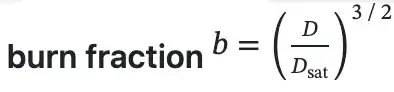
60.25 million ETH is approximately half of the current total ETH supply. As the staked amount approaches this value, the validator's net consensus-layer profit gradually approaches zero; upon reaching or exceeding this value, the consensus-layer issuance rewards earned by normally, fully performing validators will be completely offset by the new burn deductions. It should be added that 60.25 million ETH is a fixed value proposed to be written into the protocol at the hard fork.

There are two points easily misunderstood here:

First, 50% is not a staking cap, nor a target staking ratio. Validators can still continue to join; the proposal merely hopes the market will stop growing on its own before the reward is insufficient to cover liquidity, operational, slashing, and regulatory risks.

Second, the so-called "reward reaching zero" refers only to the net consensus-layer issuance reward. Execution-layer income such as priority fees and MEV is not affected by this proposal.
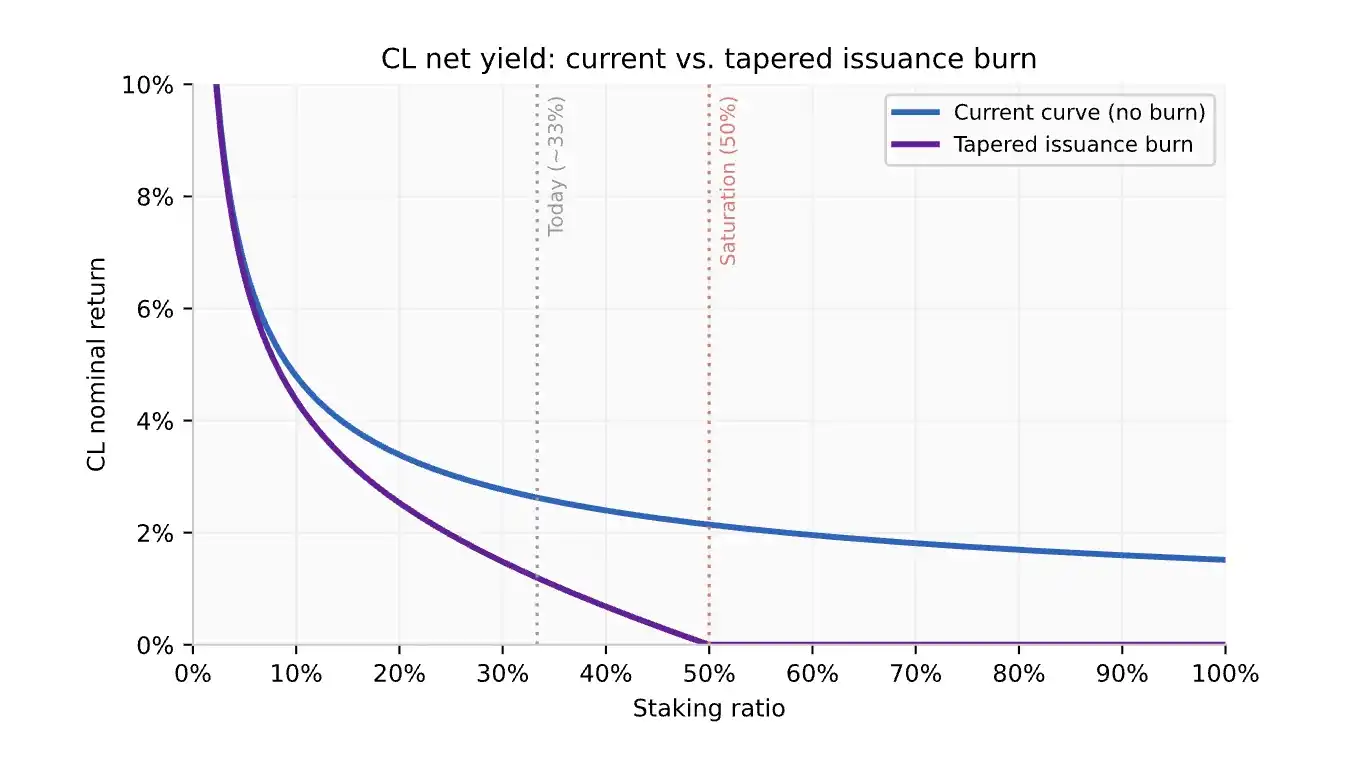
Net consensus-layer profit under the current issuance curve and the EIP-8363 curve

According to the proposal's curve, the annual consensus-layer issuance would peak near a staking ratio of about 19.8%, then decline as the staking ratio increases. Estimating with the current staking ratio of about 33%, if this curve were fully implemented at the fork, the consensus-layer yield would decrease from about 2.6% to about 1.2%.
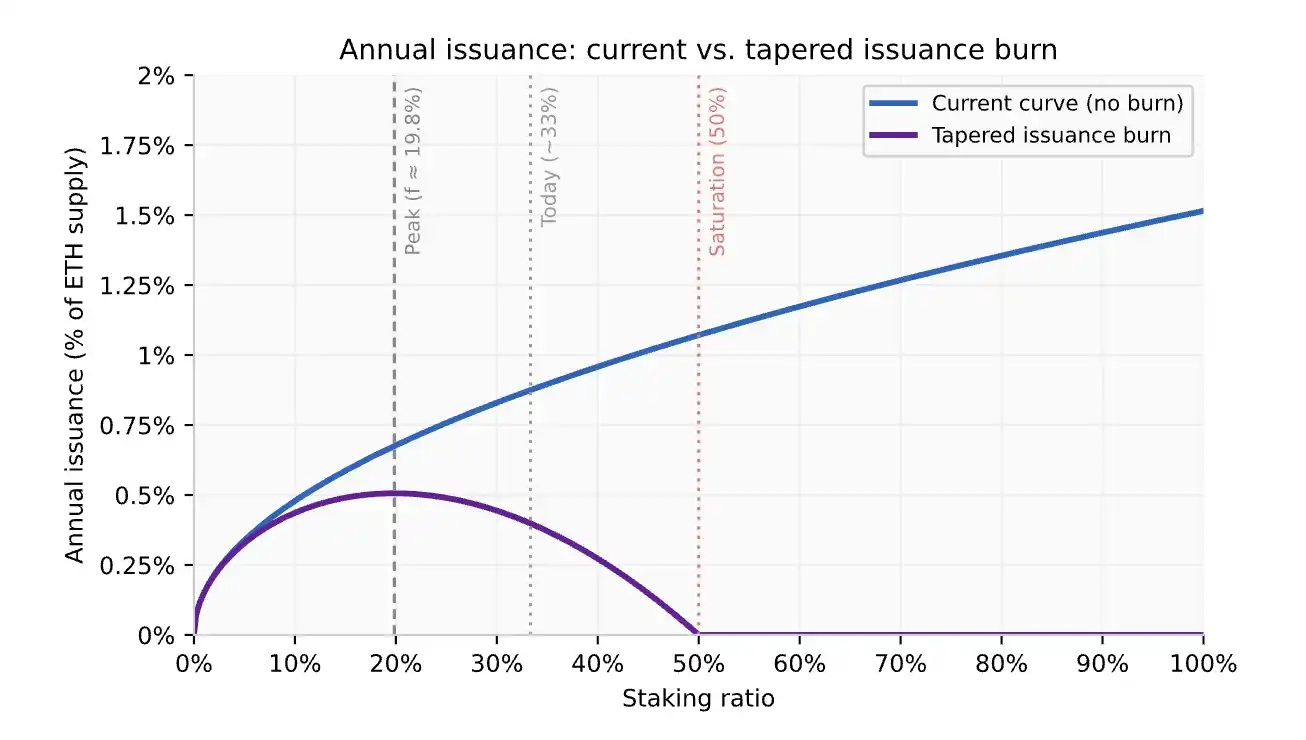
Annual issuance under the current issuance curve and the EIP-8363 curve

To avoid a sudden halving of rewards, the proposal designs an 18-month transition period: upon activation, the base reward factor will be temporarily increased from 64 to 128, then gradually reduced back to 64 over 65 steps, with each step lasting approximately 8.6 days. Therefore, the initial net profit upon activation would be close to current levels, then gradually decline. However, the rule of "providing no consensus-layer issuance incentive after 50%" takes effect from the first day of activation; it does not wait for 18 months.

Currently, this proposal is still an unmerged Core EIP draft, in the editing review and consensus assessment stage. The authors have separately submitted PR #12087, hoping to have it listed as Proposed for Inclusion for the Hegotá upgrade. This PR is also not yet merged; the current formal Hegotá Meta EIP does not include it.

Ethereum core developers plan to discuss Hegotá proposal cut-off items at the 184th ACDC meeting on August 6th. Even if it enters Proposed for Inclusion, it does not guarantee implementation; it would still need to go through subsequent stages of developer assessment, client implementation, testing, and Scheduled for Inclusion.

Community reaction is clearly negative

Jérôme de Tychey, one of the EIP-8363 authors, believes this is a "minimalist, market-driven" change. He also stated in a forum response that the issuance debate started back in 2023, and this proposal merely opens a formal feedback window; it does not equate to being confirmed for inclusion.

He also warned that if validator entries remain continuously full and exits are few, the staked amount could exceed 70 million ETH by early 2028, accounting for over 55% of the supply; reversing course then could lead to larger exit volumes and market disruptions.

The side supporting reduced issuance mainly cites three reasons:

  • Ethereum may be paying too high a cost for economic security that is already sufficiently abundant;
  • Unstaked holders are continuously diluted, forced to choose between "bearing dilution" and "undertaking staking risk";
  • LSTs, ETFs, and custodial services continuously lower staking friction, potentially ultimately allowing a few intermediaries to simultaneously control large amounts of ETH and validation rights.

However, opposition voices are more concentrated in the current public reaction.

Aave founder Stani Kulechov believes that consensus-layer staking rewards varying with the staking ratio and ultimately approaching zero would undermine the cash flow predictability valued by institutions when allocating ETH, and compress positive interest rate strategies like ETH lending and LST loop staking.

Obol co-founder Oisín Kyne points out that Ethereum's true security depends not only on how much ETH is staked, but also on whether the validation power is sufficiently decentralized. If rewards drop to extremely low levels, large institutions with low capital costs and low sensitivity to yield might have the ability to stay in the game long-term and squeeze out high-cost independent operators.

ether.fi CEO Mike Silagadze criticized the proposal for being submitted just before the Hegotá deadline, leaving insufficient lead time for ecosystem developers to discuss it; he worries that low yields will impact staking-related protocols and reduce institutional confidence in Ethereum's governance stability.

Ethereum community member Ryan Berckmans summarized that opponents at least include those worried about who will run validators under zero rewards, those unwilling to reduce staking yields, those opposed to modifying ETH monetary policy again, and those hoping to avoid escalating controversy disrupting ecosystem growth. He personally supports moderately reducing issuance but opposes letting rewards trend all the way to zero, also believing the current proposal is too divisive for the community.

A relatively neutral view comes from ARK Invest research director Lorenzo Valente. He frames this debate from the perspective of ETH's asset positioning. If one emphasizes ETH's "internet bond" attributes more, weakening staking yield indeed damages the lending market and yield curve; if one emphasizes ETH as a neutral currency and store of value more, then the base yield obtained through loop staking mainly comes from protocol issuance, at the cost of unstaked holders being diluted. Reducing issuance means reducing this transfer of yield from unstaked holders to stakers and their leverage strategies.

Who Benefits and Who Bears the Pressure?

If this proposal passes, Solo Stakers would be affected first.

The 18-month transition period spreads out the reward decline but does not reduce fixed costs like hardware, electricity, and operation/maintenance. The proposal maintains the current offline penalty intensity while lowering net rewards, so it would take longer for a single fault to be compensated by subsequent rewards. The proposal itself estimates that at the current ~33% staking ratio, the time needed to compensate for downtime losses could increase to about 3.8 times the current duration.

For large operators with backup power, disaster recovery, and 24/7 operations, such changes are relatively easier to absorb; for home validators, a few internet outages or device failures could significantly erode annual returns.

Tax treatment could also amplify this disparity. The EIP-8363 proposal notes that in some jurisdictions, it's currently unclear whether tax authorities would recognize income based on the pre-deduction reward. If the burned portion can only be recognized as a capital loss, a solo staker's post-tax earnings could be lower than the apparent net reward.

The impact would further transmit to LSTs. The base yield for products like stETH and rETH comes from the underlying validators; when consensus-layer issuance decreases, the yield gap between LSTs and native ETH would also narrow. Whether users are still willing to bear smart contract, governance, custody, and de-pegging risks for one or two percentage points of yield would become a new pricing question.

Loop strategies relying on LST yield would feel pressure sooner. The common approach is to borrow ETH, buy or mint LSTs, then use the LSTs as collateral to borrow more ETH. As staking yield gradually approaches borrowing costs, the positive interest rate spread of such trades would gradually disappear, and leveraged positions might contract voluntarily. Aave, Morpho, Pendle, and products built around LST yield might consequently face decreased ETH borrowing demand, capital utilization rates, and liquidity.

The impact would ultimately affect the entire DeFi interest rate system. Staking yield is an important base rate for ETH-denominated markets; LST lending, fixed income, yield splitting, and loop leverage are all priced around this benchmark.

Of course, LSTs would not lose all their utility because of this. What might truly change is LSTs' advantage relative to native ETH.

Looking further upstream, the staking income of ETFs, exchanges, custodians, and ETH treasury companies would also decline. For institutions relying on staking yield to enhance asset returns, ETH's predictable cash flow would weaken, potentially affecting their willingness for new allocations. Aave founder Stani Kulechov therefore believes this proposal would make it harder for institutions to evaluate ETH's yield and weaken ETH's competitiveness relative to other yield-bearing assets.

The actual impact on institutions may not be uniform. When base yields fall, high-cost participants might exit first, while the largest institutions least dependent on staking yield might instead be more capable of staying. This is precisely the reason opponents fear further validator centralization.

For ordinary ETH holders, the direction of impact is relatively clear. The burned issuance does not go to a specific protocol or fund but benefits all ETH holders collectively by reducing dilution.

However, reduced issuance does not mean ETH will necessarily become deflationary, nor can one deduce that the price will necessarily rise. The final supply change still depends on EIP-1559 fee burns, network usage, validator issuance, and market conditions. If lower yields simultaneously weaken institutional allocation, LST demand, and on-chain lending activity, demand-side changes could also offset some of the supply-side benefits.

Trend Kriptolar

İlgili Sorular

QWhat is the main objective of the EIP-8363 proposal, and what specific issue does it aim to address?

AThe main objective of EIP-8363, the 'Tapered Issuance Burn' proposal, is to install a "downward slope" for staking rewards as the total amount of staked ETH increases. It aims to address the concern that the protocol currently provides positive incentives for more staking indefinitely, potentially leading to excessive concentration of ETH and validator power among a few large custodians, exchanges, and staking derivatives (LSTs). It seeks to reduce the dilution pressure on non-staked ETH and make native ETH a more competitive neutral asset.

QHow does the EIP-8363 proposal technically achieve the reduction in consensus layer rewards for validators?

AThe proposal calculates validator rewards normally but then deducts and burns a portion of them. The burn ratio depends on the total effective staked balance relative to 60.25 million ETH (approximately half of the current supply). The formula uses the 1.5th power of this ratio, capped at 100%. As the staked amount approaches 60.25 million ETH, validators' net consensus layer rewards trend towards zero. At or above this threshold, the newly added burn would completely offset the consensus layer issuance rewards for fully performing validators. Execution layer income like priority fees and MEV remains unaffected.

QWhat are some of the key arguments raised by opponents of the EIP-8363 proposal?

AOpponents argue that: 1) It weakens the predictability of cash flows from staking, which is valued by institutions when allocating ETH. 2) Extremely low rewards could disproportionately squeeze out high-cost solo stakers, leaving capital-rich, yield-insensitive large entities in control, potentially increasing centralization. 3) It could negatively impact protocols built around staking yields (e.g., LSTs, lending markets, leverage strategies). 4) The proposal was submitted close to the Hegotá upgrade deadline, leaving insufficient time for community discussion. 5) It represents another contentious change to ETH's monetary policy that could disrupt ecosystem growth.

QAccording to the article, how might the EIP-8363 proposal disproportionately impact solo stakers compared to large institutional operators?

ASolo stakers (home validators) would be more severely impacted because the proposal lowers net rewards without reducing fixed costs like hardware, electricity, and maintenance. The offline penalty severity remains the same, so recovering from a downtime incident would take longer with lower subsequent rewards. Large operators with backup power, disaster recovery systems, and 24/7 operations can more easily absorb these changes. Furthermore, potential unfavorable tax treatments in some jurisdictions, where the burned portion might only be recognized as a capital loss, could further reduce solo stakers' after-tax income.

QWhat is the potential impact of EIP-8363 on Liquid Staking Tokens (LSTs) and the broader DeFi ecosystem?

AThe yield gap between LSTs and native ETH would narrow as the underlying consensus layer rewards decline. This could reduce the attractiveness of LSTs, as users may be less willing to take on smart contract, governance, and de-peg risks for a smaller yield premium. Strategies relying on LST yield, such as looping (borrowing ETH to buy/mint LST and re-collateralizing), would see their positive carry diminish and potentially unwind. This could lead to decreased ETH borrowing demand, lower utilization rates, and reduced liquidity in protocols like Aave, Morpho, and Pendle, ultimately affecting the entire ETH-denominated DeFi interest rate system.

İlgili Okumalar

İşlemler

Spot

Popüler Makaleler

ETH 2.0 Nedir

ETH 2.0: Ethereum için Yeni Bir Dönem Giriş ETH 2.0, Ethereum 2.0 olarak da bilinir, Ethereum blok zincirinde önemli bir yükseltmeyi işaret eder. Bu geçiş yalnızca bir yüz değiştirme değil; ağın ölçeklenebilirliğini, güvenliğini ve sürdürülebilirliğini temelinden geliştirmeyi hedeflemektedir. Enerji yoğun Proof of Work (PoW) konsensüs mekanizmasından daha verimli olan Proof of Stake (PoS) mekanizmasına geçişle birlikte, ETH 2.0 blok zinciri ekosistemine dönüştürücü bir yaklaşım vaat etmektedir. ETH 2.0 Nedir? ETH 2.0, Ethereum'un yeteneklerini ve performansını optimize etmeye odaklanmış özel, birbirine bağlı güncellemelerin bir derlemesidir. Yenileme, mevcut Ethereum mekanizmasının karşılaştığı kritik zorlukları, özellikle işlem hızı ve ağ tıkanıklığı ile ilgili sorunları ele almak üzere tasarlanmıştır. ETH 2.0'ın Amaçları ETH 2.0'ın ana amaçları, üç temel unsuru geliştirmeye odaklanmaktadır: Ölçeklenebilirlik: Ağın saniye başına işleyebileceği işlem sayısını önemli ölçüde artırmayı hedefleyen ETH 2.0, mevcut yaklaşık 15 işlem/saniye sınırlamasını aşmayı ve potansiyel olarak binlerce işleme ulaşmayı planlamaktadır. Güvenlik: Geliştirilmiş güvenlik önlemleri, özellikle siber saldırılara karşı daha iyi direnç sağlama ve Ethereum'un merkeziyetsiz görünümünü koruma açısından ETH 2.0 için hayati öneme sahiptir. Sürdürülebilirlik: Yeni PoS mekanizması, sadece verimliliği artırmakla kalmayıp aynı zamanda enerji tüketimini de önemli ölçüde azaltma hedefiyle tasarlanmış olup, Ethereum'un operasyonel çerçevesini çevresel kaygılarla uyumlu hale getirmektedir. ETH 2.0'ın Yaratıcısı Kimdir? ETH 2.0'ın yaratılması Ethereum Vakfı'na atfedilebilir. Ethereum'un gelişimini destekleme konusunda kritik bir rol oynayan bu kar amacı gütmeyen kuruluş, dikkat çekici kurucu ortağı Vitalik Buterin tarafından yönetilmektedir. Daha ölçeklenebilir ve sürdürülebilir bir Ethereum vizyonu, bu yükseltmenin arkasındaki itici güç olmuştur ve protokolü geliştirmek için kendini adamış küresel bir geliştici ve meraklı topluluğunun katkılarını içermektedir. ETH 2.0'ın Yatırımcıları Kimlerdir? ETH 2.0 yatırımcıları ile ilgili detaylar kamuoyuna açıklanmamış olsa da, Ethereum Vakfı'nın blok zinciri ve teknoloji alanında çeşitli kuruluşlar ve bireyler tarafından desteklendiği bilinmektedir. Bu ortaklar arasında merkeziyetsiz teknolojilerin ve blok zinciri altyapısının geliştirilmesine karşılıklı ilgi duyan girişim sermayesi şirketleri, teknoloji firmaları ve hayır kurumları yer almaktadır. ETH 2.0 Nasıl Çalışır? ETH 2.0, onu öncüsünden ayıran bir dizi önemli özelliği tanıtmasıyla dikkat çekmektedir. Proof of Stake (PoS) PoS konsensüs mekanizmasına geçiş, ETH 2.0'ın en belirgin değişikliklerinden biridir. İşlem doğrulama için enerji yoğun madenciliğe dayanmak yerine, PoS kullanıcıların ağa yatırdıkları ETH miktarına göre işlemleri doğrulayıp yeni bloklar oluşturmalarına olanak tanır. Bu, enerji verimliliğinin artırılmasına yol açarak tüketimi yaklaşık %99,95 oranında azaltmakta ve Ethereum 2.0'ı önemli ölçüde daha çevre dostu bir alternatif haline getirmektedir. Shard Zincirleri Shard zincirleri, ETH 2.0'ın diğer bir kritik yeniliğidir. Bu daha küçük zincirler, ana Ethereum zinciri ile paralel olarak çalışarak birden fazla işlemin aynı anda işlenmesine olanak tanır. Bu yaklaşım, ağın genel kapasitesini artırarak Ethereum'u rahatsız eden ölçeklenebilirlik sorunlarını ele alır. Beacon Zinciri ETH 2.0'ın temelinde, ağı koordine eden ve PoS protokolünü yöneten Beacon Zinciri yer almaktadır. Bu, bir tür organizatör olarak işlev görür: doğrulayıcıları denetler, shard'ların ağa bağlı kalmasını sağlar ve blok zinciri ekosisteminin genel sağlığını izler. ETH 2.0 Zaman Çizelgesi ETH 2.0'ın yolculuğu, bu önemli yükseltmenin evrimini gösteren birkaç önemli dönüm noktası ile tanımlanmıştır: Aralık 2020: Beacon Zinciri'nin başlatılması, PoS'un tanıtımını işaret etmiş ve ETH 2.0’a geçiş için sahneyi hazırlamıştır. Eylül 2022: "The Merge" tamamlanması, Ethereum ağının başarılı bir şekilde PoW'den PoS çerçevesine geçiş yaptığı kritik bir anı temsil etmekte ve Ethereum için yeni bir dönemi müjdelemektedir. 2023: Shard zincirlerinin beklenen dağıtımı, Ethereum ağının ölçeklenebilirliğini daha da artırmayı hedeflemekte ve ETH 2.0'ı merkeziyetsiz uygulamalar ve hizmetler için sağlam bir platform haline getirmeyi pekiştirmektedir. Ana Özellikler ve Faydalar Geliştirilmiş Ölçeklenebilirlik ETH 2.0'ın en önemli avantajlarından biri, geliştirilmiş ölçeklenebilirliğidir. PoS ve shard zincirlerinin kombinasyonu, ağın kapasitesini artırarak, eski sistemle kıyaslandığında çok daha fazla işlem hacmi karşılayabilmesini sağlamaktadır. Enerji Verimliliği PoS'un uygulanması, blok zinciri teknolojisinde enerji verimliliği yönünde büyük bir adım teşkil etmektedir. Enerji tüketimini ciddi şekilde azaltarak, ETH 2.0 yalnızca işletme maliyetlerini düşürmekle kalmaz, aynı zamanda küresel sürdürülebilirlik hedefleriyle daha yakın bir uyum sağlar. Geliştirilmiş Güvenlik ETH 2.0'ın güncellenmiş mekanizmaları, ağ genelinde güvenliğin artırılmasına katkıda bulunmaktadır. PoS'un uygulanması ve shard zincirleri ile Beacon Zinciri aracılığıyla geliştirilen yenilikçi kontrol önlemleri, potansiyel tehditlere karşı daha yüksek bir koruma sağlar. Kullanıcılar için Düşük Maliyetler Ölçeklenebilirlik geliştikçe, işlem maliyetleri üzerindeki etkiler de belirgin hale gelecektir. Artan kapasite ve azalan tıkanıklığın, kullanıcılar için düşük ücretler anlamına gelmesi beklenmekte ve Ethereum'u günlük işlemler için daha erişilebilir hale getirmektedir. Sonuç ETH 2.0, Ethereum blok zinciri ekosisteminde önemli bir evrimi işaret etmektedir. Ölçeklenebilirlik, enerji tüketimi, işlem verimliliği ve genel güvenlik gibi temel sorunları ele alırken, bu güncellemenin önemi abartılamaz. Proof of Stake'e geçiş, shard zincirlerinin tanıtımı ve Beacon Zinciri'nin altyapı çalışmaları, Ethereum'un merkeziyetsiz piyasalarının artan taleplerini karşılayabileceği bir geleceği göstermektedir. Yenilik ve ilerleme ile şekillenen bir sektörde, ETH 2.0, blok zinciri teknolojisinin daha sürdürülebilir ve verimli bir dijital ekonomi için yol açmadaki yeteneklerinin bir kanıtıdır.

284 Toplam GörüntülenmeYayınlanma 2024.04.04Güncellenme 2024.12.03

ETH 2.0 Nedir

ETH 3.0 Nedir

ETH3.0 ve $eth 3.0: Ethereum'un Geleceği Üzerine Derinlemesine Bir İnceleme Giriş Hızla evrilen kripto para ve blok zinciri teknolojisi ortamında, ETH3.0, sıklıkla $eth 3.0 olarak adlandırılmakta, önemli bir ilgi ve spekülasyon konusu haline gelmiştir. Bu terim, netleştirilmesi gereken iki temel kavramı kapsamaktadır: Ethereum 3.0: Bu, mevcut Ethereum blok zincirinin yeteneklerini artırmayı hedefleyen olası bir gelecekteki güncellemeyi temsil eder, özellikle ölçeklenebilirlik ve performansı iyileştirmeye odaklanmaktadır. ETH3.0 Meme Token: Bu ayrı kripto para projesi, Ethereum blok zincirini kullanarak meme merkezli bir ekosistem oluşturmayı amaçlamakta ve kripto para topluluğu içinde etkileşimi artırmaktadır. ETH3.0'ün bu yönlerini anlamak, yalnızca kripto meraklıları için değil, aynı zamanda dijital alandaki daha geniş teknolojik trendleri gözlemleyenler için de hayati öneme sahiptir. ETH3.0 Nedir? Ethereum 3.0 Ethereum 3.0, zaten kurulmuş olan Ethereum ağına önerilen bir güncelleme olarak duyurulmaktadır; bu ağ, kuruluşundan bu yana birçok merkeziyetsiz uygulamanın (dApp'ler) ve akıllı sözleşmelerin belkemiği olmuştur. Tasarlanan iyileştirmeler, esasen ölçeklenebilirlik üzerine yoğunlaşmakta – shardlama ve sıfır bilgi kanıtları (zk-proofs) gibi ileri teknolojileri entegre etmektedir. Bu teknolojik yenilikler, saniyede eşi benzeri görülmemiş sayıda işlem (TPS) gerçekleştirmeyi kolaylaştırmayı amaçlamakta olup, muhtemelen milyonlara ulaşarak mevcut blok zinciri teknolojisinin karşılaştığı en büyük sınırlamalardan birine çözüm getirmektedir. İyileştirme yalnızca teknik değil, aynı zamanda stratejiktir; Ethereum ağını, merkeziyetsiz çözümlere olan artan talep ile belirginleşen bir geleceğe hazırlamak için tasarlanmıştır. ETH3.0 Meme Token Ethereum 3.0'ın aksine, ETH3.0 Meme Token, internet meme kültürünü kripto para dinamikleriyle birleştirerek daha hafif ve eğlenceli bir alanda hareket etmektedir. Bu proje, kullanıcıların Ethereum blok zincirinde meme alım, satım ve ticaret yapmalarına izin vererek, yaratıcılık ve ortak ilgi alanları aracılığıyla topluluk etkileşimini teşvik eden bir platform sunmaktadır. ETH3.0 Meme Token, blok zinciri teknolojisinin dijital kültürle nasıl kesişebileceğini göstererek, hem eğlenceli hem de finansal olarak sürdürülebilir kullanım senaryoları oluşturmayı hedeflemektedir. ETH3.0'un Yaratıcısı Kimdir? Ethereum 3.0 Ethereum 3.0'a yönelik girişim, esas olarak Ethereum topluluğundaki bir geliştirici ve araştırmacı konsorsiyumu tarafından yönlendirilmektedir ve bunlar arasında Justin Drake de bulunmaktadır. Ethereum'un evrimine yönelik içgörüleri ve katkılarıyla tanınan Drake, Ethereum'u “Beam Chain” olarak adlandırılan yeni bir konsensüs katmanına geçirme konusundaki tartışmalarda öne çıkan bir figür olmuştur. Geliştirmeye yönelik bu iş birliği yaklaşımı, Ethereum 3.0'ın tek bir yaratıcının ürünü olmadığını, aksine blok zinciri teknolojisini ilerletmeye odaklanmış kolektif bir dehanın tezahürü olduğunu göstermektedir. ETH3.0 Meme Token ETH3.0 Meme Token'ın yaratıcısına dair detaylar şu anda izlenemez durumdadır. Meme tokenların doğası, genellikle daha merkeziyetsiz ve topluluk odaklı bir yapıya yol açmakta olup, bu da spesifik bir atıf eksikliğini açıklayabilir. Bu durum, yeniliğin genellikle iş birliği yerine bireysel çabalardan ortaya çıktığı kripto topluluğunun genel felsefesiyle uyumludur. ETH3.0 Yatırımcıları Kimlerdir? Ethereum 3.0 Ethereum 3.0'a olan destek, esasen Ethereum Vakfı ve hevesli bir geliştirici ve yatırımcı topluluğu tarafından sağlanmaktadır. Bu temel birliktelik, yıllar süren ağ operasyonlarıyla inşa edilen güven ve itibarından yararlanarak önemli bir meşruiyet sağlamaktadır. Kripto para dünyasının hızla değişen ikliminde, topluluk desteği, gelişim ve benimsemeyi yönlendirmede kritik bir rol oynamakta ve Ethereum 3.0'ı gelecekteki blok zinciri ilerlemeleri için ciddi bir rakip haline getirmektedir. ETH3.0 Meme Token Mevcut kaynaklar, ETH3.0 Meme Token'ı destekleyen yatırım temelleri veya kuruluşları hakkında net bilgiler sağlamasa da, bu durum meme tokenlar için tipik olan finansman modelini göstermektedir; bu model genellikle tabandan destek ve topluluk katılımına dayanır. Bu tür projelerdeki yatırımcılar genellikle toplum odaklı yenilik potansiyeli ve kripto topluluğunda bulunan iş birliği ruhuyla motive olmuş bireylerden oluşmaktadır. ETH3.0 Nasıl Çalışır? Ethereum 3.0 Ethereum 3.0'ın ayırt edici özellikleri, önerilen shardlama ve zk-proof teknolojisinin uygulanmasında yatmaktadır. Shardlama, blok zincirini daha küçük, yönetilebilir parçalara veya “parçalara” ayırma yöntemidir; bu parçalar işlemleri ardışık değil, eşzamanlı olarak işleyebilir. Bu işlem yükünün merkeziyetsizliği, tıkanıklığı önlemeye yardımcı olur ve ağın yoğun yük altında bile yanıt verebilir olmasını sağlar. Sıfır bilgi kanıtı (zk-proof) teknolojisi, işleme katılan temel verileri ifşa etmeden işlem doğrulaması sağlamasıyla başka bir sofistike katman ekler. Bu yön, sadece gizliliği artırmakla kalmaz, aynı zamanda ağın genel verimliliğini de artırır. Bu güncellemeye, ağın yeteneklerini ve faydasını daha da artırarak sıfır bilgi Ethereum Sanal Makinesi (zkEVM) entegrasyonunun da eklenmesi gündeme gelmektedir. ETH3.0 Meme Token ETH3.0 Meme Token, meme kültürünün popülaritesinden yararlanarak kendini farklılaştırmaktadır. Kullanıcıların sadece eğlence için değil, aynı zamanda potansiyel ekonomik kazançlar için meme ticareti yapmalarına olanak tanıyacak bir pazar yeri oluşturur. Stake etme, likidite sağlama ve yönetim mekanizmaları gibi özelliklerin entegrasyonu sayesinde, proje topluluk etkileşimini ve katılımını teşvik eden bir ortam oluşturur. Eğlence ve ekonomik fırsatların eşsiz bir karışımını sunarak, ETH3.0 Meme Token, kripto tutkunlarından gündelik meme meraklılarına kadar çeşitli bir kitleyi çekmeyi hedeflemektedir. ETH3.0 Zaman Çizelgesi Ethereum 3.0 11 Kasım 2024: Justin Drake, ölçeklenebilirlik iyileştirmeleri etrafında şekillenen yaklaşan ETH 3.0 güncellemesine işaret ediyor. Bu duyuru, Ethereum'un gelecekteki mimarisi hakkında resmi tartışmaların başlangıcını simgeliyor. 12 Kasım 2024: Ethereum 3.0'a yönelik beklenen önerinin, Bangkok'taki Devcon'da açıklanması planlanıyor ve bu, daha geniş topluluk geri bildirimi ve gelişim için olası sonraki adımların zeminini hazırlıyor. ETH3.0 Meme Token 21 Mart 2024: ETH3.0 Meme Token, CoinMarketCap'ta resmi olarak listeleniyor, bu da kamusal kripto alanına adım atarak meme merkezli ekosisteminin görünürlüğünü artırıyor. Ana Noktalar Sonuç olarak, Ethereum 3.0, gelişmiş teknolojiler aracılığıyla ölçeklenebilirlik ve performansla ilgili sınırlamaların üstesinden gelmeye odaklanan Ethereum ağındaki önemli bir evrimi temsil etmektedir. Önerilen güncellemeleri, gelecekteki talepler ve kullanılabilirlik için proaktif bir yaklaşımı yansıtmaktadır. Öte yandan, ETH3.0 Meme Token, kripto para alanındaki topluluk odaklı kültürün özünü kapsamakta, meme kültürünü kullanarak kullanıcı yaratıcılığını ve katılımını teşvik eden etkileşimli platformlar oluşturmayı hedeflemektedir. ETH3.0 ve $eth 3.0'un farklı amaçlarının ve işlevlerinin anlaşılması, kripto alanındaki gelişmeleri takip eden herkes için hayati öneme sahiptir. Her iki girişim de benzersiz yollar çizerek, blok zinciri yeniliğinin dinamik ve çok yönlü doğasını birlikte vurgulamaktadır.

266 Toplam GörüntülenmeYayınlanma 2024.04.04Güncellenme 2024.12.03

ETH 3.0 Nedir

ETH Nasıl Satın Alınır

HTX.com’a hoş geldiniz! Ethereum (ETH) satın alma işlemlerini basit ve kullanışlı bir hâle getirdik. Adım adım açıkladığımız rehberimizi takip ederek kripto yolculuğunuza başlayın. 1. Adım: HTX Hesabınızı OluşturunHTX'te ücretsiz bir hesap açmak için e-posta adresinizi veya telefon numaranızı kullanın. Sorunsuzca kaydolun ve tüm özelliklerin kilidini açın. Hesabımı Aç2. Adım: Kripto Satın Al Bölümüne Gidin ve Ödeme Yönteminizi SeçinKredi/Banka Kartı: Visa veya Mastercard'ınızı kullanarak anında Ethereum (ETH) satın alın.Bakiye: Sorunsuz bir şekilde işlem yapmak için HTX hesap bakiyenizdeki fonları kullanın.Üçüncü Taraflar: Kullanımı kolaylaştırmak için Google Pay ve Apple Pay gibi popüler ödeme yöntemlerini ekledik.P2P: HTX'teki diğer kullanıcılarla doğrudan işlem yapın.Borsa Dışı (OTC): Yatırımcılar için kişiye özel hizmetler ve rekabetçi döviz kurları sunuyoruz.3. Adım: Ethereum (ETH) Varlıklarınızı SaklayınEthereum (ETH) satın aldıktan sonra HTX hesabınızda saklayın. Alternatif olarak, blok zinciri transferi yoluyla başka bir yere gönderebilir veya diğer kripto para birimlerini takas etmek için kullanabilirsiniz.4. Adım: Ethereum (ETH) Varlıklarınızla İşlem YapınHTX'in spot piyasasında Ethereum (ETH) ile kolayca işlemler yapın.Hesabınıza erişin, işlem çiftinizi seçin, işlemlerinizi gerçekleştirin ve gerçek zamanlı olarak izleyin. Hem yeni başlayanlar hem de deneyimli yatırımcılar için kullanıcı dostu bir deneyim sunuyoruz.

4.0k Toplam GörüntülenmeYayınlanma 2024.12.10Güncellenme 2026.06.02

ETH Nasıl Satın Alınır

Tartışmalar

HTX Topluluğuna hoş geldiniz. Burada, en son platform gelişmeleri hakkında bilgi sahibi olabilir ve profesyonel piyasa görüşlerine erişebilirsiniz. Kullanıcıların ETH (ETH) fiyatı hakkındaki görüşleri aşağıda sunulmaktadır.

活动图片