Decoding Unitree's IPO Prospectus: The True Picture of the Robot Market

marsbitPubblicato 2026-05-25Pubblicato ultima volta 2026-05-25

Introduzione

Unitree Robotics's IPO prospectus reveals a profitable and rapidly growing company, dominating the global humanoid robot market by shipment volume (5,500 units in 2025). A key shift is that humanoids now constitute over half of its revenue, up from just 1.9% in 2023. However, the current market reality is stark: 74% of humanoid sales are for academic research, 17% for commercial "display" purposes, and only 9% for genuine industrial applications. In contrast, its quadruped robots see more mature industrial use (e.g., inspection). Financially, Unitree is strong with 335% revenue growth to ~$252M in 2025, ~60% gross margins (bolstered by deep vertical integration of key components like motors), and GAAP profitability since 2024. The company plans to invest nearly half of its $620M IPO proceeds into AI and "embodied" large model development, signaling a strategic push beyond hardware into the critical software layer for future differentiation. Unitree's story highlights that while advanced, cost-effective hardware exists, widespread commercial and industrial adoption awaits more capable AI models.

Author:Tanay Jaipuria

Compiled by: Deep Tide TechFlow

Deep Tide Guide: Unitree robotics is about to conduct an IPO on the Shanghai Stock Exchange's Sci-Tech Innovation Board, raising $620 million. The prospectus reveals for the first time the complete financial data of a profitable robot company. The company shipped 5,500 humanoid robots in 2025, ranking first globally, but 74% were sold to universities for research, with genuine industrial applications accounting for only 9%—this is the current reality of the robotics industry: hardware is ready, but commercialization is waiting for AI models to catch up.

Unitree Robotics recently submitted an IPO application to the Shanghai Stock Exchange's Sci-Tech Innovation Board, planning to raise $620 million. This prospectus is quite interesting because it gives us a clear view of the current state of the robot market.

Unitree is already profitable, growing rapidly, and leads in global humanoid robot shipments.

This article will discuss:

  • What Unitree produces
  • The shift in revenue structure towards humanoid robots
  • Who is buying robots (and why)
  • The vertical integration strategy
  • Financial status
  • Ambitions at the model layer

1. What Unitree Produces

Unitree was founded in 2016 and is based in Hangzhou. Its founder, Wang Xingxing, is a self-taught robotics expert who built the first quadruped robot in his own apartment. The company currently has 480 employees, with about 175 engaged in R&D.
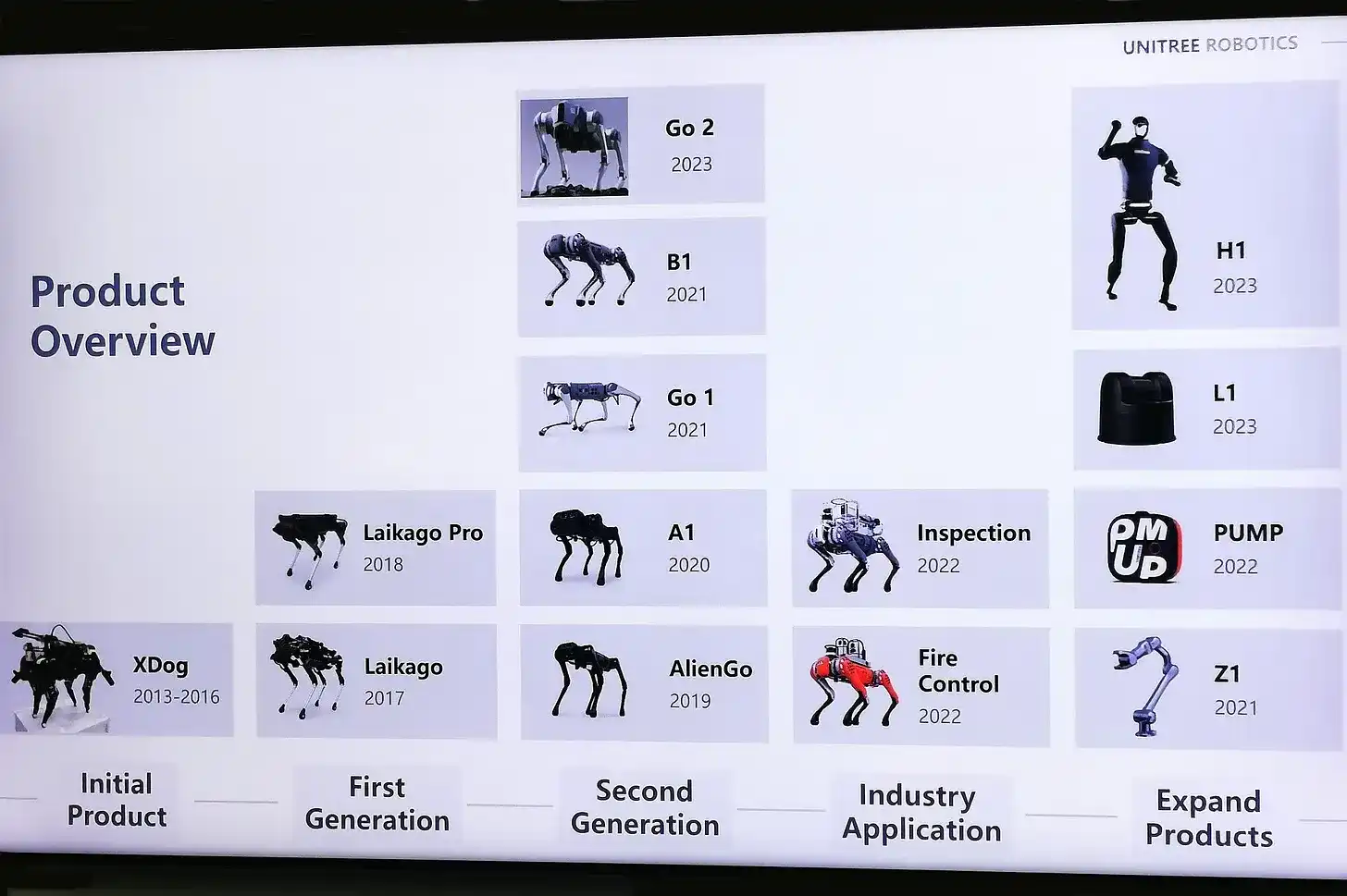
The company sells two product lines:

Quadruped Robots: Go2 (consumer and research grade), B2 (industrial grade), and A2

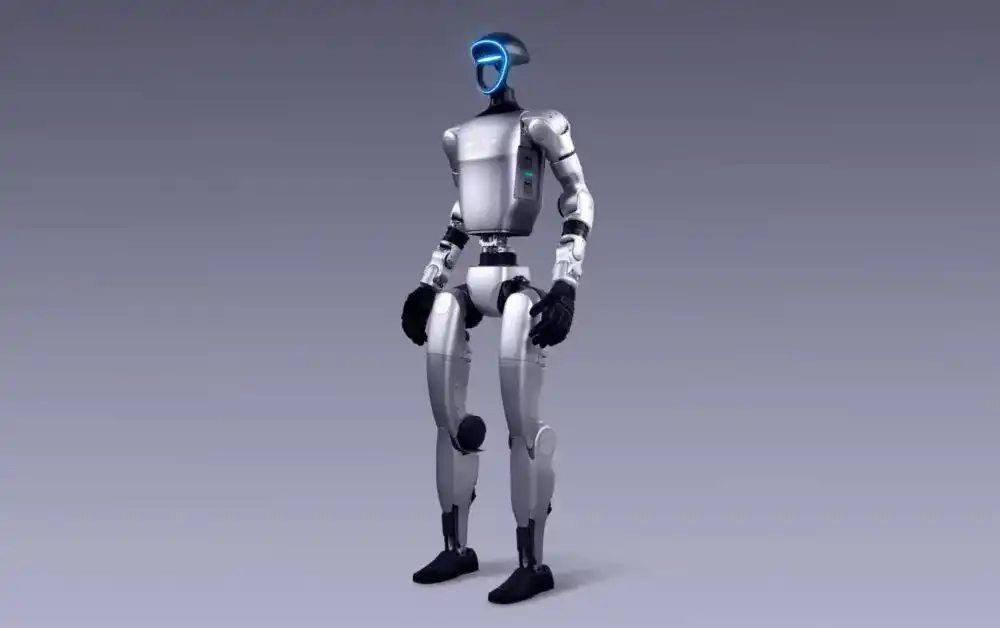
Humanoid Robots: H1, H2, G1, and R1. The G1 is the one you might have seen in viral videos, standing 1.32 meters tall and weighing 35 kg.
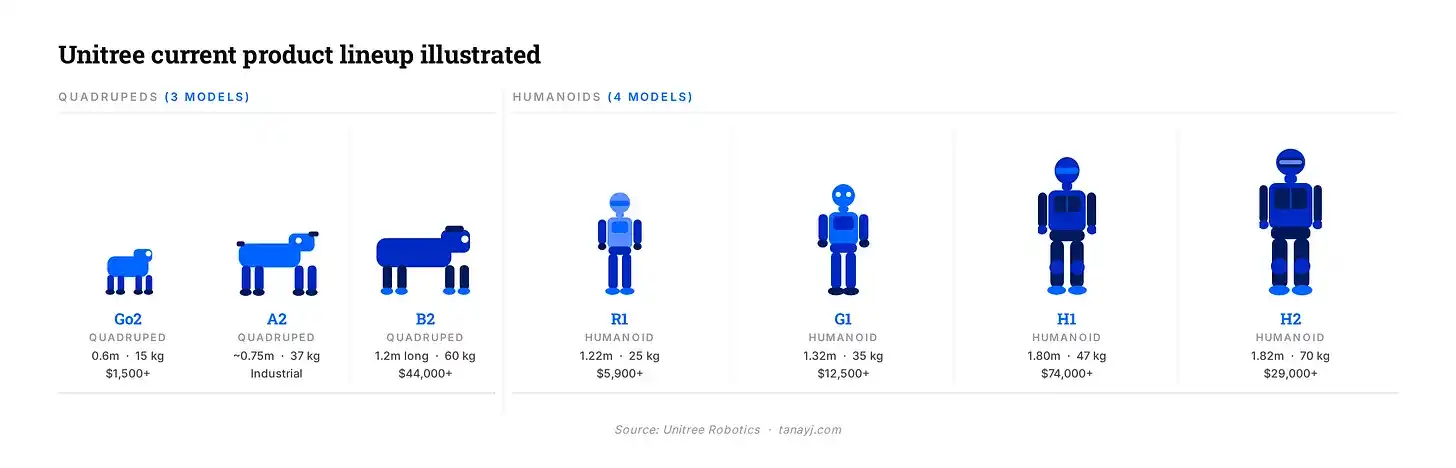
The company began international sales in 2018. Over 35% of revenue comes from outside China, including a significant number of academic customers in the US.

2. The Shift in Revenue Structure Towards Humanoid Robots

Two years ago, Unitree was essentially a robot dog company, primarily selling quadruped robots. Humanoid robots accounted for only 1.9% of revenue in 2023.

By the first three quarters of 2025, humanoid robots already accounted for over half of core revenue.
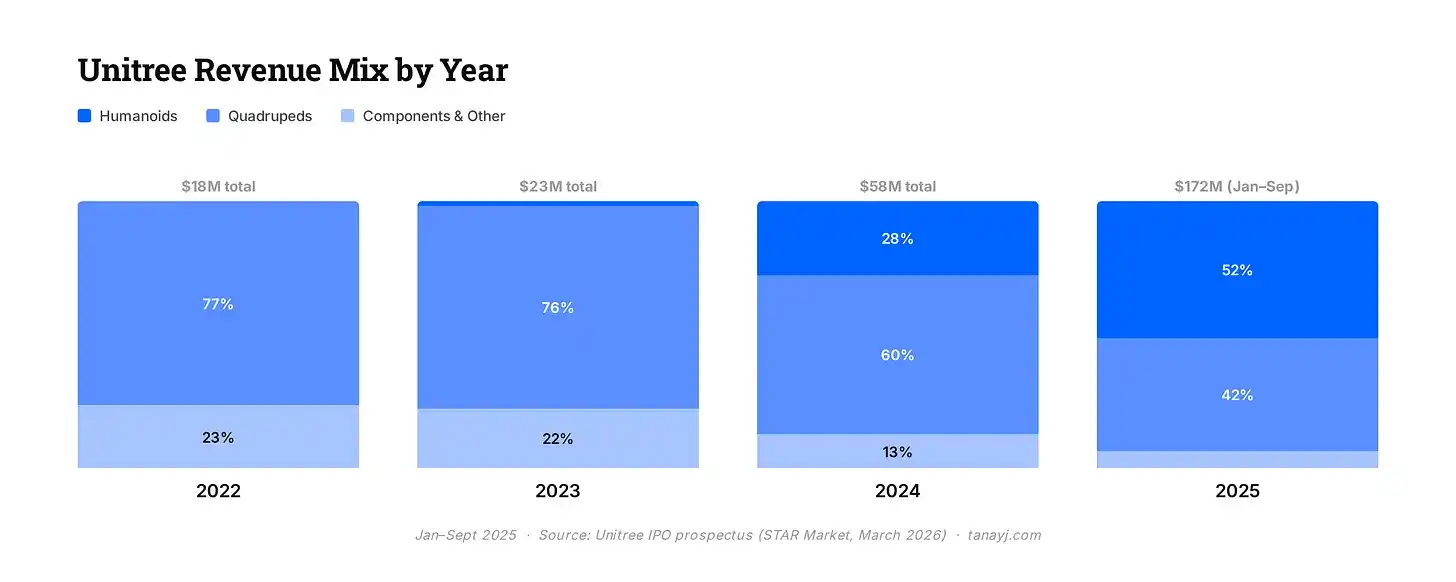
This shift was driven by improved product-market fit and aggressive marketing. The company's humanoid robots have appeared on CCTV's Spring Festival Gala for two consecutive years, one of the most-watched programs globally. Jensen Huang brought Unitree robots on stage at the 2024 GTC conference.

This brand exposure translated into commercial and research demand, something most Chinese hardware companies have never truly achieved.

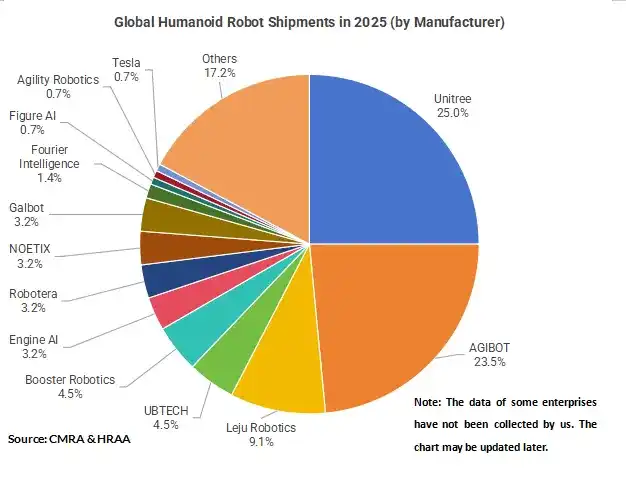
The shipment data for humanoid robots is particularly impressive. Unitree shipped about 5,500 humanoid robots in 2025, making it the world's largest manufacturer of humanoid robots by shipment volume. China's Zhiyuan Robotics comes closest to this number. In contrast, well-known US companies like Figure AI and Agility Robotics have only shipped in the hundreds.
The 5-year target in the prospectus is an annual production capacity of 75,000 humanoid robots and 115,000 quadruped robots. This is about 14 times the humanoid robot shipments in 2025. The goal is aggressive but also highlights how early stage we still are.

3. Who is Really Buying Robots

The prospectus categorizes buyers into three types: Research & Education, Commercial & Consumer, and Industrial Applications.

The reality is that most current demand for humanoid robots comes from research and education purposes.
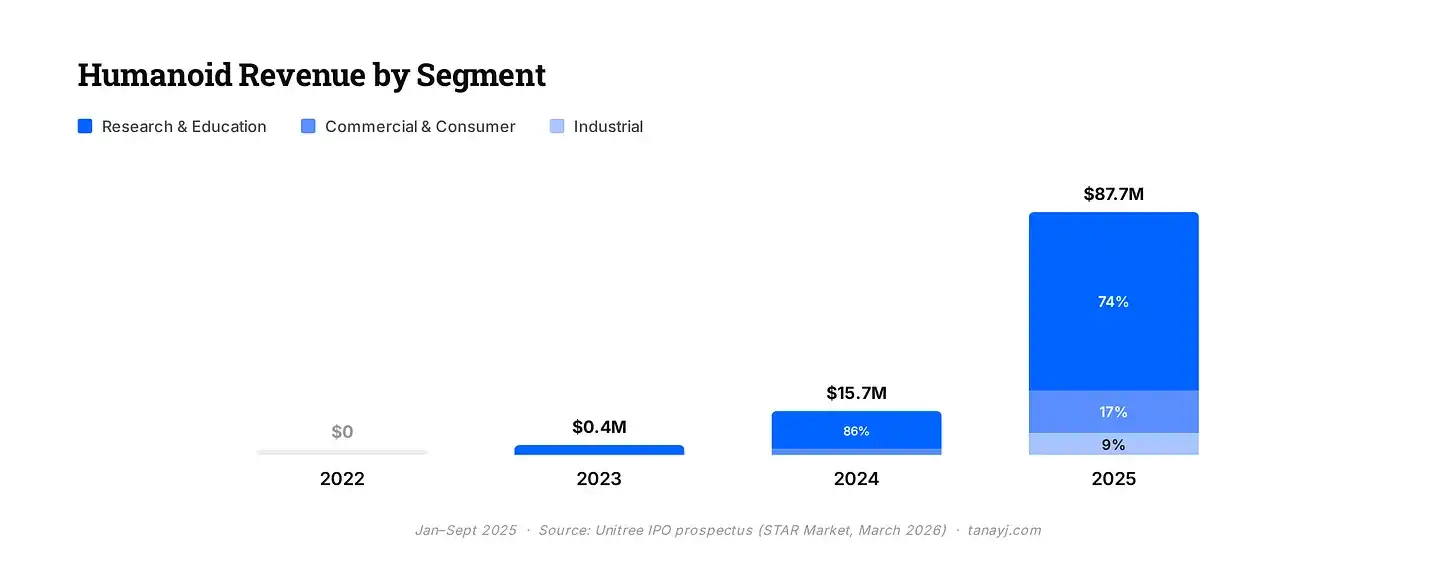
1/ Research & Education accounts for 74% of humanoid robot revenue/shipments. Academic buyers have been Unitree's core support since at least 2022 and remain the company's largest revenue source.

2/ Commercial & Consumer accounts for 17% of humanoid robot shipments. Non-academic consumers who buy these robots mainly use them for "showcasing": acting as eye-catching promoters in retail stores, tourist spots, performances, and exhibitions. Consumer revenue grew nearly fourfold year-on-year in the first nine months of 2025, which sounds impressive, but the base was actually very small. In reality, the practical use of a $25,000 humanoid robot today is to stand at the entrance of a store in Shenzhen attracting tourists.

3/ Industrial Applications account for only 9% of humanoid robot shipments. Unitree acknowledges that industrial deployment is more limited because the technology is not yet mature enough, which illustrates the current technological state. Within this 9% of shipments, about 50-70% are used in scenarios like corporate reception and guiding tours. So overall, only 3-4% of humanoid robot shipments are genuinely used for work like corporate reception and inspection.

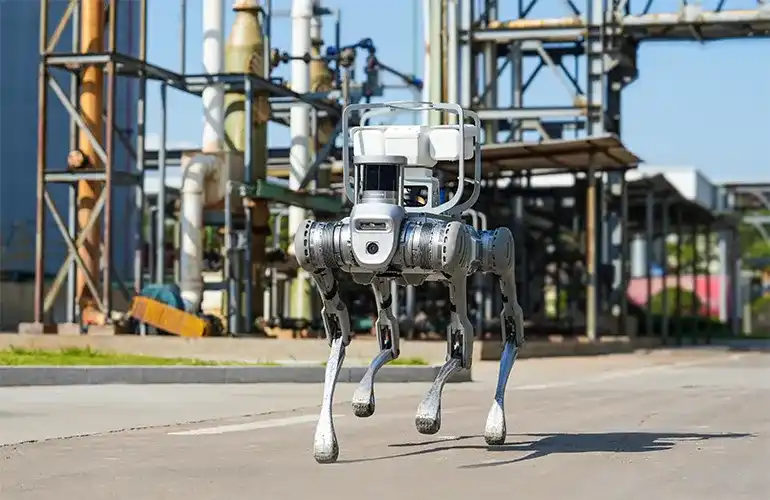
For quadruped robots, the situation is better: only about one-third of revenue comes from research, over 40% from commercial use, and the rest from industrial use. Productive use cases there are relatively more mature. Clients include State Grid, Southern Grid, PetroChina, Sinopec, Baowu Group, and JD.com (Unitree's largest customer). These companies use quadruped robots for real inspection scenarios in chemical plants, substations, coal mines, pipelines, etc.
4. Vertical Integration Strategy

A unique aspect of Unitree is that it independently designs and manufactures most of its key components: high-torque motors, precision reducers, encoders, joint modules, intelligent controllers, high-precision sensors, dexterous hands, lidars, and cameras. According to McKinsey data, the drive system (motors, reducers, and the joint systems that actually make the robot move) typically accounts for 40-60% of the total BOM cost of a humanoid robot.

Most companies in this field source these components externally, but Unitree manufactures them itself. Outsourced components account for only about 14-18% of the total cost. What it outsources are only generic parts like batteries, flash memory, and differentiated parts like the core computing board.

The unit manufacturing cost for quadruped robots has decreased from about $3,300 in 2022 to about $1,800 in mid-2025, a 46% reduction. Humanoid robot costs have also decreased, from about $10,800 to $9,200 over the same period.

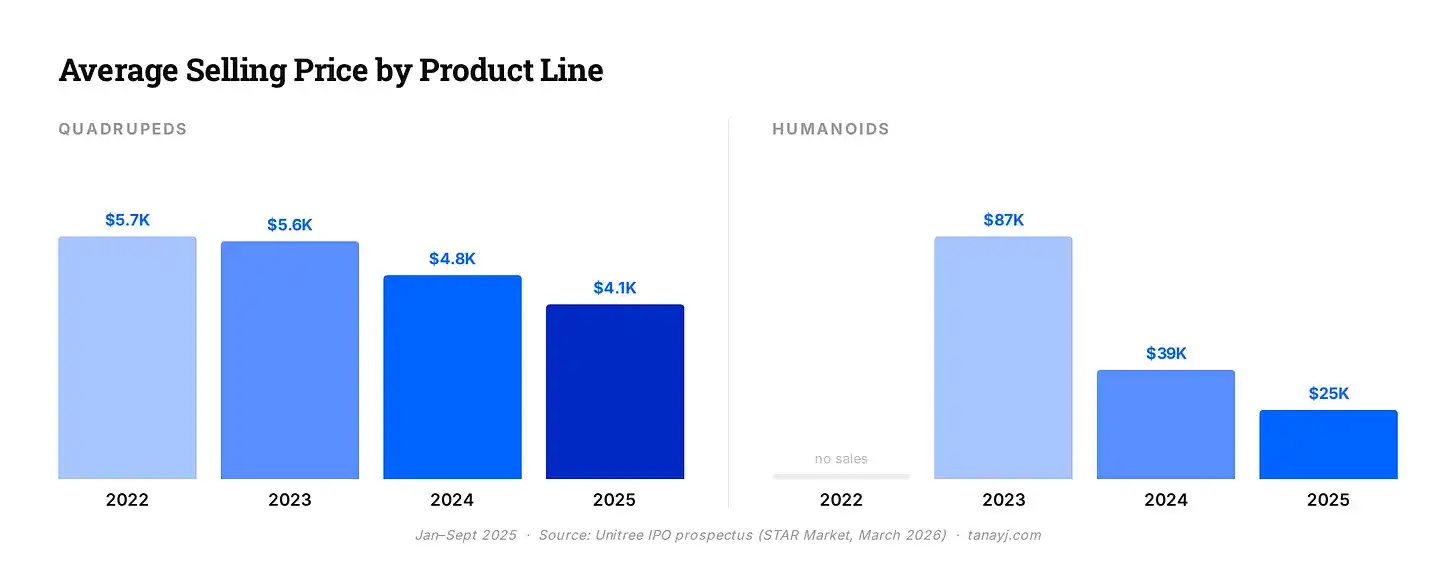
Interestingly, as shown in the chart below, the average selling prices for both quadruped and humanoid robots have also dropped significantly year by year. However, gross margins have actually expanded over the period, rising from the low 40s in 2022-2023 to nearly 60% in 2025, largely due to their vertical integration strategy.
5. Financial Status

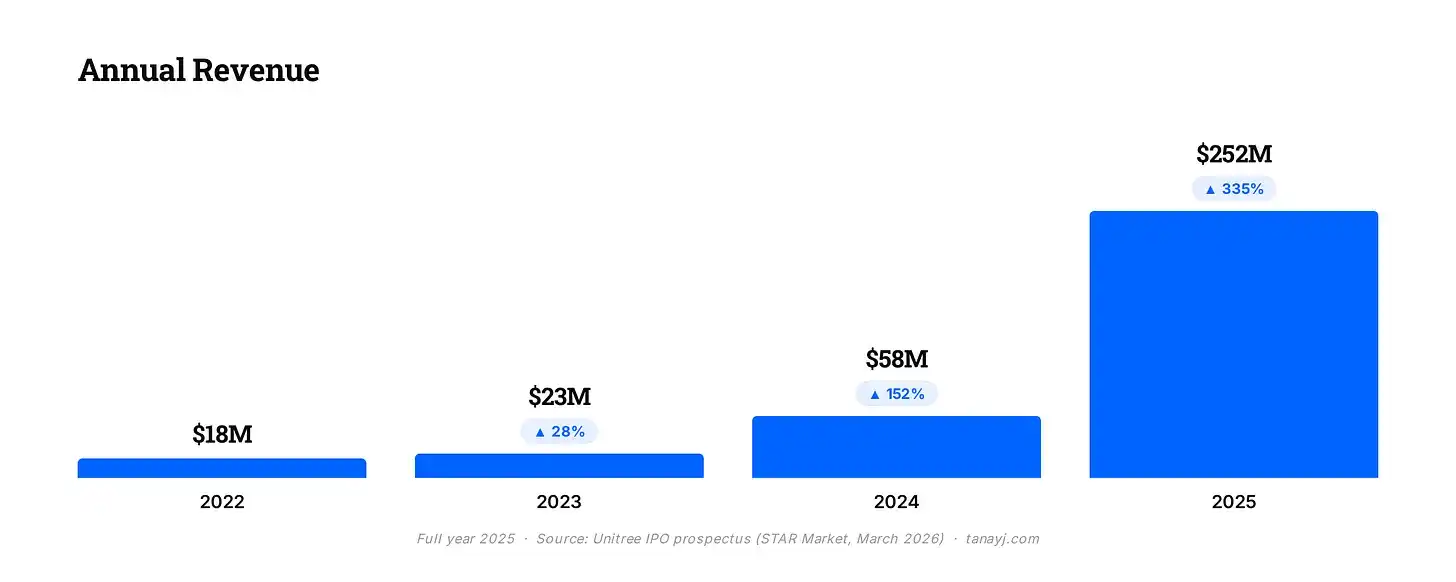
Revenue grew from $58 million in 2024 to an estimated ~$252 million in 2025, a 335% increase, primarily driven by strong performance in humanoid robots. For most of the company's history, international sales accounted for over 55% of revenue. In 2025, the domestic Chinese market surpassed exports for the first time, although the absolute value of export revenue still more than doubled year-on-year.
Gross margins are close to 60% and have been expanding over the years.
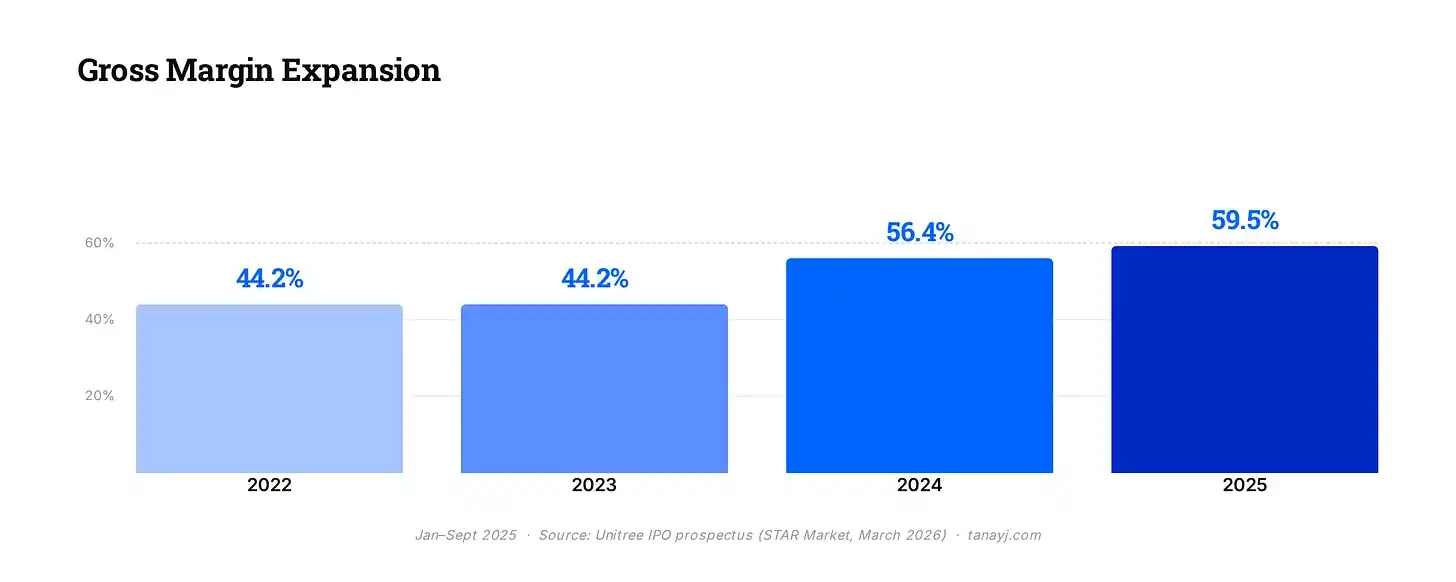
For comparison: Most hardware companies have gross margins of 30-40%. Software companies typically achieve 70-80%. For a company selling physical robots, Unitree's gross margins are relatively high, benefiting from their vertical integration strategy and currently relatively differentiated products.

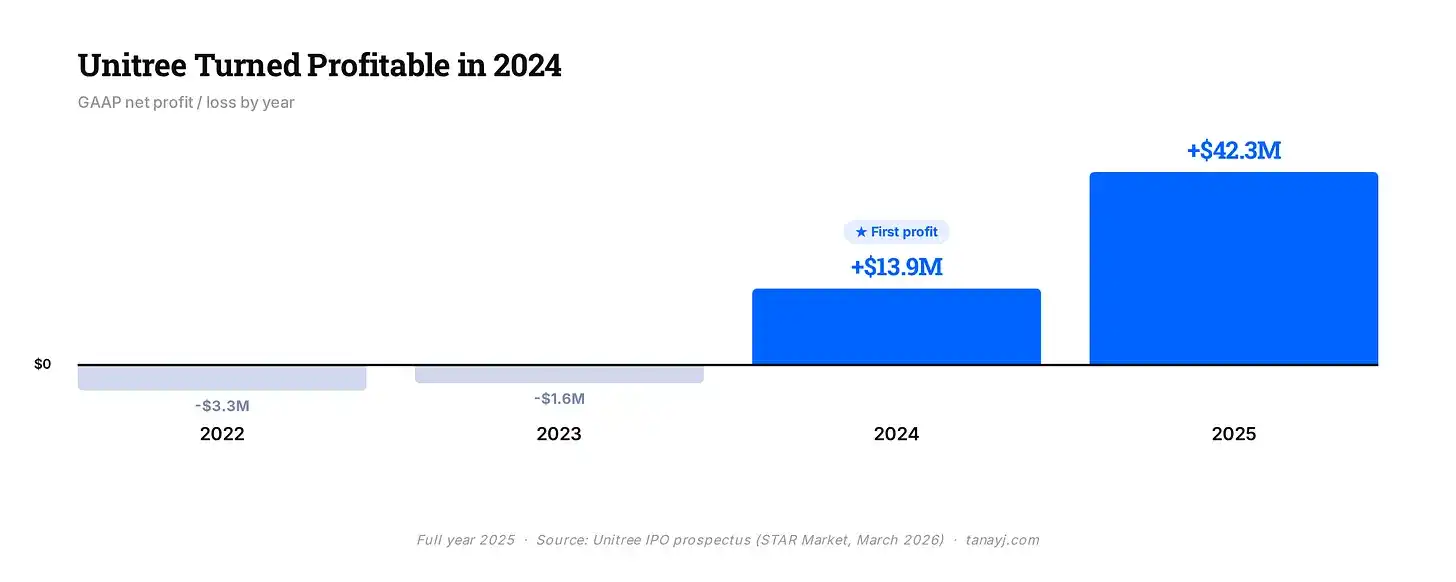
The company became profitable on a GAAP basis in 2024, with a profit margin of about 18%, and close to 35% on an adjusted basis.
Unitree's IPO target valuation is approximately $6-7 billion.

6. Ambitions at the Model Layer

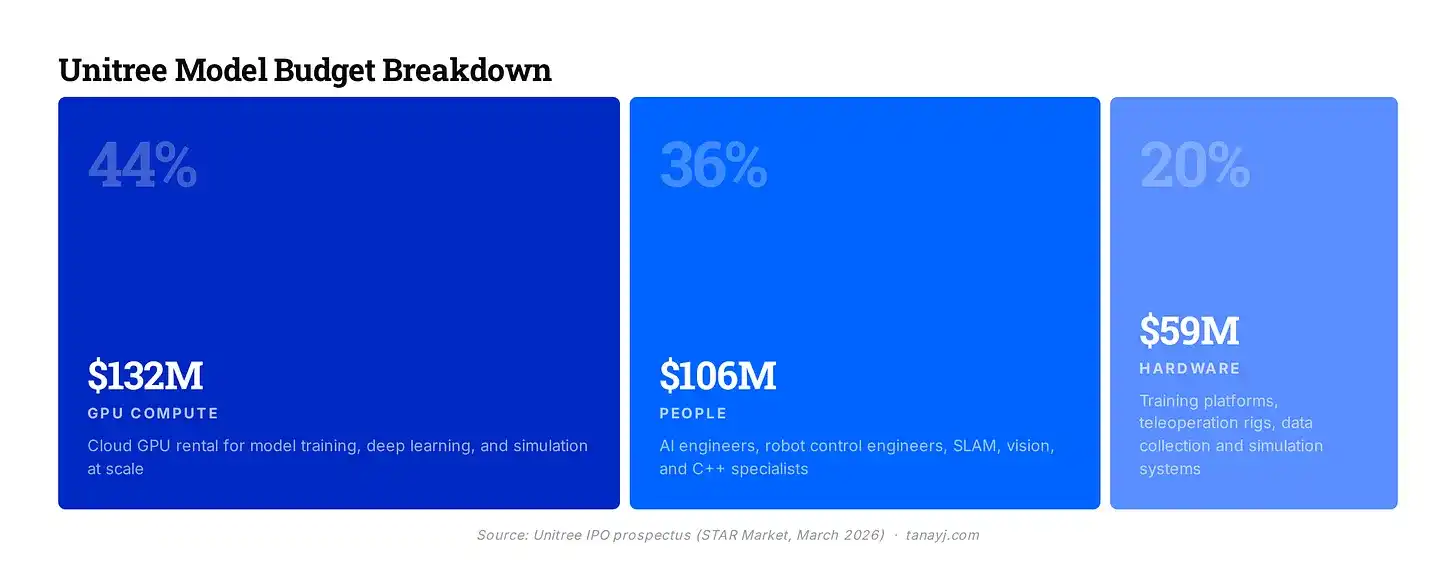
Unitree plans to allocate nearly half of the IPO proceeds to software. Out of the $620 million raised, about $300 million will be used for AI model training over the next three years, with approximately $100 million invested annually in what the company calls the "Embodied Large Model."

The prospectus describes two parallel model architectures. The first is VLA (Vision-Language-Action): a model that directly maps visual and language inputs to motor commands, allowing the robot to generalize to unfamiliar tasks without manually coded instructions. The second is WMA (World Model + Action), which is their preferred direction. The WMA model builds an internal simulation of physical reality. The robot predicts what will happen before acting, rather than learning purely through trial and error.

They have already released initial versions of both. They open-sourced UnifoLM-WMA-0 in September 2025; UnifoLM-VLA-0 was released in January 2026.

They also detailed the approximate allocation of spending on the model side, as shown below:
Unitree's current hardware leadership is real, but the company understands that lasting advantage in robotics may require control over the model layer: the systems that decide what the robot does and how it moves. Software ambition is also a hedge against commoditization. Unitree has built a moat in hardware manufacturing.

But if actuators and joint modules eventually become standard components like batteries in electric vehicles, then defensibility shifts to the model layer.

7. Summary

Unitree has a profitable hardware business, a genuine manufacturing moat, and ships more humanoid robots than anyone else, at prices others cannot match. But as the actual usage patterns of humanoid robots show, the story of widespread commercial application is still in its early stages. "Showcase" use cases dominate consumer demand, and industrial deployment is narrow.

Unitree gives us a glimpse of the current state of the robotics market; there is still much work to be done in models, hardware, and use cases. If you're building in robotics and embodied AI, feel free to reach out at tanay at wing.vc.


Domande pertinenti

QWhat were the key financial highlights and performance metrics revealed in Unitree Robotics' IPO prospectus?

AUnitree's prospectus shows rapid growth, with revenue expected to reach approximately $252 million in 2025, a 335% increase from 2024's $58 million. The company achieved GAAP profitability in 2024 with margins around 18% (nearly 35% on an adjusted basis). Gross margins are near 60%, which is high for a hardware company, largely due to its vertical integration strategy. The IPO aims to raise $620 million at a target valuation of $6-7 billion.

QWho are the primary customers for Unitree's humanoid robots, and what does this indicate about the current state of the market?

AAs of 2025, 74% of Unitree's humanoid robot shipments were for scientific research and education, 17% for commercial/consumer 'showcase' uses (like retail displays), and only 9% for industrial applications. Furthermore, within that 9%, 50-70% are used for enterprise reception and guided tours. This indicates that widespread commercial and industrial deployment is still in its early stages. The primary productive use for robots today remains in research and niche, non-autonomous applications, highlighting that hardware capabilities may be ahead of the AI models and software needed for complex tasks.

QWhat is Unitree's vertical integration strategy, and what benefits has it provided?

AUnitree's vertical integration strategy involves independently designing and manufacturing most of its robots' key components, including high-torque motors, precision reducers, encoders, joint modules, controllers, sensors, dexterous hands, LiDAR, and cameras. Only generic components like batteries and flash memory are outsourced. This strategy has reduced manufacturing costs (e.g., quadruped robot costs dropped 46% from ~$3300 in 2022 to ~$1800 in mid-2025) while allowing the company to expand its gross margins to nearly 60% despite falling average selling prices. It provides cost control, supply chain security, and a hardware moat.

QWhat are Unitree's ambitions in the AI model layer, and how does it plan to use funds from the IPO?

AUnitree plans to invest heavily in AI software development, allocating roughly $300 million (about half of the $620 million IPO proceeds) over the next three years for AI model training. The focus is on developing 'Embodied Large Models,' specifically two architectures: VLA (Vision-Language-Action) models for direct mapping from sensory input to action, and WMA (World Model + Action) models, which it favors. WMA models create an internal simulation of physical reality to predict outcomes before acting. The company has already released open-source versions of both. This investment is a strategic move to build a defensible advantage in the software layer as hardware components potentially become commoditized.

QHow has Unitree's product mix and market focus shifted in recent years?

AUnitree has undergone a significant shift from being primarily a quadruped robot company to a leader in humanoid robots. In 2023, humanoids accounted for only 1.9% of its revenue. By the first three quarters of 2025, humanoid robots constituted over half of its core revenue. This shift was driven by improved product-market fit and aggressive marketing (e.g., appearances on China's Spring Festival Gala and NVIDIA's GTC stage). The company shipped approximately 5,500 humanoid robots in 2025, making it the world's largest manufacturer by volume. Its ambitious 5-year goal is to produce 75,000 humanoids annually.

Letture associate

After $HYPE Hits a New High, Is It Worth Considering the Stock of "HYPE Version MicroStrategy" $PURR?

**HYPE Hits New Highs: Is $PURR, the "HYPE Version of MicroStrategy," Worth Considering?** The stock of Hyperliquid Strategies (NASDAQ: $PURR), a publicly-traded company that exclusively buys and holds the cryptocurrency HYPE, has gained over 100% year-to-date, mirroring HYPE's own 150% surge to new all-time highs. This has sparked discussions about PURR being a more "capital-efficient" play than MicroStrategy's bitcoin strategy, given its reported ~$1 billion unrealized gain on a ~$220 million investment. The article clarifies that PURR is essentially a pure-play wrapper for HYPE, with no other business. It resulted from a 2025 SPAC merger led by firms like Paradigm and Atlas Merchant Capital, bringing traditional finance veterans to its board. Its value is entirely derived from the price of HYPE. While PURR offers a crucial compliance bridge for US-based institutional and retirement accounts unable to access HYPE directly, the analysis questions the "capital efficiency" narrative. The outsized gains are attributed to HYPE's exceptional performance, not superior corporate strategy. For investors who can buy HYPE directly, holding PURR introduces unnecessary risks: potential shareholder dilution from future stock offerings, incomplete passthrough of staking rewards, market hour mismatches, and counterparty risk via its single custodian. A key metric is its mNAV (modified net asset value). Current calculations show PURR trades at a discount to its HYPE holdings, but this could flip to a premium depending on the execution of registered share issuances. The article concludes that PURR is primarily a "conduit product." The investment thesis hinges entirely on one's bullishness on HYPE itself, not on the PURR wrapper, which adds friction and risk for those with direct crypto access.

marsbit26 min fa

After $HYPE Hits a New High, Is It Worth Considering the Stock of "HYPE Version MicroStrategy" $PURR?

marsbit26 min fa

The Real Progress and Investment Opportunities of Decentralized AI Computing Power Networks in 2026

In 2026, the AI compute market is marked by centralized GPU consolidation and a significant GPU shortage for smaller players. In this context, Decentralized Physical Infrastructure Networks (DePIN), valued at $9.4B+, have emerged as a viable, revenue-generating alternative. Leading protocols like Aethir ($150M ARR), io.net (130k+ GPUs), Akash, Bittensor, and Render are carving out distinct niches, moving beyond hype to deliver verifiable income primarily from non-crypto-native clients. The key advantage of decentralized GPU networks lies in serving latency-tolerant, cost-sensitive workloads like AI inference, fine-tuning, data preprocessing, and agent operations, offering substantial cost savings (45-80%) compared to major cloud providers. However, reliability variance, lack of robust SLAs, and fragmented tech stacks remain significant adoption hurdles. The sector is maturing with critical 2026 shifts: 1) Evolution of tokenomics towards demand-driven, revenue-linked models (e.g., Render's BME, io.net's IDE), and 2) Clearer enterprise adoption pathways, with traditional firms integrating decentralized compute. For new entrants, opportunities are now concentrated in specialized tooling layers (orchestration, verification, SLA management), vertical applications (e.g., bio-med, content generation), and innovative token designs tied to real usage, rather than generic GPU aggregation. The convergence with the emerging AI Agent economy presents a significant future growth vector.

marsbit27 min fa

The Real Progress and Investment Opportunities of Decentralized AI Computing Power Networks in 2026

marsbit27 min fa

We Captured Thousands of Job Postings and Discovered ByteDance is Reviving Smartphone R&D

This article analyzes ByteDance's recent hiring activities, revealing a potential restart of smartphone hardware development. By scraping and analyzing thousands of ByteDance job postings, the authors identify three key categories: roles for the "Doubao Phone Assistant" (an AI agent), for a "Mobile OS" (system-level development), and for hardware/engineering positions in Shenzhen (a manufacturing hub). The piece traces the context to the 2025 launch of the "Doubao Phone," a concept device that integrated an AI agent directly into a smartphone, allowing it to see the screen, operate apps, and perform tasks like shopping or booking tickets. While innovative as an early AI Agent prototype, it faced operational restrictions from major platforms like WeChat and Alipay. The new hiring signals a deeper commitment. "Doubao Phone Assistant" roles focus on core Agent capabilities (task execution, memory, cross-app operation). "Mobile OS" positions involve deep system work (kernel, chip adaptation, power/thermal management) necessary for a responsive, always-on AI. Shenzhen-based hardware roles (structure design, testing, production) suggest preparation for physical device manufacturing. The article concludes that in the AI era, where phones may become an Agent's "body," controlling the operating system and hardware is critical. For a company like ByteDance, being merely an app within others' ecosystems is no longer sustainable if it aims to own the next-generation user interface. Therefore, while a consumer phone brand isn't confirmed, ByteDance is decisively moving beyond app development into the complex domain of system-level and hardware-integrated AI.

marsbit57 min fa

We Captured Thousands of Job Postings and Discovered ByteDance is Reviving Smartphone R&D

marsbit57 min fa

AI Impact on SaaS Software Stocks: Deconstructing the Bottom-Fishing Logic of Salesforce, ServiceNow, and Snowflake

"AI Nightmare for SaaS Stocks: Unpacking the Bottom-Fishing Logic for Salesforce, ServiceNow, and Snowflake" A deep dive analysis argues that the recent collapse in SaaS software stocks, dubbed the "SaaS Doom," presents a contrarian buying opportunity. The market panic, triggered by fears that AI will disrupt traditional per-user subscription models through "seat compression" and AI agents bypassing software UIs, has led to extreme selling in the software sector. The analysis evaluates three major players under a unified framework: 1. **Salesforce (CRM):** Positioned as a "margin of safety" play. Trading at historically low valuations (13-14x forward P/E), with strong cash flow and a massive buyback, it offers value. Its key challenge is transitioning from a "seat economy" to an AI-driven "task economy" with its Agentforce platform. 2. **ServiceNow (NOW):** The "clearest AI narrative" play. Its "AI Control Tower" strategy aims to become the governance and orchestration layer for enterprise AI agents, benefiting from AI proliferation. Backed by Nvidia's CEO, it trades at a relatively low valuation post-correction. 3. **Snowflake (SNOW):** The "high-risk, high-reward" bet. Its consumption-based model aligns with rising AI workloads, and its RPO growth is strong. However, it faces intense competition (e.g., Databricks), is not yet GAAP profitable, and carries the highest valuation. The conclusion counters the simplified "AI kills software" narrative. AI is eliminating software that sells only functional interfaces but rewarding platforms that provide essential infrastructure, data, and governance. The current sell-off may have created a buying opportunity for resilient software leaders positioned as future AI infrastructure platforms.

marsbit1 h fa

AI Impact on SaaS Software Stocks: Deconstructing the Bottom-Fishing Logic of Salesforce, ServiceNow, and Snowflake

marsbit1 h fa

Trading

Spot
Futures

Articoli Popolari

Cosa è $S$

Comprendere SPERO: Una Panoramica Completa Introduzione a SPERO Mentre il panorama dell'innovazione continua a evolversi, l'emergere delle tecnologie web3 e dei progetti di criptovaluta gioca un ruolo fondamentale nel plasmare il futuro digitale. Un progetto che ha attirato l'attenzione in questo campo dinamico è SPERO, denotato come SPERO,$$s$. Questo articolo mira a raccogliere e presentare informazioni dettagliate su SPERO, per aiutare gli appassionati e gli investitori a comprendere le sue basi, obiettivi e innovazioni nei domini web3 e crypto. Che cos'è SPERO,$$s$? SPERO,$$s$ è un progetto unico all'interno dello spazio crypto che cerca di sfruttare i principi della decentralizzazione e della tecnologia blockchain per creare un ecosistema che promuove l'impegno, l'utilità e l'inclusione finanziaria. Il progetto è progettato per facilitare interazioni peer-to-peer in modi nuovi, fornendo agli utenti soluzioni e servizi finanziari innovativi. Al suo interno, SPERO,$$s$ mira a responsabilizzare gli individui fornendo strumenti e piattaforme che migliorano l'esperienza dell'utente nello spazio delle criptovalute. Questo include la possibilità di metodi di transazione più flessibili, la promozione di iniziative guidate dalla comunità e la creazione di percorsi per opportunità finanziarie attraverso applicazioni decentralizzate (dApps). La visione sottostante di SPERO,$$s$ ruota attorno all'inclusività, cercando di colmare le lacune all'interno della finanza tradizionale mentre sfrutta i vantaggi della tecnologia blockchain. Chi è il Creatore di SPERO,$$s$? L'identità del creatore di SPERO,$$s$ rimane piuttosto oscura, poiché ci sono risorse pubblicamente disponibili limitate che forniscono informazioni dettagliate sul suo fondatore o fondatori. Questa mancanza di trasparenza può derivare dall'impegno del progetto per la decentralizzazione—un ethos che molti progetti web3 condividono, dando priorità ai contributi collettivi rispetto al riconoscimento individuale. Centrando le discussioni attorno alla comunità e ai suoi obiettivi collettivi, SPERO,$$s$ incarna l'essenza dell'empowerment senza mettere in evidenza individui specifici. Pertanto, comprendere l'etica e la missione di SPERO rimane più importante che identificare un creatore singolo. Chi sono gli Investitori di SPERO,$$s$? SPERO,$$s$ è supportato da una varietà di investitori che vanno dai capitalisti di rischio agli investitori angelici dedicati a promuovere l'innovazione nel settore crypto. Il focus di questi investitori generalmente si allinea con la missione di SPERO—dando priorità a progetti che promettono avanzamenti tecnologici sociali, inclusività finanziaria e governance decentralizzata. Queste fondazioni di investitori sono tipicamente interessate a progetti che non solo offrono prodotti innovativi, ma contribuiscono anche positivamente alla comunità blockchain e ai suoi ecosistemi. Il supporto di questi investitori rafforza SPERO,$$s$ come un concorrente degno di nota nel dominio in rapida evoluzione dei progetti crypto. Come Funziona SPERO,$$s$? SPERO,$$s$ impiega un framework multifunzionale che lo distingue dai progetti di criptovaluta convenzionali. Ecco alcune delle caratteristiche chiave che sottolineano la sua unicità e innovazione: Governance Decentralizzata: SPERO,$$s$ integra modelli di governance decentralizzati, responsabilizzando gli utenti a partecipare attivamente ai processi decisionali riguardanti il futuro del progetto. Questo approccio favorisce un senso di proprietà e responsabilità tra i membri della comunità. Utilità del Token: SPERO,$$s$ utilizza il proprio token di criptovaluta, progettato per servire varie funzioni all'interno dell'ecosistema. Questi token abilitano transazioni, premi e la facilitazione dei servizi offerti sulla piattaforma, migliorando l'impegno e l'utilità complessivi. Architettura Stratificata: L'architettura tecnica di SPERO,$$s$ supporta la modularità e la scalabilità, consentendo un'integrazione fluida di funzionalità e applicazioni aggiuntive man mano che il progetto evolve. Questa adattabilità è fondamentale per mantenere la rilevanza nel panorama crypto in continua evoluzione. Coinvolgimento della Comunità: Il progetto enfatizza iniziative guidate dalla comunità, impiegando meccanismi che incentivano la collaborazione e il feedback. Nutrendo una comunità forte, SPERO,$$s$ può affrontare meglio le esigenze degli utenti e adattarsi alle tendenze di mercato. Focus sull'Inclusione: Offrendo basse commissioni di transazione e interfacce user-friendly, SPERO,$$s$ mira ad attrarre una base utenti diversificata, inclusi individui che potrebbero non aver precedentemente interagito nello spazio crypto. Questo impegno per l'inclusione si allinea con la sua missione generale di empowerment attraverso l'accessibilità. Cronologia di SPERO,$$s$ Comprendere la storia di un progetto fornisce preziose intuizioni sulla sua traiettoria di sviluppo e sui traguardi. Di seguito è riportata una cronologia suggerita che mappa eventi significativi nell'evoluzione di SPERO,$$s$: Fase di Concettualizzazione e Ideazione: Le idee iniziali che formano la base di SPERO,$$s$ sono state concepite, allineandosi strettamente con i principi di decentralizzazione e focus sulla comunità all'interno dell'industria blockchain. Lancio del Whitepaper del Progetto: Dopo la fase concettuale, è stato rilasciato un whitepaper completo che dettaglia la visione, gli obiettivi e l'infrastruttura tecnologica di SPERO,$$s$ per suscitare interesse e feedback dalla comunità. Costruzione della Comunità e Prime Interazioni: Sono stati effettuati sforzi attivi di outreach per costruire una comunità di early adopters e potenziali investitori, facilitando discussioni attorno agli obiettivi del progetto e ottenendo supporto. Evento di Generazione del Token: SPERO,$$s$ ha condotto un evento di generazione del token (TGE) per distribuire i propri token nativi ai primi sostenitori e stabilire una liquidità iniziale all'interno dell'ecosistema. Lancio della Prima dApp: La prima applicazione decentralizzata (dApp) associata a SPERO,$$s$ è stata attivata, consentendo agli utenti di interagire con le funzionalità principali della piattaforma. Sviluppo Continuo e Partnership: Aggiornamenti e miglioramenti continui alle offerte del progetto, inclusi partnership strategiche con altri attori nello spazio blockchain, hanno plasmato SPERO,$$s$ in un concorrente competitivo e in evoluzione nel mercato crypto. Conclusione SPERO,$$s$ rappresenta una testimonianza del potenziale del web3 e delle criptovalute di rivoluzionare i sistemi finanziari e responsabilizzare gli individui. Con un impegno per la governance decentralizzata, il coinvolgimento della comunità e funzionalità progettate in modo innovativo, apre la strada verso un panorama finanziario più inclusivo. Come per qualsiasi investimento nello spazio crypto in rapida evoluzione, si incoraggiano potenziali investitori e utenti a ricercare approfonditamente e a impegnarsi in modo riflessivo con gli sviluppi in corso all'interno di SPERO,$$s$. Il progetto mostra lo spirito innovativo dell'industria crypto, invitando a ulteriori esplorazioni delle sue innumerevoli possibilità. Mentre il percorso di SPERO,$$s$ è ancora in fase di sviluppo, i suoi principi fondamentali potrebbero effettivamente influenzare il futuro di come interagiamo con la tecnologia, la finanza e tra di noi in ecosistemi digitali interconnessi.

75 Totale visualizzazioniPubblicato il 2024.12.17Aggiornato il 2024.12.17

Cosa è $S$

Cosa è AGENT S

Agent S: Il Futuro dell'Interazione Autonoma in Web3 Introduzione Nel panorama in continua evoluzione di Web3 e criptovalute, le innovazioni stanno costantemente ridefinendo il modo in cui gli individui interagiscono con le piattaforme digitali. Uno di questi progetti pionieristici, Agent S, promette di rivoluzionare l'interazione uomo-computer attraverso il suo framework agentico aperto. Aprendo la strada a interazioni autonome, Agent S mira a semplificare compiti complessi, offrendo applicazioni trasformative nell'intelligenza artificiale (AI). Questa esplorazione dettagliata approfondirà le complessità del progetto, le sue caratteristiche uniche e le implicazioni per il dominio delle criptovalute. Cos'è Agent S? Agent S si presenta come un innovativo framework agentico aperto, progettato specificamente per affrontare tre sfide fondamentali nell'automazione dei compiti informatici: Acquisizione di Conoscenze Specifiche del Dominio: Il framework apprende in modo intelligente da varie fonti di conoscenza esterne ed esperienze interne. Questo approccio duale gli consente di costruire un ricco repository di conoscenze specifiche del dominio, migliorando le sue prestazioni nell'esecuzione dei compiti. Pianificazione su Lungo Orizzonte di Compiti: Agent S impiega una pianificazione gerarchica potenziata dall'esperienza, un approccio strategico che facilita la suddivisione e l'esecuzione efficiente di compiti complessi. Questa caratteristica migliora significativamente la sua capacità di gestire più sottocompiti in modo efficiente ed efficace. Gestione di Interfacce Dinamiche e Non Uniformi: Il progetto introduce l'Interfaccia Agente-Computer (ACI), una soluzione innovativa che migliora l'interazione tra agenti e utenti. Utilizzando Modelli Linguistici Multimodali di Grandi Dimensioni (MLLM), Agent S può navigare e manipolare senza sforzo diverse interfacce grafiche utente. Attraverso queste caratteristiche pionieristiche, Agent S fornisce un framework robusto che affronta le complessità coinvolte nell'automazione dell'interazione umana con le macchine, preparando il terreno per innumerevoli applicazioni nell'AI e oltre. Chi è il Creatore di Agent S? Sebbene il concetto di Agent S sia fondamentalmente innovativo, informazioni specifiche sul suo creatore rimangono elusive. Il creatore è attualmente sconosciuto, il che evidenzia sia la fase embrionale del progetto sia la scelta strategica di mantenere i membri fondatori sotto anonimato. Indipendentemente dall'anonimato, l'attenzione rimane sulle capacità e sul potenziale del framework. Chi sono gli Investitori di Agent S? Poiché Agent S è relativamente nuovo nell'ecosistema crittografico, informazioni dettagliate riguardanti i suoi investitori e sostenitori finanziari non sono documentate esplicitamente. La mancanza di approfondimenti pubblicamente disponibili sulle fondazioni di investimento o sulle organizzazioni che supportano il progetto solleva interrogativi sulla sua struttura di finanziamento e sulla roadmap di sviluppo. Comprendere il supporto è cruciale per valutare la sostenibilità del progetto e il suo potenziale impatto sul mercato. Come Funziona Agent S? Al centro di Agent S si trova una tecnologia all'avanguardia che gli consente di funzionare efficacemente in contesti diversi. Il suo modello operativo è costruito attorno a diverse caratteristiche chiave: Interazione Uomo-Computer Simile a Quella Umana: Il framework offre una pianificazione AI avanzata, cercando di rendere le interazioni con i computer più intuitive. Mimando il comportamento umano nell'esecuzione dei compiti, promette di elevare le esperienze degli utenti. Memoria Narrativa: Utilizzata per sfruttare esperienze di alto livello, Agent S utilizza la memoria narrativa per tenere traccia delle storie dei compiti, migliorando così i suoi processi decisionali. Memoria Episodica: Questa caratteristica fornisce agli utenti una guida passo-passo, consentendo al framework di offrire supporto contestuale mentre i compiti si sviluppano. Supporto per OpenACI: Con la capacità di funzionare localmente, Agent S consente agli utenti di mantenere il controllo sulle proprie interazioni e flussi di lavoro, allineandosi con l'etica decentralizzata di Web3. Facile Integrazione con API Esterne: La sua versatilità e compatibilità con varie piattaforme AI garantiscono che Agent S possa adattarsi senza problemi agli ecosistemi tecnologici esistenti, rendendolo una scelta attraente per sviluppatori e organizzazioni. Queste funzionalità contribuiscono collettivamente alla posizione unica di Agent S all'interno dello spazio crittografico, poiché automatizza compiti complessi e multi-fase con un intervento umano minimo. Man mano che il progetto evolve, le sue potenziali applicazioni in Web3 potrebbero ridefinire il modo in cui si svolgono le interazioni digitali. Cronologia di Agent S Lo sviluppo e le tappe di Agent S possono essere riassunti in una cronologia che evidenzia i suoi eventi significativi: 27 Settembre 2024: Il concetto di Agent S è stato lanciato in un documento di ricerca completo intitolato “Un Framework Agentico Aperto che Usa i Computer Come un Umano”, mostrando le basi per il progetto. 10 Ottobre 2024: Il documento di ricerca è stato reso pubblicamente disponibile su arXiv, offrendo un'esplorazione approfondita del framework e della sua valutazione delle prestazioni basata sul benchmark OSWorld. 12 Ottobre 2024: È stata rilasciata una presentazione video, fornendo un'idea visiva delle capacità e delle caratteristiche di Agent S, coinvolgendo ulteriormente potenziali utenti e investitori. Questi indicatori nella cronologia non solo illustrano i progressi di Agent S, ma indicano anche il suo impegno per la trasparenza e il coinvolgimento della comunità. Punti Chiave su Agent S Man mano che il framework Agent S continua a evolversi, diversi attributi chiave si distinguono, sottolineando la sua natura innovativa e il potenziale: Framework Innovativo: Progettato per fornire un uso intuitivo dei computer simile all'interazione umana, Agent S porta un approccio nuovo all'automazione dei compiti. Interazione Autonoma: La capacità di interagire autonomamente con i computer attraverso GUI segna un passo avanti verso soluzioni informatiche più intelligenti ed efficienti. Automazione di Compiti Complessi: Con la sua metodologia robusta, può automatizzare compiti complessi e multi-fase, rendendo i processi più veloci e meno soggetti a errori. Miglioramento Continuo: I meccanismi di apprendimento consentono ad Agent S di migliorare dalle esperienze passate, migliorando continuamente le sue prestazioni e la sua efficacia. Versatilità: La sua adattabilità attraverso diversi ambienti operativi come OSWorld e WindowsAgentArena garantisce che possa servire un'ampia gamma di applicazioni. Man mano che Agent S si posiziona nel panorama di Web3 e delle criptovalute, il suo potenziale per migliorare le capacità di interazione e automatizzare i processi segna un significativo avanzamento nelle tecnologie AI. Attraverso il suo framework innovativo, Agent S esemplifica il futuro delle interazioni digitali, promettendo un'esperienza più fluida ed efficiente per gli utenti in vari settori. Conclusione Agent S rappresenta un audace passo avanti nell'unione tra AI e Web3, con la capacità di ridefinire il modo in cui interagiamo con la tecnologia. Sebbene sia ancora nelle sue fasi iniziali, le possibilità per la sua applicazione sono vaste e coinvolgenti. Attraverso il suo framework completo che affronta sfide critiche, Agent S mira a portare le interazioni autonome al centro dell'esperienza digitale. Man mano che ci addentriamo nei regni delle criptovalute e della decentralizzazione, progetti come Agent S giocheranno senza dubbio un ruolo cruciale nel plasmare il futuro della tecnologia e della collaborazione uomo-computer.

521 Totale visualizzazioniPubblicato il 2025.01.14Aggiornato il 2025.01.14

Cosa è AGENT S

Come comprare S

Benvenuto in HTX.com! Abbiamo reso l'acquisto di Sonic (S) semplice e conveniente. Segui la nostra guida passo passo per intraprendere il tuo viaggio nel mondo delle criptovalute.Step 1: Crea il tuo Account HTXUsa la tua email o numero di telefono per registrarti il tuo account gratuito su HTX. Vivi un'esperienza facile e sblocca tutte le funzionalità,Crea il mio accountStep 2: Vai in Acquista crypto e seleziona il tuo metodo di pagamentoCarta di credito/debito: utilizza la tua Visa o Mastercard per acquistare immediatamente SonicS.Bilancio: Usa i fondi dal bilancio del tuo account HTX per fare trading senza problemi.Terze parti: abbiamo aggiunto metodi di pagamento molto utilizzati come Google Pay e Apple Pay per maggiore comodità.P2P: Fai trading direttamente con altri utenti HTX.Over-the-Counter (OTC): Offriamo servizi su misura e tassi di cambio competitivi per i trader.Step 3: Conserva Sonic (S)Dopo aver acquistato Sonic (S), conserva nel tuo account HTX. In alternativa, puoi inviare tramite trasferimento blockchain o scambiare per altre criptovalute.Step 4: Scambia Sonic (S)Scambia facilmente Sonic (S) nel mercato spot di HTX. Accedi al tuo account, seleziona la tua coppia di trading, esegui le tue operazioni e monitora in tempo reale. Offriamo un'esperienza user-friendly sia per chi ha appena iniziato che per i trader più esperti.

935 Totale visualizzazioniPubblicato il 2025.01.15Aggiornato il 2025.03.21

Come comprare S

Discussioni

Benvenuto nella Community HTX. Qui puoi rimanere informato sugli ultimi sviluppi della piattaforma e accedere ad approfondimenti esperti sul mercato. Le opinioni degli utenti sul prezzo di S S sono presentate come di seguito.

活动图片