The Real Progress and Investment Opportunities of Decentralized AI Computing Power Networks in 2026

marsbitPubblicato 2026-05-25Pubblicato ultima volta 2026-05-25

Introduzione

In 2026, the AI compute market is marked by centralized GPU consolidation and a significant GPU shortage for smaller players. In this context, Decentralized Physical Infrastructure Networks (DePIN), valued at $9.4B+, have emerged as a viable, revenue-generating alternative. Leading protocols like Aethir ($150M ARR), io.net (130k+ GPUs), Akash, Bittensor, and Render are carving out distinct niches, moving beyond hype to deliver verifiable income primarily from non-crypto-native clients. The key advantage of decentralized GPU networks lies in serving latency-tolerant, cost-sensitive workloads like AI inference, fine-tuning, data preprocessing, and agent operations, offering substantial cost savings (45-80%) compared to major cloud providers. However, reliability variance, lack of robust SLAs, and fragmented tech stacks remain significant adoption hurdles. The sector is maturing with critical 2026 shifts: 1) Evolution of tokenomics towards demand-driven, revenue-linked models (e.g., Render's BME, io.net's IDE), and 2) Clearer enterprise adoption pathways, with traditional firms integrating decentralized compute. For new entrants, opportunities are now concentrated in specialized tooling layers (orchestration, verification, SLA management), vertical applications (e.g., bio-med, content generation), and innovative token designs tied to real usage, rather than generic GPU aggregation. The convergence with the emerging AI Agent economy presents a significant future growth vector.

In 2026, the global AI computing power market has entered an extremely dynamic phase. On one hand, leading technology companies are consolidating GPU resources at an unprecedented pace. For example:

  • xAI's Colossus supercomputing cluster has aggregated 550,000 NVIDIA GPUs and is progressing toward the publicly stated roadmap goal of 1 million GPUs;
  • Project Stargate, initiated by OpenAI, Oracle, SoftBank, and others, has deployed over 450,000 NVIDIA GPUs in Texas, with a target total power of 1.2GW.
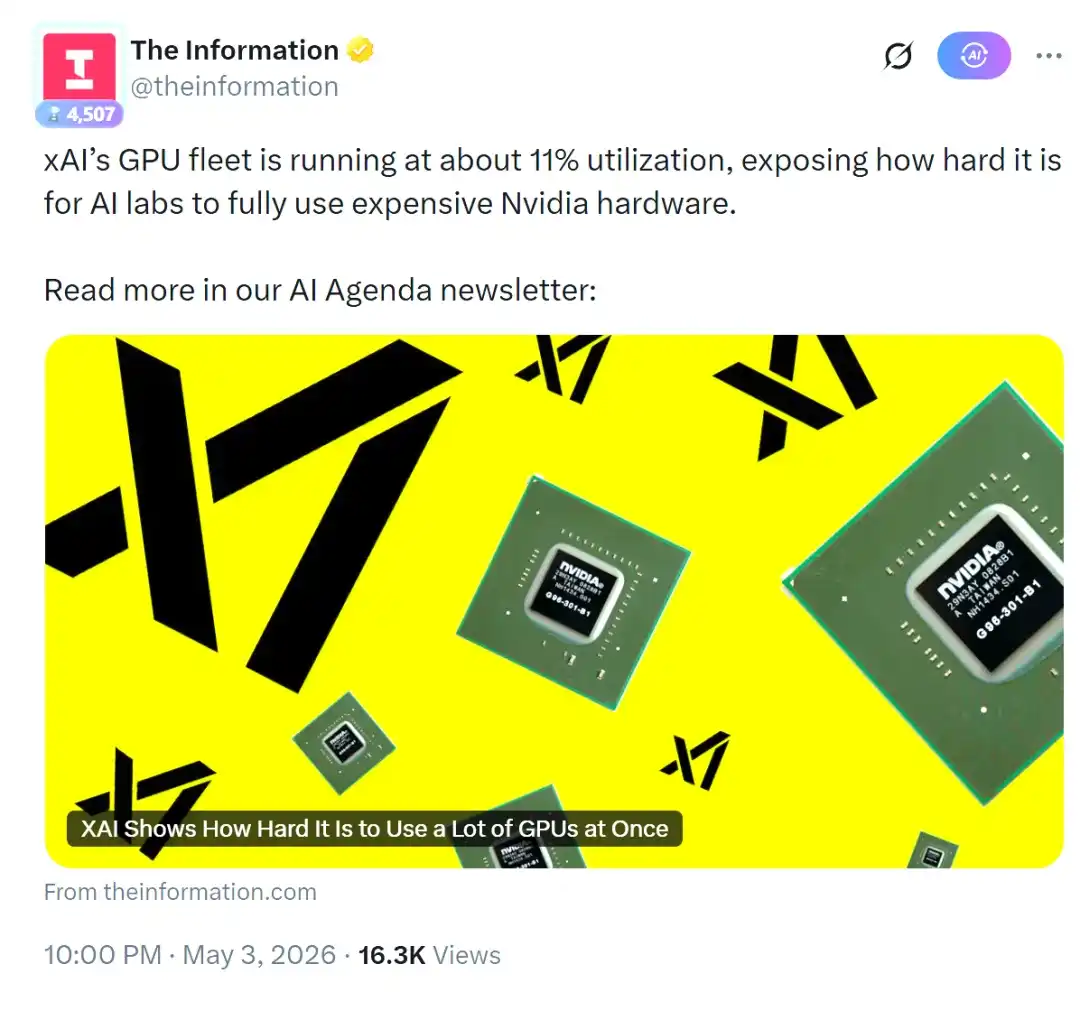
On the other hand, a large number of small and medium-sized AI startups and independent research teams are suffering from computing power shortages. AWS's H100 clusters experienced waiting periods of 8 to 12 months from 2023 to 2024, with cloud computing bills easily exceeding millions of dollars.

It is precisely in this context of severe supply shortage that the Decentralized Physical Infrastructure Networks (DePIN) track has rapidly emerged.

  • As of the end of March 2026, the total market capitalization of the DePIN track is approximately $9.423 billion, with nearly 250 active projects tracked by CoinGecko.
  • The sector reached a market cap high of about $19.2 billion in September 2025, achieving a year-on-year growth of approximately 270% compared to $5.2 billion in the same period of 2024.
  • More crucially, according to on-chain data aggregated by DeFiLlama and Dune Analytics, the annualized protocol revenue of decentralized GPU computing protocols exceeded $200 million in early 2026.

We have to admit that this sector has crossed a massive threshold that other crypto narratives have never achieved—it is generating real revenue from non-crypto-native clients.

I. Industry Panorama: From Fervent Narrative to Revenue Realization

In 2026, the DePIN computing power industry began to have verifiable revenue data, rather than just a stack of market cap tables and token emission schedules. Over the past two years, the sector has formed a clear hierarchical structure. The operational status of major protocols is shown in the following table:

Table 1: Key Data Comparison of Mainstream Decentralized Computing Networks in 2026
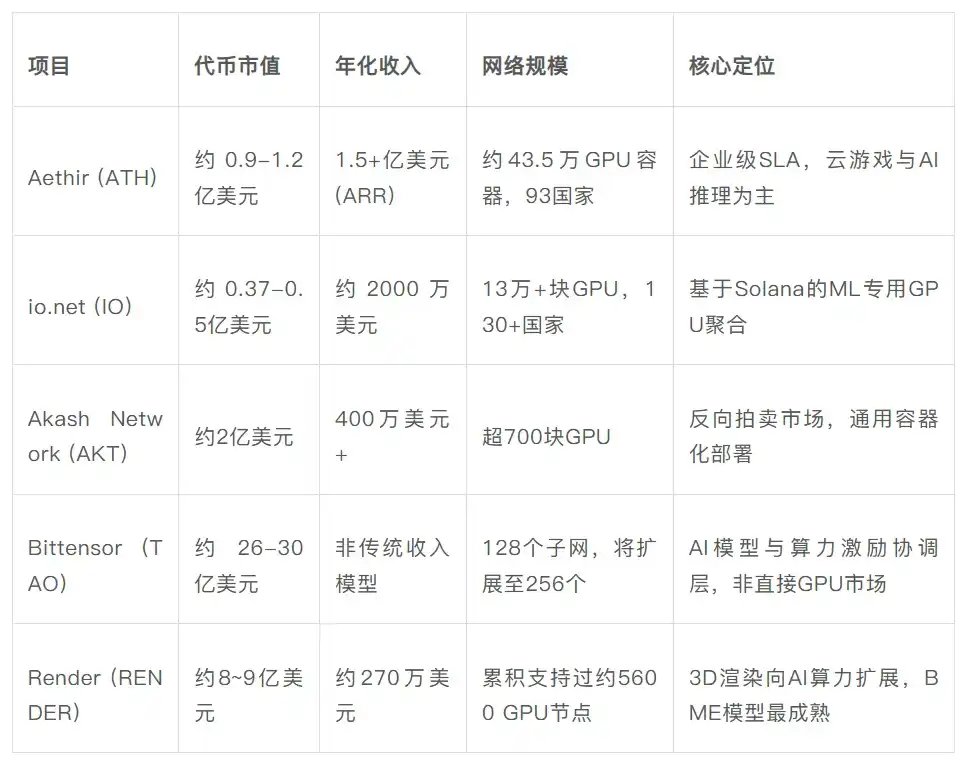
Data source: Official disclosures of each project, Messari quarterly reports, CoinMarketCap, CoinGecko / Coinbase. Data as of May 2026. Note: Bittensor does not have "protocol revenue" in the traditional sense—it is an AI model incentive coordination layer, rewarding participants via inflationary token issuance, with each subnet generating revenue independently.

As can be seen from the table above, these five protocols occupy different ecological positions.

  • Aethir leads in enterprise-level revenue, with an annualized recurring revenue of approximately $150 million. It is currently the protocol with the largest revenue scale in the decentralized computing track, serving clients including game studios, AI inference providers, and model training teams.
  • io.net focuses on orchestrating distributed ML computing clusters, covering over 130,000 GPU devices across more than 130 countries.
  • Akash has formed genuine price competition through its reverse auction pricing mechanism. Its Q1 2026 computing power expenditure broke a historical high of over $5 million, and the AKT token has risen over 72% year-to-date.
  • Bittensor is entirely different; it doesn't rent GPU hardware but incentivizes AI intelligence output itself, forming a decentralized machine intelligence market through 128 subnets.
  • Render started with 3D rendering, having cumulatively rendered over 67 million frames, and is now expanding into general AI computing.

II. Capability Boundaries: What Decentralized GPU Networks Can and Cannot Do

Decentralized GPU networks have long been caught between two extreme narratives: one side claims costs are only one-tenth of AWS's and will soon disrupt cloud computing; the other side believes distributed GPUs cannot support real AI workloads at all. Both judgments are biased.

The key to understanding this sector lies in confronting the structural characteristics of consumer-grade GPUs.

On one hand, the computing power supply of decentralized networks largely comes from consumer-grade GPUs, which have limited VRAM capacity, and inter-node bandwidth relies on home broadband. This inherently makes them unsuitable for synchronous training of frontier large models—such tasks require thousands of high-end GPUs to be interconnected with extremely low latency, a scenario designed for hyperscale clouds.

On the other hand, for workloads with higher latency tolerance and cost sensitivity, the cost-effectiveness advantage of decentralized networks is quite evident: parallel molecular screening in AI drug discovery, batch rendering for text-to-image and text-to-video, and large-scale data preprocessing pipelines are typical matching scenarios.

Furthermore, the continuous expansion of open-source models and the technological evolution of lightweight inference are systematically expanding the serviceable market for decentralized networks. An increasing number of models can run efficiently on a single or a few consumer-grade GPUs. The barriers to inference and fine-tuning are decreasing, which happens to be the most competitive range for decentralized networks.

Chart 2: Matching Relationship between AI Workloads and Computing Power Infrastructure
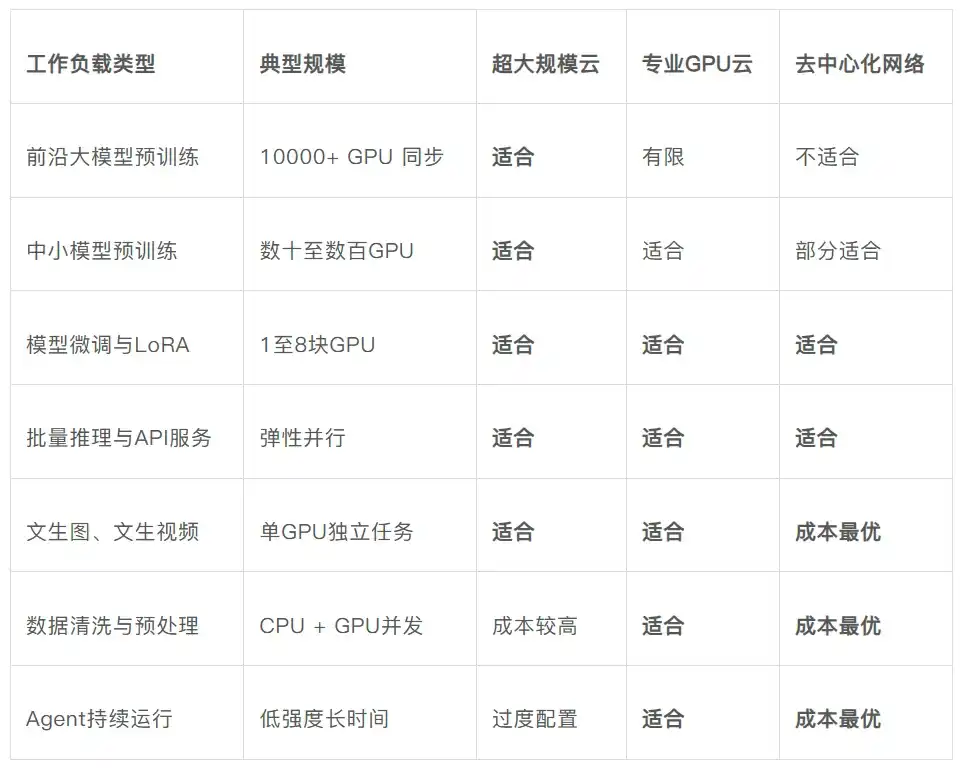
Data source: Compiled from Together AI's multi-node training report (January 2026), Dell LLM cluster network traffic technical documentation (December 2025), Cointelegraph industry analysis (January 2026).

Based on this, the real opportunity for decentralized GPUs concentrates on fragmented, distributed, and price-sensitive scenarios such as inference, fine-tuning, data preprocessing, and Agent continuous operation, rather than directly competing with hyperscale clouds in the frontier training market.

It is worth noting that from the perspective of current AI production environments, the proportion of training in total computing power consumption is now far lower than that of inference and Agent-like tasks, the latter being the main source of growth in computing power demand. This means that the market targeted by decentralized networks is not marginal in scale—it corresponds precisely to the largest and fastest-growing layer in the AI computing power demand structure.

III. Is the Price Advantage Real: Is It Really 60% Cheaper?

One reason decentralized computing power is highly sought after is the widely circulated claim of being "60% cheaper." This statement originates from a cost comparison between the two. The publicly listed price on the Akash Network website shows the hourly rental rate for an H100 GPU is approximately $1.33; after a price reduction of about 44% in June 2025, the per-GPU hourly rate for an AWS p5 instance (averaged across 8 cards) is about $3.93. This is the comparison most frequently cited in reports and the source of the claim "decentralized is over 60% cheaper."

Chart 3: H100 GPU Hourly Rental Price Comparison (Early 2026)
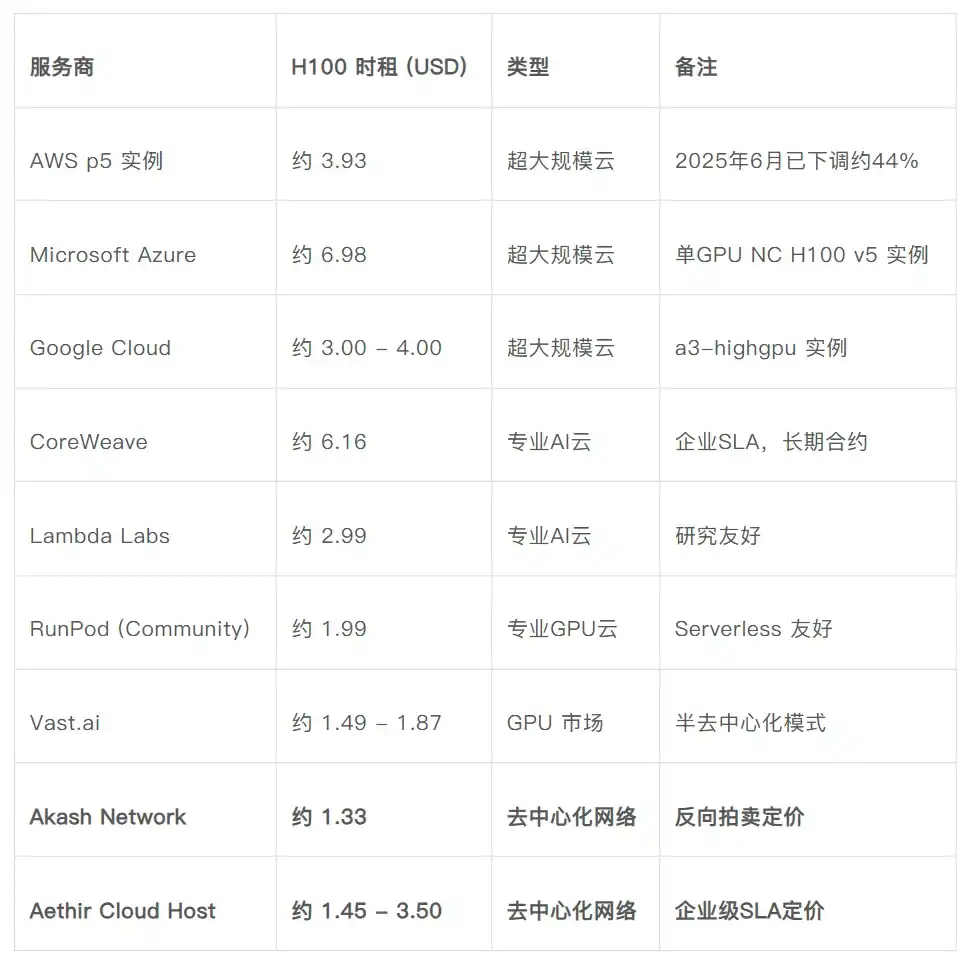
Data source: AWS, Azure, Google Cloud public pricing; Akash Network official website; Aethir official documentation; getdeploying.com (May 2026); IntuitionLabs' "H100 Rental Prices Compared" (May 2026); Silicon Data "H100 Price Spike" (January 2026).

The table above compares the price difference for H100 GPU rentals between centralized platforms and decentralized networks. The comparison leads to the following conclusions:

First, the price advantage of decentralized GPU networks over hyperscale clouds is real—approximately 60% lower compared to the AWS p5 average price, and can be as low as 75%~80% compared to single-GPU instances (AWS/Azure).

Second, compared to fully competitive professional GPU clouds (RunPod, Vast.ai), the price gap with decentralized GPU networks narrows to 15%~35%, and is basically flat in some scenarios.

Third, what truly constitutes differentiation are more structural attributes: no enterprise account required, no minimum usage commitment, on-demand start-stop, flexible geographical distribution of nodes, and no vendor lock-in—this is the real charm of decentralized GPUs.

However, one point that must be raised simultaneously is: Hidden costs cannot be ignored. The node stability of decentralized networks varies greatly. In production scenarios, redundant deployment or increased fault-tolerance mechanisms are needed. These additional costs erode the nominal price advantage to varying degrees. This is one of the main practical barriers facing large-scale enterprise adoption of decentralized GPUs in 2026.

IV. The Real Changes in the Sector in 2026

Based on existing data, the decentralized computing power sector is undergoing two observable deep-seated changes in 2026.

The first is the maturation of tokenomics. Early DePIN projects generally relied on inflationary token subsidies for hardware suppliers, a model with inherent flaws: falling token prices lead to shrinking supplier profits, supplier exits reduce network availability, which further depresses token prices, creating a vicious cycle. Between 2025 and 2026, leading projects have gradually shifted to new models that directly bind token mechanisms to real business volume.

Render Network's BME (Burn-Mint Equilibrium) model, established through RNP-001, requires creators to pay for rendering tasks at fiat prices. Payments are automatically converted to RENDER tokens and burned upon task completion. This mechanism has been operating for years.

io.net's original tokenomics relied on fixed emissions and price-sensitive supplier income, making it prone to a "death spiral." Its upcoming IDE (Incentive Dynamic Engine), slated for Q2 2026, will replace fixed emissions with a demand-driven model, stabilize supplier income pegged to the US dollar, and dynamically adjust token supply based on real-time revenue and token prices.

These two models differ in mechanism but share a common logic: linking token burning and minting to real computing power consumption and anchoring supplier income to the US dollar value. This is the first time decentralized infrastructure has a financial structural logic in token design comparable to traditional SaaS businesses.

The second is the gradual clarification of market entry paths. Early DePIN computing power networks almost exclusively served crypto-native teams, creating a natural market ceiling. Since 2025, several cases of traditional enterprises entering the decentralized computing power system through specific collaborations have emerged.
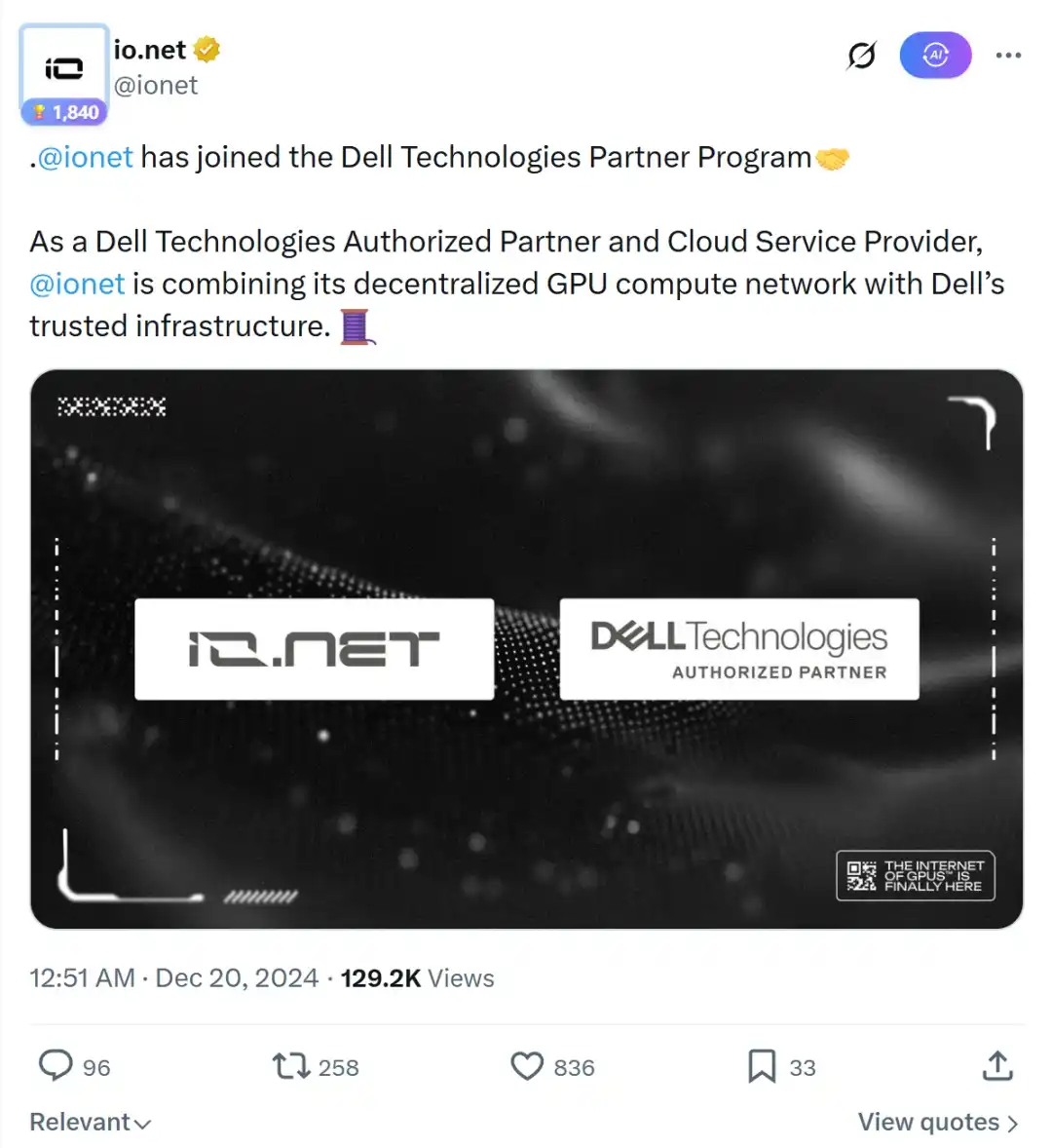
As early as December 2024, io.net joined the Dell Technologies Partner Program as an authorized partner and cloud service provider. The two sides will collaborate on marketing and demand development, enabling enterprise clients to integrate and deploy decentralized GPU computing power with Dell hardware. Prior to that, in April 2024, io.net established a partnership with the AI creative platform KREA, whose enterprise client list includes Nike, Apple, FC Barcelona, Publicis Group, and Meta. io.net provided KREA with NVIDIA A100-80GB GPU clusters at approximately one-third of the market average price.

Meanwhile, Aethir's over 150 paying enterprise clients are distributed across AI, Web3, and gaming sectors. Its Q3 2025 single-quarter revenue reached $39.8 million, with annualized revenue exceeding $147 million, covering scenarios such as AI inference, model training, and Agent platforms.

Regarding Akash, Venice.ai (a private, uncensored generative AI application) uses Akash GPUs to handle inference requests, and FLock.io (a federated learning platform) allows operators to deploy validator nodes on Akash. Both integrations were completed in 2024.

The common feature of the above cases is that non-crypto-native enterprises have begun to incorporate decentralized computing power into actual procurement and technical integration, moving beyond mere narrative levels. Although the number of cases is not vast, they represent a substantive breakthrough in market entry paths.

Chart 4: Key Metric Changes in the DePIN Computing Power Sector (2024 - 2026)
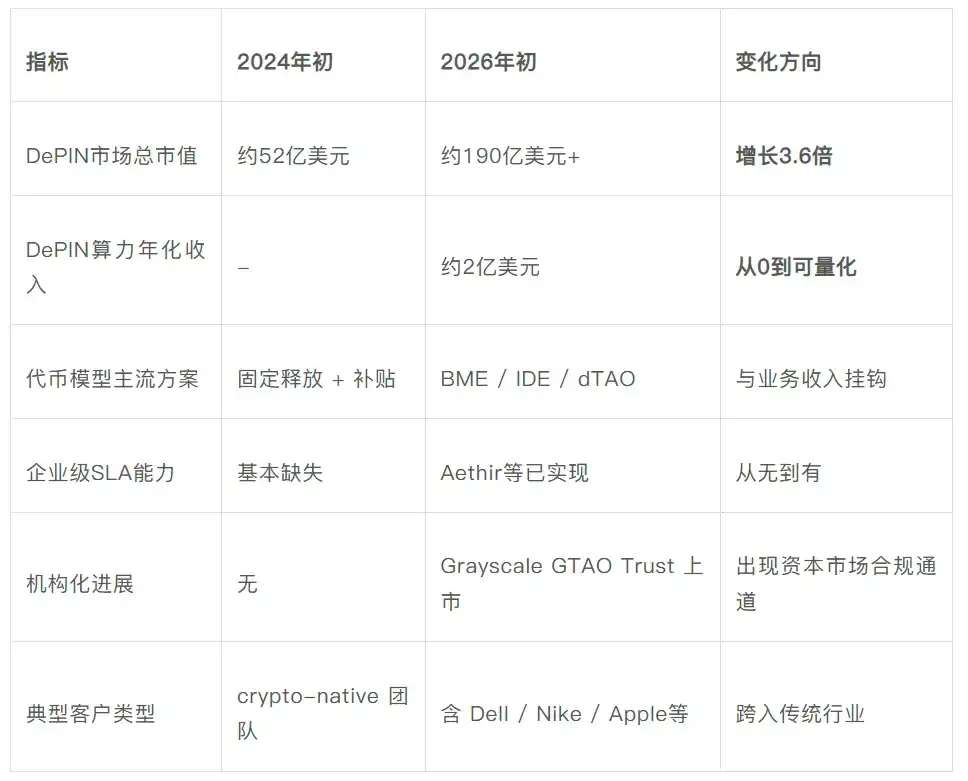
Data source: BlockEden "Decentralized GPU Networks 2026," "DePIN Revenue Inflection"; Yellow.com (May 2026); Messari project report series; CoinGecko "Top Bittensor Subnets" (April 2026).

However, it must also be admitted that: the decentralized computing power sector still faces significant unresolved core obstacles.

First, raw GPU quotes are indeed cheaper (offering discounts of 45-60%), but reliability variance often forces users to over-provision computing power, significantly eroding the nominal cost savings.

Second, enterprise adoption of decentralized computing power still faces difficulties, such as: orchestration challenges, difficulties in debugging distributed failures, and lack of enforceable SLA (Service Level Agreement) guarantees.

Third, the DePIN technology stack is highly fragmented—computing power, storage, verification, and data are scattered across different protocols. Developers must piece together multiple systems to complete production-level deployments, significantly increasing engineering costs.

An exception worth noting on the enterprise front is Aethir. Aethir maintains a 99.31% uptime across over 435,000 GPU containers, possesses enforceable enterprise-level SLAs, and is one of the few projects in the decentralized computing power sector currently capable of meeting enterprise contract-level service requirements.

Of course, the existence of these problems represents both current constraints and tangible gaps that project teams can concretely address.

V. Implications for Ecosystem Player Development Paths

For ecosystem players entering this sector in 2026, the aforementioned data points to several specific judgments:

First, avoid redundant construction of basic aggregation layers. io.net, Akash, and Aethir have already established GPU aggregation networks of considerable scale across different price points. New projects that merely enter as generic GPU aggregators, without significant differentiation—whether in geographic coverage, compliance qualifications, special hardware types, or vertical industry certifications—will find it difficult to establish sustainable advantages. Projects like Render (extending from rendering to AI computing) and Aethir (extending from cloud gaming to enterprise AI inference), which themselves have accumulated resources in specific scenarios, are more likely to gain initial users and differentiated pricing power than pure generic aggregation networks.

Second, tooling and middleware layers are more realistic entry points. Each of the aforementioned unresolved problems—reliability management, distributed debugging, SLA guarantees, cross-chain settlement, Agent-level computing power procurement, and reconciliation—corresponds to a tooling-type project that can stand independently.
  • Gensyn's Verde is an early example. It is a verification protocol specifically designed for machine learning in decentralized environments. Its core is a lightweight dispute arbitration system capable of pinpointing the first step in the training computation graph where the trainer and verifier diverge. Thus, only that single operation needs to be recomputed, not the entire task, significantly reducing verification overhead.
  • Other ideas include, for instance, what io.net proposed: utilizing the MCP protocol to enable AI Agents to directly procure and schedule computing resources without human KYC or enterprise accounts, thereby bypassing the onboarding barriers of traditional cloud services, which are unfriendly to autonomous Agents.

Building toolchains around these underlying protocols offers more clear-cut differentiation space than creating another GPU marketplace.

Third, opportunities at the vertical application layer are diverging. Specific scenarios such as AI biomedicine, AI image/video generation, AI Agent continuous operation, on-chain data analysis and backtesting, and privacy computing (combined with TEE) have different sensitivities to computing power cost, latency tolerance, and reliability requirements. Cases like the Templar subnet training the 72B-parameter Covenant model on Bittensor demonstrate that small-scale, task-specific training is feasible on decentralized networks; however, the subsequent team departure incident also indicates that the governance and team stability of vertical application projects are deeply tied to token market performance.

Fourth, tokenomics design has become a core barrier. Token models like BME and IDE, which are tied to real business volume, have become the de facto standard for the new generation of DePIN computing projects. The early path of releasing tokens first, attracting hardware to the network, and then promoting market cap to attract users has been proven unsustainable in the 2026 market environment. The token model design of new projects must answer from day one: where does the token demand side come from?

Fifth, a point needs to be added: the integration of decentralized GPU networks and the AI Agent economy has just begun in 2026. When the number of AI Agents experiences exponential growth in the next 12 to 18 months, the demand for decentralized computing power will no longer be an option for enterprise-level teams but the default entry point for non-human economic activities. This change is structurally compatible with decentralized computing power networks—the human KYC and enterprise account systems of traditional cloud services are unfriendly to Agents, while permissionless computing power markets can fill this gap.

VI. Observations from Go2Mars Research Institute

The state of decentralized GPU networks in 2026 is neither the "complete disruption of cloud computing" touted by proponents nor the "conceptual scam" claimed by skeptics. It has become a layer within the AI infrastructure stack with real revenue, clear capability boundaries, and is purchasable by enterprises—but its most suitable scenarios still concentrate in areas such as inference, fine-tuning, data preparation, and Agent continuous operation. The market for frontier foundational model training still belongs to hyperscale centralized clouds.

For ecosystem players, this means the opportunity window for the next 12 to 18 months is concentrated in three types of positions.

  • The first category is the tooling layer around the Agent economy and AI inference, including infrastructure for computing power orchestration, behavior verification, metering and billing, SLA guarantees, and cross-chain settlement.
  • The second category is the application layer tied to specific vertical industries, including cost-sensitive and latency-tolerant scenarios such as biomedicine, content generation, and on-chain data science.
  • The third category is the deep integration of next-generation tokenomics and enterprise-level payment paths, requiring direct binding of token demand side with real business volume.

The research institute team has recently engaged in in-depth cooperation with multiple AI × Crypto project teams in areas such as track positioning, technology path selection, token model design, market entry strategies, and VC connections. If a project team believes they are better suited to enter one of the three aforementioned positions, please feel free to contact us for further research and incubation support.


Domande pertinenti

QWhat is the current market state of decentralized GPU networks in 2026 according to the article, and what key metric indicates their real-world traction?

AIn 2026, the decentralized GPU network (DePIN) sector has matured from speculative narrative to a revenue-generating layer. The key metric indicating its real-world traction is that decentralized GPU computing protocols have achieved an annualized protocol revenue exceeding $200 million in early 2026, derived from non-crypto native customers.

QBased on the article's comparison, what are the main areas where decentralized GPU networks demonstrate true price advantages over centralized clouds, and what are the limitations?

AThe main price advantage is for on-demand H100 GPU rentals, where decentralized networks (e.g., Akash at ~$1.33/hr) can be ~60% cheaper than major cloud providers (e.g., AWS p5 at ~$3.93/hr) and up to 75-80% cheaper compared to single-GPU instances. The key limitation is the 'hidden cost' of variable node reliability, which necessitates redundant deployments and fault tolerance mechanisms, partially eroding the nominal price savings for production workloads.

QWhat are the two deep-seated changes the decentralized compute sector is undergoing in 2026, as highlighted in the article?

AThe two deep-seated changes are: 1) The maturation of token economics, with leading projects shifting to models that directly link token mint/burn mechanics to real compute consumption (e.g., Render's BME, io.net's planned IDE), anchoring provider revenue to USD value. 2) The clarification of market entry paths, with concrete examples of non-crypto native enterprises (like KREA's clients, Venice.ai, FLock.io) beginning to integrate and procure decentralized compute resources.

QWhat are the core unresolved challenges currently facing the decentralized compute sector, as per the article's analysis?

AThe core unresolved challenges are: 1) High variance in node reliability, forcing users to over-provision compute and eating into cost savings. 2) Enterprise adoption hurdles like orchestration difficulty, complex distributed debugging, and a lack of enforceable Service Level Agreements (SLAs). 3) A highly fragmented DePIN tech stack, requiring developers to integrate multiple protocols (compute, storage, verification) for production deployment, increasing engineering costs.

QFor ecosystem participants in 2026, what are the three primary opportunity areas identified by the Go2Mars Research Institute based on the sector's current state?

AThe three primary opportunity areas are: 1) The tooling layer around Agent economy and AI inference, including compute orchestration, behavior verification, metering/billing, SLA guarantees, and cross-chain settlement. 2) The application layer tied to specific verticals like biopharma, content generation, and on-chain data science, which are cost-sensitive and latency-tolerant. 3) The deep integration of next-generation token economics with enterprise payment pathways, ensuring token demand is directly tied to real business volume.

Letture associate

New Information Laundering in Prediction Markets: How Secrets Blend into Investment Signals

"The New Information Laundering in Prediction Markets: How Secrets Infiltrate Investment Signals In late February 2026, nine linked anonymous wallets on Polymarket placed over 80 bets on specific details of a US-Iran war, winning over $2.4 million with a 98% win rate. This exemplifies 'information laundering'—a destructive flaw inherent to prediction markets. These markets function by aggregating trader supply and demand on an order book to set prices, which represent collective probability estimates. This makes them valuable real-time sentiment indicators for institutions. However, the system cannot distinguish between public information and stolen secrets. Confidential information enters one end, and 'clean' market prices—bearing no trace of their illicit origin—emerge from the other. For example, an insider knowing of an imminent strike can buy contracts at low odds, pushing the price up and disguising the secret as a savvy market signal, then profit massively when the event occurs. Analysts can sometimes uncover these schemes due to the blockchain's transparency, as seen with Bubblemaps. Paradoxically, this same transparency can inadvertently broadcast secrets to adversarial observers, providing them with low-cost intelligence. Current laws, like insider trading regulations focused on corporate information, fail to address this issue, especially concerning events like military actions with no 'issuer.' Jurisdictional challenges are amplified as platforms operate offshore, easily bypassing national bans with VPNs. Recent US congressional investigations and proposed bills aim to ban war betting and trading on non-public information by officials. The core issue is that information laundering is not a bug but a feature: a market that perfectly converts knowledge into price will inherently reward those with the best information, including those who obtained it illicitly. As prediction markets grow, potentially reaching hundreds of billions in volume, society must confront whether it can tolerate a machine that profitably transforms its most guarded secrets into public, tradable numbers."

链捕手9 min fa

New Information Laundering in Prediction Markets: How Secrets Blend into Investment Signals

链捕手9 min fa

Trump’s Dual Pressure: When the Iran Deal Meets the Midterm Elections

U.S. President Donald Trump’s efforts to negotiate a deal with Iran are triggering a political backlash within his own Republican Party, as the approach of midterm elections intensifies internal divisions. Reports of a potential agreement—involving a temporary ceasefire, phased sanctions relief, and the unfreezing of Iranian assets in exchange for discussions on Tehran diluting or transferring its stockpile of highly enriched uranium—have drawn sharp criticism from GOP hawks. Key allies like Senators Lindsey Graham and Ted Cruz warned that such concessions could allow Iran to recuperate, undermine recent U.S. military gains, and ultimately strengthen a hostile regime. The dispute highlights a broader political struggle for Trump, who must reconcile his "America First" posture with diplomatic compromise while facing a tough electoral landscape. With Republicans fighting to maintain control of Congress and Trump’s approval ratings declining, the Iran deal has quickly become a test of party loyalty and perceived toughness. Public sparring between Trump aides and critics—including former Secretary of State Mike Pompeo—underscores the internal pressure. While Secretary of State Marco Rubio defended Trump’s historically hardline stance, skeptics like Senator Thom Tillis questioned the logic of any deal that leaves nuclear materials in Iran. The outcome now hinges on whether Trump can persuade his party’s hardliners to accept a negotiated exit.

marsbit12 min fa

Trump’s Dual Pressure: When the Iran Deal Meets the Midterm Elections

marsbit12 min fa

Raised $1.3 Billion in Seven Weeks, Yet SpaceX's Weighting Halved: The Dilution Trap of the NASA ETF

A new ETF named NASA, launched just seven weeks ago, has rapidly become the world's largest space-themed fund, amassing $1.3 billion in assets. Its primary draw is its unique position as a "pure" space ETF holding SpaceX stock through a special purpose vehicle (SPV). However, its exposure to SpaceX has been drastically diluted from 10.3% to 4.6% due to a massive, rapid inflow of investor cash. New money is forced into buying other public space stocks like Rocket Lab, meaning investors seeking SpaceX exposure end up with a portfolio of other companies. Further complications arise from the SPV's valuation mechanism, which only updates during specific manager trades, potentially lagging behind SpaceX's market price. This SPV will also face a six-month lock-up post-IPO, preventing investors from selling that portion if SpaceX shares drop after listing. The article highlights a valuation bubble in the broader space sector, with stocks like Planet Labs surging nearly 1000% in a year, driven more by the "SpaceX IPO narrative" than underlying fundamentals. Meanwhile, SpaceX's own financials show significant losses in 2024, and its record-breaking IPO valuation bundles its space business with other Musk assets like xAI, creating a complex investment proposition. The core warning is that the NASA ETF essentially uses SpaceX as bait but delivers a different product. The real beneficiaries may be the ETF issuers collecting high fees, while investors face dilution and hidden risks ahead of SpaceX's historic IPO on June 12th.

marsbit32 min fa

Raised $1.3 Billion in Seven Weeks, Yet SpaceX's Weighting Halved: The Dilution Trap of the NASA ETF

marsbit32 min fa

NEAR Doubles: 3 Major Trends Become the 'Engine' for Token Price Surge

NEAR token price surged from around $1.24 in early May to over $2.5, with its market cap returning above $3 billion. This significant growth, occurring amidst broader market volatility, is attributed to three key factors. First, the AI narrative has been a major driver. NEAR co-founder Illia Polosukhin is a co-author of the seminal Transformer paper, the foundation of modern AI models like ChatGPT. NEAR has integrated AI capabilities into its ecosystem, notably through the Near.com super-app, positioning itself as a key decentralized AI infrastructure project. Endorsements from figures like Arthur Hayes further boosted market sentiment. Second, NEAR is enhancing its utility as a privacy-focused blockchain. With the launch of NEAR Intents for cross-chain transactions, privacy features like Confidential Payments and Confidential Intents have become critical to protect users from MEV attacks. These functionalities allow private transfers of assets like ETH and BTC across more than 35 chains, balancing privacy with usability and appealing to institutional and enterprise users. Third, a new tokenomics mechanism is providing buy-side pressure. Following the full unlocking of its initial supply in late 2025, NEAR now employs a fee-burn model. All protocol fees generated by the NEAR Intents layer are used to buy back and effectively remove NEAR tokens from circulation. With NEAR Intents TVL exceeding $80 million, this creates consistent monthly buybacks estimated around $3 million, reducing sell pressure. Additional technical upgrades planned for mid-2026, including dynamic re-sharding and post-quantum security, aim to further strengthen the network's scalability and robustness.

marsbit34 min fa

NEAR Doubles: 3 Major Trends Become the 'Engine' for Token Price Surge

marsbit34 min fa

After $HYPE Hits a New High, Is It Worth Considering the Stock of "HYPE Version MicroStrategy" $PURR?

**HYPE Hits New Highs: Is $PURR, the "HYPE Version of MicroStrategy," Worth Considering?** The stock of Hyperliquid Strategies (NASDAQ: $PURR), a publicly-traded company that exclusively buys and holds the cryptocurrency HYPE, has gained over 100% year-to-date, mirroring HYPE's own 150% surge to new all-time highs. This has sparked discussions about PURR being a more "capital-efficient" play than MicroStrategy's bitcoin strategy, given its reported ~$1 billion unrealized gain on a ~$220 million investment. The article clarifies that PURR is essentially a pure-play wrapper for HYPE, with no other business. It resulted from a 2025 SPAC merger led by firms like Paradigm and Atlas Merchant Capital, bringing traditional finance veterans to its board. Its value is entirely derived from the price of HYPE. While PURR offers a crucial compliance bridge for US-based institutional and retirement accounts unable to access HYPE directly, the analysis questions the "capital efficiency" narrative. The outsized gains are attributed to HYPE's exceptional performance, not superior corporate strategy. For investors who can buy HYPE directly, holding PURR introduces unnecessary risks: potential shareholder dilution from future stock offerings, incomplete passthrough of staking rewards, market hour mismatches, and counterparty risk via its single custodian. A key metric is its mNAV (modified net asset value). Current calculations show PURR trades at a discount to its HYPE holdings, but this could flip to a premium depending on the execution of registered share issuances. The article concludes that PURR is primarily a "conduit product." The investment thesis hinges entirely on one's bullishness on HYPE itself, not on the PURR wrapper, which adds friction and risk for those with direct crypto access.

marsbit1 h fa

After $HYPE Hits a New High, Is It Worth Considering the Stock of "HYPE Version MicroStrategy" $PURR?

marsbit1 h fa

Trading

Spot
Futures

Articoli Popolari

Cosa è GROK AI

Grok AI: Rivoluzionare la Tecnologia Conversazionale nell'Era Web3 Introduzione Nel panorama in rapida evoluzione dell'intelligenza artificiale, Grok AI si distingue come un progetto notevole che collega i domini della tecnologia avanzata e dell'interazione con l'utente. Sviluppato da xAI, un'azienda guidata dal rinomato imprenditore Elon Musk, Grok AI cerca di ridefinire il modo in cui interagiamo con l'intelligenza artificiale. Mentre il movimento Web3 continua a prosperare, Grok AI mira a sfruttare il potere dell'IA conversazionale per rispondere a query complesse, offrendo agli utenti un'esperienza che è non solo informativa ma anche divertente. Cos'è Grok AI? Grok AI è un sofisticato chatbot di intelligenza artificiale conversazionale progettato per interagire dinamicamente con gli utenti. A differenza di molti sistemi di intelligenza artificiale tradizionali, Grok AI abbraccia un'ampia gamma di domande, comprese quelle tipicamente considerate inappropriate o al di fuori delle risposte standard. Gli obiettivi principali del progetto includono: Ragionamento Affidabile: Grok AI enfatizza il ragionamento di buon senso per fornire risposte logiche basate sulla comprensione contestuale. Supervisione Scalabile: L'integrazione dell'assistenza degli strumenti garantisce che le interazioni degli utenti siano sia monitorate che ottimizzate per la qualità. Verifica Formale: La sicurezza è fondamentale; Grok AI incorpora metodi di verifica formale per migliorare l'affidabilità delle sue uscite. Comprensione del Lungo Contesto: Il modello di IA eccelle nel trattenere e richiamare una vasta storia di conversazione, facilitando discussioni significative e consapevoli del contesto. Robustezza Adversariale: Concentrandosi sul miglioramento delle sue difese contro input manipolati o malevoli, Grok AI mira a mantenere l'integrità delle interazioni degli utenti. In sostanza, Grok AI non è solo un dispositivo di recupero informazioni; è un partner conversazionale immersivo che incoraggia un dialogo dinamico. Creatore di Grok AI Il cervello dietro Grok AI non è altri che Elon Musk, un individuo sinonimo di innovazione in vari campi, tra cui automotive, viaggi spaziali e tecnologia. Sotto l'egida di xAI, un'azienda focalizzata sull'avanzamento della tecnologia AI in modi benefici, la visione di Musk mira a rimodellare la comprensione delle interazioni con l'IA. La leadership e l'etica fondamentale sono profondamente influenzate dall'impegno di Musk nel superare i confini tecnologici. Investitori di Grok AI Sebbene i dettagli specifici riguardanti gli investitori che sostengono Grok AI rimangano limitati, è pubblicamente riconosciuto che xAI, l'incubatore del progetto, è fondato e supportato principalmente dallo stesso Elon Musk. Le precedenti imprese e partecipazioni di Musk forniscono un robusto sostegno, rafforzando ulteriormente la credibilità e il potenziale di crescita di Grok AI. Tuttavia, al momento, le informazioni riguardanti ulteriori fondazioni di investimento o organizzazioni che supportano Grok AI non sono facilmente accessibili, segnando un'area per potenziali esplorazioni future. Come Funziona Grok AI? Le meccaniche operative di Grok AI sono innovative quanto il suo framework concettuale. Il progetto integra diverse tecnologie all'avanguardia che facilitano le sue funzionalità uniche: Infrastruttura Robusta: Grok AI è costruito utilizzando Kubernetes per l'orchestrazione dei container, Rust per prestazioni e sicurezza, e JAX per il calcolo numerico ad alte prestazioni. Questo trio garantisce che il chatbot operi in modo efficiente, si scaldi efficacemente e serva gli utenti prontamente. Accesso alla Conoscenza in Tempo Reale: Una delle caratteristiche distintive di Grok AI è la sua capacità di attingere a dati in tempo reale attraverso la piattaforma X—precedentemente nota come Twitter. Questa capacità consente all'IA di accedere alle informazioni più recenti, permettendole di fornire risposte e raccomandazioni tempestive che altri modelli di IA potrebbero perdere. Due Modalità di Interazione: Grok AI offre agli utenti la scelta tra “Modalità Divertente” e “Modalità Normale”. La Modalità Divertente consente uno stile di interazione più giocoso e umoristico, mentre la Modalità Normale si concentra sulla fornitura di risposte precise e accurate. Questa versatilità garantisce un'esperienza su misura che soddisfa varie preferenze degli utenti. In sostanza, Grok AI sposa prestazioni con coinvolgimento, creando un'esperienza che è sia arricchente che divertente. Cronologia di Grok AI Il viaggio di Grok AI è segnato da traguardi fondamentali che riflettono le sue fasi di sviluppo e distribuzione: Sviluppo Iniziale: La fase fondamentale di Grok AI si è svolta in circa due mesi, durante i quali sono stati condotti l'addestramento iniziale e il perfezionamento del modello. Rilascio Beta di Grok-2: In un significativo avanzamento, è stata annunciata la beta di Grok-2. Questo rilascio ha introdotto due versioni del chatbot—Grok-2 e Grok-2 mini—ognuna dotata delle capacità per chattare, programmare e ragionare. Accesso Pubblico: Dopo lo sviluppo beta, Grok AI è diventato disponibile per gli utenti della piattaforma X. Coloro che hanno account verificati tramite un numero di telefono e attivi per almeno sette giorni possono accedere a una versione limitata, rendendo la tecnologia disponibile a un pubblico più ampio. Questa cronologia racchiude la crescita sistematica di Grok AI dall'inizio all'impegno pubblico, enfatizzando il suo impegno per il miglioramento continuo e l'interazione con gli utenti. Caratteristiche Chiave di Grok AI Grok AI comprende diverse caratteristiche chiave che contribuiscono alla sua identità innovativa: Integrazione della Conoscenza in Tempo Reale: L'accesso a informazioni attuali e rilevanti differenzia Grok AI da molti modelli statici, consentendo un'esperienza utente coinvolgente e accurata. Stili di Interazione Versatili: Offrendo modalità di interazione distinte, Grok AI soddisfa varie preferenze degli utenti, invitando alla creatività e alla personalizzazione nella conversazione con l'IA. Avanzata Struttura Tecnologica: L'utilizzo di Kubernetes, Rust e JAX fornisce al progetto un solido framework per garantire affidabilità e prestazioni ottimali. Considerazione del Discorso Etico: L'inclusione di una funzione di generazione di immagini mette in mostra lo spirito innovativo del progetto. Tuttavia, solleva anche considerazioni etiche riguardanti il copyright e la rappresentazione rispettosa di figure riconoscibili—una discussione in corso all'interno della comunità AI. Conclusione Come entità pionieristica nel campo dell'IA conversazionale, Grok AI incarna il potenziale per esperienze utente trasformative nell'era digitale. Sviluppato da xAI e guidato dall'approccio visionario di Elon Musk, Grok AI integra conoscenze in tempo reale con capacità di interazione avanzate. Si sforza di spingere i confini di ciò che l'intelligenza artificiale può realizzare, mantenendo un focus su considerazioni etiche e sicurezza degli utenti. Grok AI non solo incarna il progresso tecnologico, ma rappresenta anche un nuovo paradigma conversazionale nel panorama Web3, promettendo di coinvolgere gli utenti con sia conoscenze esperte che interazioni giocose. Man mano che il progetto continua a evolversi, si erge come testimonianza di ciò che l'incrocio tra tecnologia, creatività e interazione simile a quella umana può realizzare.

473 Totale visualizzazioniPubblicato il 2024.12.26Aggiornato il 2024.12.26

Cosa è GROK AI

Cosa è ERC AI

Euruka Tech: Una Panoramica di $erc ai e delle sue Ambizioni in Web3 Introduzione Nel panorama in rapida evoluzione della tecnologia blockchain e delle applicazioni decentralizzate, nuovi progetti emergono frequentemente, ciascuno con obiettivi e metodologie uniche. Uno di questi progetti è Euruka Tech, che opera nel vasto dominio delle criptovalute e del Web3. L'obiettivo principale di Euruka Tech, in particolare del suo token $erc ai, è presentare soluzioni innovative progettate per sfruttare le crescenti capacità della tecnologia decentralizzata. Questo articolo si propone di fornire una panoramica completa di Euruka Tech, un'esplorazione dei suoi obiettivi, della funzionalità, dell'identità del suo creatore, dei potenziali investitori e della sua importanza nel contesto più ampio del Web3. Cos'è Euruka Tech, $erc ai? Euruka Tech è caratterizzato come un progetto che sfrutta gli strumenti e le funzionalità offerte dall'ambiente Web3, concentrandosi sull'integrazione dell'intelligenza artificiale nelle sue operazioni. Sebbene i dettagli specifici sul framework del progetto siano piuttosto sfuggenti, è progettato per migliorare l'engagement degli utenti e automatizzare i processi nello spazio crypto. Il progetto mira a creare un ecosistema decentralizzato che non solo faciliti le transazioni, ma incorpori anche funzionalità predittive attraverso l'intelligenza artificiale, da cui il nome del suo token, $erc ai. L'obiettivo è fornire una piattaforma intuitiva che faciliti interazioni più intelligenti e un'elaborazione delle transazioni più efficiente all'interno della crescente sfera del Web3. Chi è il Creatore di Euruka Tech, $erc ai? Attualmente, le informazioni riguardanti il creatore o il team fondatore di Euruka Tech rimangono non specificate e piuttosto opache. Questa assenza di dati solleva preoccupazioni, poiché la conoscenza del background del team è spesso essenziale per stabilire credibilità nel settore blockchain. Pertanto, abbiamo classificato queste informazioni come sconosciute fino a quando dettagli concreti non saranno resi disponibili nel dominio pubblico. Chi sono gli Investitori di Euruka Tech, $erc ai? Allo stesso modo, l'identificazione degli investitori o delle organizzazioni di supporto per il progetto Euruka Tech non è prontamente fornita attraverso la ricerca disponibile. Un aspetto cruciale per i potenziali stakeholder o utenti che considerano di impegnarsi con Euruka Tech è la garanzia che deriva da partnership finanziarie consolidate o dal supporto di società di investimento rispettabili. Senza divulgazioni sulle affiliazioni di investimento, è difficile trarre conclusioni complete sulla sicurezza finanziaria o sulla longevità del progetto. In linea con le informazioni trovate, anche questa sezione rimane allo stato di sconosciuto. Come funziona Euruka Tech, $erc ai? Nonostante la mancanza di specifiche tecniche dettagliate per Euruka Tech, è essenziale considerare le sue ambizioni innovative. Il progetto cerca di sfruttare la potenza computazionale dell'intelligenza artificiale per automatizzare e migliorare l'esperienza dell'utente all'interno dell'ambiente delle criptovalute. Integrando l'IA con la tecnologia blockchain, Euruka Tech mira a fornire funzionalità come operazioni automatizzate, valutazioni del rischio e interfacce utente personalizzate. L'essenza innovativa di Euruka Tech risiede nel suo obiettivo di creare una connessione fluida tra gli utenti e le vaste possibilità presentate dalle reti decentralizzate. Attraverso l'utilizzo di algoritmi di apprendimento automatico e IA, mira a ridurre le sfide degli utenti alle prime armi e semplificare le esperienze transazionali all'interno del framework Web3. Questa simbiosi tra IA e blockchain sottolinea l'importanza del token $erc ai, fungendo da ponte tra le interfacce utente tradizionali e le avanzate capacità delle tecnologie decentralizzate. Cronologia di Euruka Tech, $erc ai Sfortunatamente, a causa delle limitate informazioni disponibili riguardo a Euruka Tech, non siamo in grado di presentare una cronologia dettagliata dei principali sviluppi o traguardi nel percorso del progetto. Questa cronologia, tipicamente preziosa per tracciare l'evoluzione di un progetto e comprendere la sua traiettoria di crescita, non è attualmente disponibile. Man mano che le informazioni su eventi notevoli, partnership o aggiunte funzionali diventano evidenti, gli aggiornamenti miglioreranno sicuramente la visibilità di Euruka Tech nella sfera crypto. Chiarimento su Altri Progetti “Eureka” È importante sottolineare che più progetti e aziende condividono una nomenclatura simile con “Eureka.” La ricerca ha identificato iniziative come un agente IA della NVIDIA Research, che si concentra sull'insegnamento ai robot di compiti complessi utilizzando metodi generativi, così come Eureka Labs ed Eureka AI, che migliorano l'esperienza utente nell'istruzione e nell'analisi del servizio clienti, rispettivamente. Tuttavia, questi progetti sono distinti da Euruka Tech e non dovrebbero essere confusi con i suoi obiettivi o funzionalità. Conclusione Euruka Tech, insieme al suo token $erc ai, rappresenta un attore promettente ma attualmente oscuro nel panorama del Web3. Sebbene i dettagli sul suo creatore e sugli investitori rimangano non divulgati, l'ambizione centrale di combinare intelligenza artificiale e tecnologia blockchain si erge come un punto focale di interesse. Gli approcci unici del progetto nel promuovere l'engagement degli utenti attraverso l'automazione avanzata potrebbero distinguerlo mentre l'ecosistema Web3 progredisce. Con l'evoluzione continua del mercato crypto, gli stakeholder dovrebbero tenere d'occhio gli sviluppi riguardanti Euruka Tech, poiché lo sviluppo di innovazioni documentate, partnership o una roadmap definita potrebbe presentare opportunità significative nel prossimo futuro. Così com'è, attendiamo ulteriori approfondimenti sostanziali che potrebbero svelare il potenziale di Euruka Tech e la sua posizione nel competitivo panorama crypto.

494 Totale visualizzazioniPubblicato il 2025.01.02Aggiornato il 2025.01.02

Cosa è ERC AI

Cosa è DUOLINGO AI

DUOLINGO AI: Integrare l'apprendimento delle lingue con Web3 e innovazione AI In un'era in cui la tecnologia rimodella l'istruzione, l'integrazione dell'intelligenza artificiale (AI) e delle reti blockchain annuncia una nuova frontiera per l'apprendimento delle lingue. Entra in scena DUOLINGO AI e la sua criptovaluta associata, $DUOLINGO AI. Questo progetto aspira a fondere la potenza educativa delle principali piattaforme di apprendimento delle lingue con i benefici della tecnologia decentralizzata Web3. Questo articolo esplora gli aspetti chiave di DUOLINGO AI, esaminando i suoi obiettivi, il framework tecnologico, lo sviluppo storico e il potenziale futuro, mantenendo chiarezza tra la risorsa educativa originale e questa iniziativa indipendente di criptovaluta. Panoramica di DUOLINGO AI Alla sua base, DUOLINGO AI cerca di stabilire un ambiente decentralizzato in cui gli studenti possono guadagnare ricompense crittografiche per il raggiungimento di traguardi educativi nella competenza linguistica. Applicando smart contracts, il progetto mira ad automatizzare i processi di verifica delle competenze e le allocazioni di token, aderendo ai principi di Web3 che enfatizzano la trasparenza e la proprietà da parte degli utenti. Il modello si discosta dagli approcci tradizionali all'acquisizione linguistica, facendo forte affidamento su una struttura di governance guidata dalla comunità, che consente ai detentori di token di suggerire miglioramenti ai contenuti dei corsi e alle distribuzioni delle ricompense. Alcuni degli obiettivi notevoli di DUOLINGO AI includono: Apprendimento Gamificato: Il progetto integra traguardi blockchain e token non fungibili (NFT) per rappresentare i livelli di competenza linguistica, promuovendo la motivazione attraverso ricompense digitali coinvolgenti. Creazione di Contenuti Decentralizzati: Apre opportunità per educatori e appassionati di lingue di contribuire con i propri corsi, facilitando un modello di condivisione dei ricavi che beneficia tutti i collaboratori. Personalizzazione Guidata dall'AI: Utilizzando modelli avanzati di machine learning, DUOLINGO AI personalizza le lezioni per adattarsi ai progressi individuali, simile alle funzionalità adattive presenti nelle piattaforme consolidate. Creatori del Progetto e Governance A partire da aprile 2025, il team dietro $DUOLINGO AI rimane pseudonimo, una pratica comune nel panorama decentralizzato delle criptovalute. Questa anonimato è inteso a promuovere la crescita collettiva e il coinvolgimento degli stakeholder piuttosto che concentrarsi su sviluppatori individuali. Lo smart contract distribuito sulla blockchain di Solana annota l'indirizzo del wallet dello sviluppatore, che segna l'impegno verso la trasparenza riguardo alle transazioni, nonostante l'identità dei creatori sia sconosciuta. Secondo la sua roadmap, DUOLINGO AI mira a evolversi in un'Organizzazione Autonoma Decentralizzata (DAO). Questa struttura di governance consente ai detentori di token di votare su questioni critiche come l'implementazione di funzionalità e le allocazioni del tesoro. Questo modello si allinea con l'etica dell'empowerment della comunità presente in varie applicazioni decentralizzate, enfatizzando l'importanza del processo decisionale collettivo. Investitori e Partnership Strategiche Attualmente, non ci sono investitori istituzionali o capitalisti di rischio identificabili pubblicamente legati a $DUOLINGO AI. Invece, la liquidità del progetto proviene principalmente da scambi decentralizzati (DEX), segnando un netto contrasto con le strategie di finanziamento delle aziende tradizionali di tecnologia educativa. Questo modello di base indica un approccio guidato dalla comunità, riflettendo l'impegno del progetto verso la decentralizzazione. Nel suo whitepaper, DUOLINGO AI menziona la formazione di collaborazioni con “piattaforme educative blockchain” non specificate, mirate ad arricchire la sua offerta di corsi. Sebbene partnership specifiche non siano ancora state divulgate, questi sforzi collaborativi suggeriscono una strategia per mescolare innovazione blockchain con iniziative educative, ampliando l'accesso e il coinvolgimento degli utenti attraverso diverse vie di apprendimento. Architettura Tecnologica Integrazione AI DUOLINGO AI incorpora due componenti principali guidate dall'AI per migliorare la sua offerta educativa: Motore di Apprendimento Adattivo: Questo sofisticato motore apprende dalle interazioni degli utenti, simile ai modelli proprietari delle principali piattaforme educative. Regola dinamicamente la difficoltà delle lezioni per affrontare le sfide specifiche degli studenti, rinforzando le aree deboli attraverso esercizi mirati. Agenti Conversazionali: Utilizzando chatbot alimentati da GPT-4, DUOLINGO AI offre una piattaforma per gli utenti per impegnarsi in conversazioni simulate, promuovendo un'esperienza di apprendimento linguistico più interattiva e pratica. Infrastruttura Blockchain Costruito sulla blockchain di Solana, $DUOLINGO AI utilizza un framework tecnologico completo che include: Smart Contracts per la Verifica delle Competenze: Questa funzionalità assegna automaticamente token agli utenti che superano con successo i test di competenza, rinforzando la struttura di incentivi per risultati di apprendimento genuini. Badge NFT: Questi token digitali significano vari traguardi che gli studenti raggiungono, come completare una sezione del loro corso o padroneggiare competenze specifiche, consentendo loro di scambiare o mostrare digitalmente i loro successi. Governance DAO: I membri della comunità dotati di token possono partecipare alla governance votando su proposte chiave, facilitando una cultura partecipativa che incoraggia l'innovazione nell'offerta di corsi e nelle funzionalità della piattaforma. Cronologia Storica 2022–2023: Concettualizzazione I lavori per DUOLINGO AI iniziano con la creazione di un whitepaper, evidenziando la sinergia tra i progressi dell'AI nell'apprendimento delle lingue e il potenziale decentralizzato della tecnologia blockchain. 2024: Lancio Beta Un lancio beta limitato introduce offerte in lingue popolari, premiando i primi utenti con incentivi in token come parte della strategia di coinvolgimento della comunità del progetto. 2025: Transizione DAO Ad aprile, avviene un lancio completo della mainnet con la circolazione di token, stimolando discussioni nella comunità riguardo a possibili espansioni nelle lingue asiatiche e ad altri sviluppi dei corsi. Sfide e Direzioni Future Ostacoli Tecnici Nonostante i suoi obiettivi ambiziosi, DUOLINGO AI affronta sfide significative. La scalabilità rimane una preoccupazione costante, in particolare nel bilanciare i costi associati all'elaborazione dell'AI e nel mantenere una rete decentralizzata reattiva. Inoltre, garantire la creazione e la moderazione di contenuti di qualità in un'offerta decentralizzata presenta complessità nel mantenere standard educativi. Opportunità Strategiche Guardando al futuro, DUOLINGO AI ha il potenziale per sfruttare partnership di micro-credentialing con istituzioni accademiche, fornendo validazioni verificate dalla blockchain delle competenze linguistiche. Inoltre, l'espansione cross-chain potrebbe consentire al progetto di attingere a basi utenti più ampie e a ulteriori ecosistemi blockchain, migliorando la sua interoperabilità e portata. Conclusione DUOLINGO AI rappresenta una fusione innovativa di intelligenza artificiale e tecnologia blockchain, presentando un'alternativa focalizzata sulla comunità ai sistemi tradizionali di apprendimento delle lingue. Sebbene il suo sviluppo pseudonimo e il modello economico emergente comportino alcuni rischi, l'impegno del progetto verso l'apprendimento gamificato, l'istruzione personalizzata e la governance decentralizzata illumina un percorso per la tecnologia educativa nel regno di Web3. Man mano che l'AI continua a progredire e l'ecosistema blockchain evolve, iniziative come DUOLINGO AI potrebbero ridefinire il modo in cui gli utenti interagiscono con l'istruzione linguistica, potenziando le comunità e premiando il coinvolgimento attraverso meccanismi di apprendimento innovativi.

449 Totale visualizzazioniPubblicato il 2025.04.11Aggiornato il 2025.04.11

Cosa è DUOLINGO AI

Discussioni

Benvenuto nella Community HTX. Qui puoi rimanere informato sugli ultimi sviluppi della piattaforma e accedere ad approfondimenti esperti sul mercato. Le opinioni degli utenti sul prezzo di AI AI sono presentate come di seguito.

活动图片