Just now, a massive bombshell exploded in the global tech world—
Demis Hassabis, Google AI's top leader, DeepMind founder, and Nobel laureate, was reportedly revealed to be an early, secret financial backer of its biggest rival, the super-unicorn Anthropic!
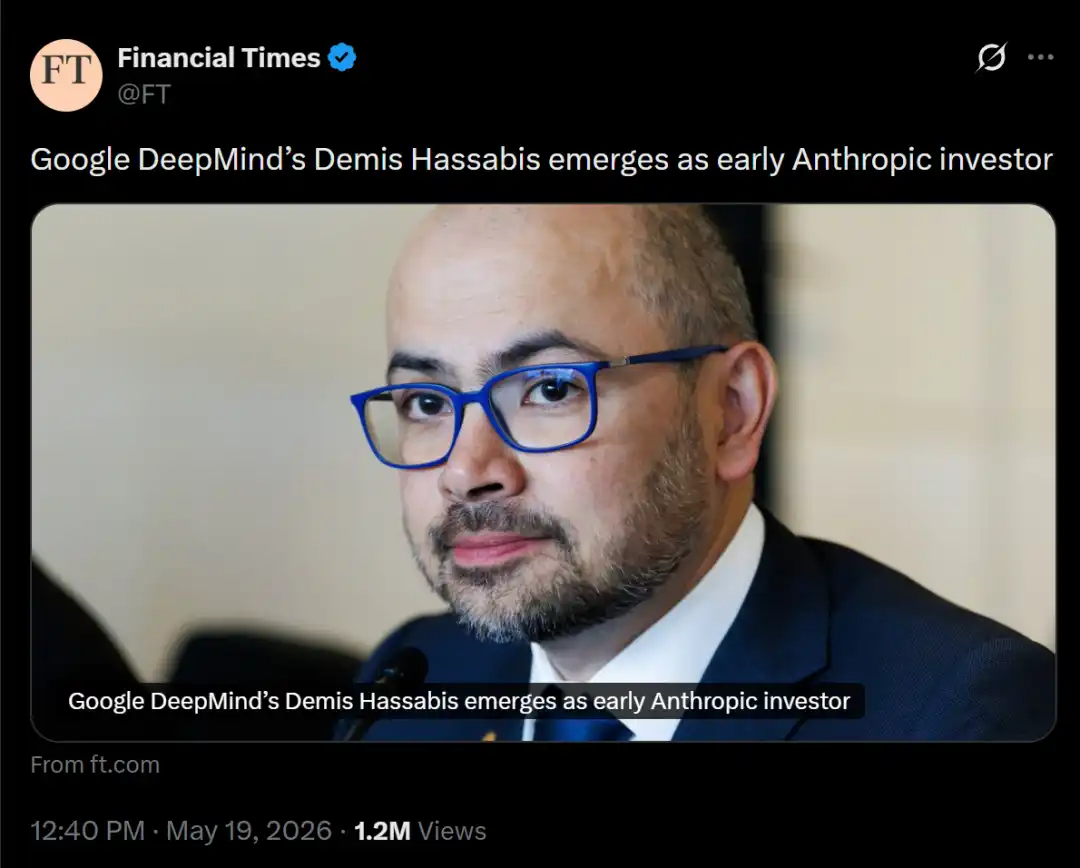
This meticulously planned infiltration is utterly shocking.
Even more unexpected is that following this clue has unearthed a vast 'DeepMind Mafia' empire, intricately woven and with deeply intertwined interests, personally orchestrated by Hassabis.
From Anthropic, valued at a staggering $900 billion, to Inflection AI which secured massive Microsoft investment, to Ineffable Intelligence which recently landed over $3 billion in funding... the leading figures or early backers behind the world's hottest, most cash-magnetizing AI startups are all him!
This is perhaps the most brilliant "Trojan Horse" in tech history—this "Godfather of AI" has quietly taken control of the discourse power in the global AI ecosystem right under our noses.
The Ultimate "Infiltration": Google AI Boss is a Major Shareholder in Its Rival?
In the current large model battlefield, Google's Gemini and Anthropic's Claude are locked in intense competition.
To outmaneuver their opponent, the two companies are engaged in a pixel-perfect arms race every day.
Yet, who would have thought that while Google employees work overtime to benchmark against Claude, their top boss had quietly bought shares in this "rival" company back when Anthropic was first founded.
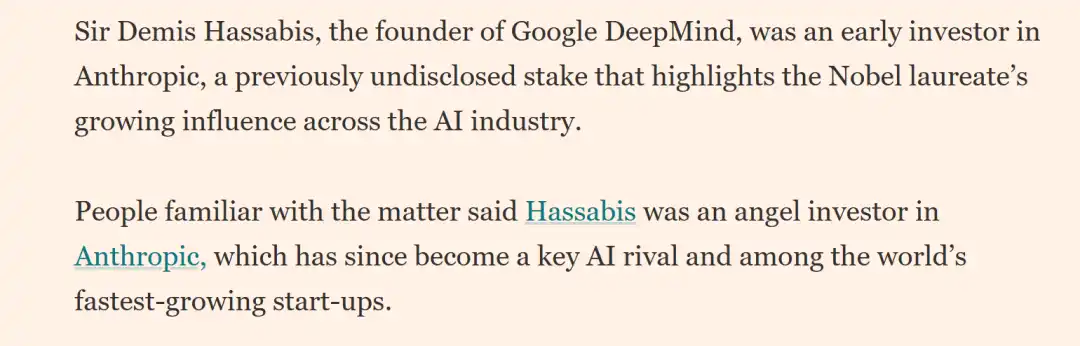
According to the latest revelations by the Financial Times, Hassabis secretly invested in Anthropic as a personal angel investor during its early days.
This hidden ownership stake was previously unknown to the public.
The shock level is akin to discovering that during the fierce Cola Wars, the CEO of Coca-Cola was a founding shareholder of PepsiCo.
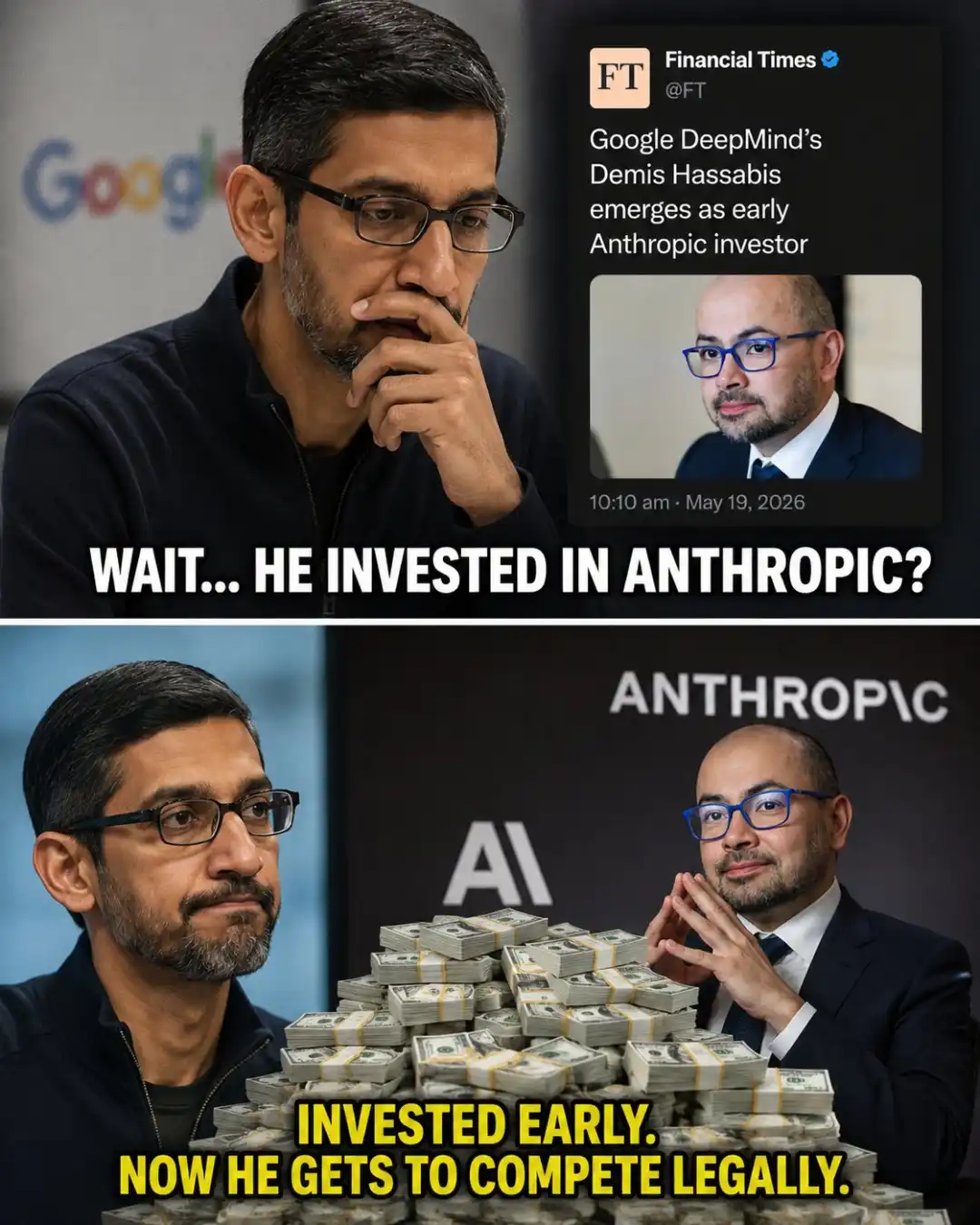
Looking at Anthropic's current monstrous size, you know Hassabis's investment paid off handsomely.
According to insiders, Anthropic's valuation has skyrocketed to an astonishing $900 billion in its latest funding round!
It has not only surpassed its arch-rival OpenAI but has ballooned into the fastest-growing "Leviathan" in global tech history.
Do the math, the assets in Hassabis's hands are now enormous enough to rival nations.
What's even more interesting is that Hassabis's "mothership," Google, later joined the game as well.
Google officially announced a multi-billion dollar investment in Anthropic earlier, establishing a deep cloud and AI partnership.
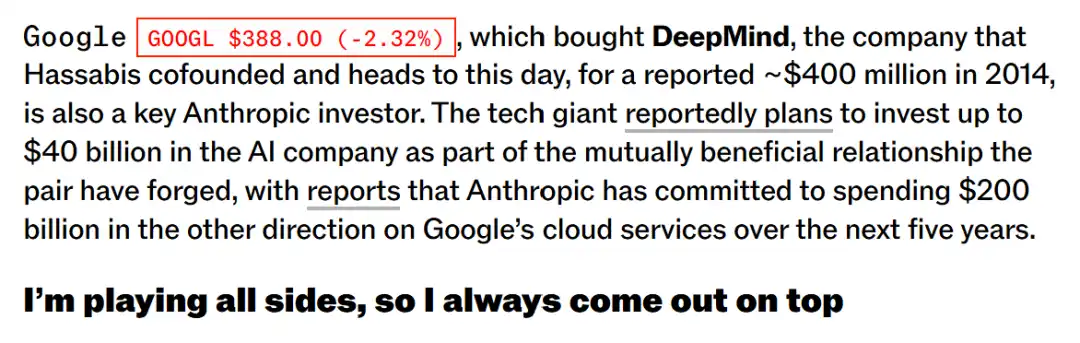
Rumored details of the deal suggest the scale of this "two-way street" is staggering—
Google reportedly plans to invest up to $40 billion in Anthropic; in return, as part of the agreement, Anthropic is said to have committed to spending a whopping $200 billion on Google Cloud services over the next five years!
In his left hand is the Google AI empire he commands; in his right hand is the $900 billion rival he incubated early on; and in between are tens of billions in cloud service contracts.
Hassabis's actions show us, "If I bet on both sides, the only winner in the end can be me."

Dario: He is My Mentor
Digging deeper, things get even more intriguing.
The relationship between the two men goes far beyond mere financial ties.
According to sources close to Anthropic's leadership, Dario Amodei, Anthropic's founder and CEO, privately regards Hassabis as his role model and mentor.
Even though Dario previously held a core executive position at OpenAI, in his heart, Hassabis's DeepMind represents the holy grail of modern AI engineering.
In Dario's widely circulated personal essay "Machines of Loving Grace," although he doesn't name names directly, the reverence and admiration for a certain "AI pioneer" between the lines is unmistakable to anyone reading.
Anyone with insight can tell—he's talking about Hassabis.
The "Couch Moment" at the World Economic Forum
This relationship of friendly rivalry and mutual admiration was immortalized in a famous moment at the 2025 World Economic Forum.
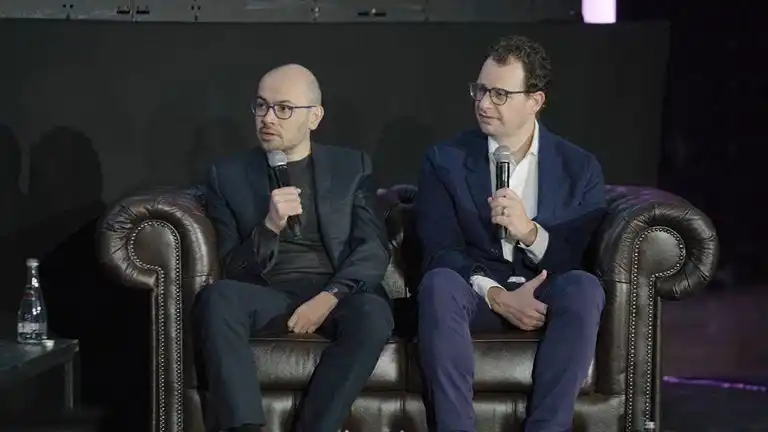
At the time, as leaders of two industry giants, Hassabis and Dario, during an interview, were squeezed onto a narrow two-seater sofa by event staff.
The two AI titans, worth billions and shaping humanity's future, sat shoulder to shoulder, pressed tightly together due to the cramped space.
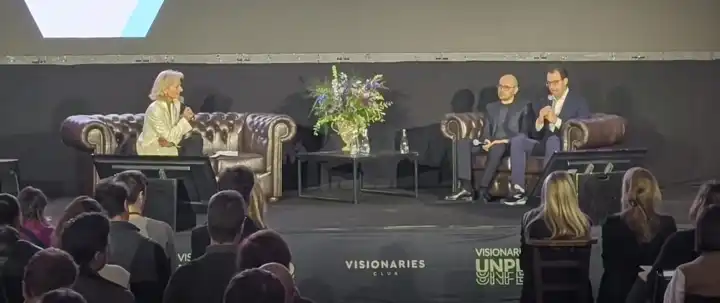
According to eyewitnesses, the scene was described like this: "It was a textbook example of tech world bromance. Two public rivals, squeezed together on camera, their eyes holding not animosity, but instead a sense of mutual understanding and amusement shared by peers at the top."
This personal closeness, transcending corporate boundaries, not only softens the coldness of business warfare but also reveals that on the highest throne of AI, they are fellow travelers on the same path.
The "DeepMind Mafia" on a Rampage: Former Employees Raised $14 Billion in Four Years!
Hassabis's ambition is far from limited to just Anthropic.
In Silicon Valley, there was once the famous "PayPal Mafia." This entrepreneurial clique, consisting of Elon Musk, Peter Thiel, Reid Hoffman, and others, nearly dominated the early Web 2.0 era.
Today, a more massive and potentially more disruptive "DeepMind Mafia" is rapidly expanding, with dual centers in London and Silicon Valley.
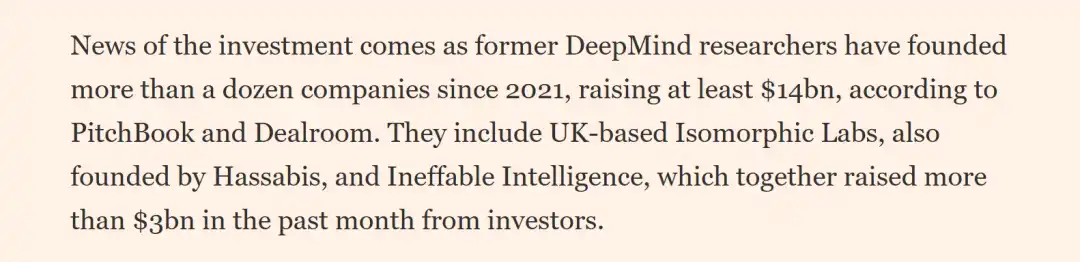
According to the latest statistics from the international authoritative startup databases PitchBook and Dealroom: Since 2021, core technical leads and executives who left DeepMind have gone on to found over 12 super AI startups.
Within just four years, this faction has cumulatively and frenziedly secured over $14 billion in funding from the market!
This scale is enough to make any venture capital firm tremble.
Let's look at this empire map composed of Hassabis and his disciples—
Core Members of the "DeepMind Mafia"
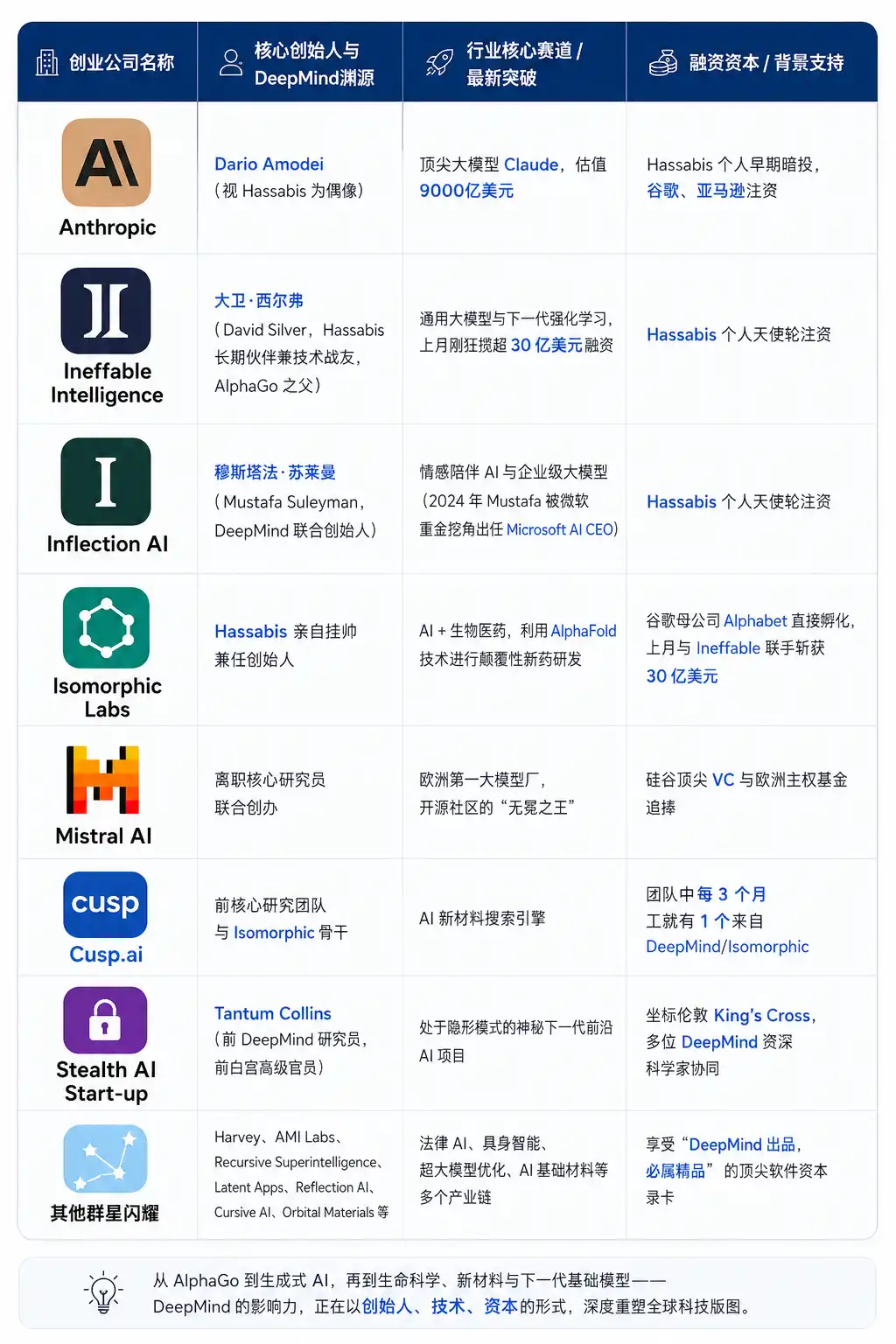
This list is still growing rapidly.
A seasoned Silicon Valley investor put it this way: "Nowadays, in the AI startup scene, if your resume says 'Former Senior Researcher at DeepMind,' you don't even need to finish your pitch deck—the checks are already on the table."
The Hidden Capital Web: Revealing the Harsh Truth Behind the Giants' 'Bloody War'
The most terrifying aspect of Hassabis's capital puzzle is its comprehensiveness and covertness.
As a billionaire who sold DeepMind to Google for £400 million in 2014, Hassabis holds vast cash reserves.
But instead of spending it on yachts or mansions like the typical wealthy, he turned this money into numerous precise capital tentacles, quietly reaching into the entrepreneurial ventures of former colleagues and subordinates.
David Silver wants to work on general AI, Hassabis invests.
Mustafa Suleyman leaves to start Inflection AI, Hassabis invests.
He is even a core angel investor in the famous startup incubator Entrepreneurs First (EF).
This kind of capital deployment completely tears open the harsh truth of modern tech giant competition—
Under the spotlight, the giants fight fiercely over market share, for financial reports and stock prices, engaging in bloody PR wars and patent battles.
But behind the curtain, the top AI elites are deeply bound together through a hidden network woven from personal capital, mentor-discipleship, and former colleague relationships.
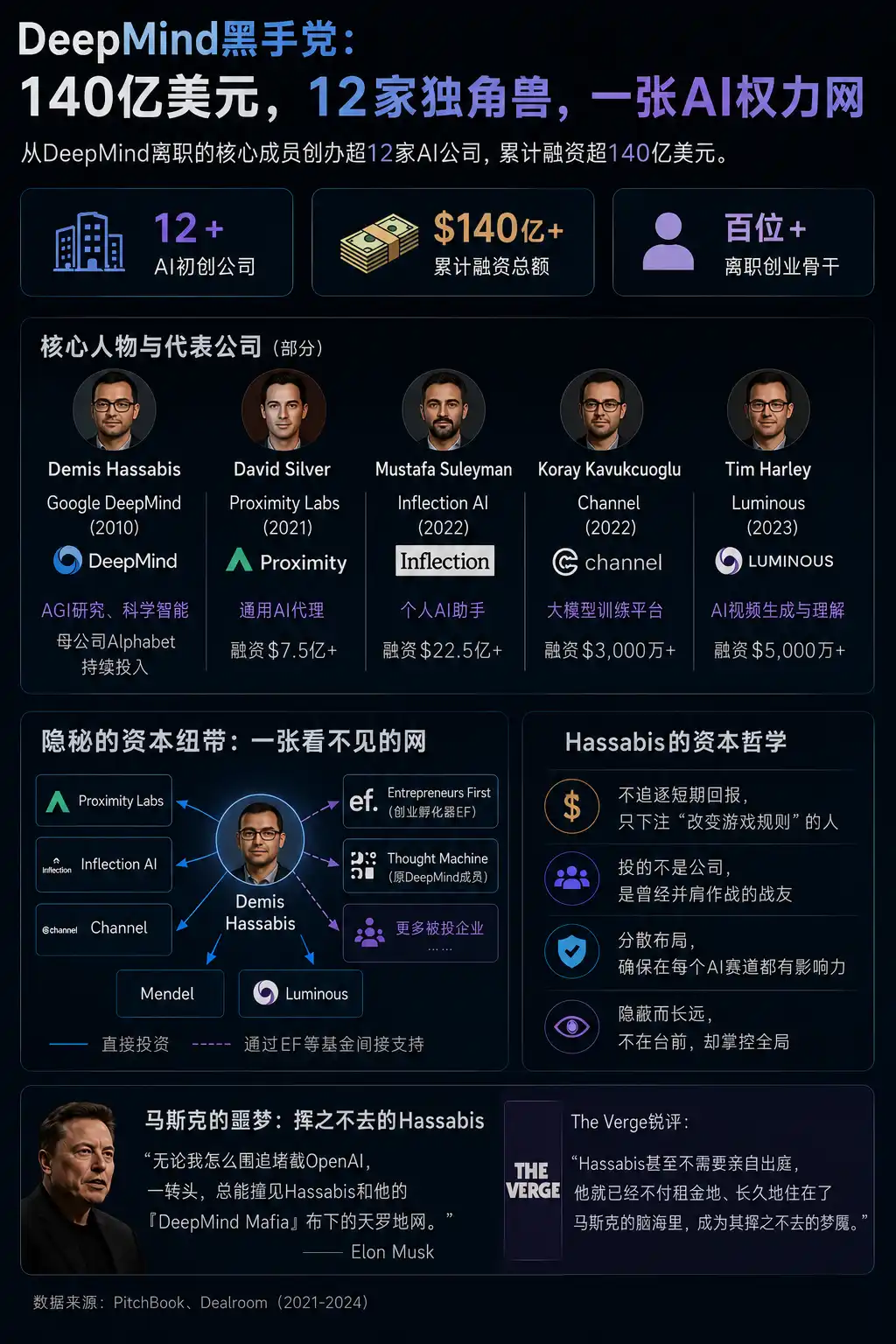
This phenomenon has even caused the maverick Elon Musk anxiety and anger.
In the high-profile, ongoing "Musk vs. Altman" lawsuit, court documents and testimonies show that Hassabis's name appears with high frequency in Musk's legal filings.
The Verge sharply commented: "Hassabis doesn't even need to show up in court; he already resides rent-free, permanently, in Musk's mind, becoming Musk's haunting nightmare.
Because Musk has discovered that no matter how he tries to corner OpenAI, whenever he turns around, he always runs into the intricate net laid by Hassabis and his 'DeepMind Mafia.'"
Pulling the Strings from Within: DeepMind Takes Over Google Completely
If aggressively deploying capital externally and nurturing external armies represents Hassabis's external strategy; then centralizing power and pulling strings from behind the scenes within Google is his internal mastery.
While exporting capital outward, DeepMind's senior executives are taking over the core power of the entire Google tech empire at an astonishing pace.
2023: The Unification of Google AI
Looking back to 2023, when OpenAI unleashed ChatGPT and caught Google off guard, causing its stock price to plummet, Alphabet made a historic decision: forcibly merging Google's once-proud Google Brain with DeepMind to form the new Google DeepMind, placed under Hassabis's unified command.
On the surface, this merger was a combination of strengths; in reality, it was a full-scale takeover of Google's core R&D force by DeepMind.
Hassabis declared at the time: "We need to simplify decision-making with greater speed, stronger collaboration, and execution to focus on achieving maximum impact."
Translation: I'm in charge of the AI business here.
Core Lieutenants, Ascending to Power
Within just two years, DeepMind's trusted inner circle has completely taken over and occupied the core decision-making layers of Google's AI and cloud services.
Koray Kavukcuoglu, DeepMind's former CTO, was officially promoted last year to Google's Chief AI Architect.
This means the underlying architecture of all future Google AI products bears the DeepMind stamp.
Pushmeet Kohli, who led the Nobel Prize-winning scientific marvel AlphaFold project, was formally appointed last month as Google Cloud's Chief Scientist. Thus, the technical brain behind Google's most profitable cloud business is also now a DeepMind confidant.
The "Power Behind the Throne" in London
Most remarkably, even though DeepMind has thoroughly completed its reverse takeover of Google's AI empire, Hassabis, wielding immense power, stubbornly keeps his headquarters in London's King's Cross district, refusing to relocate to Silicon Valley's Mountain View.
To accommodate this true power, Google even spent $1 billion building a grand new headquarters building in London's King's Cross.
"Demis possesses terrifying, incalculable soft power both within Google and across the entire tech industry," remarked Matt Clifford, a long-time friend of Hassabis and co-founder of EF.
"He was a pioneer long before anyone else figured out what AI was. A large part of the reason the younger generation of founders can raise such massive amounts of money is because they carry Demis's spiritual endorsement. Whether he's in Silicon Valley or London, his influence is growing exponentially."
The Ultimate Gambit of the "Godfather of AI"
As a former child prodigy in chess, now knighted by the British monarchy, Demis Hassabis clearly sees the entire global AI industry as a grand chess game.
In this game, Gemini is his public-facing chariot charging for Google; Anthropic is the hidden piece he placed secretly as a contingency; Ineffable, Inflection, Mistral, and other billion-dollar unicorns are the sharp pawns he has scattered across the board, ready to encircle the market at any moment.
And he himself sits calmly in his King's Cross office, watching capital, talent, and technology circulate perfectly within the web he has woven.
This recent exposure by the media punctures the harshest truth in the tech circle: the so-called great war among giants is nothing but a capital game played by the top elites, moving pieces from left hand to right.
No matter where the tide of technology flows, it never escapes the grasp of those who bought into the wave early.