Edited & Compiled by: Shenchao TechFlow
Host:Nico
Podcast Source:Nico's Frontier Alpha
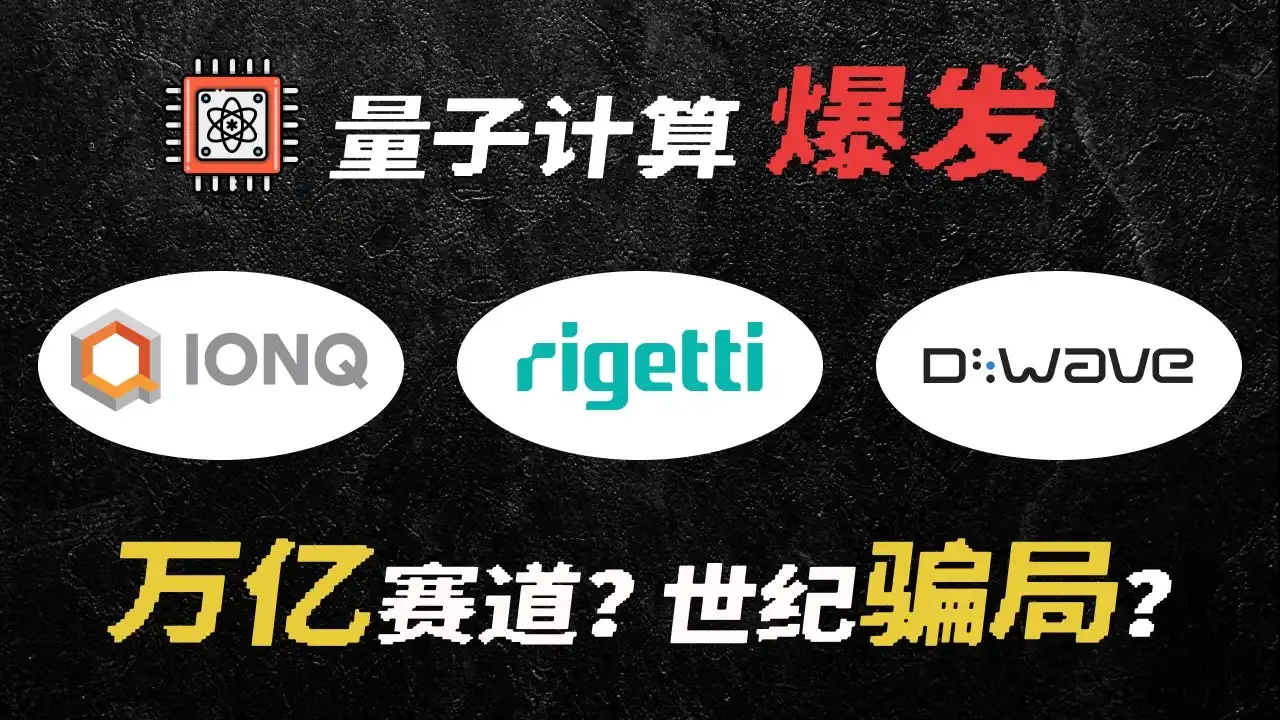
Original Title:Quantum Computing Explodes: Trillion-Dollar Sector or Century Scam? IonQ, Rigetti, D-Wave—Who's Selling Dreams, Who's the Real Future? A 10,000-Word Deconstruction of the Quantum Computing Sector
Broadcast Date:May 29, 2026
Key Takeaways
This episode systematically deconstructs the complete landscape of quantum computing, from its underlying principles and technical pathways to commercialization progress and investment frameworks. Nico believes quantum computing is not an empty scam; its long-term market potential stems from high-value applications such as drug discovery, cryptography, financial modeling, materials science, and logistics optimization. However, it remains on the eve of commercialization today, with true large-scale adoption likely still 3 to 7 years away. The program focuses on comparing the technical paths, financial health, business models, and valuation risks of three U.S.-listed quantum concept companies: IonQ, Rigetti, and D-Wave. It also discusses the roles of tech giants like Google, IBM, Microsoft, Amazon, and Nvidia in the quantum ecosystem. For investors, the current stage offers long-term imagination akin to early-stage AI, but also carries high risks of bubble bursts and valuation pullbacks.
Selected Highlights
Why Quantum Computing Has Become a National-Level Priority Again
- "The U.S. and China almost simultaneously prioritized quantum computing as a national strategic direction."
- "In theory, quantum computing can crack almost all encrypted communications on today's internet, including the encryption systems behind bank transfers, military communications, and diplomatic cables. Whoever masters this capability first may gain the initiative in future cyberspace."
- "Quantum computing companies in the U.S. stock market are not ordinary small-cap tech stocks; they are pieces being bet on in a national-level technological competition."
The Real Limits of Quantum Computing's Capabilities
- "The source of quantum speedup isn't faster individual operations, but an exponential reduction in the number of operations needed."
- "Classical computers are efficient machines for executing clear instructions; quantum computers are exploration tools searching for answers among near-infinite possibilities."
- "Quantum computing isn't a panacea; it's only useful in scenarios where the number of potential answers explodes exponentially with the problem's scale, and where you need to find the optimal solution."
Why Commercialization Has Been Delayed
- "The fundamental reason quantum computing hasn't commercialized isn't an inability to create qubits, but that qubits are too error-prone for practically valuable computations."
- "The idea of quantum error correction is to use many unreliable physical qubits to encode one highly reliable logical qubit."
- "Stability, quantity, and speed form an 'impossible triangle' for quantum computing. The six main technical paths are essentially making trade-offs around these three dimensions."
Differences Among the Three Quantum Concept Stocks
- "IonQ is the most financially stable, with the fastest commercialization progress and the highest-quality clients, but the price is a very expensive valuation, with much positive expectation already priced in."
- "Rigetti offers the highest potential payoff; it has the smallest revenue and the most exaggerated valuation, but if its technical catalysts materialize, its stock could have the greatest elasticity."
- "D-Wave has the most unique positioning; its quantum annealing path already has real customers and applications today, but whether its dual-platform transition succeeds remains a key risk."
The Symbiotic Relationship Between Giants and Small Companies
- "A unique aspect of the quantum sector today is that the technical pathways haven't fully converged. No one knows for sure which path—superconducting, ion trap, annealing, photonic, neutral atom, silicon spin—will ultimately succeed."
- "Small companies aren't necessarily competing with giants; often, they are suppliers to the giants. If a small company succeeds on a specific path, giants are more likely to cooperate or acquire."
- "Nvidia doesn't build quantum computers; it builds the connection layer between quantum and classical computing. No matter which quantum path succeeds, quantum computers will need to work with GPUs."
Investment Framework and Risks
- "Quantum computing right now looks a lot like AI from 2018 to 2020: underlying technology is accelerating, governments and tech giants are placing early bets, but the inflection point for mass commercialization hasn't arrived."
- "Before that inflection point arrives, the quantum sector will likely experience another round of bubble-clearing."
- "Currently, there are two relatively safe investment approaches. The first is to prioritize gaining exposure through tech giants that are already deeply invested in quantum. The second is to invest a small portion in quantum-focused ETFs. Another option is WQTM, which is the purest non-leveraged quantum ETF in the U.S. market, officially positioned to invest in hardware, software, and infrastructure companies within the quantum computing ecosystem."
Quantum Computing Becomes a New Front in U.S.-China Tech Rivalry
Nico:
Quantum computing, a concept that sounds somewhat sci-fi, has recently exploded back into the spotlight. Just last week, U.S. President Trump signed off on $20 billion in federal funding directed towards nine American quantum computing companies, with the federal government taking direct minority stakes. This is the most direct and heavy-handed industrial support from the U.S. government for quantum computing in recent years, marking its official inclusion in America's next-generation technology strategy.
Across the ocean, China has also written quantum technology into its 15th Five-Year Plan, listing it alongside embodied AI and controllable nuclear fusion as a core direction for future industries. In the first quarter of this year alone, funding in China's quantum sector reached over 2 billion yuan, approaching or possibly exceeding last year's total. The U.S. and China, two superpowers, have almost simultaneously prioritized this sector at the national level.
The question arises: what stage has quantum computing reached in 2026? Will it become the next global industrial revolution after AI? Or is it just another round of hype? Among the three hot quantum concept stocks in the U.S. market—IonQ, Rigetti, D-Wave—who is selling dreams, and who represents the real future?
Today's episode will spend over 40 minutes deconstructing the entire quantum computing sector, from underlying technology paths to listed companies and investment frameworks. After listening, you'll understand what quantum computing is, what it can do, the different technical paths, noteworthy companies, and how to allocate to this new sector based on your risk appetite.
Before diving into specific technical concepts, let's look at the broader context of both the U.S. and China entering the quantum race. Over a week ago, the Trump administration used funds from the CHIPS Act pool to inject $20 billion into nine U.S. quantum computing companies at once. The money itself isn't the key point; what's crucial is that the U.S. federal government directly holds minority stakes in these companies, taking a seat at the table for the entire U.S. quantum computing sector. The White House Office of Science and Technology Policy has quietly elevated quantum computing's priority to a national strategic level on par with AI. Multiple mainstream U.S. financial media outlets have also reported that a presidential executive order specifically targeting quantum computing is being drafted.
The political signal behind these actions is clear: the U.S. does not want to miss any infrastructure-level technological revolution. Looking back at history, the biggest beneficiaries of global tech revolutions—PCs, the internet, mobile internet, and AI—have consistently been American companies. The U.S. builds the infrastructure first, proves the path from 0 to 1, and then other countries follow suit. The Trump administration's move is essentially about locking in America's dominant position in the quantum industry chain early.
From a national security perspective, quantum computing has an extremely sensitive application: it can theoretically crack almost all encrypted communications on today's internet, including the encryption systems behind bank transfers, military communications, and diplomatic cables. Whoever masters this capability first will hold the initiative in future cyberspace. This is what truly worries the U.S. government.
Looking at China, the same logic applies. Both China's 15th Five-Year Plan and the funding scale in its quantum sector reveal its ambitions in this emerging field. While the U.S.-China confrontation in quantum isn't as overtly fierce as in AI models, it's simmering beneath the surface and could become the biggest geopolitical tech battle in 5 or 10 years.
Understanding this backdrop, when you look back at the few quantum computing companies in the U.S. stock market that have soared tens or hundreds of times in recent years, you realize they aren't just ordinary small-cap tech stocks; they are pieces being played in a national-level technological competition.
What Exactly is Quantum Computing: From Bits, Superposition, Entanglement to Interference
Nico:
If I jump straight into quantum computing concepts, it might be confusing. So let's start with something familiar from daily life. Whether you're watching videos on your phone or working on documents on your computer, the underlying operation involves a computer. All the images, videos, and text we see are, at their core, binary code—units called bits, consisting of 0s and 1s—which, after a series of computational processes, are transformed into understandable content.
For decades, we've been trying to make computers process 0s and 1s faster, primarily by shrinking transistors on chips. Packing more transistors onto the same chip area increases speed. But this path is nearing its end. The most advanced chip processes are at 2 nanometers; going smaller approaches the scale of individual atoms. At that scale, classical physics rules start to break down, a problem not solvable by ordinary engineering.
Beyond the hardware ceiling, the 0/1 system itself has fundamental limitations. No matter how fast the chip, a bit can only be 0 or 1 at any moment. If you need to check a quadrillion possibilities, you must try them one by one. There's a class of problems where the number of possibilities explodes exponentially with the problem's scale. For example, a delivery person with 100 packages has roughly 10^158 possible routes—a number with dozens more zeros than the total number of atoms in the observable universe. The fastest supercomputer today couldn't finish calculating all possibilities before Earth's end.
Quantum computing is proposed to break this limitation. Its underlying logic is entirely different. A classical bit is either 0 or 1. The basic unit of a quantum computer is the quantum bit, or qubit. A qubit can be both 0 and 1 simultaneously, a property called quantum superposition. This sounds counterintuitive: a coin is either heads or tails; a light is either on or off. In daily life, we never see something in two states at once.
But in the microscopic world, individual particles naturally obey quantum mechanics. Particles like electrons, photons, and atoms can indeed be in multiple states simultaneously—a physical fact repeatedly verified by experiments. We don't experience this macroscopically because everything we interact with comprises astronomical numbers of particles. When many particles gather, their interactions and contact with the environment make superposition extremely fragile and quickly lost, so the macroscopic world appears deterministic.
Quantum computers aim to protect and utilize the superposition of microscopic particles for computation. Why does superposition help with fast computation? A classical computer finding the correct answer among a quadrillion possibilities must try each one; chip speed doesn't change this fact. Quantum superposition breaks this. Fifty qubits in combination also correspond to a quadrillion possible states. The key difference is that these 50 qubits exist in a superposition of all states simultaneously. Performing one operation on these 50 qubits acts on all states at once—one operation equivalent to a classical computer's quadrillion repetitions.
But superposition alone isn't enough. If 50 qubits are in all states but are independent and uncorrelated, we can't coordinate them. This leads to the second crucial concept: quantum entanglement. Two qubits each in superposition yield random individual measurement results. But if they become entangled, an absolute correlation emerges between their random outcomes.
For example, take two entangled qubits, place one in Beijing, one in New York. Measuring one in Beijing and getting 0 means you already know the one in New York must be 1, without checking. Conversely, getting 1 in Beijing means New York's is 0. Individually, each result is random, but together, they are perfectly complementary. This correlation happens instantaneously, regardless of distance, with no signal transmission—entanglement is real, as proven by numerous experiments.
In quantum computing, entanglement binds multiple qubits into an inseparable whole. Without entanglement, 10 qubits are 10 independent states; with entanglement, they're linked—moving one affects the others. This allows coordinated operations, guiding all qubits toward the correct answer.
Next, how is the correct answer obtained? This involves the most ingenious part of quantum computing. When qubits are in superposition, each state has a corresponding amplitude or weight, roughly akin to probability. Initially, weights are evenly distributed; reading results then gives a low probability of the correct answer, almost random guessing. Quantum algorithms are sequences of carefully designed operations that gradually adjust these weight distributions.
This adjustment uses quantum interference—a wave concept. Throw two stones into calm water; where wave peaks meet, the water rises higher; where a peak meets a trough, they cancel, flattening the surface. Quantum interference strengthens waves pointing to the correct answer and cancels those pointing to wrong answers. Each quantum operation increases the probability of the correct answer and decreases that of wrong ones. After enough repetitions, the correct answer's probability approaches 100%. Measuring then causes the superposition to collapse into a definite value, yielding the final answer.
'Collapse' sounds profound, but simply understand it as the moment you read a qubit's state, it instantly changes from being both 0 and 1 to being definitively 0 or 1. Why observation causes collapse isn't fully explained by physics today, but for understanding quantum computing, just remember this rule.
In summary: superposition gives quantum computers the ability to process all possibilities simultaneously; entanglement gives them the ability to coordinate among all possibilities; interference provides the means to go from uncertain to definite. These three mechanisms are indispensable.
Let's string it together with a complete example: suppose you need to find the one lock out of a million that your key opens. A classical computer tries each lock one by one—lucky once, unlucky hundreds of thousands of times. A quantum computer first sets qubits into superposition, covering all million locks simultaneously. Then it establishes entanglement among qubits, forming a coordinated whole. Next, it executes quantum interference; each operation strengthens the signal for the correct lock and weakens others. After about 1000 repetitions, measuring the collapsed superposition directly yields the correct lock.
A classical computer might need hundreds of thousands of tries; a quantum computer needs about 1000. The source of quantum speedup isn't faster individual operations, but an exponential reduction in the number of operations required. But crucially, quantum computers only have this advantage for specific types of problems.
What Quantum Computing Can and Cannot Do
Nico:
First, an area relevant to everyone: new drug discovery. Whether a drug molecule works in the human body ultimately depends on the quantum mechanical states of electrons within the molecule. Simulating these electron states on classical computers sees computational requirements explode exponentially with molecular complexity. Simpler molecules are manageable, but slightly complex ones stump even the world's largest supercomputers. This is why, for decades, the average new drug development cycle has been stuck at over 10 years, with average costs in the tens of billions of dollars.
If quantum computers could one day precisely simulate protein folding and molecular interactions, the entire drug discovery cycle could theoretically shrink from over a decade to a few years, even months. Global pharmaceutical giants like Pfizer, AstraZeneca, and Merck are already collaborating with quantum computing companies on such explorations.
The second direction is cryptography, quantum computing's most publicly known capability and what governments are truly nervous about. Today's internet relies on the RSA encryption algorithm. Its security lies in the fact that the world's fastest supercomputer would take billions of years to crack a 2048-bit RSA key. But quantum computers are different; in theory, a sufficiently large universal quantum computer using Shor's algorithm could crack it in hours to a week.
This means if such a universal quantum computer emerges, today's entire finance and military sectors could face major security issues. Precisely because of this threat, quantum computing has spawned a new market: quantum-safe encryption. Governments and corporations worldwide need to migrate existing systems to new encryption frameworks before quantum computers mature—a massive market in itself.
The third direction is financial modeling. Core finance problems—portfolio optimization, risk pricing, derivative pricing, fraud detection—are essentially about finding optimal solutions among vast possibilities, exactly the combinatorial optimization problems quantum computing excels at. Wall Street giants like JPMorgan Chase, Goldman Sachs, and HSBC have quietly built their own quantum teams in recent years, participating in quantum algorithm testing and iteration.
Another direction related to daily life is logistics and supply chain optimization. A delivery person with 100 packages: how to plan the route to deliver all in the shortest time? Possible routes for 100 points are about 10^158, more than the number of atoms in the universe. Scale this to global supply chains with tens of thousands of warehouses, hundreds of thousands of routes, plus real-time variables like inventory, weather, and traffic—quantum computing holds huge potential value for such large-scale optimization.
However, quantum computing is not a panacea; there are many things it cannot do. Daily tasks like browsing the web, editing documents, watching videos, sending messages involve clear, step-by-step logic without searching vast possibilities; quantum computers are completely outperformed by classical computers here. Similarly, database queries, file storage, large-scale data I/O face core bottlenecks in I/O speed and storage architecture, not suited for quantum. Real-time control systems like autonomous driving and industrial robots require deterministic response times, while quantum outputs are probabilistic and need extreme physical environments, making integration impossible.
Remember a simple rule: if a problem has clear, definite steps and doesn't require searching vast possibilities, classical computers are better. If the number of possible answers explodes exponentially with problem scale, and you need the optimal solution among all possibilities, then quantum computers have a role. Classical computers are efficient machines for executing clear instructions; quantum computers are exploration tools searching for answers among near-infinite possibilities. They are complementary.
That said, the problems quantum computing suits happen to be in some of the highest-value industries: drug discovery, financial modeling, cryptography, materials science, logistics optimization. These points alone suggest a long-term market in the trillions of dollars. However, all these applications remain in the laboratory stage today.
Where Commercialization is Stuck: Error Rates, Quantum Error Correction, and the Impossible Triangle
Nico:
Why has the quantum computing story been told for years without commercialization? Where's the bottleneck?
As mentioned, the superposition of microscopic particles is extremely fragile. Temperature fluctuations, electromagnetic noise, even a stray air molecule collision can cause superposition to collapse, turning a qubit into a definite 0 or 1. Once collapse occurs, computation fails. In reality, no matter the physical system used to create qubits, interference is inevitable; no engineering can 100% shield all noise.
So today's quantum computers have a probability of error with every operation—error rates around fractions of a percent to a few percent. This sounds low, but practical problems often require thousands of operations. If each step has a 1% error chance, after 1000 steps, the final result is almost certainly wrong. This is the fundamental reason quantum computing hasn't commercialized: not an inability to create qubits, but that qubits are too error-prone for practically valuable computations.
The industry consensus is to take another path: quantum error correction. The idea is to use many unreliable physical qubits to encode one highly reliable logical qubit. Analogously: suppose you have vital information to send a friend, but the messenger is unreliable, potentially misreporting each time. If 100 people simultaneously convey the same message, even if a few err, your friend hears the majority correct and can reconstruct the right information.
Quantum error correction does something similar, using many physical qubits to check each other, detecting and fixing errors. But the cost is huge. Current estimates suggest one reliable logical qubit requires roughly 1000 to 10,000 physical qubits. If an algorithm needs 1000 logical qubits to solve a real business problem, you'd need a quantum computer with 1 million to 10 million physical qubits. Today's most advanced quantum computers have physical qubit counts in the hundreds to thousands—a gap of several orders of magnitude.
Here, the basic bottleneck becomes clear. Quantum computing needs to achieve three things simultaneously: qubits must be stable enough with low error rates; qubit counts must be high enough to scale to millions; and qubit manipulation must be fast enough to complete computation before superposition decoheres. Stability, quantity, and speed are all essential.
But in the real physical world, deep conflicts exist among these three goals. Making qubits more stable requires more extreme isolation; more extreme isolation makes manipulation harder and scaling more troublesome. Increasing qubit count raises system complexity, introduces more noise sources, and worsens stability. Faster manipulation compromises operational precision and increases error likelihood. No single physical system can optimize all three dimensions—it's an impossible triangle.
The six technical paths we'll discuss next essentially make different trade-offs among stability, quantity, and speed.
Six Technical Paths: Superconducting, Ion Trap, Annealing, Photonic, Neutral Atom, and Silicon Spin
Nico:
First, superconducting qubits, currently the most mainstream and historically researched path. Among stability, quantity, and speed, superconducting prioritizes speed. It involves cooling a small piece of special metal circuit to near -273°C, almost the universe's lowest temperature. At this temperature, the metal becomes superconducting—zero resistance. Crucially, current in the circuit can flow clockwise and counterclockwise simultaneously—that's superposition—and is manipulated with precise microwave pulses.
The superconducting path executes each quantum operation in tens of nanoseconds—the fastest among the six. Manufacturing can leverage existing semiconductor industry chains, with many processes overlapping chip fabrication. The cost is poor stability; superposition lasts only tens to hundreds of microseconds, forcing all computation within a tiny window. Also, connectivity between qubits is limited by the chip's physical layout; not every pair can interact directly.
The second, completely different path is ion traps, which prioritize stability. The method uses electromagnetic fields to create a trap in a vacuum, suspending individual charged ions so they touch nothing else, then using lasers to precisely push ions into superposition. Since individual atoms are manipulated, they are inherently stable; superposition can last seconds—orders of magnitude longer than superconducting. Also, any two ions can interact directly, unrestricted by physical layout.
The cost is slowness. Each operation takes microseconds to tens of microseconds—two to three orders of magnitude slower than superconducting. Also, engineering challenges arise when ion counts reach hundreds or thousands within one trap. IonQ is the U.S.-listed representative of the ion trap path.
The third path is quantum annealing, which sacrifices universality for practical value. It doesn't aim to build a universal machine running any quantum algorithm, but focuses solely on optimization problems. Its principle borrows from annealing in physics: heating metal to high temperature and slowly cooling it lets atoms naturally settle into the lowest-energy arrangement. Quantum annealing does something similar, letting a quantum system evolve naturally to its lowest energy state with quantum effects' help; this lowest-energy state corresponds to the optimal solution of an optimization problem.
Since it doesn't need universal quantum operations, engineering requirements are lower, allowing much larger qubit counts—currently over 4400, far beyond any universal quantum computer. For problems like logistics scheduling or financial portfolio optimization, real enterprise clients already use it. The limitation is clear: it cannot run Shor's algorithm to crack encryption or Grover's algorithm for universal search; its application is restricted to optimization. If universal quantum computers eventually succeed, quantum annealing's market might shrink. D-Wave is currently the only listed company on this path.
The fourth path is photonic quantum computing, taking a unique angle using photons as qubits. Photons have a natural advantage: they hardly interact with their environment. A photon emitted isn't disturbed by temperature or electromagnetic noise. This means photonic systems can operate at room temperature without complex cooling. Also, photons naturally travel in fiber optics, highly compatible with existing communication infrastructure.
But photons have a major drawback: when two photons meet, they generally ignore each other. Quantum computation requires precise interaction between qubits, like establishing entanglement. Getting two photons to interact at precise times and in precise ways is technically very difficult.
The fifth path, gaining attention in the last year or two, is neutral atoms, betting on scalability. The method uses laser tweezers to trap individual neutral atoms. Think of lasers as extremely tiny tweezers, each gripping one atom, arranged into neat 2D or even 3D arrays; each trapped atom is a qubit. To entangle two atoms, one is excited to a special high-energy state; atoms in this state interact strongly with neighboring atoms, enabling entanglement.
This path's biggest attraction is theoretical ease of scaling from hundreds to thousands, even tens of thousands of qubits. Among all paths, neutral atoms may have the strongest scaling potential. The limitation is lower technological maturity; this path started later than superconducting and ion traps, with many engineering issues still being explored.
The final path is silicon spin, creating qubits on traditional silicon chips. Electrons in silicon chips naturally have a quantum property called spin, which can be in a superposition of up and down states—perfect for qubits. Its biggest allure is that manufacturing could directly reuse existing semiconductor fabs. The world has decades of experience and equipment for silicon chips; if qubits can be made in the same facilities, long-term scalability and cost advantages could be the strongest among the six paths.
But currently, silicon spin is the slowest progressing path. Single-qubit quality and the number of controllable qubits lag significantly behind superconducting and ion traps.
Looking at all six paths, each one's strength is another's weakness. No single path leads in all dimensions. This is quantum computing's true state today: whoever first achieves usable levels of stability, quantity, and speed simultaneously will open the door to fault-tolerant quantum computing. Once past that threshold, commercialization will be rapid because demand is ready. The U.S. government's CHIPS Act invested $20 billion across various paths because no one knows which will win. The smartest move is to bet on all.
This immense uncertainty is both the biggest risk and the biggest opportunity in investing in quantum computing.
Industry Stage and Timeline: How Far is Quantum Computing from Commercialization?
Nico:
What stage has quantum computing reached? When will it start making real money?
The industry's development can be divided into three major stages. The first stage we're in now is NISQ—Noisy Intermediate-Scale Quantum computing. Simply put, qubit counts have reached hundreds or even thousands, but each qubit is noisy, computations are error-prone, capable of technical demonstrations and solving specific small problems, but not yet commercially viable.
The next stage is early fault-tolerance, or the logical qubit stage. As mentioned, current qubit error rates are too high, requiring quantum error correction. When error rates are suppressed sufficiently for stable execution of complex algorithms, the industry enters stage two. This is the watershed from demonstration to initial application.
Only after crossing this barrier does the industry truly enter the stage of large-scale, universal, fault-tolerant quantum computers—the commercialization stage. So when will fault-tolerant quantum computing arrive?
IBM's roadmap is currently the most specific, detailing yearly goals. They plan to launch a quantum computer called Starling in 2029, targeting 200 logical qubits capable of 100 million quantum gate operations. Further, by 2033, IBM aims for 2000 logical qubits.
On Google's side, its Willow chip achieved a landmark breakthrough in late 2024: increasing qubit count actually lowered overall error rates. This was impossible in the past 30 years—previously, more qubits meant errors compounded. This breakthrough's significance is proving, physically, that the error correction path works.
Beyond these giants, ion trap company Quantinuum's roadmap also points to around 2030. Authoritative research firm Gartner predicts quantum computing will begin threatening existing encryption by 2029. Timelines from different companies and institutions converge on the 2029–2033 window.
This means, from today, true commercialization for quantum computing is at least 3 to 7 years away. This timeline reminds me of AI's trajectory: around 2018–2020, GPT-2 had just been released; academia saw Transformer architecture's potential; companies like OpenAI and DeepMind invested heavily, but the public and most investors still saw AI as hype. Then AI experienced a major correction and pullback. When ChatGPT emerged in late 2022, AI truly exploded.
Quantum computing today is likely at a similar 'pre-ChatGPT' moment circa 2018–2020. It may still experience significant corrections and cleansings before taking off.
IonQ, Rigetti, D-Wave: Which Quantum Concept Stock is Closer to the Future?
Nico:
Having understood the quantum computing landscape, let's examine the three prominent companies: IonQ, Rigetti, and D-Wave.
First, IonQ. It follows the ion trap path and is the largest by market cap and fastest in commercialization among the three. IonQ's revenue comes from three main streams: First, cloud access. Clients don't buy entire quantum computers; they remotely rent IonQ's machines via cloud platforms like Amazon AWS, Microsoft Azure, or Google Cloud, paying per use—similar to renting cloud servers. Financial institutions like JPMorgan Chase and Goldman Sachs use IonQ this way for portfolio optimization, risk modeling, etc.
The second revenue stream is direct hardware sales of quantum computers. These are large, irregular contracts. The third is government R&D contracts. IonQ secured a $54.5 million contract with the U.S. Air Force Research Laboratory and collaborations with the Department of Energy for space quantum applications. This provides multi-year stable cash flow and, importantly, official endorsement.
In IonQ's revenue mix, about 60% comes from commercial clients, not just government contracts. Its products are sold in over 30 countries, up from single digits a year ago. Its client list includes the U.S. Department of Defense, Air Force Research Lab, as well as commercial giants like Amazon, AstraZeneca, and Nvidia. Total bookings and remaining performance obligations grew 554% year-over-year, with many unfulfilled contracts queued.
Financially, IonQ reported $130 million in revenue last year, up 202% year-over-year, making it the first publicly traded quantum company to break $100 million in annual revenue. Q1 2026 revenue was $64.7 million, up 755% year-over-year, beating Wall Street estimates by 30%. The company raised its full-year revenue guidance to $260–270 million.
IonQ's financial health is the strongest among the three, with cash, cash equivalents, and investments totaling over $3.1 billion. But note: IonQ's Q1 net profit showed $800 million, seemingly highly profitable, but nearly all of that was from accounting valuation changes of a financial warrant instrument—a paper gain, not real operating profit. Excluding such one-time factors, IonQ is still operating at a loss. The company's own guidance indicates an expected operating loss of $310–330 million this year. So IonQ remains a cash-burning quantum company, but with $3.1 billion cash, it can burn for many years.
Technologically, IonQ has notable recent progress. In qubit count, its commercial flagship is Tempo with 100 physical qubits. Interestingly, IonQ doesn't emphasize physical qubit count as much; it prefers a metric called algorithmic qubits. Tempo has 64 algorithmic qubits, because ion trap qubits are high-quality and any pair can directly cooperate, so each qubit delivers more usable computational power.
Another major IonQ advancement is its EQC (Electronic Quantum Control) technology. Traditional ion traps use lasers to manipulate each ion, but laser systems are hard to scale. IonQ's new tech uses precise electronic signals for control, integrating control elements directly onto standard semiconductor chips. This means its quantum computers could be manufactured in existing chip fabs, easing scaling and reducing costs.
Another interesting detail: IonQ was not among the nine companies funded by the recent CHIPS Act. Investors' first reaction might be that this means the government doesn't favor IonQ. I think the opposite. IonQ already holds $3.1 billion cash; it doesn't urgently need funds. Government money targets companies needing financial lifelines with uniquely valuable tech paths. IonQ not receiving funds indirectly reflects its financial independence.
IonQ's core risk now is its expensive valuation. Its market cap exceeds $20 billion. Using its 2026 revenue guidance midpoint, the forward price-to-sales ratio approaches 100x. This is common in frontier sectors like quantum. Amid hype, the market has priced in many years of high growth. Should any quarter disappoint or the commercialization inflection point delay, stock corrections could be severe.
Next, Rigetti, which follows the superconducting path. Its monetization resembles IonQ's but with different emphasis. It also has cloud access, hardware sales, and government contracts, but currently relies more on direct sales of whole machines for private deployment—clients buying entire quantum computers for their own data centers, not renting via cloud.
Revenue-wise, Rigetti is the smallest of the three. Last year's revenue was $7.1 million, down 34% year-over-year. But Q1 2026 showed a reversal: $4.4 million, up nearly 200% year-over-year. Financially, it holds $569 million cash with no debt. Q1 operating cash outflow was $16.2 million. At that rate, cash could last 8–9 years. Though cash is less than IonQ's, Rigetti's team and product scale are smaller, burning cash slower.
Technologically, Rigetti has made recent strides. In April, it launched its highest-qubit system yet, Cepheus, with 108 qubits. Its architecture is special: not a single large chip, but 12 small 9-qubit chips combined—a chiplet architecture. If successful, scaling could be easier than with monolithic chips, representing Rigetti's core technical differentiation.
However, upon launch, this system's two-qubit gate fidelity was 99.1%, still below IonQ's 99.9%. Rigetti aims to improve this to 99.5% in the second half of the year. On its smaller 9-qubit chips, it achieved 99.7%, but maintaining fidelity with higher counts is challenging—a superconducting path weakness. Next, Rigetti plans a 336-qubit Lyra chip, aiming to demonstrate quantum advantage over classical computers on a specific problem for the first time.
Rigetti's core risk is similar: with annual revenue just over $7 million supporting a multi-billion-dollar market cap, its price-to-sales ratio based on 2025 revenue exceeds 1000x—extremely high. Should product, business, or sector progress disappoint, the stock could halve quickly.
Finally, D-Wave. It's the oldest of the three, founded in 1999. D-Wave's situation is most unique, primarily following the quantum annealing path, not building universal quantum computers but specialized machines for optimization. Its Advantage2 system has over 4400 qubits, the highest count among all quantum machines.
Its core revenue comes from the Leap cloud platform, where clients access annealing machines on a pay-per-use basis. D-Wave also sells whole machines and offers professional services, helping clients translate business problems into optimization problems solvable by its machines.
D-Wave has many clients—over 100 real enterprise clients, mostly major names: Mastercard, Volkswagen, Lockheed Martin, Deloitte, Siemens Healthineers, etc., use its products. Importantly, these clients aren't just experimenting; they're solving real production problems like employee scheduling, portfolio optimization, logistics routing, factory production scheduling, even grocery chain operations. D-Wave has co-developed over 250 real applications. This is its key difference: the first two companies sell more to research institutions for exploration, while D-Wave tackles real-world problems now. This stems from quantum annealing's practicality—it's already delivering value without waiting for fault-tolerant quantum computers.
Beyond this, D-Wave's biggest recent strategic move was acquiring Quantum Circuits for $550 million, entering the universal quantum computing field. This means D-Wave now has a dual-platform strategy—both annealing and universal paths—addressing its previous limitation.
Financially, D-Wave reported $24.6 million revenue last year, up 179% year-over-year. Q1 2026 revenue was only $2.9 million, down 81% year-over-year, but this drop has a special reason: Q1 last year included a $12.6 million one-time large system sale. More telling than revenue is the bookings metric. In Q1, D-Wave secured a record $33.4 million in new bookings, up nearly 2000% year-over-year; backlog stands at $42.4 million, up 563%. This includes a $20 million system purchase by Florida Atlantic University and a $10 million quantum computing services contract with a large enterprise.
Financially, D-Wave holds $588 million cash, roughly enough for about 4 years at current burn rates. Beyond valuation risk, it faces dual-platform transition risk. Its annealing path is commercially proven with real clients and revenue, but its universal quantum computing path is just starting, competing against players like Google, IBM, and Rigetti with years of superconducting experience—a significant challenge.
Comparing the three, differences are clear. IonQ is financially strongest, with fastest commercialization, highest client quality, $3.1 billion cash, 755% revenue growth, and $470 million backlog—priced with a very expensive valuation, incorporating much positive expectation. Rigetti offers the highest potential payoff, with the smallest revenue and most extreme valuation, but has technological catalysts like the Lyra chip and potential quantum advantage demonstrations later this year; if delivered, stock elasticity could be highest; if delayed, the downside could be severe. D-Wave has the most unique positioning with quantum annealing, already serving many real-world clients, with strong booking momentum; the key watchpoint is its dual-platform transition success.
How to Price Quantum Concept Stocks: Not Traditional Valuation, but Milestone Options
Nico:
Following the three companies, let's discuss valuation. For such a frontier, hype-driven sector without mass commercialization, traditional valuation methods mostly fail. Most companies are still burning cash with small revenue; how should we price these quantum concept stocks?
First, consider the total addressable market trend. Quantum computing's long-term market ranges from hundreds of billions to trillions of dollars. Stock prices reflect investors' views on what future market share a company can capture.
Another logic is milestone option pricing. Each breakthrough in qubit count, error correction improvement, or new product launch triggers market repricing. Additionally, there's a premium from government or corporate partnership/investment endorsements. Receiving CHIPS Act funding is an official seal of approval—a layer of government protection. This backing lowers investor concerns about the company and sector's long-term viability, raising risk appetite for quantum computing overall.
After discussing the three companies, we must look at the real leaders in quantum computing: established tech giants like Google, IBM, Microsoft, Amazon, and Nvidia.
First, Google, furthest along the superconducting path with its 105-qubit Willow chip. Willow achieved the first instance where more qubits actually lowered overall error rates—impossible in the past 30 years. This step physically proved the error correction path works, the most critical threshold toward practical quantum computers.
IBM's roadmap is very clear: targeting 200 logical qubits by 2029, 2000 by 2033. IBM recently made error correction breakthroughs, potentially reducing the number of physical qubits needed per logical qubit by 90%, significantly lowering commercialization barriers. In the CHIPS Act, IBM alone received $1 billion—the most—to build a quantum foundry. It aims to be the TSMC of the quantum era, fabricating quantum chips for the industry.
Microsoft takes the most unique and risky path: topological qubits. Theoretically, if successful, this offers the best stability and lowest error correction costs. But Microsoft has only demonstrated 8 qubits so far, far from practical application, and its experimental results face academic controversy. However, Microsoft has a backup: via its Azure cloud, it offers access to hardware from IonQ, Quantinuum, etc. Even if its own path fails, it can still profit from quantum cloud services.
Amazon similarly offers quantum cloud services via AWS. Finally, Nvidia doesn't build quantum computers; it builds the bridge between quantum and classical computing. Its CUDA-Q platform enables GPU and quantum computer collaboration, and it has invested in several quantum startups. Nvidia's strategy is clear: no matter which quantum path succeeds, quantum computers will need to work with GPUs, and it's building the connective layer—the underlying infrastructure.
Do Small Companies Have a Chance Amidst Giants?
Nico:
With giants dominating, can small companies survive? I believe small companies still have significant opportunities.
A unique aspect of the quantum sector today is that technical pathways haven't fully converged. No one knows for sure which of the six paths—superconducting, ion trap, annealing, photonic, neutral atom, silicon spin—will ultimately win. This gives small companies a window to establish local leadership on specific paths. IonQ has first-mover advantage in ion traps; Rigetti has its unique chiplet architecture in superconducting; D-Wave faces almost no competition in annealing.
Giants' advantages are clear: more money, talent, resources, and many pursue the same paths as small companies. For small quantum companies to survive, they indeed need to align with tech giants. IonQ's quantum computers are already accessible via Amazon AWS and Microsoft Azure; Rigetti's systems are too. This means they aren't competing with giants; they are suppliers to giants. If a small company succeeds on a specific path, giants are more likely to cooperate or acquire.
Finally, my assessment of the quantum sector. From an investment perspective, quantum is still in a relatively early stage, very similar to AI from 2018 to 2020. Underlying tech is accelerating; governments and tech giants are placing early bets, but the mass commercialization inflection point hasn't arrived. Before that window opens, I think another round of bubble-clearing is highly likely, which is why I haven't yet built positions in any pure-play quantum computing stocks.
Investment Framework: Safer Windows and ETF Choices
Nico:
I think there are currently two relatively safe investment approaches.
The first is to prioritize gaining quantum exposure through tech giants already deeply invested in quantum, like Google, IBM, Microsoft, Nvidia, Amazon. Quantum is a small part of these companies' overall business; even if quantum progress disappoints, their stock prices wouldn't be hugely affected.
The second is to invest a small allocation in quantum sector ETFs. Since we can't know which company will succeed, diversifying via ETF is best. Currently, two ETFs are relevant. One is QTUM, the largest and most liquid in this space, launched in 2018, now over $5 billion in assets. But it's crucial to know it's not a pure quantum ETF; it's a blend of "Quantum Computing + Machine Learning + AI + Semiconductor." Pure quantum plays like IonQ, D-Wave, Rigetti each have less than 1% weight.
The other is WQTM, the purest non-leveraged quantum ETF in the U.S. market, officially positioned to invest in hardware, software, and infrastructure companies within the quantum computing ecosystem. Its purity is higher, making it more suitable as a satellite allocation for quantum exposure.
Returning to the opening question: quantum computing is indeed a real technological sector with enormous long-term growth potential, capable of reaching hundreds of billions or even trillions of dollars—not a century-long scam. In the next 5 to 7 years, quantum computing may enter mass commercialization, and we stand today on the eve of its potential explosion.
But we must also recognize that short-term volatility and uncertainty in the quantum sector remain very high. Before investing, clearly understand the potential rewards and risks.