Can Pi Network’s protocol v25 upgrade push PI price to $0.12?

ambcryptoPublished on 2026-07-20Last updated on 2026-07-20

Abstract

Pi Network's PI token extended its bullish momentum, briefly reclaiming $0.10 before trading around $0.098 with an 11% daily gain. This rally is backed by a 200% surge in trading volume, a market cap of $1 billion, and sustained demand from investors ahead of the upcoming Protocol v25 upgrade on July 22nd. The upgrade aims to improve network stability, introduce zero-knowledge application capabilities, and restore pioneer confidence. Market sentiment is optimistic, with the Long/Short Ratio remaining above 1 for two days and positive market demand indicated by a consecutive nine-day positive Delta. Technically, PI shows strong upward momentum, flipping key moving averages and forming a bullish MACD crossover. However, the MACD remains negative, suggesting buyers have not yet fully dominated. If the upcoming upgrade fuels further accumulation, PI could sustain above $0.10 and target the $0.12 resistance level.

Pi Network [PI] extended its bullish streak, briefly reclaiming $0.1 before slightly retracing. At press time, PI was trading at around $0.098 after rising 11% on the daily charts.

This price hike was backed by a 200% jump in trading volume while the market cap reclaimed $1 billion, reflecting steady capital flow.

Protocol v25 upgrade improves PI’s stability

The crypto market has been highly anticipated for the Pi Network’s upcoming upgrade. On the 22nd of July, the network will undergo an upgrade to Protocol v25. The upgrade seeks to improve the network’s reliability and stability and to add capabilities for more efficient, privacy-preserving smart contracts.

Protocol v25 will bring BN254 cryptography and Poseidon hashing, enabling developers to build modern zero-knowledge applications. Additionally, the network updated its app profile page in the mining app, thus restoring pioneers’ confidence in the ecosystem.

Demand for the altcoin holds steady

The anticipation of the upgrade has sparked market-wide optimism, with investors rushing to reposition.

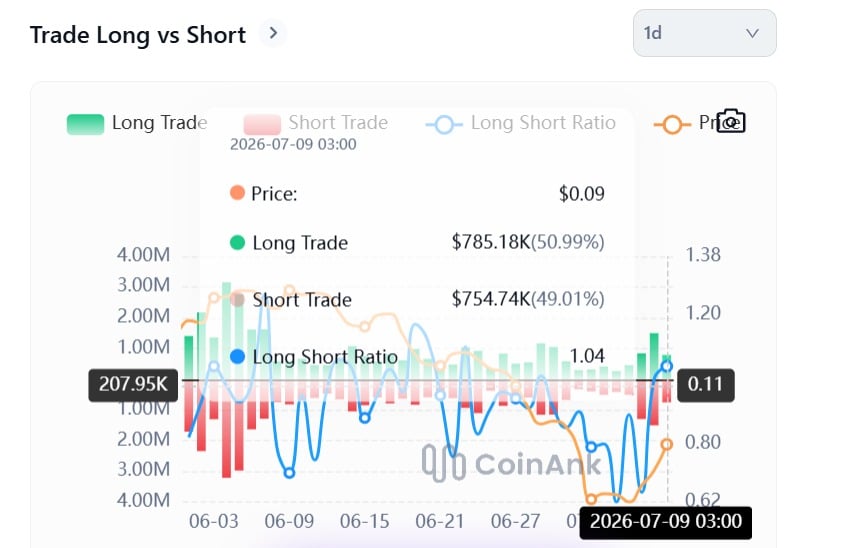
In fact, the speculative demand rebounded significantly. According to Coinank, PI’s Long/Short Ratio has remained above 1 for two consecutive days.
Source: Coinank

At press time, the metric was 1.04, with 50.9% accounting for long positions. When traders mostly open longs, it suggests they were bullish and anticipated further gains.

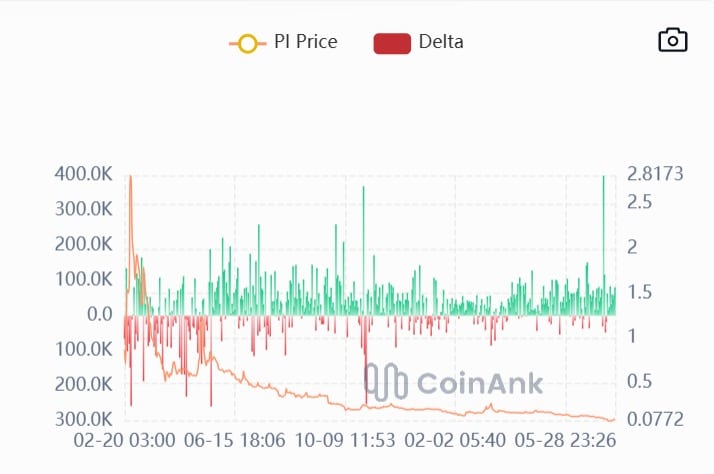
Moreover, investors on the spot side have been aggressively accumulating PI. Notably, the market Delta has remained positive for nine consecutive days.
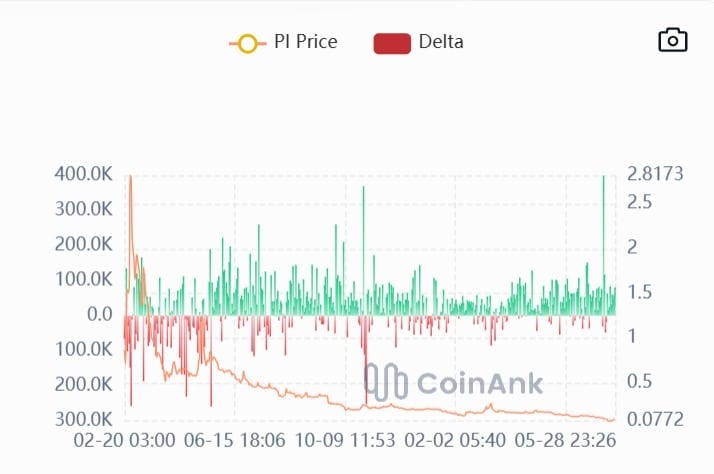
Source: Coinank

A positive delta suggests that market demand is currently strong, with buyers actively pushing prices higher. This is often a strong bullish confirmation.

Typically, when both speculators and spot buyers are active, it strengthens the market, setting the stage for further gains on price charts.

Can the momentum hold?

PI has experienced strong upside momentum, closing at higher highs for four consecutive days. As a result, the altcoin flipped both the 21 and 9-day Moving Averages, signaling strong upside momentum.
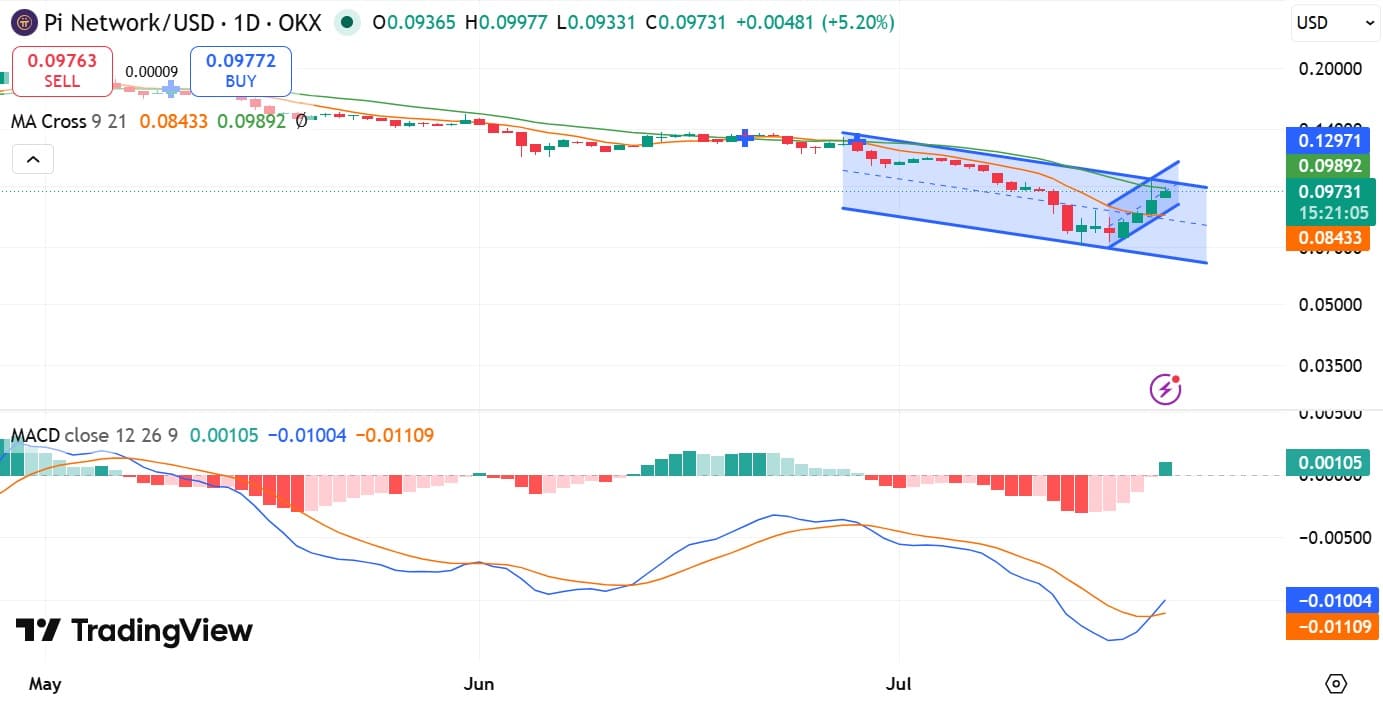
Source: TradingView

At the same time, the altcoin’s MACD formed a bullish crossover, rising to -0.009, further confirming the strengthening trend. However, the MACD remained negative, indicating that buyers have not yet fully retaken and dominated the market.

For now, if the upcoming upgrade incentivizes more market players to retake, the altcoin will make further gains. In doing so, PI will hold above $0.10 and target the $0.12 resistance.


Final Summary

  • Pi Network extended its bullish streak, rising by 11% to $0.1 before slightly retracing to $0.098 at press time.
  • PI has experienced renewed demand as traders reposition ahead of the upcoming protocol v25 upgrade.


Trending Cryptos

Related Questions

QWhat is the significance of Pi Network's Protocol v25 upgrade scheduled for July 22nd?

AThe Protocol v25 upgrade aims to improve the Pi Network's reliability and stability, add capabilities for more efficient and privacy-preserving smart contracts, and introduce BN254 cryptography and Poseidon hashing to enable developers to build modern zero-knowledge applications.

QWhat are the key on-chain and market indicators suggesting about trader sentiment towards PI ahead of the upgrade?

AKey indicators show bullish sentiment: PI's Long/Short Ratio remained above 1 for two consecutive days, with 50.9% long positions at press time. Additionally, the market delta has stayed positive for nine consecutive days, indicating strong demand and buyers actively pushing prices higher.

QBased on the technical analysis in the article, what is the potential price target for PI if the current momentum holds?

AIf the current momentum holds and the upgrade incentivizes more market players, the article suggests PI could hold above $0.10 and target the $0.12 resistance level.

QWhat recent price action did Pi Network (PI) experience according to the press time data?

AAt press time, PI was trading at around $0.098 after rising 11% on the daily charts. It had briefly reclaimed the $0.1 level before slightly retracing.

QHow did the trading volume and market capitalization of PI change alongside its recent price increase?

AThe recent price hike was backed by a 200% jump in trading volume, and the market cap reclaimed $1 billion, reflecting steady capital flow into the asset.

Related Reads

L2 'Recalibration': When L1 Becomes Its Own Rollup, What Is Ethereum's Endgame?

The article discusses the evolving relationship between Ethereum's Layer 1 (L1) and Layer 2 (L2) solutions, moving beyond the initial "L2 for scaling" model. As Ethereum L1 itself scales (increasing Gas Limit, statelessness, zkEVM), the unique value proposition of L2s shifts from merely providing cheap execution to offering differentiated features like application-specific optimization, privacy, and flexible governance. The piece explores three key themes: 1. **L2's New Role:** L2s are transitioning from a pure scaling technology to a spectrum of execution environments with varying degrees of security inheritance from Ethereum L1. 2. **Interoperability as State Trust:** Solving L2 fragmentation is less about cross-chain bridges and more about enabling faster, trust-minimized state verification between environments. This involves initiatives like faster L1 finality, intent-based architectures (Open Intents Framework), and native account abstraction. 3. **Blurring Layers:** With the potential integration of zk-proofs into L1 validation (making L1 akin to its own "Rollup") and the concept of "Native Rollups," the rigid boundary between L1 and L2 may fade. The future could be a unified system with multiple execution domains (for DeFi, gaming, privacy, etc.) sharing a common security, settlement, and state framework. In conclusion, Ethereum's goal is not to abandon L2s or re-centralize everything on L1, but to re-integrate the fragmented user experience—liquidity, accounts, applications—while preserving the scaling benefits of a multi-environment ecosystem. The endgame is a cohesive "one chain" feeling for users, powered by diverse but securely interconnected execution layers.

marsbit8m ago

L2 'Recalibration': When L1 Becomes Its Own Rollup, What Is Ethereum's Endgame?

marsbit8m ago

The Encryption Bill Clarity's Challenge: A Thorny Path of Bipartisan Compromise in the U.S.

U.S. lawmakers are attempting to advance the Clarity Act, a significant crypto market structure bill, but its path is fraught with partisan hurdles. The process has been rocky since January, when a prior bipartisan deal in the Senate Banking Committee was upended. A key compromise in May on "yield" issues allowed the bill to move forward in committee, but only with the conditional support of two Democratic senators, Angela Alsobrooks and Ruben Gallego. They emphasized that their final vote depends on reaching an agreement on ethics provisions for elected officials. Ultimately, the Senate Agriculture Committee passed its version along party lines without Democratic support. As Republicans push for a full Senate vote in July, the demand for strong ethics language has expanded beyond Democrats. Additional controversies surround provisions related to yields (aligning some Republicans with large banks) and developer protections (opposed by enforcement agencies). Core concerns about illicit finance and consumer protection remain central to the debate. Despite consensus on the need for legislation, achieving the necessary bipartisan compromise is proving difficult. While momentum exists—including recent meetings between senators and White House officials—a reconciled bill text faces skepticism. Senator Gallego has stated that without ethics terms acceptable to Democrats, they will not provide the needed votes. The immediate goals for the crypto community in Congress are unclear: a symbolic Senate vote before the August recess, eventual passage into law by 2026, or forging a final compromise framework. The arduous, vote-by-vote effort to build bipartisan support continues, mirroring the traditional legislative grind the industry must now navigate.

Foresight News59m ago

The Encryption Bill Clarity's Challenge: A Thorny Path of Bipartisan Compromise in the U.S.

Foresight News59m ago

Trading

Spot

Hot Articles

Discussions

Welcome to the HTX Community. Here, you can stay informed about the latest platform developments and gain access to professional market insights. Users' opinions on the price of S (S) are presented below.

活动图片