STRC's First Financial Report Post-Depegging, How is Strategy Restoring the Capital Flywheel?

Odaily星球日报Published on 2026-07-31Last updated on 2026-07-31

Abstract

On July 31, 2026, Bitcoin treasury company Strategy released its Q2 financial report. Despite a 6.9% year-over-year increase in revenue to $122 million, the company recorded a substantial net loss of $8.22 billion, primarily due to $8.32 billion in unrealized losses from Bitcoin holdings. While Strategy's core Bitcoin strategy remains intact—its holdings grew 11% to 843,775 BTC—the company is undergoing a fundamental shift in its capital model. Following the de-pegging of its key financing tool, the STRCoin (STRC), from its $100 target in May, Strategy has pivoted from a one-directional "raise funds, buy Bitcoin" cycle to a more dynamic, multi-asset capital management approach. A key part of this new framework is the "Monetization Program," through which Strategy has sold approximately $218.4 million worth of BTC to bolster liquidity. The company's top priority is repairing STRC's peg, committing not to issue discounted shares until it returns to its target range. It has initiated a $1 billion buyback program for discounted digital credit securities, having repurchased $28.9 million face value of STRC so far. Management aims to restore the peg around September 8, 2026. Strategy now actively manages a matrix of assets: Bitcoin (for accumulation or strategic sales), USD cash reserves (now at $3.75 billion), common stock (MSTR), and digital credit securities like STRC. This allows for tactical moves like repurchasing discounted debt or equity to capture value. The future suc...

Original | Odaily Planet Daily (@OdailyChina)

Author | Azuma (@azuma_eth)


On July 31, Beijing time, the bitcoin treasury company Strategy officially released its financial report for the second quarter of 2026 after the US stock market closed.

The financial report shows that Strategy's total revenue for Q2 was $122 million, a year-on-year increase of 6.9%; however, affected by Bitcoin price fluctuations, the company recorded a net loss of $8.22 billion, with unrealized losses from changes in the fair value of digital assets amounting to $8.32 billion.
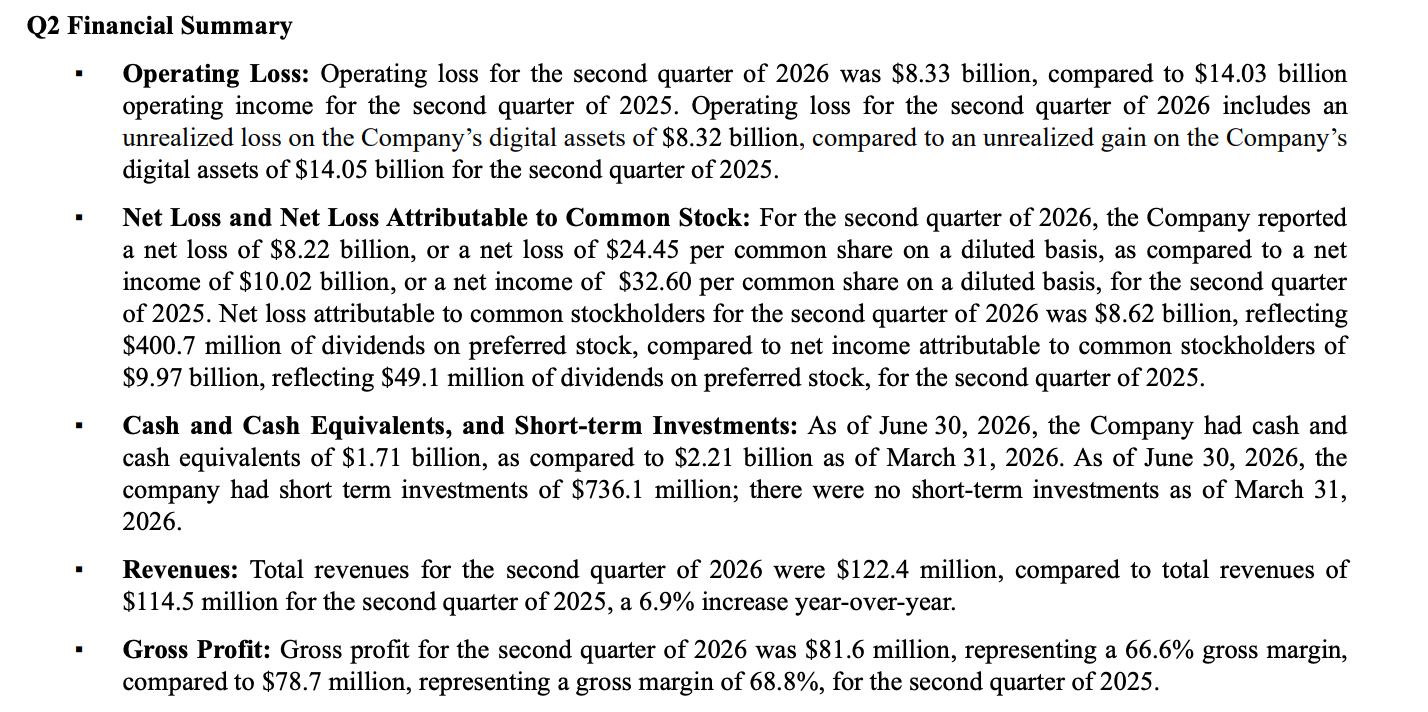
From a purely traditional financial reporting perspective, this is undoubtedly a poor report card. However, for Strategy, the market had already anticipated the decline in the net value of reserve assets during the BTC downtrend cycle. The more pressing question for investors is — after undergoing its most severe capital structure stress test since inception, can Strategy prove the sustainability of its financing model again?

Since May this year, Strategy's most important financing tool, STRC, has gradually deviated from its target par value of $100, once dropping to a low of $74.57. As of the close of the US market today, it temporarily reported $89.5, still not back to its peg.

Today's financial report can be seen as the first detailed answer sheet submitted by Strategy since the STRC crisis began to unfold. The results show that Strategy remains committed to its Bitcoin strategy, but its capital model has undergone a dramatic change — from the relatively fixed cycle of continuous fundraising and hoarding BTC in the past, to more active capital management using cash reserves, preferred stock, common stock, and the BTC assets themselves.

BTC Reserves Continue to Grow, But 'Buying' Is No Longer the Only Option

In the second quarter, Strategy's overall BTC holdings continued to grow.

Financial report data shows that as of the end of Q2, Strategy holds 843,775 BTC, an increase of approximately 11% from the previous quarter. The company's current Bitcoin reserve value is approximately $55 billion, with an average holding cost per BTC of about $75,000. This means that despite recording huge paper losses due to BTC price volatility, Strategy is still adhering to its core strategy of being a "Bitcoin Treasury."

Furthermore, Bitcoin per Share for Strategy increased from 201,170 sats to 210,824 sats in Q2. From this metric, Strategy still achieved positive asset accumulation in Q2.

However, it is important to note that since the launch of the "Digital Credit Capital Framework" aimed at solving the STRC depegging issue at the end of Q2 (June 29), Strategy's current BTC capital system has been reconfirmed to no longer have only the "buy" direction.

  • Odaily Note: For details on the "Digital Credit Capital Framework," please refer to "Lightning Five-Whip! Strategy's Self-Rescue Plan Officially Released."

In this financial report, the company systematically disclosed the progress of the BTC "Monetization Program" (part of the "Digital Credit Capital Framework" plan) for the first time — as of July 26, Strategy has sold approximately $218.4 million worth of BTC through this program.

This means that for Strategy, BTC is gradually shifting from being a purely long-term reserve asset in the past to becoming an actively managed tool on the balance sheet.

Although Strategy still emphasizes treating BTC as a core reserve asset, as the digital credit system expands, Strategy is trying to establish a more flexible capital structure — in a favorable market environment, raise funds by issuing securities to expand BTC reserves; when market conditions are under pressure, manage liquidity through cash reserves, securities repurchases, and the BTC monetization program.

The Top Priority Now is Still Fixing STRC

During the investor conference call following the earnings release, Strategy's management clearly stated: "Bringing STRC back to its par value is the company's core task at present."

Facing the current situation where STRC is still trading at a discount around $89.5, Strategy's management outlined several feasible paths to push STRC back to its target trading range during the call.

Strategy founder Michael Saylor emphasized that before STRC recovers to its target range, Strategy will not issue a single share of STRC at a discount, to avoid harming existing investors' interests. In other words, Strategy's current priority is not to continue stimulating financing, but to first repair market trust in its digital credit system.

Addressing market speculation that the company might continuously increase the dividend rate to stimulate STRC buying pressure, Strategy CEO Phong Le clarified that increasing the STRC interest rate is not an effective way to drive the price back to par, and the company plans to maintain the annual dividend rate at 12%. Compared to further increasing the yield, Strategy currently hopes to restore market confidence by bolstering its cash safety net — as of July 26, Strategy's USD reserve has been increased to $3.75 billion, sufficient to cover preferred stock dividends and debt interest payments for over 2.1 years.
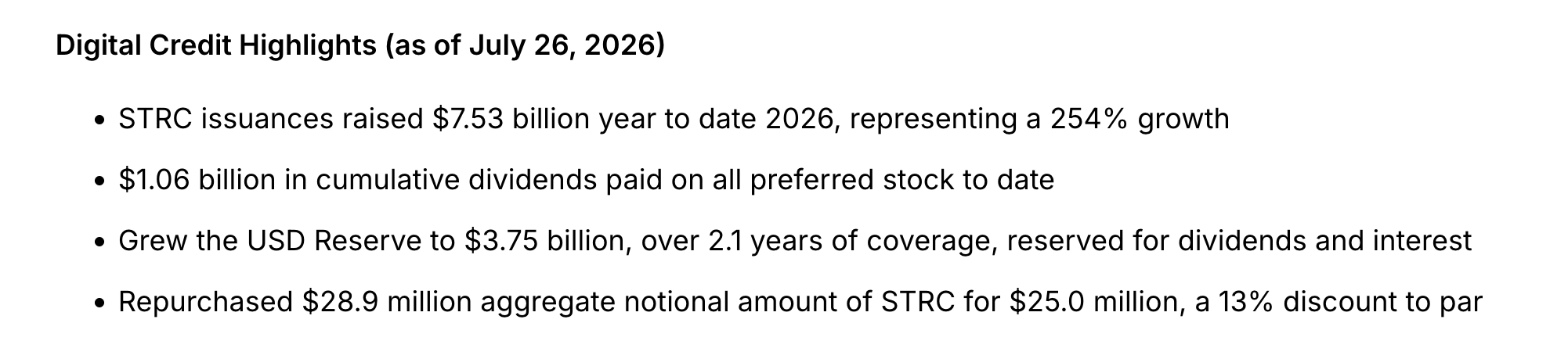
In the previously mentioned "Digital Credit Capital Framework," Strategy disclosed a plan to launch up to $1 billion in digital credit securities repurchases, which would prioritize repurchasing discount-trading STRC. To date, Strategy has repurchased approximately $28.9 million in face value of STRC, with an actual payment of $25 million.

Saylor also emphasized that there is still $975 million in available capacity under this repurchase plan. If $975 million is insufficient to fill the gap, Strategy's total reserves of up to $58.5 billion can provide backup funding support.

Saylor gave a clear reference timeframe for re-pegging during the call — when STRC was first listed, the company spent about 70 trading days to push it from around $90 back near par. Since STRC fell below the $99 pegging range on May 28, 40 trading days had passed as of the earnings call. Strategy management is targeting the same 70-trading-day repair cycle, setting September 8 (the 70th trading day) as a key reference node for pushing STRC back to its peg.

Strategy Shifts to Active Capital Management

If the logic of Strategy's previous capital flywheel could be summarized as the one-way cycle of "issue stock/debt ➡️ buy BTC ➡️ drive NAV and stock price up ➡️ continue financing ➡️ continue buying BTC," then this quarter's financial report clearly declares the end of this one-way model, replaced by "two-way active capital management."

During the conference call, Phong Le elaborated on this shift. The current Strategy is no longer just a one-way "buyer." Instead, it has integrated the four core elements on its balance sheet — BTC, USD cash reserves, common stock (MSTR), and digital credit (preferred stock/convertible bonds like STRC) — forming a dynamic management matrix for multi-directional allocation:

  • BTC shifts from 'One-way Hoarding' to 'Flexible Monetization': It can not only serve as underlying reserves but can also, when necessary, be monetized to replenish USD reserves, pay preferred stock dividends, or even provide funds for securities repurchases.
  • Capital Tools Shift from 'One-way Issuance' to 'Two-way Arbitrage and Repurchase': When STRC or common stock trades at a discount or is undervalued in the market, the company can initiate repurchase plans of up to $1 billion each to capture gains in Bitcoin per Share (BPS); when a certain asset is trading at a premium, targeted issuance can be conducted.
  • Active Optimization of Debt Structure: In Q2, Strategy repurchased $1.5 billion in convertible bonds at an 8% discount during a market pullback, reducing long-term debt from $8.2 billion to $6.7 billion, a net debt reduction of 18%.

By flexibly allocating various assets, Strategy is attempting to prove that it is not merely a passive ETF alternative fluctuating with the coin price, but an operating company capable of using capital market volatility for self-regulation and liability management.

Future Tests: STRC Re-pegging & BTC Price

Overall, the Q2 financial report demonstrates Strategy's risk resilience and model adjustment capabilities to some extent. However, whether this capital flywheel can regain acceleration still fundamentally depends on one short-term and one long-term test.

The short-term test is the result of STRC's repair. Although the STRC discount has eased somewhat since the "Digital Credit Capital Framework" was released, it has not fully returned to its peg yet. As the cornerstone of the digital credit system, whether STRC can return to its target trading range as soon as possible will directly determine the market's baseline trust in its credit expansion ability and is a prerequisite for its flywheel to restart fundraising through issuance.

The long-term test is the trend of BTC's price. All of Strategy's capital arbitrage and liability management are ultimately built upon the long-term appreciation expectation of Bitcoin. Only if BTC emerges from its slump and returns to an upward trend can its growth logic receive genuine support.


Trending Cryptos

Related Questions

QWhat were the key financial highlights from Strategy's Q2 2026 earnings report?

AStrategy reported Q2 2026 total revenue of $122 million, a 6.9% year-over-year increase. However, due to Bitcoin price volatility, the company recorded a net loss of $8.22 billion, including $8.32 billion in unrealized losses from the fair value change of its digital assets.

QWhat is the primary challenge Strategy is facing according to the article, and what is their core task to address it?

AThe primary challenge is the depegging of its key financing tool, STRC, from its target face value of $100. The company's core task is to repair the STRC and restore its value to the target parity range, which is considered a prerequisite for restarting its capital flywheel.

QHow did Strategy's Bitcoin holdings change in Q2, and what is a significant shift in how they manage this asset?

AStrategy's Bitcoin holdings grew by approximately 11% in Q2 to 843,775 BTC. A significant shift is that Bitcoin is no longer managed solely as a long-term reserve for accumulation ('buy-only'). It is now also used as an active management tool, as demonstrated by the 'Monetization Program' which sold approximately $218.4 million worth of BTC by July 26.

QWhat is the 'Digital Credit Capital Framework,' and what action has Strategy taken under it regarding STRC?

AThe 'Digital Credit Capital Framework' is a plan launched to address the STRC depegging issue. As part of this framework, Strategy initiated a digital credit securities repurchase plan of up to $1 billion, prioritizing the buyback of discounted STRC. As of the report, the company had repurchased approximately $28.9 million face value of STRC for $25 million.

QAccording to the article, how has Strategy's capital management model fundamentally changed?

AStrategy's capital management model has shifted from a one-directional flywheel of 'issue equity/debt -> buy Bitcoin -> drive net asset value/stock price -> issue more -> buy more Bitcoin' to a two-way, active capital management matrix. This involves flexibly reallocating between four core elements: Bitcoin, USD cash reserves, common stock (MSTR), and digital credit securities (like STRC), including activities like asset monetization, opportunistic repurchases, and debt structure optimization.

Related Reads

Analyzing the Impact of AI on Economic Growth and Productivity

**Title: Analyzing AI's Impact on Economic Growth and Productivity** This article examines three contrasting views on AI's influence on economic growth and productivity. **The Optimistic View** posits that AI, especially through automating R&D ("recursive self-improvement"), could dramatically accelerate growth, even triggering a technological "singularity" with explosive, potentially infinite, economic expansion. **The Moderate/Mainstream View** acknowledges AI's productivity benefits but emphasizes significant real-world constraints that could limit its impact. These include: limited cost savings per task, structural ceilings on which jobs and industries are "exposed" to AI, adoption bottlenecks (e.g., compute, energy, regulatory hurdles), and the "weak link" effect where non-automatable tasks cap overall gains. Consequently, the realized AI dividend may be far lower than optimistic projections, with estimates typically ranging from 0.1% to 1.3% annual productivity growth. **The Pessimistic View** stems from two strands. The first aligns with the moderate view but applies extremely conservative assumptions about task exposure and efficiency gains, yielding minimal projected impact. The second introduces a demand-side critique: if AI primarily replaces rather than augments labor, it could depress labor's share of income, weaken consumer demand, and create a "demand trap" that ultimately stifles growth, unless offset by redistribution policies. **The authors' assessment** is nuanced: * **Short-term (1-2 years):** AI will support growth primarily through investment spending, not significant productivity gains. * **Medium-term (3-5 years):** Three potential paths emerge based on AI demand and bottleneck severity: 1. **"Optimistic Path":** High demand, few bottlenecks. Rapid productivity gains but risk of major job displacement and social conflict without redistribution. 2. **"Moderate Path" (most likely):** High demand but significant, surmountable bottlenecks. Leads to moderate productivity gains, financial market volatility (K-shaped returns), and sectoral job losses. 3. **"Pessimistic Path":** Low demand or severe bottlenecks. Minimal productivity and growth impact, triggering financial market corrections but allowing a smoother societal transition with less labor disruption. * **Long-term:** AI holds potential for a major productivity revolution and prosperity. The conclusion stresses that no path is smooth. Technologically "optimistic" outcomes could be socially detrimental, while "pessimistic" technological diffusion might be more socially stable. Policymakers must monitor developments and prepare balanced responses to manage economic, financial, and social sustainability.

marsbit9m ago

Analyzing the Impact of AI on Economic Growth and Productivity

marsbit9m ago

The New Cold War is a Tech Stock War

The New Cold War is a Tech Stock War The article argues that the contemporary geopolitical and economic rivalry between the US and China represents a "New Cold War," but one fundamentally fought through technology and financial markets, not physical barriers or conventional trade. Historically, US dominance was secured through financial systems. The Soviet Union, reliant on the rigid "Transferable Ruble," was ultimately undermined by its dependency on the US dollar for oil trade. Later, Japan's semiconductor challenge was countered not just by tariffs (e.g., Plaza Accord, 301 investigations) but by binding it to US Treasury bonds. China presents a more complex, "embedded" challenger. While it holds vast dollar reserves and US debt like Japan, its industrial base is stronger and more diversified than the Soviet Union's. Surviving the initial 2018 trade war phase, the conflict has evolved into a "tech-financial war." The core battlefield is now the stock market. US tech stocks (AI, semiconductors) are treated as sovereign assets, buoyed by bipartisan national will. China is pushing to strengthen its own financial markets to convert industrial strength into financial power and fund its tech ambitions. Companies like ChangXin (semiconductors), Moonshot AI, and DJI compete not just for market share but as financial proxies for their respective systems. The new paradigm is moving from globally efficient monopolies (Apple, Google) towards companies that achieve monopolistic profits within their respective geopolitical spheres. This competition over "pricing power" and financial valuation in segmented markets defines the current era, making the stock market the primary arena for this tech-centric struggle.

marsbit18m ago

The New Cold War is a Tech Stock War

marsbit18m ago

RWA Weekly: Ten European Financial Institutions Establish Tokenized Asset Cooperative; Ondo Launches New Execution Network Ondo Network

RWA Weekly: European Banks Form Tokenized Asset Cooperative; Ondo Launches New Execution Network Ondo Network Covering July 24-31, 2026, the RWA sector saw a steady on-chain total value locked (TVL) of $36.8 billion, with holder count hitting a record high. However, stablecoin transfer volumes fell sharply (~30%), indicating low on-chain settlement demand. Key regulatory moves include South Korea advancing stablecoin legislation and a push to scrap crypto taxes, Kenya lowering capital requirements for stablecoin issuers, and Zimbabwe approving seven projects for its crypto sandbox. In project developments, BIS-led Project Agorá successfully tested cross-border payments with tokenized funds across six currencies. Ten major European financial institutions formed the RL1 blockchain cooperative to build tokenized asset infrastructure. Other notable updates: Aviva launched a tokenized dollar liquidity fund on XRPL, POSCO International tokenized commercial invoices on Injective, and a Brazilian farmer used tokenized cattle as collateral for a loan. Additional progress includes BNY Mellon migrating its core transfer agent operations to blockchain, Securitize gaining SEC investment advisor registration, and Tether’s compliant stablecoin USA₮ launching on Celo. Ondo Finance introduced Ondo Network, a new execution layer focused on speed and privacy, moving away from its initial chain plans. An analysis highlights that despite the growing scale of on-chain RWAs (~$32B), approximately 90% remain underutilized in DeFi, pointing to a critical challenge in unlocking liquidity and fostering real-world application beyond mere issuance.

marsbit19m ago

RWA Weekly: Ten European Financial Institutions Establish Tokenized Asset Cooperative; Ondo Launches New Execution Network Ondo Network

marsbit19m ago

South Korean Stock Market Sees Sharp Rebound After Forceful De-leveraging, SK Hynix Rises 30%

On July 31, South Korean stocks staged a historic rebound. The benchmark KOSPI index surged 18.27%, with chipmaker SK Hynix hitting a 30% gain limit. This followed a brutal, near-40% decline in the KOSPI over the previous month, driven largely by a deleveraging spiral involving leveraged ETFs. Analysts attributed the sharp sell-off to structural liquidity issues rather than deteriorating corporate fundamentals. The rally was triggered by a confluence of positive catalysts. Firstly, strong earnings from U.S. cloud giants Microsoft and Amazon alleviated fears of an "AI bubble burst," boosting global tech sentiment. Secondly, SK Group Chairman Chey Tae-won made a rare personal purchase of SK Hynix shares, seen as a strong vote of confidence. Thirdly, the South Korean government announced a 20 trillion won ($139 billion) AI investment fund. In response to the market turmoil, South Korean regulators are tightening controls on leveraged ETFs, admitting oversight shortcomings. Measures include raising minimum cash保证金 requirements for散户 investors and suspending new product launches. While the rebound signals eased liquidity pressure, analysts note deep structural issues remain. The market's future stability is seen as dependent on global tech capital expenditure trends and memory chip price cycles, with some viewing the surge as a technical correction rather than a definitive trend reversal.

marsbit39m ago

South Korean Stock Market Sees Sharp Rebound After Forceful De-leveraging, SK Hynix Rises 30%

marsbit39m ago

Trading

Spot

Hot Articles

Discussions

Welcome to the HTX Community. Here, you can stay informed about the latest platform developments and gain access to professional market insights. Users' opinions on the price of S (S) are presented below.

活动图片