Author: David Hoffman
Compiled by: Jia Huan, ChainCatcher
If you missed the news last week, I sold my ETH.
For someone who has built a career, community, identity, and business around Ethereum, this was not an easy decision.
The reasons behind the decision to sell require a more thorough explanation than scattered tweets on Twitter.
The "ETH is Money" thesis hasn't failed... it has simply been realized. Ethereum has gotten the ETH price it deserved, and I don't believe ETH as an asset will be revalued, either up or down.

"ETH is Money" is the core narrative proposed by author David Hoffman in 2019 and long promoted through Bankless, arguing that ETH should become a global store of value. It was once one of the most mainstream bullish logics for Ethereum.
P.S.: I am extremely bullish on Ethereum. I expect the Ethereum network to perform exceptionally well from now on. But I believe only a very small portion of that success will be reflected in ETH.
The full article is as follows:
ETH is Money Was Always an Aspiration
Money is a coordination game, and coordination is very difficult.
The Ethereum project itself is a series of coordination challenges stacked on multiple levels, and the "ETH is Money" thesis required success at all these levels, unequivocally.
ETH could become money if and only if every layer of Ethereum's techno-social stack outperformed its competitors.
Given the ambition of the Ethereum project, achieving its most successful version was always a massive challenge. Despite shortcomings, the Ethereum project has performed exceptionally well and fully deserves its existing market capitalization.
Nevertheless, the window of opportunity for the market to "revalue" $ETH appears to be closing.
In some sense, ETH is money. But it's not the maximally successful version we collectively aimed for.
Ethereum is a Coordination Game
Turing-complete blockchain is such a powerful idea that Ethereum's maximum potential is the entire crypto world. To encompass everything.
The only obstacle to Ethereum achieving 100% absolute dominance over all things is coordination.
Ethereum's leadership needs to be sufficiently decentralized, its governance needs "rough consensus" to create credible neutrality, maximizing Ethereum's adoption at the highest level.
Ethereum leadership needs to react swiftly to market dynamics, operating like a startup facing an existential threat of marginalization.
Ethereum L2s need to operate and make their own market choices independently of the base layer, but they also need to be economically bound and constrained by the broader Ethereum economy and brand.
Ethereum's roadmap needs to be executed in a specific sequence to maximize and maintain Ethereum's momentum and market dominance, fully quelling competition and maximizing confidence in Ethereum and ETH.
Key technology R&D and engineering implementation need to be fast enough so that Ethereum can both prove its utility to the outside world and stay ahead of competitors.
The "ETH is Money" thesis was about creating an exceptionally revolutionary and powerful financial asset, attracting otherwise indifferent individuals with its unique properties as the superior global store of value.
Ethereum's brand and ETH's strength need to be so powerful that major traditional capital not only feels safe but actively positions ETH as a significant allocation in their retirement portfolios because of the Ethereum project's dominance.
For "ETH is Money" to happen, everything upstream of ETH needed to function with extreme perfection.
Ethereum is not Bitcoin; it chose the hard path. Bitcoin stripped everything off its blockchain to elevate BTC.
Ethereum chose to add everything to its blockchain to maximize the utility of its block space. Only by doing this in the best possible way before competitors could ETH achieve its status as global money.
We have come a long way, and Ethereum has already achieved the maximum potential market share it deserves.
I fear the window to play this game has closed.
The Macro Environment May Never Allow It to Happen
Looking back over the past few years, I see a large set of macro headwinds that Ethereum needed to overcome.
1. L1 Assets Are Inextricably Linked to Revenue
Say what you will about how difficult it is to evaluate smart contract chains based on fees and revenue, but fees and revenue are clearly how smart contract L1 assets increase their pricing power.
By 2026, we have ample data showing all these factors are closely correlated: L1 activity, L1 fees, and price appreciation of the L1 native asset.
In 2021, when ETH had the highest share of L1 revenue, it dominated.
In 2024, when SOL's share of L1 revenue broke out industry-wide, it dominated.
In 2026, NEAR is undergoing price revaluation while simultaneously seeing fundamental growth in its L1 revenue and NEAR burn.
You can also look at assets like BNB and TRX, which are perhaps the highest cumulative revenue projects of all time. Their price charts look exactly like what I once expected ETH's to look like—if only ETH could have maintained its L1 fee dominance longer than just that stretch in 2022.
2. The Strong Version of Crypto Didn't Work
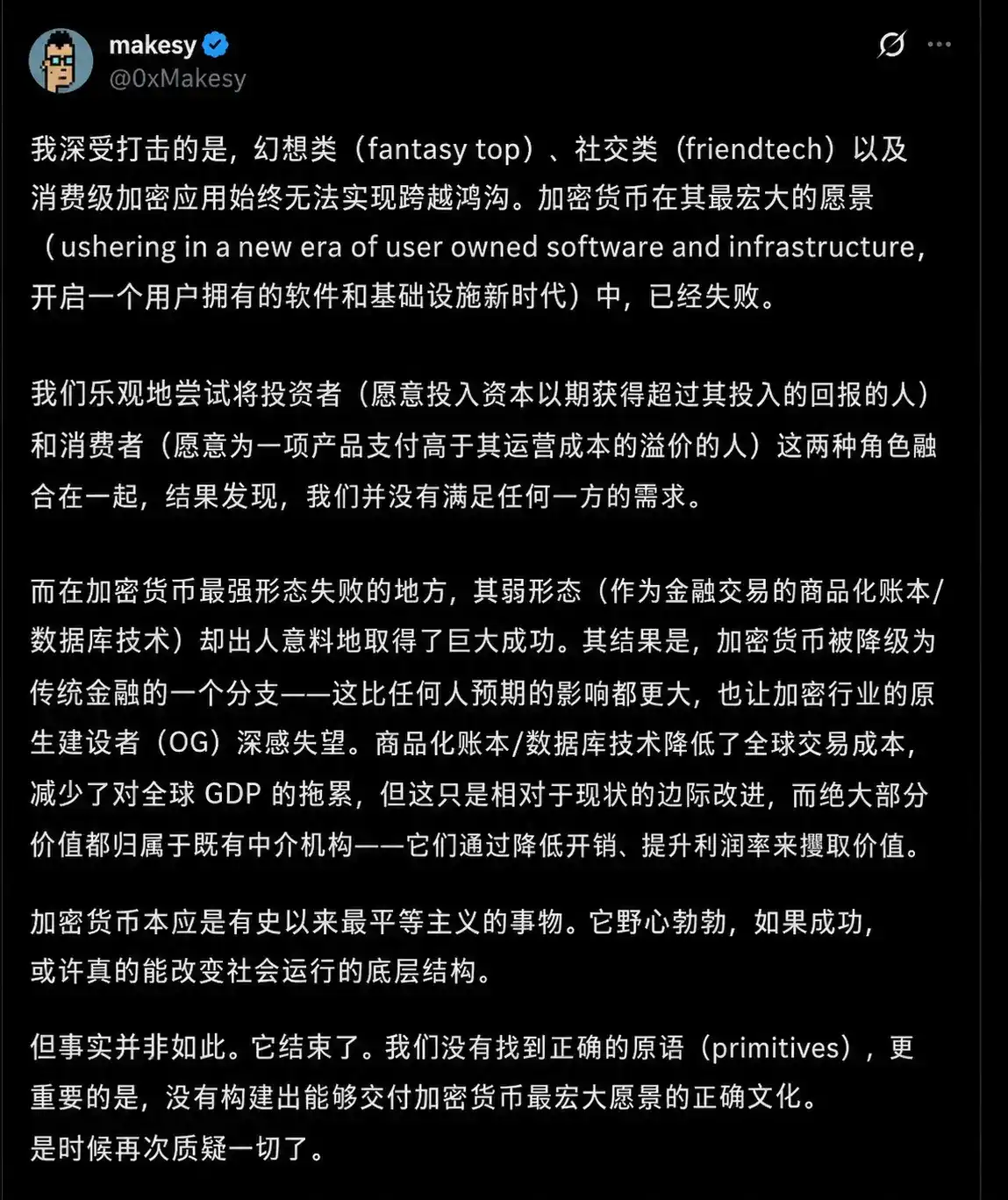
@0xMakesy put it well:
Ethereum represented the strong version of crypto, crypto for crypto's sake, self-sustaining and self-perpetuating. DeFi, NFTs, DAOs, we were the rebels, building a financial system of the people, by the people, plugging imagination into the money system.
Then there was the weak version: efficient ledger infrastructure for the backends of financial institutions. The weak version would fuel the strong version, channeling demand for an internet ledger into inward flowing capital, into crypto, into Ethereum, and finally into ETH.
Maybe if Ethereum executed better, faster, stronger, if crypto hadn't attracted such a large cohort of speculative hustlers and value extractors, the industry could have won the influence and respect I always thought it deserved.
But the only period where crypto maintained a positive brand image with the public was from late 2020 to early 2022. Outside this narrow window, crypto's reputation has been fraud, scams, get-rich-quick schemes, and uselessness to ordinary people.
ETH is Money Relied on "Strong Crypto"
It was at that moment when everyone was forced online that ETH emerged as the internet's money. The world discovered crypto for the first time, and for a brief window, it was very cool.
Money is a coordination game, and the Schelling Point of a money is held together by belief. In 2021, a broad public believed in ETH: it was cool, disruptive, and populist. Bitcoin shared these properties and has retained them better than ETH post-2021.
This raises a disconcerting possibility: the strong version of crypto may never have been a stable equilibrium. Covid was an extremely distortive time for money, and maybe "ETH as money" was only supported because of that distortion.
If so, ETH becoming money always depended on the strong version of crypto working better than it ever did in reality.
3. Ethereum's Utility Benefits Other Moneys Just as Much
Is Bitcoin money? Is the dollar money? Is gold money? It doesn't matter—whatever is money will be tokenized on Ethereum.
In 2020, Nic Carter argued on Bankless that stablecoins would likely parasitize ETH as Ethereum's native unit. Back then, Ethereum had $3B in stablecoins. Today, that number is $163B, a 54x increase.
The utility provided by Ethereum is helping expand the monetary network of whatever is truly money, which is why the US is so bullish on using crypto to proliferate stablecoins. Ethereum is helping America maintain dollar hegemony, and leveraging this fact is explicit government policy.
Clearly, the positive spillover for $ETH as money is far less powerful than what the US government sees in the Ethereum stablecoin ecosystem.
Ethereum is a Giver, Not a Taker
At its core, Ethereum is a giver, not a taker.
It provides the world's most secure block space to L2s at cost.
It tokenizes all the world's assets at cost.
It secures billions in DeFi at cost.
Ethereum charges no markup on anything it does.
This is the nature of open-source software and the power of Ethereum. Ethereum offers its full suite of incredibly important value to the world at cost.
Ethereum is noble. Ethereum is excellent.
Ethereum is the world's most successful non-profit.
Naturally, massive adoption will occur on Ethereum. It was and will continue to be the most impactful open-source software project ever built by humans, and being a "non-profit protocol" is one of its core characteristics.
This is why the path for ETH to become money depended on maintaining sustained, incredibly high market dominance.
Eventually, as block space commoditizes, fees trend to zero. That's fine for Ethereum as long as it's Ethereum, not a competitor, that achieves commoditization and maintains its margins and dominance.
Eventually, Fat Protocol Theory gives way to Fat Application Theory, and applications swallow remaining profits.
That's fine for ETH as long as they're Ethereum's applications, not a competitor's.
It's hard to reconcile "ETH is Money" with "Ethereum is a giver, not a taker." Ethereum's architecture is intentionally designed to give everything back to its ecosystem and take only the bare minimum required to keep the network running.
Architecturally, ETH is not prioritized within Ethereum; this is a feature, not a bug. ETH could only become money if Ethereum won a battle it architecturally refuses to fight.
This could have worked if Ethereum had maintained incredible market dominance.
The Thesis Asks Too Much of Ethereum
"ETH is Money" required everything to go right for Ethereum. The margin for error was far smaller than I originally believed. Ethereum's momentum in 2021 and 2022 made it feel like "ETH is Money" was the default path.
In hindsight, Solana's 2021 rise alongside rising anti-Ethereum sentiment was the first major sign that Ethereum and ETH's coordination game wasn't going according to plan.
The Ethereum Foundation needed to decentralize and allow alternative power structures to emerge. But it also needed to respond to market forces with the urgency and drive of a startup facing existential elimination.
L2 teams needed freedom of self-determination but also needed to operate under the larger umbrella brand of Ethereum and ETH. Technical sync integrations between Ethereum and its L2s needed to be executed much faster.
Smart contract chains are valued by fees, and to break out of that pattern, Ethereum needed to rewrite the rules with overwhelming success.
My Reason for Selling
It just didn't achieve its maximum potential either.
Ethereum did the noble thing, choosing the hardest, most ambitious, most ideologically pure path for its future.
It achieved some incredible victories and failed to win some challenges.
Ethereum has earned the market cap it deserves.
I am very bullish on the Ethereum network and its ecosystem—Ethereum is architected to maximize the success of its applications, L2s, and ecosystem. Fat Application Theory means Ethereum's apps take all the fees, and the rollup-centric roadmap means L2s take 97% of the profits.
As for the ETH asset, I struggle to see how it gets structurally revalued, either up or down.
So, my reason for selling ETH isn't bearish on ETH; it's that I believe the "ETH is Money" thesis has been realized, and I wish to allocate capital to other opportunities in the market that I am bullish on.