Big Short Burry Warns: Fed's RMP Aims to Conceal Banking System Fragility, Essentially a Restart of QE

深潮Published on 2025-12-12Last updated on 2025-12-12

Abstract

Michael Burry, of "The Big Short" fame, issued a warning that the Federal Reserve's new Reserve Management Purchases (RMP) program is a covert form of quantitative easing (QE) designed to mask deep-seated vulnerabilities in the US banking system. He argues that the need to inject liquidity, despite over $3 trillion in bank reserves, signals systemic fragility, not strength, stemming from the 2023 banking crisis. Burry contends that each crisis now forces the Fed to permanently expand its balance sheet to prevent funding crises. The market reaction showed rising 2-month Treasury yields and falling 10-year yield, alongside ongoing repo market volatility, raising concerns about year-end funding stress. He cautions against bullish bank stock advice and prefers Treasury money market funds for large deposits. While the Fed states RMP is a technical operation to ensure sufficient liquidity, Burry sees it as evidence of a weakened financial system reliant on constant central bank support.

Author: Zhang Yaqi

Source: Wall Street News

Michael Burry, the real-life inspiration for the movie "The Big Short," issued a stern warning about the Federal Reserve's latest bond-buying plan, pointing out that it is called "Reserve Management Purchases" (RMP) but actually exposes the deep-seated fragility of the U.S. banking system. He believes this move is essentially a restart of quantitative easing (QE), aimed at concealing the liquidity crunch facing the banking system, rather than the routine operation claimed by the Fed.

As previously reported by Wall Street News, the Fed announced overnight that it would begin purchasing short-term Treasury bonds as needed to maintain sufficient reserve supplies. The New York Fed simultaneously released a notice, planning to buy $40 billion in short-term Treasury bonds over the next 30 days. This is the latest action since the official halt to quantitative tightening last week. This move comes against the backdrop of unsettling interest rate fluctuations in the $12 trillion U.S. repo market recently, with ongoing turmoil in the money market forcing the Fed to act quickly.

However, Burry believes this action precisely indicates that the banking system has still not shaken off the aftermath of the 2023 small banking crisis. He warned that if the banking system still needs the central bank to "inject blood" despite having over $3 trillion in reserves, this is by no means a sign of strength but a strong signal of systemic fragility.

Burry further analyzed that each crisis seems to force the Fed to permanently expand its balance sheet; otherwise, it cannot avoid the outbreak of a bank funding crisis. The subsequent market reaction validated the tight funding conditions, with the U.S. 2-month Treasury yield jumping and the 10-year Treasury yield falling. At the same time, volatility in the repo market persists, sparking concerns about a year-end funding crunch and forcing investors to reassess the stability of the financial system.

Covert Quantitative Easing and a Fragile Banking System

Burry questioned the Fed's use of the term "Reserve Management Purchases," interpreting it as a covert move aimed at stabilizing the still struggling banking industry. According to FRED data, before the 2023 crisis, U.S. bank reserves were only $2.2 trillion, but have now climbed to over $3 trillion.

Burry issued a warning:

"If the U.S. banking system cannot operate without over $3 trillion in reserves or Fed 'life support,' this is not a sign of robustness but a symptom of fragility."

He added that the pattern now seems to be that after each crisis, the Fed needs to permanently expand its balance sheet, or else face the risk of bank funding chains breaking. While this mechanism partly explains why the stock market is performing strongly, it also reveals the financial system's extreme dependence on central bank liquidity.

Market Operation Mismatch and Hedging Strategies

From an operational perspective, Burry highlighted a significant strategic shift between the U.S. Treasury and the Fed: the Treasury tends to sell more short-term bills, while the Fed focuses on buying these bills. This strategy helps avoid pushing up the 10-year Treasury yield. As expected by the market, after the Federal Open Market Committee (FOMC) meeting, the U.S. 2-month Treasury yield rose, while the 10-year Treasury yield fell.
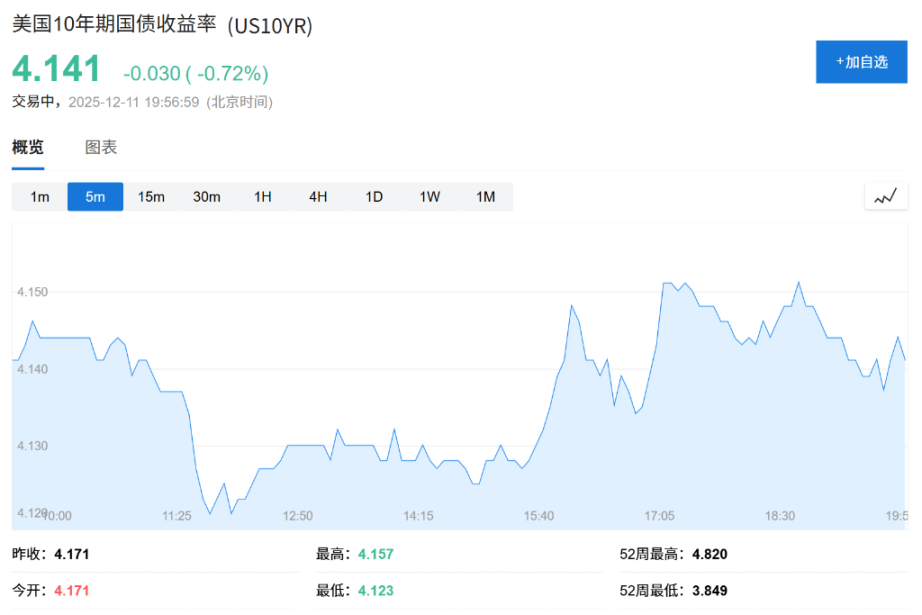
Given the ongoing volatility in the repo market, some analysts expect the Fed may need to take more aggressive action to avoid a year-end funding crunch. Against this backdrop, Burry sees this as further evidence of underlying weakness in the financial system. He warned investors to be wary of misleading advice from Wall Street about buying bank stocks and revealed that for funds exceeding the FDIC's $250,000 insurance limit, he prefers holding Treasury money market funds to hedge risks.

It is important to note that the primary goal of "quantitative easing" (QE) is to lower long-term interest rates by purchasing long-term Treasury bonds and MBS to stimulate economic growth. The purpose of RMP is more technical, focusing on buying short-term Treasury bonds to ensure there is enough liquidity in the financial system's "pipes" to prevent accidents. Bank of America stated that, based on the 2019 experience, liquidity injections will quickly lower the Secured Overnight Financing Rate (SOFR), while the response of the Federal Funds Rate (FF) will be relatively delayed. This "time difference" will create significant arbitrage opportunities for investors.


Related Questions

QWhat is Michael Burry's main criticism of the Federal Reserve's Reserve Management Purchases (RMP) program?

AMichael Burry criticizes the RMP as a covert form of quantitative easing (QE) designed to mask the underlying fragility of the U.S. banking system, rather than a routine operation as the Fed claims.

QAccording to Burry, what does the need for Fed 'lifesupport' despite over $3 trillion in bank reserves indicate about the U.S. banking system?

ABurry argues that if the U.S. banking system cannot function without over $3 trillion in reserves or Fed support, it is not a sign of strength but a symptom of systemic fragility.

QWhat market event prompted the Federal Reserve to initiate the RMP program?

AThe Fed's action was prompted by unsettling rate volatility in the $12 trillion U.S. repo market and ongoing turmoil in money markets, which forced the central bank to act.

QHow does Burry describe the pattern of the Federal Reserve's response to crises in relation to its balance sheet?

ABurry states that each crisis seems to force the Fed to permanently expand its balance sheet to avoid bank funding crises, revealing the financial system's extreme dependence on central bank liquidity.

QWhat investment strategy does Michael Burry recommend for funds exceeding the FDIC's $250,000 insurance limit?

AFor funds exceeding the FDIC's $250,000 insurance limit, Burry recommends holding Treasury money market funds to mitigate risk.

Related Reads

It's Bankless That Needs Ethereum, Not Ethereum That Needs Bankless

Titled "Bankless Needs Ethereum, Not the Other Way Around," this article analyzes the significant recent news involving Bankless, a prominent crypto media outlet. Bankless co-founder David Hoffman announced the sale of all his ETH holdings, while the company also reportedly underwent major layoffs, with its founders parting ways. The news, likened to a high-profile defection, initially sent shockwaves through the Ethereum community, given Bankless's historical role as a key evangelist and "semi-official" narrative builder for Ethereum. For years, through its podcasts and writings, Bankless championed core Ethereum ideas like "ultrasound money" and the blockchain's role as a new financial settlement layer, acting as a crucial community hub and belief system during its growth phase. However, the article argues this development is not necessarily negative for Ethereum. It suggests Bankless's "first mission"—serving as Ethereum's passionate, inward-facing "propaganda department"—has largely been completed. As Ethereum matures and moves towards mainstream, institutional adoption, the narrative baton has shifted. Today, the value propositions of ETH are increasingly communicated to traditional finance by asset managers like BlackRock and VanEck, public companies adding ETH to their treasuries, and established financial figures. This represents a natural evolution towards a more decentralized, professional, and institutionally-focused narrative network. Therefore, while Bankless's retreat marks the end of an era, it signifies Ethereum's growing resilience and its reduced reliance on any single entity for belief, as its story is now carried forward by a broader and more mature ecosystem of advocates.

链捕手14m ago

It's Bankless That Needs Ethereum, Not Ethereum That Needs Bankless

链捕手14m ago

Google Officially Declares War

Google Declares War with AI-First I/O 2026 At its 2026 I/O developer conference, Google launched an aggressive, multi-pronged offensive, embedding AI across its ecosystem and challenging rivals on performance and price. The event showcased three major releases: Gemini 3.5 Flash, the video-centric Gemini Omni Flash, and the system-level AI assistant Spark. Gemini 3.5 Flash, despite being a smaller "Flash" model, outperforms its Pro counterpart in key benchmarks like mathematical reasoning (GSM8K) and coding (SWE-bench). Google attributes this to "extreme knowledge distillation" from a larger teacher model and a novel, highly granular MoE (Mixture of Experts) architecture with 256 experts, achieving sub-65ms response times. The native multi-modal model, Gemini Omni Flash, offers real-time video understanding with 120ms latency, enabling applications like preventing a cup from overfilling. The new Spark assistant gains deep Android system integration, allowing it to automate complex multi-app workflows based on voice commands. Complementing these, Google unveiled lightweight AI glasses featuring Micro-OLED displays and on-device Gemini chips for instant, offline translation and scene analysis. CEO Sundar Pichai announced Gemini has reached 900 million monthly active users, leveraged through integration into Chrome, Android, and Workspace. Google also slashed prices dramatically: the Gemini 3.5 Flash API is priced at a fraction of competitor rates. This price war is enabled by Google's vertically integrated TPU infrastructure. The strategy signals a shift: standalone AI models are becoming commoditized. Google's advantage lies in its "device + cloud + ecosystem + hardware" integration, aiming to reshape internet traffic from user-initiated searches to AI-driven service distribution. This move pressures pure-play AI firms like OpenAI and Anthropic on business models, and challenges Apple to respond in the next-generation, screen-less device race.

链捕手33m ago

Google Officially Declares War

链捕手33m ago

Top 10 Promising Emerging Hyperliquid Native Protocols to Watch

Title: A Review of 10 Emerging Native Protocols on Hyperliquid Hyperliquid is evolving beyond perpetual contracts into a comprehensive on-chain financial stack. This article highlights 10 key native protocols driving this growth: 1. **Monetrix**: A yield-optimizing protocol akin to Ethena, aggregating funding rates, HLP rewards, maker rebates, and HIP-3 into a single stablecoin yield. 2. **ROSETTA**: An automated stablecoin yield router, allocating USDC across top protocols (e.g., Felix, Aave, HLP) for optimal returns, factoring in gas and slippage. 3. **papertrade.xyz**: A fair-launched perpetuals protocol offering up to 1000x leverage, no funding rates, no slippage, and fully on-chain, oracle-based execution. 4. **alt.fun**: A launchpad where tokens are paired with leveraged perpetual positions (2x-5x), linking token price to trading activity and underlying position performance. 5. **Ventuals**: Pre-IPO perpetual contracts (built on HIP-3) allowing up to 10x leveraged speculation on valuations of private companies like SpaceX and Stripe. 6. **Liminal**: A delta-neutral yield protocol that captures funding rates via automated short positions and uses generated xTokens (xBTC, etc.) as DeFi collateral. 7. **Melt**: Brings tokenized stocks, commodities, and RWAs to Hyperliquid spot markets, enabling 24/7 trading alongside crypto assets. 8. **Chainsight**: An oracle and data infrastructure protocol providing low-latency (<3s) price feeds, volatility indices, and risk metrics for novel derivatives. 9. **rip.xyz**: Tokenized vault strategies on HyperEVM; its flagship rHYPURR offers liquidity and fractional exposure to a Hypurr NFT basket, priced hourly via NAV. 10. **Markets**: A perpetuals exchange (by Kinetiq) for trading stocks, forex, commodities, bonds, and crypto with up to 50x leverage, using USDH collateral and Kaiko oracles. These protocols form the foundational layer for generating real yield, liquidity, and innovative financial products natively on Hyperliquid.

marsbit1h ago

Top 10 Promising Emerging Hyperliquid Native Protocols to Watch

marsbit1h ago

Trading

Spot
Futures

Hot Articles

Discussions

Welcome to the HTX Community. Here, you can stay informed about the latest platform developments and gain access to professional market insights. Users' opinions on the price of S (S) are presented below.

活动图片