Lummis: The CLARITY Act mechanism "is not working" as the Senate drags its feet

cryptonews.ruPublished on 2026-07-31Last updated on 2026-07-31

Abstract

U.S. Senator Cynthia Lummis has argued that the current regulatory framework for digital assets is inadequate, harming industry, investors, and regulators alike. She is urgently pushing for the Senate to pass the Digital Asset Market Clarity Act (H.R. 3633/CLARITY Act) before the August recess, warning the current momentum for the bill is a unique opportunity this decade. The legislation aims to divide oversight between the SEC and CFTC. Time is running out, as the Senate must act before its August 8th recess. Delays would push the debate to September, further squeezing the legislative calendar before the midterm elections. Forecasting platforms now estimate only a 30% chance of the bill becoming law in 2026, a sharp drop from over 80% in February. Passage requires 60 votes, meaning at least seven Democrats must join Republicans, a task complicated by Democratic opposition. Key objections from figures like Senator Elizabeth Warren center on concerns the bill could weaken oversight of decentralized finance (DeFi) and consumer protection, potentially endangering the financial system. Over 200 crypto industry organizations, including Coinbase and Ripple, are lobbying for a vote, arguing continued uncertainty drives innovation and jobs overseas. Lummis contends the bill's custody and disclosure rules are precisely the consumer protections needed to close existing loopholes. The bill's fate now hinges on whether Senate Majority Leader John Thune schedules a vote this week or de...

Today, Lummis argued, stating that the existing set of rules regulating digital assets satisfies no one it affects, namely companies operating in this sphere, ordinary asset holders, and agencies tasked with combating fraud. In recent days, the senator has repeatedly spoken in the Senate to pressure colleagues regarding the bill and told journalists she plans to continue talking about it as the voting deadline approaches.
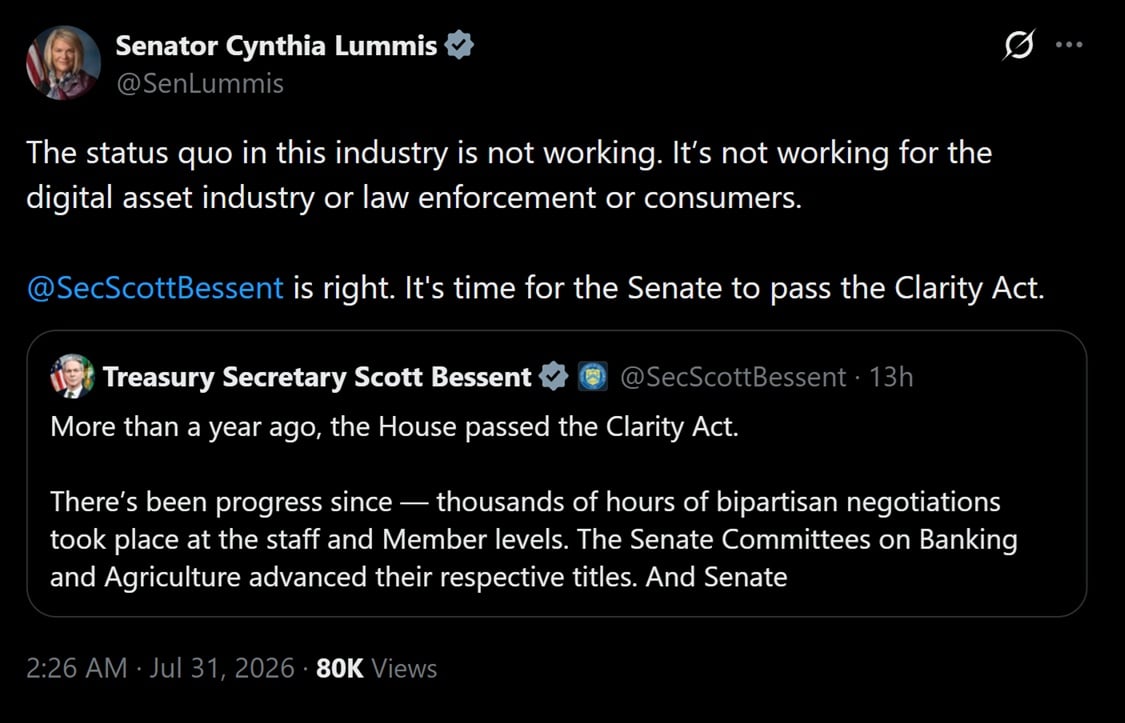
Image Source: X

The Digital Asset Market Clarity Act, officially designated as H.R. 3633, provides for the division of oversight over digital assets between the Securities and Exchange Commission (SEC) and the Commodity Futures Trading Commission (CFTC). Lummis separately warned that the current momentum with which the bill is advancing "will not be repeated again in this decade," noting that further delays will result in the bill not being passed this year.

She also framed the essence of the confrontation in more concrete terms, telling colleagues that prolonged debates could leave cryptocurrency custody rules unprotected just as the industry is increasingly penetrating the sphere of traditional finance.

Time is Running Out

The Senate is scheduled to begin its August recess on August 8th, and Majority Leader John Thune has not yet allocated time for the bill to be debated in the Senate. If lawmakers do not reach a decision by this deadline, discussion will only resume in September, further shrinking the already diminishing legislative window before the midterm elections.

This deadline pressure is reflected in prediction markets: forecasting platforms currently estimate the probability of CLARITY becoming law in 2026 at approximately 30%, significantly lower than the figure of over 80% recorded in February. Passing the bill in the Senate requires 60 votes. Republicans control 53 seats, meaning at least seven Democrats must vote for it for passage—a task that has proven difficult due to unresolved objections within the Democratic caucus.

What is Holding Up the Vote

Beyond the ethics provisions governing cryptocurrency ownership by federal officials, which Senate negotiators are working on separately, opponents have expressed concern about how the bill approaches decentralized finance (DeFi) protocols and whether its consumer protection provisions go far enough. Senator Elizabeth Warren argues that the bill would weaken oversight to the point of jeopardizing the financial system as a whole—a position she has reiterated since the committee vote in May.

Cryptocurrency industry associations have also strongly opposed the delay: over 200 organizations, including Coinbase, Ripple, Kraken, and Circle, are urging Senate leadership to bring the bill for a vote, arguing that the ongoing uncertainty is driving innovation and jobs overseas while leaving American consumers without clear protection.

Lummis directly linked the urgency of considering the bill to consumer protection measures, arguing that the bill's requirements for asset custody and disclosure are necessary precisely because existing legislation contains loopholes that bad actors could exploit.

However, with Senate floor time for the bill still not scheduled and only a few days remaining before the parliamentary recess ends, the bill's fate now hinges on whether Thune allocates time for its consideration this week or postpones it until the fall session. Reconvening in September would keep the CLARITY bill on the agenda but would push the final vote closer to the midterm election campaign season, when legislative activity typically slows down even further.


Related Questions

QAccording to Senator Lummis, why is the CLARITY Act's mechanism 'not working'?

AAccording to Senator Lummis, the mechanism of the CLARITY Act is 'not working' because the Senate is delaying the legislative process, with Majority Leader John Thune not yet scheduling time for its floor consideration, leading to a high risk it won't pass this year.

QWhich two regulatory bodies would oversee digital assets under the proposed CLARITY Act (H.R. 3633)?

AUnder the proposed Digital Asset Market Clarity Act (H.R. 3633), oversight of digital assets would be divided between the Securities and Exchange Commission (SEC) and the Commodity Futures Trading Commission (CFTC).

QWhat is the estimated current probability of the CLARITY Act becoming law in 2026, according to betting platforms, and why has it dropped significantly?

ABetting platforms currently estimate the probability of the CLARITY Act becoming law in 2026 is about 30%, a significant drop from over 80% in February. The drop is due to the legislative delay and the shrinking window for action before the August recess and midterm elections.

QWhat are two key concerns raised by opponents, like Senator Elizabeth Warren, regarding the CLARITY bill?

AOpponents like Senator Elizabeth Warren have raised concerns that the bill's approach to decentralized finance (DeFi) protocols is problematic and that its consumer protection provisions are insufficient. Warren specifically argues it would weaken oversight enough to endanger the overall financial system.

QWhat consequence does Senator Lummis warn about if the CLARITY Act is further delayed?

ASenator Lummis warns that further delays will result in the bill not passing this year. She also cautions that prolonged debates could leave rules for cryptocurrency custody unprotected just as the industry increasingly integrates with traditional finance.

Related Reads

UNI Doubles in Two Months Against the Trend: A 5-Year-Overdue Value Realization

Amidst a generally stagnant crypto market in June and July, UNI, the governance token of Uniswap, saw a significant surge, nearly doubling in price from around $2.3 to $4.6. This rally represents a delayed but significant value reassessment, triggered by the practical implementation of its long-debated "fee switch" mechanism. The key turning point was the on-chain execution of the UNIfication proposal in December 2025. It activated a protocol fee on select pools, directed Unichain sequencer revenue (net of costs) to a communal treasury, executed a one-time burn of 100 million UNI, and established a system where all protocol revenue flows into a "TokenJar" contract. This treasury has a single exit: purchasing and permanently burning UNI via a "Firepit" contract. Initially, the market reacted tepidly as the generated revenue and corresponding burn rate were modest. The narrative shifted dramatically in July 2025 with two major developments. First, the launch of Robinhood Chain, tailored for tokenized stocks, rapidly became a primary source of volume and fees for Uniswap, at one point contributing nearly half of its weekly fees. Second, governance votes successfully expanded the fee mechanism to v4 pools and initiated a temperature check for fees on Robinhood Chain. The activation of v4 fees caused the protocol's daily revenue earmarked for UNI burns to nearly triple. The core of UNI's recent price action is the transition from a pure governance token to a cash-flow asset with a permanent, protocol-funded buyer. Its effectiveness is amplified by UNI's mature and widely distributed supply, with no major impending unlocks to dilute the impact of the buybacks. The sustainability of this rally now hinges on whether the transaction volume, particularly on Robinhood Chain, persists after its initial gas subsidies expire, determining if this is a genuine value realization or a subsidy-fueled spike.

marsbit44m ago

UNI Doubles in Two Months Against the Trend: A 5-Year-Overdue Value Realization

marsbit44m ago

Breaking: Google Earth Urgently Pulls Back Nano Banana 2 Image Generation Feature!

Google Earth's newly launched "Create image" feature, powered by the Nano Banana 2 AI image generation model, was abruptly withdrawn shortly after its release due to being "played" by users. The feature allowed users to generate and overlay AI-created visuals directly onto real-world satellite and 3D maps in Google Earth. The tool enabled creative applications like historical recreations (e.g., visualizing ancient Pompeii), generating informational graphics for landmarks, and envisioning architectural projects or futuristic cityscapes on real terrain. It operated under "geospatial grounding," meaning the AI respected the underlying geography, topography, and perspective of the chosen map view. The model also integrated with Gemini to retrieve relevant factual information. However, upon release, users quickly tested its limits. A prominent example involved reimagining Philadelphia's historic Independence Hall as a post-apocalyptic ruin overrun by "happy" zombies, evil clowns, and giant alien mechs. This highlighted both the feature's playful potential and its risks regarding the generation of inappropriate or misleading content on realistic maps, leading to its swift temporary removal. Google stated it would re-release the feature after implementing "enhanced guardrails." Analysts note this move strategically leverages Google's vast proprietary geospatial data, positioning its AI not just for artistic generation but for spatially accurate world visualization—a unique advantage in the competitive AI image generation landscape.

marsbit2h ago

Breaking: Google Earth Urgently Pulls Back Nano Banana 2 Image Generation Feature!

marsbit2h ago

Altman Admits: Overestimated AI Snatching Jobs! Huang Renxun: The Unemployment Narrative Is Completely Backwards

Sam Altman has revised his earlier predictions about AI rapidly replacing jobs, admitting he overestimated the speed at which AI would eliminate entry-level white-collar roles. Speaking on the "Invest Like the Best" podcast, he stated that people do not truly want an AI CEO, as accountability and human connection remain critical. He found that individuals prefer interacting with people who can be held responsible for decisions. Similarly, NVIDIA's Jensen Huang argued that the narrative of AI destroying jobs is misguided. He distinguishes between tasks and jobs, noting that while AI can automate specific tasks, entire jobs—encompassing communication, judgment, coordination, and accountability—are not eliminated. He cited examples like radiologists and software engineers, where demand for these roles has increased as AI handles repetitive tasks, allowing for business expansion and the creation of more positions. Data from a University of Maryland and LinkUp study supports this, showing that U.S. job postings for new graduates have actually risen, countering the fear of vanishing entry-level roles. However, a significant shift is occurring: the traditional entry-level tasks that help newcomers gain experience are being automated, making initial career access more challenging. The key insight is that as AI takes over standardized tasks, the enduring value of human work shifts toward areas of responsibility, trust-building, and final decision-making—aspects that AI cannot replicate. The real "moat" for professionals lies in these irreplaceable human elements.

marsbit2h ago

Altman Admits: Overestimated AI Snatching Jobs! Huang Renxun: The Unemployment Narrative Is Completely Backwards

marsbit2h ago

Trading

Spot
活动图片