David Hoffman: Ethereum in the New World Order

marsbitPublished on 2026-01-26Last updated on 2026-01-26

Abstract

David Hoffman, founder of Bankless, reflects on the 2026 Davos Forum, where crypto leaders gathered amidst a significant shift in global order. U.S. Secretary Howard declared "globalization has failed," while Canada’s Minister Mark noted the "fracturing, not transformation" of the rules-based international system. Hoffman argues that the post-WWII order, upheld by fragile institutions like the UN, is collapsing as the U.S. abandons multilateralism under Trump’s "America First" policy, reverting to a might-makes-right reality. In this fragmented landscape, Hoffman sees decentralized crypto protocols like Bitcoin and Ethereum as emerging higher-order structures that can unify a divided world. They don’t replace nation-states but provide a neutral, rules-based coordination layer for global cooperation. Bitcoin enforces accountability through its decentralized, algorithmic "if-then" logic, while Ethereum’s Turing-complete smart contracts extend this principle further. Despite current crypto market pessimism, Hoffman believes these protocols could deliver the rules-based order that traditional institutions failed to sustain—potentially making Ethereum the unexpected foundation for a new global system.

Author: David Hoffman, Founder of Bankless

Compiled by: Hu Tao, ChainCatcher

This year's Davos Forum was truly spectacular.

It brought together many heavyweight figures from the cryptocurrency industry, including Brian Armstrong, Jeremy Allaire, CZ, and Larry Fink.

Although cryptocurrency was a focal point of this forum, what truly captured attention was the Trump administration's clear statement regarding a phased shift in the global order.

Two significant speeches at the Davos Forum highlighted this point. U.S. Secretary of Commerce Howard delivered a speech titled "Globalization Has Failed," while Canadian Prime Minister Mark responded by saying, "The rules-based international order is experiencing a rupture, not a transformation."

Rules-Based International Order vs. Law of the Jungle

Since World War II, the international community has maintained a certain degree of order and cooperation. Although the United Nations has relatively little power, it is highly respected in the decision-making of various countries and plays a pivotal role.

"International law" once truly existed, but mainly because we all believed in it. We collectively赋予 it meaning.

The Trump administration decided to puncture this shared illusion.

Trump believes that this "rules-based international order" exists only because the United States allows it to exist. As the most powerful nation with the strongest military force, this means that we are the ones who truly构建 this "rules-based international order," and Trump's "America First" philosophy means he no longer wants to play nice with the rest of the world.

According to Trump, as elaborated in Lutnick's speech, this model does not serve the best interests of the United States, so we are now taking a different path.
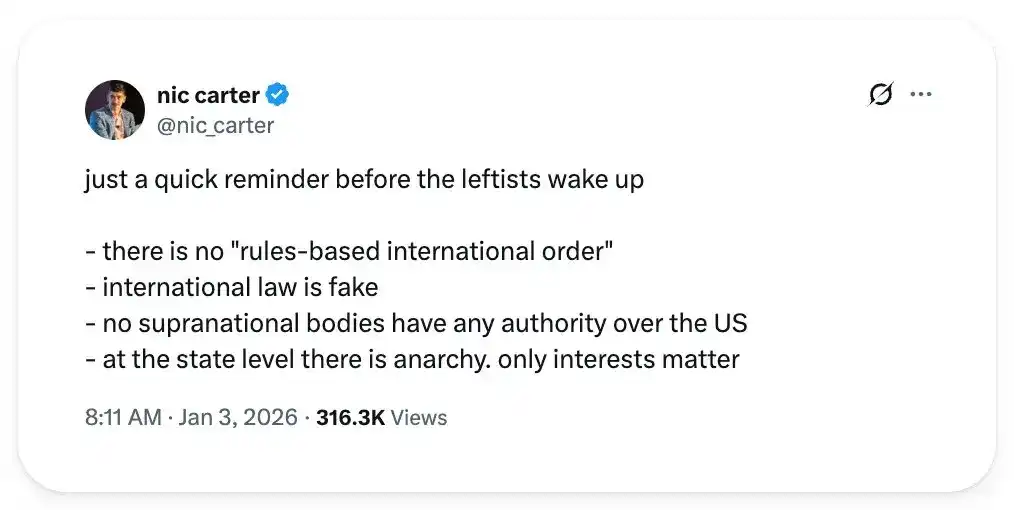
Nic Carter is right—the state is the highest level of organization that humanity has created. Before the nation-state, religion and monarchy were the highest levels of organizational structure that humans could create, and before that were feudal systems and tribes.

We attempted to build higher-level organizational structures through "common agreements" with institutions like the United Nations, but these agreements ultimately proved very fragile and had minimal impact on the world.

Therefore, our current situation is this: by 2026, the United States has abandoned the attempt to build a higher-level unified organizational structure and claims that we are better off going it alone.

It is worth mentioning that "pariah states" like Russia and Iran have恰恰 thrived by relying on a weak international order. They have always adhered to the law of the strong and exploited the weaknesses of the "rules-based international order" to expand their power, committing human rights violations that the United Nations merely condemns.

Although it is regrettable to see the attempts at global cooperation ultimately fail, at least we can finally be frank in pointing out that countries like Russia never truly followed these rules.

Bitcoin, Ethereum, and Decentralized Crypto Protocols

Decentralized crypto protocols are powerful and autonomous "higher-level organizational structures" that failed to materialize from the "rules-based international order" paradigm.

Trump's分裂 of the unified international community is precisely the situation that Ethereum aims to balance.

When the unified world falls apart and degenerates into regional powers, Ethereum reunites it in cyberspace.

These protocols do not enforce laws or protect their members. They do not replace nation-states. However, they are a ubiquitous, autonomous coordination layer for the people of the world to unite.

The conversation between Brian Armstrong and the Governor of the Bank of France exemplifies this power. The central bank governor made the mistake that all central bank governors make: misunderstanding and underestimating Bitcoin. Brian corrected him, pointing out that "Bitcoin has no issuer—it is a decentralized protocol...", and then he went on to elaborate on Bitcoin's most important role in unifying the world: "...[Bitcoin] is actually the most effective accountability mechanism for deficit spending."

No, we cannot establish a "rules-based international order" through voluntary coordination and cooperation among nations. But can we obtain a "rules-based international order" from a decentralized, cryptography-based internet protocol?

Bitcoin operates on "if...then..." statements. In my opinion, that sounds like a "rules-based international order." Doesn't Ethereum extend the same principle to Turing-complete smart contracts?

Despite the current atmosphere of despair and negativity in the cryptocurrency industry, I still firmly believe that we are far from tapping the potential of smart contracts.

So, perhaps we won't get a "rules-based international order" from the United Nations.

Perhaps we will get it from an unexpected place.

Perhaps we will get it from Ethereum.

Related Questions

QWhat is the main argument David Hoffman makes about the role of Ethereum in the context of a failing international order?

ADavid Hoffman argues that as the unified global order fragments into regional powers, Ethereum serves as a decentralized, autonomous coordination layer in cyberspace that can unify the world by providing a 'rules-based international order' through its cryptographic protocols and smart contracts, unlike the failed attempts of institutions like the UN.

QAccording to the article, how did the Trump administration's stance impact the 'rules-based international order'?

AThe Trump administration rejected the 'rules-based international order' by claiming it only existed because the U.S. allowed it, and with its 'America First' policy, it no longer wanted to cooperate under this framework, effectively puncturing the collective illusion of global cooperation and international law.

QWhat example does the article provide to illustrate the power of decentralized crypto protocols like Bitcoin in holding governments accountable?

AThe article cites Brian Armstrong's conversation with the French Central Bank governor, where Armstrong corrected the governor's misunderstanding by stating that Bitcoin is a decentralized protocol without an issuer and serves as 'the most effective accountability mechanism for deficit spending,' enforcing rules through its 'if-then' operational logic.

QWhy does the author believe that decentralized crypto protocols are superior to traditional international institutions like the UN?

AThe author believes decentralized crypto protocols are superior because they are robust, autonomous higher-level organizational structures that exist ubiquitously in cyberspace, enforcing rules through code and cryptography, whereas traditional institutions like the UN rely on fragile voluntary coordination and have minimal real-world impact.

QWhat historical context does the article provide about the evolution of human organizational structures before nation-states?

AThe article references Nic Carter's view that nation-states are the highest form of organization humans have created, preceded by religions and monarchies, and before that, feudal systems and tribes, highlighting the failed attempts to create higher-level structures through agreements like the UN.

Related Reads

HSK Officially Launches on Kraken with USD and EUR Trading Pairs

HSK, the native token of the HashKey ecosystem, was officially listed on the major cryptocurrency exchange Kraken on January 26, 2026, at 13:00 UTC. The listing includes the HSK/USD and HSK/EUR spot trading pairs, marking a significant expansion into global USD and EUR-based liquidity systems. This move provides traders, particularly in compliant European and American markets, with more direct and transparent trading channels while enhancing HSK's global liquidity structure. The listing follows a strategic partnership between HashKey and Kraken, aimed at fostering ecosystem collaboration, product integration, and market expansion. Both parties are committed to advancing the integration of traditional finance and digital assets, as well as accelerating institutional-grade asset tokenization in the Asia-Pacific region. HSK is utilized across various core functions within the HashKey ecosystem, including trading fee discounts, exclusive token purchase privileges, and node validation. It also serves as the native and gas token on HashKey Chain. HSK is already available on multiple centralized exchanges, such as HashKey Global, HTX, KuCoin, Gate.io, MEXC, and BingX. Kraken, one of the world’s oldest and most security- and compliance-focused crypto exchanges, is a key gateway for institutional and professional traders in Europe and North America. The listing reflects Kraken's recognition of HSK’s technical stability, transparency, and market foundation. It also strengthens HSK’s global network across Asia, Europe, and North America, attracting more international users to enrich its community ecosystem.

marsbit1h ago

HSK Officially Launches on Kraken with USD and EUR Trading Pairs

marsbit1h ago

Trading

Spot
Futures

Hot Articles

Cómo comprar ORDER

¡Bienvenido a HTX.com! Hemos hecho que comprar Orderly (ORDER) sea simple y conveniente. Sigue nuestra guía paso a paso para iniciar tu viaje de criptos.Paso 1: crea tu cuenta HTXUtiliza tu correo electrónico o número de teléfono para registrarte y obtener una cuenta gratuita en HTX. Experimenta un proceso de registro sin complicaciones y desbloquea todas las funciones.Obtener mi cuentaPaso 2: ve a Comprar cripto y elige tu método de pagoTarjeta de crédito/débito: usa tu Visa o Mastercard para comprar Orderly (ORDER) al instante.Saldo: utiliza fondos del saldo de tu cuenta HTX para tradear sin problemas.Terceros: hemos agregado métodos de pago populares como Google Pay y Apple Pay para mejorar la comodidad.P2P: tradear directamente con otros usuarios en HTX.Over-the-Counter (OTC): ofrecemos servicios personalizados y tipos de cambio competitivos para los traders.Paso 3: guarda tu Orderly (ORDER)Después de comprar tu Orderly (ORDER), guárdalo en tu cuenta HTX. Alternativamente, puedes enviarlo a otro lugar mediante transferencia blockchain o utilizarlo para tradear otras criptomonedas.Paso 4: tradear Orderly (ORDER)Tradear fácilmente con Orderly (ORDER) en HTX's mercado spot. Simplemente accede a tu cuenta, selecciona tu par de trading, ejecuta tus trades y monitorea en tiempo real. Ofrecemos una experiencia fácil de usar tanto para principiantes como para traders experimentados.

135 Total ViewsPublished 2024.12.10Updated 2025.03.21

Discussions

Welcome to the HTX Community. Here, you can stay informed about the latest platform developments and gain access to professional market insights. Users' opinions on the price of ORDER (ORDER) are presented below.

活动图片