THIS is the stablecoin power angle that nobody is talking about

ambcryptoPublished on 2026-02-02Last updated on 2026-02-02

Abstract

Dollar-backed stablecoins are increasingly serving as a tool for the U.S. to extend its monetary influence abroad without physically moving dollars overseas, according to a Rabobank report. When foreign entities demand dollar stablecoins, U.S. issuers convert this demand into Treasury bill purchases, helping fund U.S. deficits at lower rates while digital tokens circulate internationally. This mechanism allows dollars to remain within the U.S. financial system while still facilitating global trade. Non-USD stablecoins are also gaining traction, with their supply surging 260% over the past year to a combined market cap of $1.55 billion, though they remain small compared to dollar-pegged alternatives. A key application driving adoption is crypto-backed payment cards, which have grown into an $18 billion market. Monthly transaction volumes have increased from $100 million in early 2023 to over $1.5 billion, growing at an annual rate exceeding 100%. These cards operate on top of traditional networks like Visa and Mastercard, using stablecoins to settle transactions in the background while maintaining a familiar user experience. In summary, dollar-backed stablecoins are expanding U.S. monetary power digitally without exporting physical dollars, while crypto payment infrastructure accelerates their real-world use.

Dollar-backed stablecoins are now more than just a crypto payment tool. Recent reports say that they may also be helping the U.S. extend dollar influence abroad, in a way that keeps real capital at home.

Here’s what you need to know.

Stablecoins – A secret weapon?

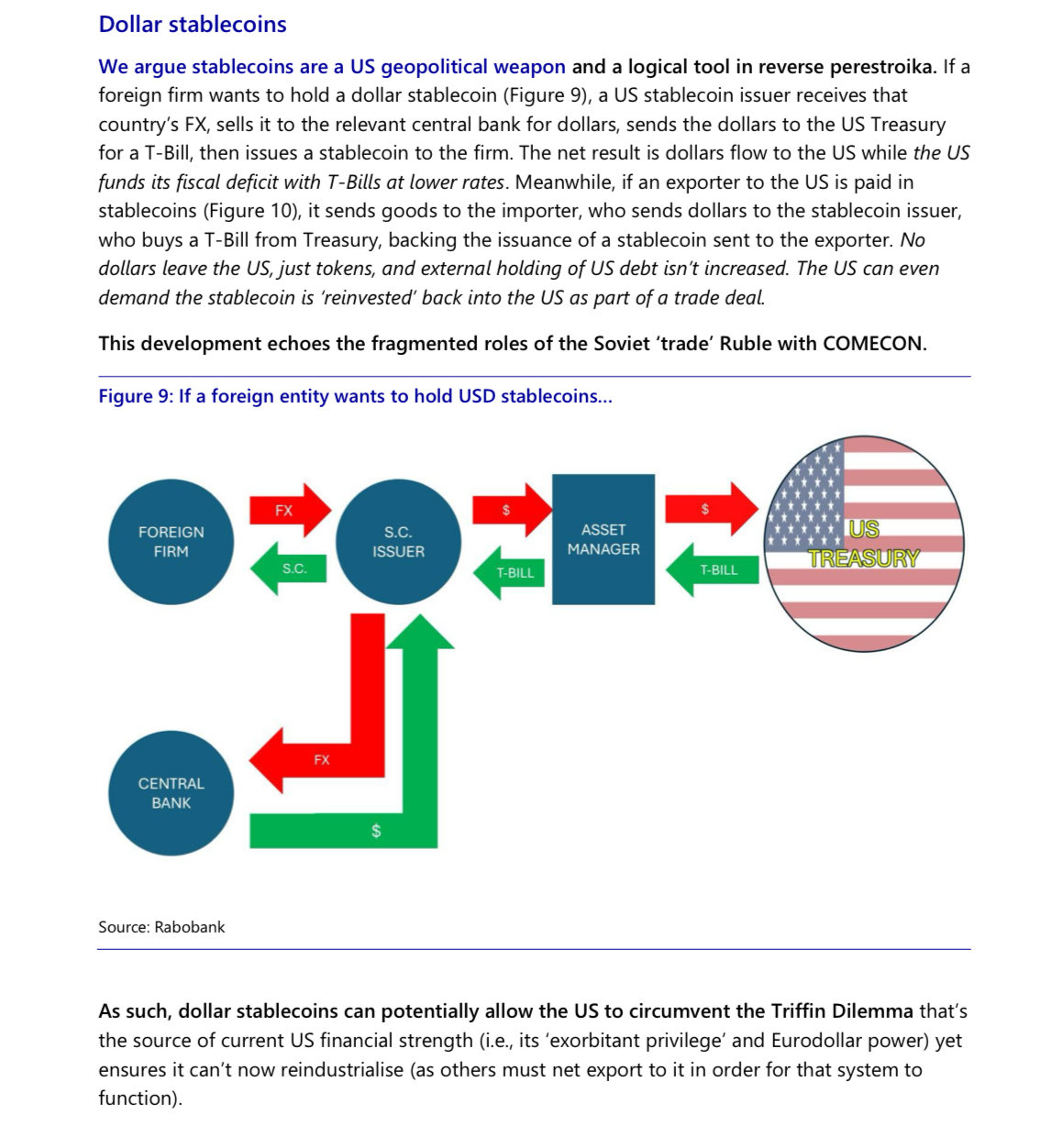
A report by Rabobank has stated that dollar-backed stablecoins are spreading dollar influence, without letting real dollars leave the country.

Source: X

The idea is that when a foreign firm wants a dollar stablecoin, a U.S. issuer converts that demand into Treasury bill purchases. Dollars flow back to the U.S. government, helping fund deficits at lower rates, while the firm gets digital dollars instead of cash.

In trade, it goes a step further. U.S. importers can pay exporters in stablecoins, while the underlying dollars stay parked in Treasuries. Only tokens move across borders.

With comparisons to the Soviet-era trade ruble, dollars are exported digitally… all while keeping the power at home.

Non-dollar stablecoins step up

That growing influence hasn’t gone unnoticed, with non-USD-pegged alternatives gaining ground.

For long, more than 99% of stablecoins were pegged to the U.S. dollar. That number is now decreasing at the margins.

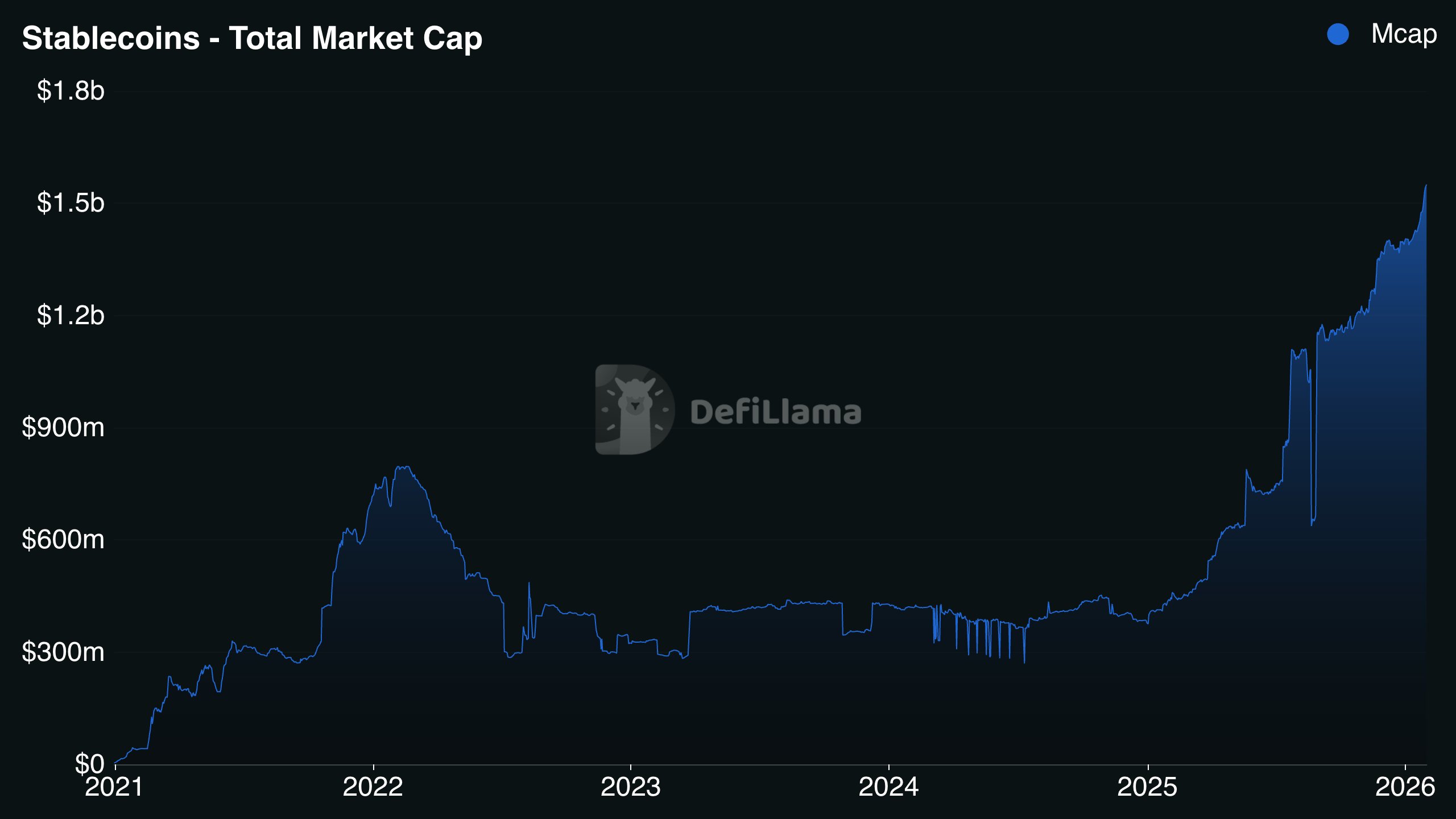
Over the past year, non-USD stablecoins have surged 260% in supply, pushing their combined market cap to about $1.55 billion.

Source: X

It’s still small next to dollar-backed giants, but it certainly matters.

All of this theory matters because…

…it’s already showing up in day-to-day payments. One of the fastest-growing payment modes for stablecoins right now is crypto cards.

Source: X

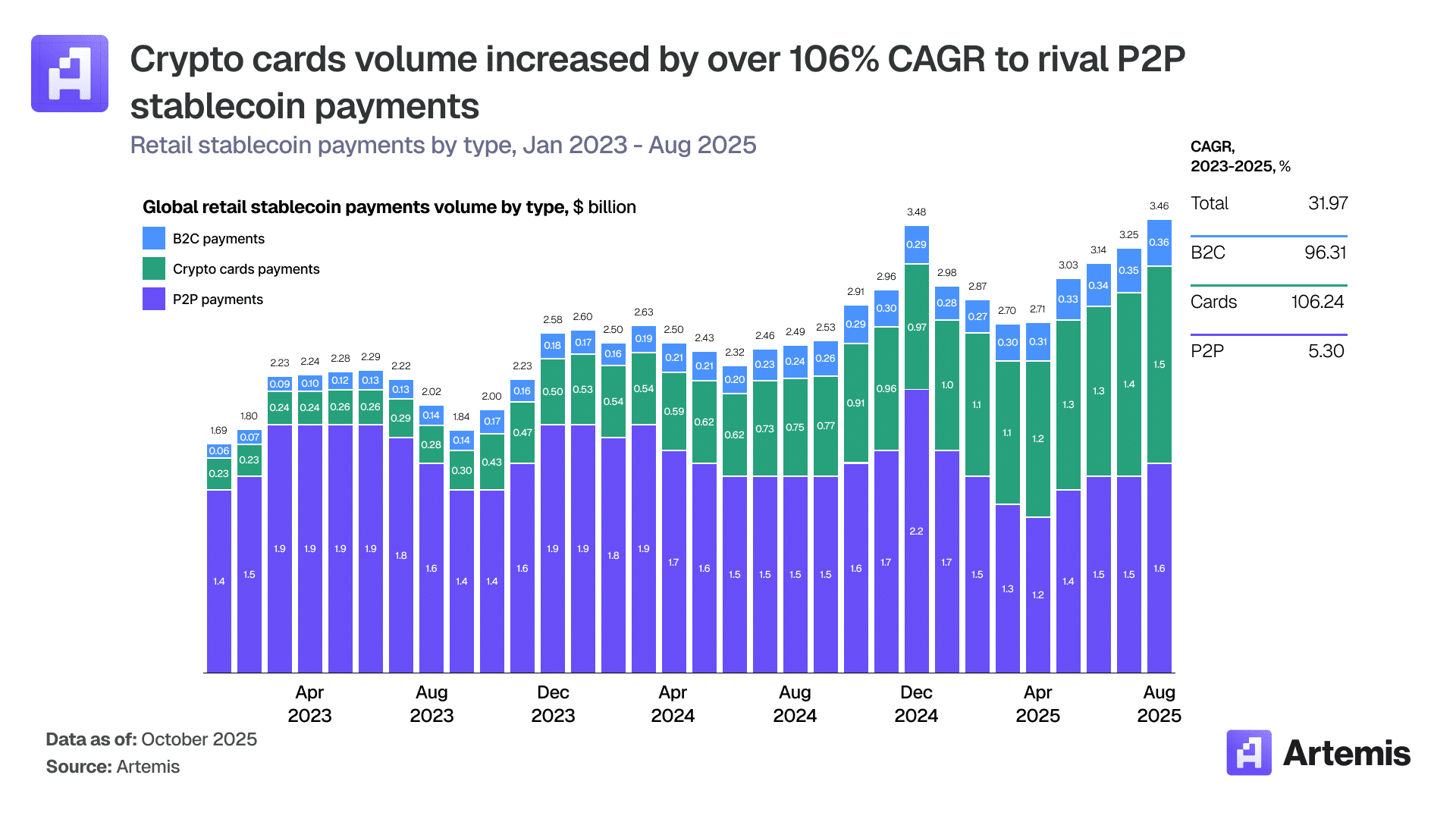
Once a niche product, crypto cards are now an $18 billion market.

Monthly volumes went from about $100 million in early 2023 to over $1.5 billion today, growing at a 100%+ annual rate.

Source: X

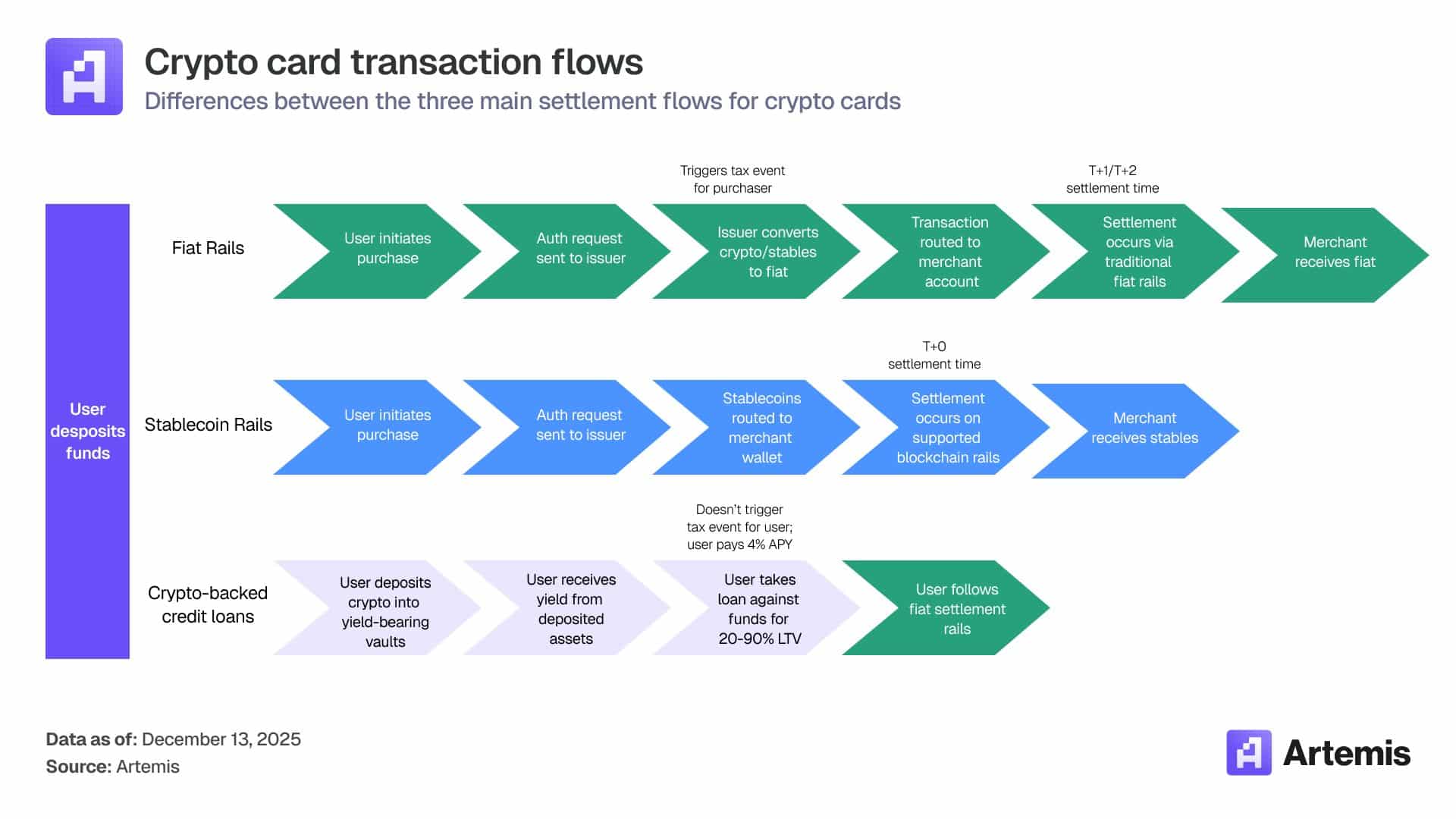
Importantly, these cards don’t replace Visa or Mastercard.

Rather, they sit on top of them. Stablecoins fund the transaction in the background, while card networks handle acceptance. For users and merchants, what looks like normal payments are actually digital dollars doing the work.


Final Thoughts

  • Dollar-backed stablecoins are exporting U.S. monetary power, without exporting actual dollars.
  • As crypto cards grow, digital dollars are moving fast.
Next: BONK drops 18% as memecoins slide – Is another leg down coming?
Share
  • Share
  • Tweet

Related Questions

QHow are dollar-backed stablecoins helping the U.S. extend dollar influence abroad without exporting real dollars?

ADollar-backed stablecoins allow foreign firms to obtain digital dollars while U.S. issuers convert that demand into Treasury bill purchases. This keeps actual dollars within the U.S., helping fund deficits at lower rates, while only tokens move across borders.

QWhat is the current market trend for non-USD-pegged stablecoins?

ANon-USD stablecoins have surged 260% in supply over the past year, reaching a combined market cap of approximately $1.55 billion, though they remain small compared to dollar-backed stablecoins.

QHow are crypto cards contributing to the growth of stablecoin payments?

ACrypto cards, now an $18 billion market, use stablecoins to fund transactions in the background while leveraging traditional card networks like Visa or Mastercard for acceptance. Monthly volumes grew from $100 million in early 2023 to over $1.5 billion, with a 100%+ annual growth rate.

QWhat role do U.S. Treasury bills play in the stablecoin ecosystem?

AWhen foreign demand for dollar stablecoins arises, U.S. issuers purchase Treasury bills with the incoming dollars, effectively recycling foreign demand into U.S. government debt and keeping capital domestically parked.

QWhy are non-USD stablecoins gaining traction despite the dominance of dollar-backed options?

ANon-USD stablecoins are growing as alternatives to reduce reliance on U.S. dollar influence, with a 260% supply increase reflecting heightened interest in diversified digital currency pegs.

Related Reads

The Bustle Belongs to the 'Epsteins', Saylor Just Wants to Hoard Coins

The article discusses Michael Saylor, founder of MicroStrategy (now Strategy), in the context of the recently released Epstein documents. Saylor was mentioned in a 2010 email from Epstein's PR agent, Peggy Siegal, who described him as a socially awkward "zombie-like" figure who was difficult to engage with at a high-society dinner party. This perceived social ineptitude, a liability in elite circles, is presented as a key strength in his role as a Bitcoin maximalist. Saylor’s company is the largest corporate holder of Bitcoin, with 712,647 BTC purchased at an average cost of $76,037. Despite recent market volatility pushing Bitcoin below his average buy price and causing a 60% drop in his company's stock, Saylor remains unwavering. His strategy is simple and relentless: buy Bitcoin consistently and never sell, a philosophy he summarizes as "More Orange." The piece argues that the very traits that made him an outsider in social settings—being "boring," unemotional, and immune to external noise—are the same traits that make him uniquely suited to his long-term, single-minded accumulation strategy. While cautioning that his corporate financial tools are not available to the average investor, the article concludes that in a noisy market, a "boring" and disciplined approach is often the most profitable, contrasting Saylor's current success with the downfall of many involved in the Epstein scandal.

比推22m ago

The Bustle Belongs to the 'Epsteins', Saylor Just Wants to Hoard Coins

比推22m ago

The World of Gold, the Dollar, and Debt: A Revaluation of the Balance Sheet

The article "The World of Gold, the Dollar, and Debt: A Revaluation of the Balance Sheet" argues that the fundamental, often hidden mechanism organizing modern society is not money itself, but the continuous extension of debtor-creditor relationships. Nations, communities, and individuals essentially trade the future for the present. Economic growth and consumption are fueled by an institutionalized consensus that the future can be allocated in advance, with debt being the technical instrument of this system. From this perspective, the core question becomes: who has the power to discount the future into the present and define that future? Money creation and contraction are merely expressions of this debt-based world. The true "magic" of finance is the intertemporal exchange of resources. The roles of the US dollar and gold are clarified through this lens. The dollar is not merely currency; it is the primary tool for coordinating and denominating global debt. The system functions as a massive intertemporal trade: the US provides future promises, while the world provides present productive capacity to承接 (undertake) that debt. Gold is unique as the only major financial asset with no corresponding liability; it is the ultimate settlement that requires no counterparty's promise. It is therefore often seen as inefficient in a healthy debt system but gains value when the future兑现 (fulfillment) of promises is doubted. The author posits that true避险 (risk aversion) is not about finding a permanently safe asset but about identifying healthy, sustainable balance sheets at different times. The fundamental risk is not volatility but structural debt imbalance. The rise of AI is identified as the key variable reshaping global balance sheets. AI creates a paradox: it drastically reduces the price of digital efficiency (software, information processing) while creating unprecedented rigid demand for physical capital (compute power, electricity, land, energy, minerals). This forces a recalibration of the debt system, as growth becomes tethered to physical constraints rather than financial engineering. Markets are thus pricing future production constraints, seen in the rise of silver and other commodities. The article concludes that while the dollar's network effect and its role as the deepest global asset pool (e.g., for settling trades and collateralizing loans) make it currently irreplaceable, its supremacy is not guaranteed. Its ability to discount the future is challenged by physical constraints. For the dollar to maintain its status, the US must lead in building AI infrastructure, making the dollar the essential token for purchasing the world's most powerful compute and efficient productivity. Failure to do so could lead to a slow, irreversible relative decline of the dollar system, until a new monetary anchor, better aligned with real productive capacity and technological leadership, emerges. Gold, while a temporary haven, is not a permanent solution as it generates no cash flow and cannot enhance productivity.

marsbit58m ago
The World of Gold, the Dollar, and Debt: A Revaluation of the Balance Sheet

marsbit58m ago

Trading

Spot
Futures
活动图片