MY Group Completes Web4.0 First Stock Listing Layout, SEC Officially Discloses Form 8-K Announcement

marsbit2026-05-17 tarihinde yayınlandı2026-05-17 tarihinde güncellendi

Özet

MY Group has completed the listing layout for the "Web4.0 First Share," with the U.S. Securities and Exchange Commission (SEC) formally disclosing a Form 8-K report. According to the filing, the company's board has officially appointed Mr. Zhang Dingwen as Chief Executive Officer (CEO) and Executive Director, marking a significant upgrade in management and the entry into a new phase of its global capital market strategy. The disclosure of Form 8-K, used for reporting major corporate events, coincides with market information indicating the company is advancing several key capital market initiatives. These include a global brand system upgrade, corporate strategic restructuring, and a change of its stock ticker symbol. These moves are viewed by industry experts as signals of accelerated internationalization and enhanced global market presence. Concurrently, MY Group's proposed "Web4.0 Ecosystem" is garnering market attention. The company is integrating core capabilities across social traffic portals, global payment systems, public blockchain infrastructure, digital asset trading, and AI-powered financial systems. Analysts suggest that by closing this ecosystem loop, MY Group has the potential to become a next-generation platform merging Web2 user scale with Web3 asset frameworks and AI financial capabilities. With the management upgrade finalized, the global brand strategy launched, and the stock ticker change pending, MY Group is positioning itself as a focal point in the g...

The Company to Advance Stock Ticker Change, Global Capital Strategy Enters New Stage

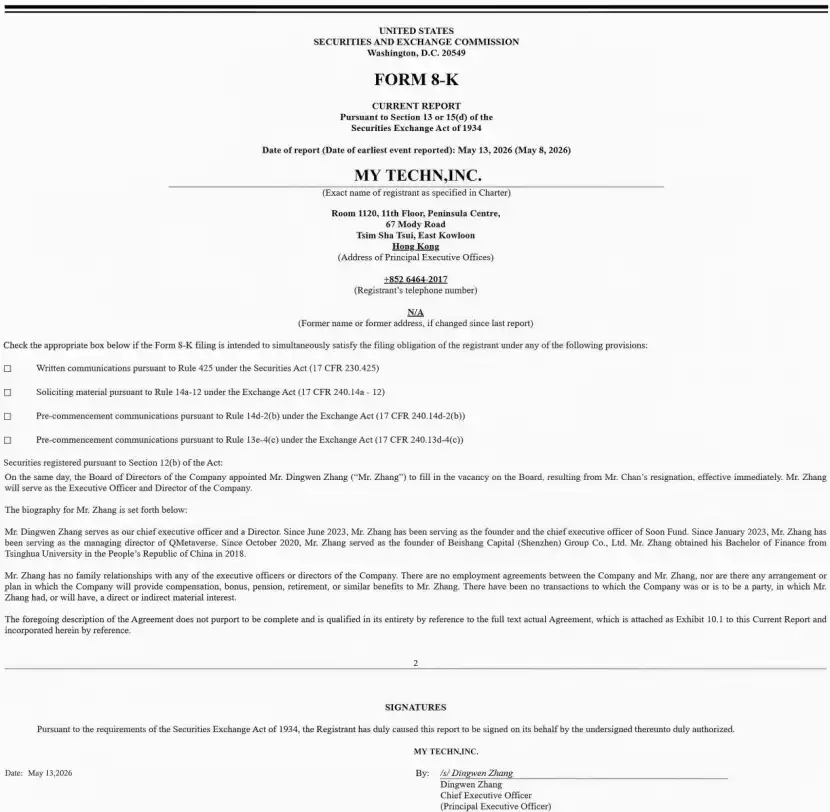
2026513日, The U.S. Securities and Exchange Commission (SEC) has officially disclosed the Form 8-K Current Report submitted by MY Technology Group.

According to the SEC announcement, the board of directors has formally appointed Mr. Zhang Dingwen as the company's Chief Executive Officer (CEO) and Executive Director of the board, with the appointment having taken effect.

The official disclosure of this Form 8-K also signifies that the company's management upgrade and its global capital market strategy have entered a new phase.

Public information indicates that Form 8-K is an immediate disclosure document for significant events of U.S. listed companies, typically used to report important information including management changes, board adjustments, and major capital market matters.

Simultaneously, market sources indicate the company is also currently advancing several key capital market actions, including: global brand system upgrade, corporate strategic structure optimization, stock ticker symbol change, and international capital market positioning upgrade.

Industry insiders believe such actions typically indicate that a listed company is accelerating its international capital market strategy and further enhancing its global market recognition and long-term capitalization capabilities.

Notably, following the disclosure of this Form 8-K, market attention towards the company's subsequent stock ticker change and brand upgrade plans has also increased significantly.

Capital market participants stated: After completing a management upgrade, a listed company simultaneously advancing brand and ticker system optimization is often seen as an important signal of the company entering a new stage.

Public records show that Mr. Zhang Dingwen has long been deeply involved in the fields of technology, digital finance, and international business, possessing extensive experience in corporate strategy and capital markets.

Following the completion of this management upgrade, the company's pace in advancing its international capital market strategy is expected to accelerate further.

As of now, the company has not disclosed its new stock ticker, but related matters are expected to proceed according to SEC regulations and exchange processes.

It is widely believed within the industry that with the official disclosure of this Form 8-K, the company's global capital market layout is continuously deepening, and its subsequent strategic moves are expected to receive further market attention.

"Web4.0 First Stock" Garnering Market Attention

With the ongoing integration of AI, digital payments, Web3, and social ecosystems, the global capital market is searching for the next generation of internet platform companies.

The "Web4.0 Ecosystem" proposed by MY Group is also becoming a key focus in the industry.

Currently, the company has gradually developed core capabilities including: social traffic entry points, global payment systems, public chain infrastructure, digital asset trading ecosystems, and AI-powered financial systems.

Market observers believe: If MY Group can further complete its ecosystem loop, it has the potential to become one of the few new-generation technology platforms in the global capital market that truly integrates "Web2-scale user base + Web3 asset systems + AI financial capabilities."

With the SEC officially disclosing the Form 8-K, management upgrade completed, global brand strategy launched, stock ticker change imminent, and Web4.0 strategy advancing, MY Group may become one of the Web4.0 platform-level companies drawing significant attention in the global technology capital market.

İlgili Sorular

QWhat significant SEC filing was disclosed for MY Tech Group, and what was the key announcement within it?

AThe U.S. Securities and Exchange Commission (SEC) formally disclosed a Form 8-K Current Report for MY Tech Group. The key announcement was the official appointment of Mr. Zhang Dingwen as the company's Chief Executive Officer (CEO) and an executive director of the board, with the appointment already in effect.

QAccording to the article, what other strategic moves is MY Group reportedly advancing alongside the management change?

AAlongside the management change, MY Group is reportedly advancing several key capital market actions, including a global brand system upgrade, corporate strategic structure optimization, a stock ticker symbol change, and an upgrade to its international capital market positioning.

QWhat core capabilities make up MY Group's proposed 'Web4.0 ecosystem'?

AMY Group's proposed 'Web4.0 ecosystem' is built on core capabilities including social traffic portals, a global payment system, public chain infrastructure, a digital asset trading ecosystem, and an AI-powered intelligent financial system.

QWhy is the Form 8-K filing considered significant for a publicly traded company?

AForm 8-K is a significant filing because it is used for the immediate disclosure of major events by U.S. listed companies, typically covering important information such as management changes, board adjustments, and significant capital market matters.

QWhat market potential does the article suggest for MY Group in relation to the Web4.0 concept?

AThe article suggests that if MY Group can further complete its ecosystem, it has the potential to become one of the few next-generation technology platforms in the global capital market that truly integrates 'Web2 user scale, Web3 asset systems, and AI financial capabilities,' positioning it as a key Web4.0 platform-level company for market focus.

İlgili Okumalar

When Computing Power Becomes Commoditized, How Long Until a GPU Futures Market Emerges?

"When Will GPU Futures Arrive? A Framework for Assessing Compute as a Commodity" The article explores the potential for a robust futures market for compute power (GPUs), arguing that such a market is not yet mature but may emerge. It analyzes the landscape using a five-part framework developed for new commodity futures markets. The analysis scores the current state: * **Fragmented Supply (Red)**: Supply is highly concentrated among hyperscale cloud providers (AWS, Azure, GCP, Oracle), limiting the need for price discovery. * **Price Volatility (Green)**: GPU pricing is already highly volatile due to uncertain supply and surging demand. * **Physical Settlement Infrastructure (Green)**: Early infrastructure exists via OTC brokers and price indices (e.g., Ornn, Silicon Data) standardizing contracts. * **Standardized Unit (Red)**: A lack of standardized, tradable units hinders markets; a GPU instance hour varies by region, configuration, and contract terms. * **Lack of Alternatives (Yellow)**: Large players hedge internally via vertical integration, while smaller players bear spot market risk. Overall, the market shows promise (volatility, early infrastructure) but lacks the fragmented supply and standardization needed for large-scale futures trading. Most activity remains OTC. Key open questions and hypotheses: 1. Supply is expected to fragment moderately in 1-2 years, driven by new cloud providers, cheap power locations, and demand from non-frontier labs and AI startups using open-source models. 2. Standardization is most likely to emerge around inference workloads (forecast to be >65% of AI compute demand by 2029), which have simpler, more homogeneous hardware needs than training. Widespread adoption of open-source model weights could accelerate this by democratizing inference and creating demand for optimized, standardized infrastructure. 3. The primary traded unit will likely be the **"chip instance hour"** (akin to electricity, traded regionally), not the physical chip or the downstream AI output (tokens).

marsbit19 dk önce

When Computing Power Becomes Commoditized, How Long Until a GPU Futures Market Emerges?

marsbit19 dk önce

When Computing Power Becomes Commoditized, How Long Until a GPU Futures Market?

When Compute is Commoditized: How Far Away is a GPU Futures Market? The article explores the potential emergence of a futures market for computing power ("compute"), akin to markets for commodities like oil or electricity. It uses a five-dimension framework to assess the market's maturity for sustaining robust futures trading. **Current Market Assessment (Scorecard):** * **Supply Fragmentation:** 🔴 **Red.** Supply is highly concentrated, dominated by a few hyperscale cloud providers. * **Price Volatility:** 🟢 **Green.** GPU pricing is already highly volatile. * **Physical Settlement Infrastructure:** 🟢 **Green.** Early infrastructure exists at the OTC/broker level. * **Standardization:** 🔴 **Red.** Compute lacks a standardized, tradable unit (e.g., an H100 hour is not uniform). * **Lack of Substitutes:** 🟡 **Yellow.** Vertically integrated players can hedge internally, while others are forced to be long. **Conclusion:** The overall scorecard suggests a robust futures market is premature. The market has volatility and early settlement infrastructure but lacks the necessary supply fragmentation and standardization for large-scale price discovery. Most activity remains OTC. **Key Unanswered Questions & Hypotheses:** The article posits that the market could evolve in the next 1-2 years: 1. **Supply:** May become *moderately more fragmented* due to new cloud providers, cheaper power locations, and demand from long-tail users (e.g., startups running open-source model inference). 2. **Standardization:** Could emerge from the growing **inference** workload (expected to be >65% of AI compute demand by 2029), which has more homogeneous hardware requirements than custom training workloads. Widespread adoption of **open-source model weights** is seen as a key catalyst for democratizing inference and driving infrastructure standardization. 3. **Traded Unit:** The most viable layer for trading is likely the **"chip-instance-hour"** (powered, usable compute time), traded similarly to electricity in regional contracts with spot/futures overlays. Trading at the upstream "chip" layer is unlikely due to supply concentration, while the downstream "token" layer faces challenges due to lack of uniformity across AI models.

链捕手25 dk önce

When Computing Power Becomes Commoditized, How Long Until a GPU Futures Market?

链捕手25 dk önce

Interview with Anthropic's Product Manager: Claude 'Dreams' in the Background, We Study Its Consciousness Formation Like Raising a Child

**Title**: Anthropic Product Manager Interview: Claude "Dreams" in the Background, We Study Its Consciousness Formation Like Raising a Child **Summary**: In this interview, Anthropic Research Product Manager Alex Albert discusses the development of the next-generation Claude model. He explains that Anthropic treats each new model as a product, defining its intended capabilities and desired "personality" from the start. The development process is likened to "raising" a model, where the final traits emerge during training. Key focus areas include integrating user feedback into training, prioritizing key capabilities like coding and knowledge work, and refining Claude's interactive personality. Albert highlights the importance of Claude's character as models evolve into autonomous agents making unsupervised decisions. He details features like "adaptive thinking," which lets Claude decide when to reason deeply, and a "dreaming" process where the agent reviews and consolidates its memories offline, akin to human memory reconsolidation. The interview also covers how AI accelerates product development, shifting bottlenecks from building to strategic coordination. Albert describes using Claude as a brainstorming partner and research tool internally. While Anthropic has researchers exploring questions of AI consciousness, the company has no official stance on whether Claude is conscious. The focus remains on ensuring Claude is trustworthy and aligned as it takes on more complex, long-term tasks.

marsbit1 saat önce

Interview with Anthropic's Product Manager: Claude 'Dreams' in the Background, We Study Its Consciousness Formation Like Raising a Child

marsbit1 saat önce

Annual Loss Rate Only 0.03%: Data Disassembles the Real Risk of DeFi Lending

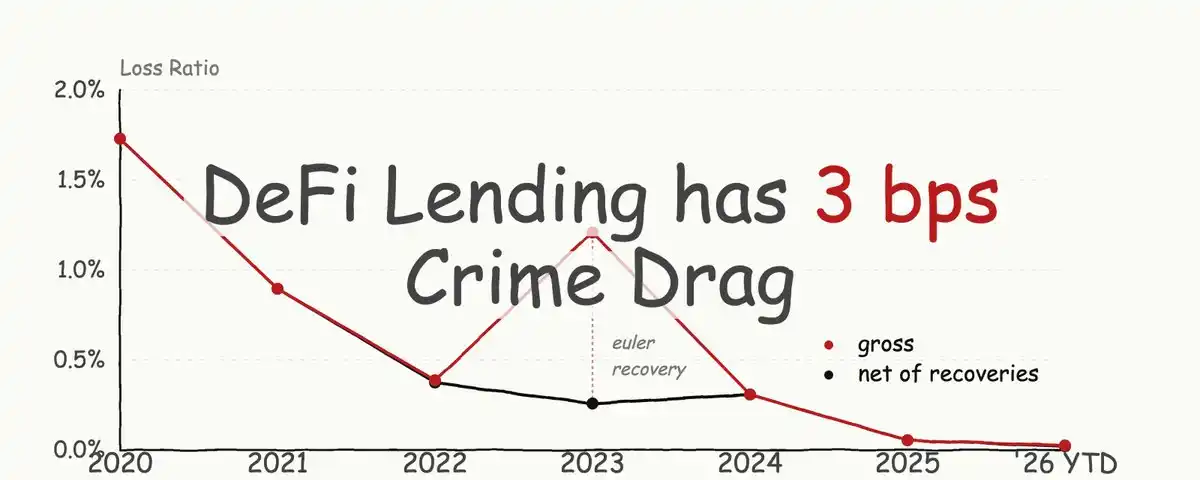
DeFi lending's real-world annual loss rate from hacks and exploits is approximately 0.03% of the Total Value Locked (TVL), excluding cross-chain bridge incidents. This analysis, based on data from DeFi Llama, shows that while lending protocols are frequent targets due to their concentrated assets, the actual financial impact relative to the sector's massive scale is minimal. The overall DeFi hack total of $77.51B is heavily skewed by cross-chain bridge breaches. Removing those, losses drop to $45.18B, with lending and AMM protocols being the most affected non-bridge categories. Risk has significantly improved as the ecosystem has matured. For the year leading to May 2026, net losses in EVM and Solana lending protocols were $30.1 million against an average daily TVL of $99.6 billion, resulting in the 0.03% loss rate. Notably, the industry's asset recovery capability, exemplified by the full recovery and surplus from the Euler Finance hack, mitigates net losses, with a ~20% recovery rate for non-bridge lending incidents. Attack scale follows a log-normal distribution, meaning most incidents are small, and catastrophic losses are rare. This demonstrates that diversification across protocols is an effective risk mitigation strategy. The data indicates that DeFi lending has evolved into a measurable, compartmentalized, and relatively low-risk sector within the broader digital asset landscape.

marsbit1 saat önce

Annual Loss Rate Only 0.03%: Data Disassembles the Real Risk of DeFi Lending

marsbit1 saat önce

İşlemler

Spot
Futures
活动图片