Annual Loss Rate Only 0.03%: Data Disassembles the Real Risk of DeFi Lending

marsbit2026-05-18 tarihinde yayınlandı2026-05-18 tarihinde güncellendi

Özet

DeFi lending's real-world annual loss rate from hacks and exploits is approximately 0.03% of the Total Value Locked (TVL), excluding cross-chain bridge incidents. This analysis, based on data from DeFi Llama, shows that while lending protocols are frequent targets due to their concentrated assets, the actual financial impact relative to the sector's massive scale is minimal. The overall DeFi hack total of $77.51B is heavily skewed by cross-chain bridge breaches. Removing those, losses drop to $45.18B, with lending and AMM protocols being the most affected non-bridge categories. Risk has significantly improved as the ecosystem has matured. For the year leading to May 2026, net losses in EVM and Solana lending protocols were $30.1 million against an average daily TVL of $99.6 billion, resulting in the 0.03% loss rate. Notably, the industry's asset recovery capability, exemplified by the full recovery and surplus from the Euler Finance hack, mitigates net losses, with a ~20% recovery rate for non-bridge lending incidents. Attack scale follows a log-normal distribution, meaning most incidents are small, and catastrophic losses are rare. This demonstrates that diversification across protocols is an effective risk mitigation strategy. The data indicates that DeFi lending has evolved into a measurable, compartmentalized, and relatively low-risk sector within the broader digital asset landscape.

Written by: Alex McFarlane

Compiled by: Chopper, Foresight News

Every disruptive financial technology is bound to experience growing pains, and decentralized finance (DeFi) is no exception. In the early days, lending markets launched rapidly and expanded dramatically. The industry was hit by various security attacks in the open market one after another, then gradually explored ways to improve code security, collateral risk control, oracle mechanisms, liquidation logic, and governance systems.

Past risk cases have reference value, but they can no longer represent today's mature DeFi ecosystem. After all, those who only review history often fail to seize current opportunities.

Excluding security incidents related to cross-chain bridges, the estimated annual loss rate caused by theft and malicious attacks for DeFi lending operations on Ethereum Virtual Machine (EVM) and Solana chains is about 0.03% of the total value locked (TVL) in lending. This analysis data is all integrated from hacker attacks and vulnerability theft events annotated on the DeFi Llama platform.

The core standard for judging security risk is: how significant is the actual loss from exploited vulnerabilities relative to the amount of funds in the market?

The loss rate of three ten-thousandths is roughly equivalent to the probability of an American citizen dying from an accidental slip and fall. This shows that, setting aside the widespread market panic, the actual security risk of DeFi lending business is actually quite low.

Breakdown of DeFi Security Incidents

As of May 16, 2026, DeFi Llama statistics show that the total amount stolen across all categories of DeFi protocols reached $7.751 billion. This statistical scope is extremely broad. The overall data includes cross-chain bridges, decentralized exchanges, derivative protocols, blockchain game-related projects, digital wallets, underlying infrastructure failures, and non-lending DeFi businesses.

Among them, cross-chain bridges are the hardest hit area: after removing security incidents related to cross-chain bridges, the total theft loss in the DeFi field is reduced to $4.518 billion.
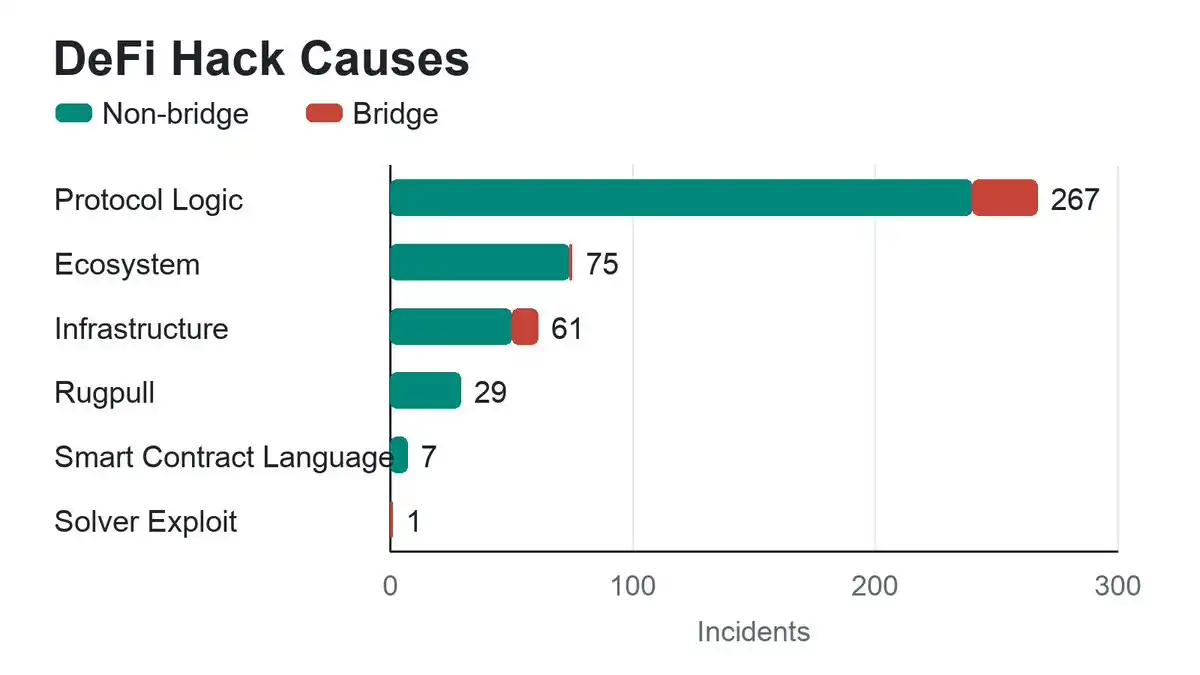
Code execution strictly follows written instructions, not the developer's ideal expectations, which is the root cause of frequent vulnerabilities. It is meaningful to categorize risks well: DeFi is not a single sector with unified risks. Cross-chain bridge theft, DEX oracle manipulation, wallet phishing scams, and collateral asset vulnerabilities in lending markets are all completely different types of risks.

Among all DeFi protocols, lending markets are attacked most frequently, for a very straightforward reason: large amounts of assets are locked in smart contracts for extended periods, making them primary targets for hackers.
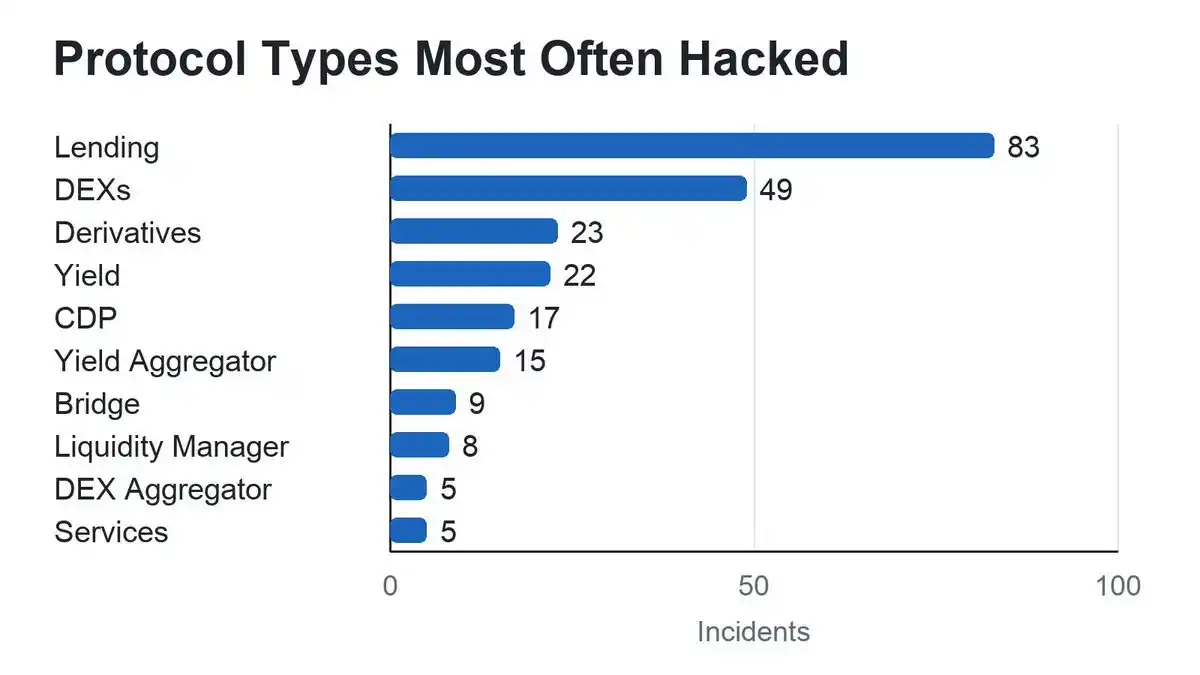
Lending protocols and automated market makers (AMMs) are sectors with high incident rates. Their core commonality is the need to pool large amounts of assets into smart contracts. Apart from cross-chain bridges, the vast majority of security incidents are concentrated in these two types of protocols. This article will focus on the lending and capital borrowing sector for analysis.

Fund Loss Rate Has Greatly Improved

Today, the overall TVL of DeFi is far higher than in the early stages of frequent vulnerabilities, especially in the lending sector. Projects have more mature risk control systems, more comprehensive code audits, and increasingly sophisticated real-time network-wide risk monitoring. Excluding cross-chain bridge incidents, the actual annualized theft loss proportion for lending businesses in EVM and Solana ecosystems has significantly decreased.
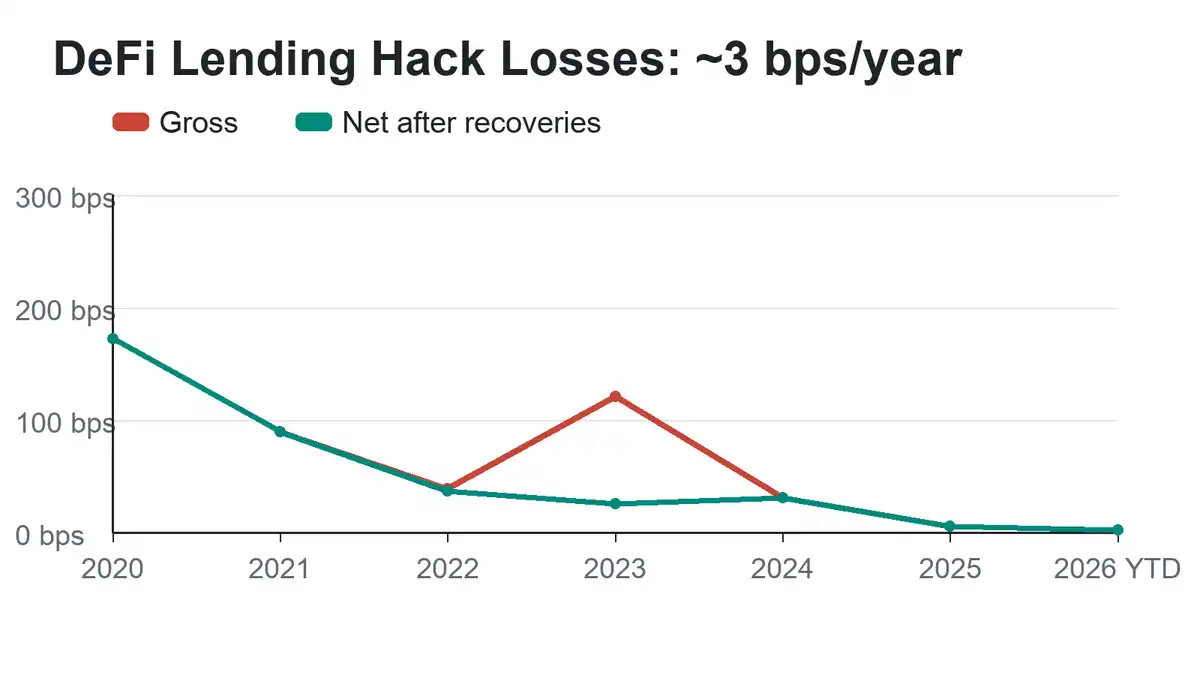
Euler even set a classic risk handling case by successfully recovering all stolen assets. In 2023, Euler was hacked for $197 million, not only fully recovered but also ended up with $240 million due to asset price fluctuations, achieving a positive surplus. This also widened the gap between book losses and actual recovery amounts in the industry.

Taking May 16, 2026 as the cut-off point and summarizing data from the past year:

  • Total book loss from thefts in non-cross-chain lending businesses on EVM and Solana: $30.9 million
  • Actual net loss after deducting asset recoveries: $30.1 million
  • Average daily locked capital size in the lending sector: $99.6 billion
  • Book fund loss rate: 3.1 basis points
  • Actual net loss rate: 3 basis points

Converted, the annual capital loss remains stable at about 0.03% of the total lending TVL.

Advantages of Asset Diversification

DeFi security incidents show a clear polarization characteristic: a very small number of extremely high-value theft incidents account for the vast majority of the industry's publicly disclosed total losses. Charting the scale of incidents on a logarithmic scale reveals that the scale of various theft events roughly follows a log-normal distribution. Visually, the vast majority of security incidents result in relatively small losses, with high-value thefts concentrated in only a few extreme cases.
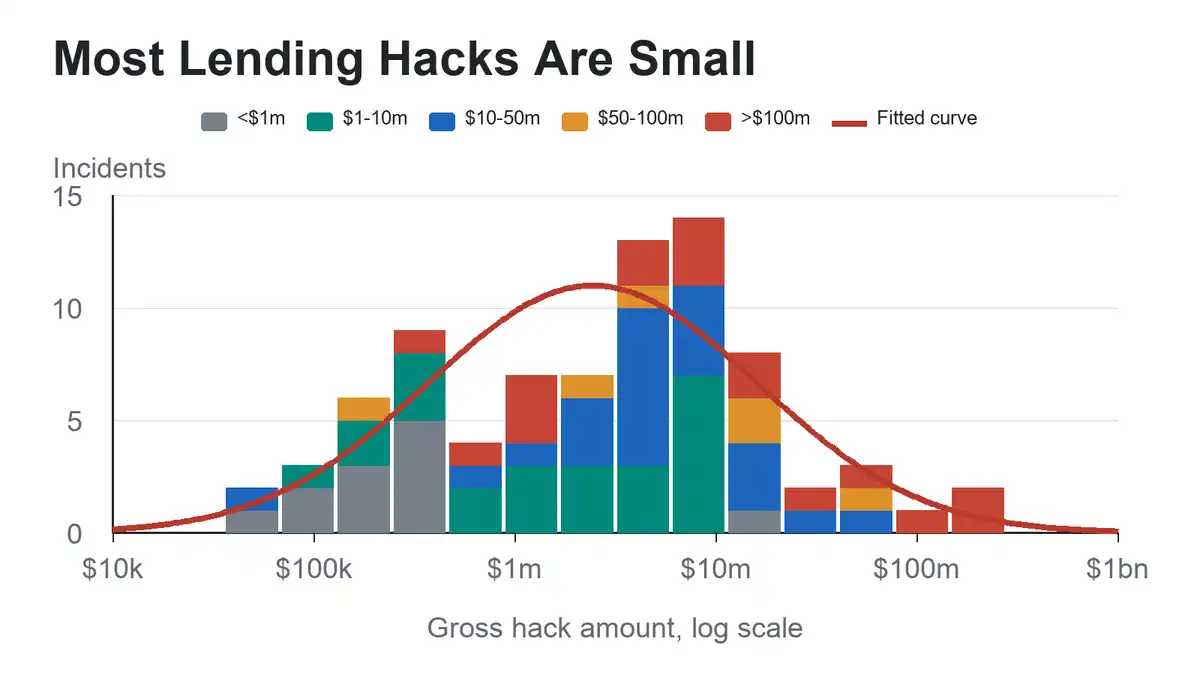
Although ChatGPT expressed a different opinion, I believe this data strongly proves that portfolio diversification is an excellent method to prevent crime.

From the perspective of risk transfer and commercial insurance, this data model also provides reasonable support for industry security insurance businesses. Insurance institutions can set single-claim limits for different protocols and conduct underwriting business in an orderly manner.

Furthermore, the vast majority of theft incidents have limited impact, far from enough to shake the entire capital pool of the lending sector. Moreover, the larger the overall size of the sector, the smaller the impact a single security event has on the whole.
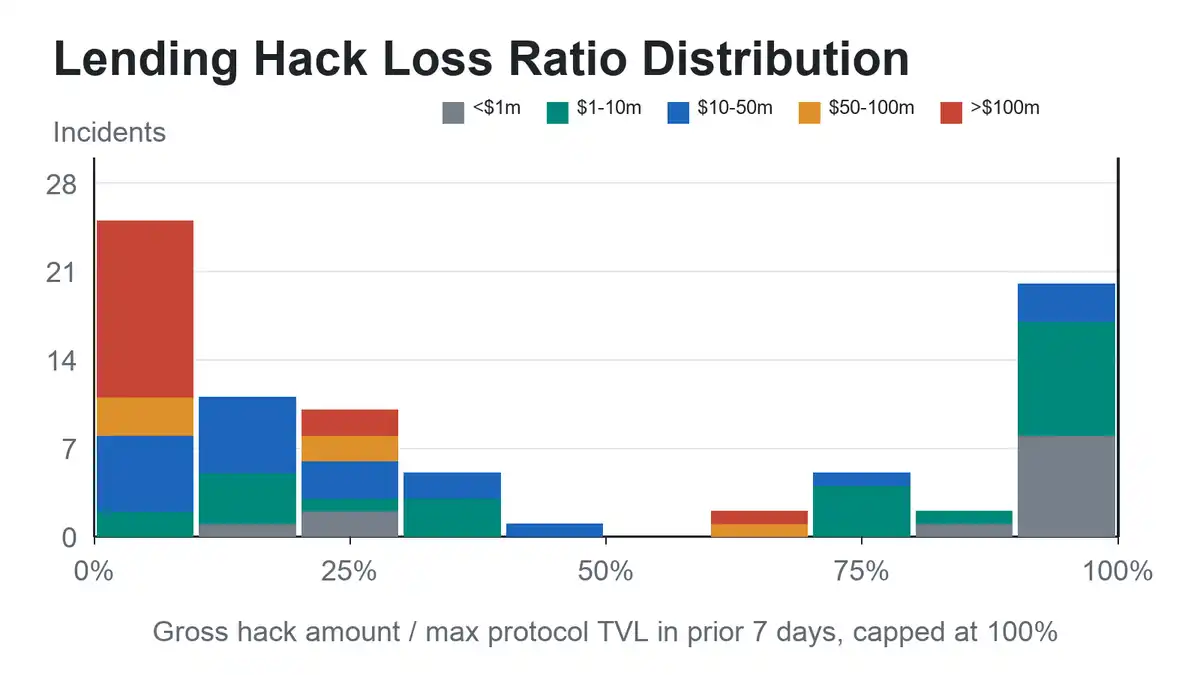
Note: For some theft incidents where the loss amount appears to exceed the project's own TVL, such cases are uniformly counted as 100% loss. There are two main reasons for this data discrepancy: first, there is a time lag between the TVL statistics time and the security incident occurrence time, causing asset volumes to change; second, DeFi Llama's TVL statistical scope is inconsistent with the actual standards for assets at risk exposure.

Although this measurement method is not absolutely perfect, it clearly reflects the industry's current state: the vast majority of vulnerability attacks only affect a single business module within a lending protocol; it is extremely rare for the entire asset pool to be compromised, especially for large-scale leading projects. This research data also provides key basis for DeFi industry risk hedging and asset security custody businesses.

Asset Recovery Capability is Crucial

Asset recovery has also greatly optimized the actual risk performance of the DeFi lending sector. Based on DeFi Llama's all-category DeFi theft data, the overall industry asset recovery amount accounts for about 8% of the total book loss. However, after excluding cross-chain bridge incidents, the asset recovery ratio for the EVM and Solana lending sector is even higher, reaching about 20% of the book loss.

Asset recovery success rates are generally higher for theft cases occurring in regions with well-established legal systems and mature regulatory governance. This phenomenon also hints at industry insights related to access permissions.

Positive Industry Outlook

Today, the security risks in the DeFi lending sector have become quantifiable and classifiable, with the actual fund loss ratio continuously declining. Data proves the industry has entered a mature development stage: actual vulnerability theft losses are extremely low relative to the sector's massive existing capital, various risks are clearly identifiable, and risk boundaries are increasingly transparent.

In conclusion, there's no need to be swayed by external bearish rhetoric; data and facts are sufficient to confirm the true risk level of the DeFi lending sector.


İlgili Sorular

QWhat is the annual estimated loss rate due to theft and malicious attacks in EVM and Solana DeFi lending, excluding cross-chain bridge incidents, according to the article?

AThe annual estimated loss rate is about 0.03% of the total value locked (TVL) in DeFi lending on EVM and Solana, excluding cross-chain bridge incidents.

QWhy are lending markets and AMMs highlighted as high-risk categories for security incidents in DeFi?

ALending markets and Automated Market Makers (AMMs) are high-risk because they require large amounts of assets to be pooled and locked in smart contracts, making them prime targets for hackers.

QWhat key improvement does the article mention regarding the handling of the Euler Finance hack in 2023?

AThe Euler Finance hack resulted in the successful full recovery of the stolen assets. Not only were the initial $197 million recovered, but price fluctuations led to the return of $240 million, creating a positive surplus.

QHow does the distribution of hack sizes in DeFi lending affect risk, according to the article's analysis?

AThe hack sizes follow an approximate log-normal distribution, meaning the vast majority of security incidents result in relatively small losses, with only a few extreme cases accounting for the largest portions of total losses. This supports the effectiveness of portfolio diversification as a risk mitigation strategy.

QWhat is the asset recovery rate for EVM and Solana lending sector hacks, excluding cross-chain bridge incidents?

AExcluding cross-chain bridge incidents, the asset recovery rate for hacks in the EVM and Solana lending sector is about 20% of the账面 (book value) losses.

İlgili Okumalar

Topping GitHub's Trending, the Essential Guide for Claude Code Users

The CLAUDE.md file, trending on GitHub, is a project-level guide for Claude Code designed to dramatically improve its accuracy and efficiency. It addresses key issues like repetitive context explanations, unauthorized code changes, and forgotten decisions across sessions. By placing this plain-text file in a project root, Claude Code reads it automatically at the start of each session. The guide includes rules to eliminate redundant explanations, enforce strict behavioral constraints (e.g., no modifications outside the requested scope without confirmation), and establish a "memory" system using companion files like MEMORY.md and ERRORS.md to log past decisions and failures. It also locks in the project's specific tech stack to prevent inappropriate tool recommendations. Highlighted are four foundational rules from Andrej Karpathy that reportedly increased coding accuracy from 65% to 94%: always ask for clarity first, implement the simplest solution, never touch unrelated code, and explicitly flag uncertainties. The article quantifies significant weekly cost savings for developers and teams by eliminating wasted time on re-explaining context, rolling back unauthorized edits, and re-evaluating previously rejected solutions. The core message is that a small, upfront investment in creating a CLAUDE.md file leads to a more predictable, controlled, and cost-effective AI programming assistant.

marsbit10 dk önce

Topping GitHub's Trending, the Essential Guide for Claude Code Users

marsbit10 dk önce

When Computing Power Becomes Commoditized, How Long Until a GPU Futures Market Emerges?

"When Will GPU Futures Arrive? A Framework for Assessing Compute as a Commodity" The article explores the potential for a robust futures market for compute power (GPUs), arguing that such a market is not yet mature but may emerge. It analyzes the landscape using a five-part framework developed for new commodity futures markets. The analysis scores the current state: * **Fragmented Supply (Red)**: Supply is highly concentrated among hyperscale cloud providers (AWS, Azure, GCP, Oracle), limiting the need for price discovery. * **Price Volatility (Green)**: GPU pricing is already highly volatile due to uncertain supply and surging demand. * **Physical Settlement Infrastructure (Green)**: Early infrastructure exists via OTC brokers and price indices (e.g., Ornn, Silicon Data) standardizing contracts. * **Standardized Unit (Red)**: A lack of standardized, tradable units hinders markets; a GPU instance hour varies by region, configuration, and contract terms. * **Lack of Alternatives (Yellow)**: Large players hedge internally via vertical integration, while smaller players bear spot market risk. Overall, the market shows promise (volatility, early infrastructure) but lacks the fragmented supply and standardization needed for large-scale futures trading. Most activity remains OTC. Key open questions and hypotheses: 1. Supply is expected to fragment moderately in 1-2 years, driven by new cloud providers, cheap power locations, and demand from non-frontier labs and AI startups using open-source models. 2. Standardization is most likely to emerge around inference workloads (forecast to be >65% of AI compute demand by 2029), which have simpler, more homogeneous hardware needs than training. Widespread adoption of open-source model weights could accelerate this by democratizing inference and creating demand for optimized, standardized infrastructure. 3. The primary traded unit will likely be the **"chip instance hour"** (akin to electricity, traded regionally), not the physical chip or the downstream AI output (tokens).

marsbit38 dk önce

When Computing Power Becomes Commoditized, How Long Until a GPU Futures Market Emerges?

marsbit38 dk önce

When Computing Power Becomes Commoditized, How Long Until a GPU Futures Market?

When Compute is Commoditized: How Far Away is a GPU Futures Market? The article explores the potential emergence of a futures market for computing power ("compute"), akin to markets for commodities like oil or electricity. It uses a five-dimension framework to assess the market's maturity for sustaining robust futures trading. **Current Market Assessment (Scorecard):** * **Supply Fragmentation:** 🔴 **Red.** Supply is highly concentrated, dominated by a few hyperscale cloud providers. * **Price Volatility:** 🟢 **Green.** GPU pricing is already highly volatile. * **Physical Settlement Infrastructure:** 🟢 **Green.** Early infrastructure exists at the OTC/broker level. * **Standardization:** 🔴 **Red.** Compute lacks a standardized, tradable unit (e.g., an H100 hour is not uniform). * **Lack of Substitutes:** 🟡 **Yellow.** Vertically integrated players can hedge internally, while others are forced to be long. **Conclusion:** The overall scorecard suggests a robust futures market is premature. The market has volatility and early settlement infrastructure but lacks the necessary supply fragmentation and standardization for large-scale price discovery. Most activity remains OTC. **Key Unanswered Questions & Hypotheses:** The article posits that the market could evolve in the next 1-2 years: 1. **Supply:** May become *moderately more fragmented* due to new cloud providers, cheaper power locations, and demand from long-tail users (e.g., startups running open-source model inference). 2. **Standardization:** Could emerge from the growing **inference** workload (expected to be >65% of AI compute demand by 2029), which has more homogeneous hardware requirements than custom training workloads. Widespread adoption of **open-source model weights** is seen as a key catalyst for democratizing inference and driving infrastructure standardization. 3. **Traded Unit:** The most viable layer for trading is likely the **"chip-instance-hour"** (powered, usable compute time), traded similarly to electricity in regional contracts with spot/futures overlays. Trading at the upstream "chip" layer is unlikely due to supply concentration, while the downstream "token" layer faces challenges due to lack of uniformity across AI models.

链捕手44 dk önce

When Computing Power Becomes Commoditized, How Long Until a GPU Futures Market?

链捕手44 dk önce

İşlemler

Spot
Futures
活动图片