CARV Deep Dive: Cashie 2.0 Integrated x402, Turning Social Capital Into On-Chain Value

TheNewsCryptoPubblicato 2025-12-10Pubblicato ultima volta 2025-12-10

Introduzione

CARV introduces Cashie 2.0, a programmable on-chain layer that transforms social engagement into verifiable economic activity. Integrated with the x402 protocol, Cashie bridges social and economic ledgers through three core pillars: x402 Payment (pledging funds via ERC-3009 signatures), CARV ID (mapping social actions to on-chain identities), and ERC-8004 Agent (autonomous execution of rewards). The upgrade enables gasless, trustless campaigns and supports AI-native APIs for agent-to-agent coordination. It also offers universal ERC-20 token compatibility via transaction hash verification. Cashie 2.0 aims to decentralize social monetization, with an initial $45,000 creator campaign to drive adoption. Built on CARV’s modular infrastructure for sovereign AI Beings, it expands the creator economy by turning social capital into on-chain value.

San Fransisco, California, December 10th, 2025, Chainwire

As CARV advances its vision of sovereign AI Beings, it’s become clear that true value creation lies not just in compute or data, but in people. At the heart of CARV’s AI Being roadmap is a new class of agents, AI-powered digital extensions of individuals, anchored in verifiable identity and private context. To bridge the Social and Economic Ledgers that have long operated in silos, CARV introduces Cashie: a programmable on-chain layer turning real social engagement into verifiable economic activity. No longer just a social payment tool, Cashie is evolving into a core protocol for trustless coordination between influence and value.

As part of CARV’s broader modular agentic infrastructure, alongside CARV ID (ERC-7231), Model Context Protocol (MCP), and the Shielded Mind update, Cashie’s integration with x402 protocol transforms social engagement into verifiable, automated, and privacy-preserving on-chain rewards, pushing the boundaries and limits of the creator economy, turning social capital into on-chain value.

How Cashie 2.0 Works: The Three-Pillar Bridge
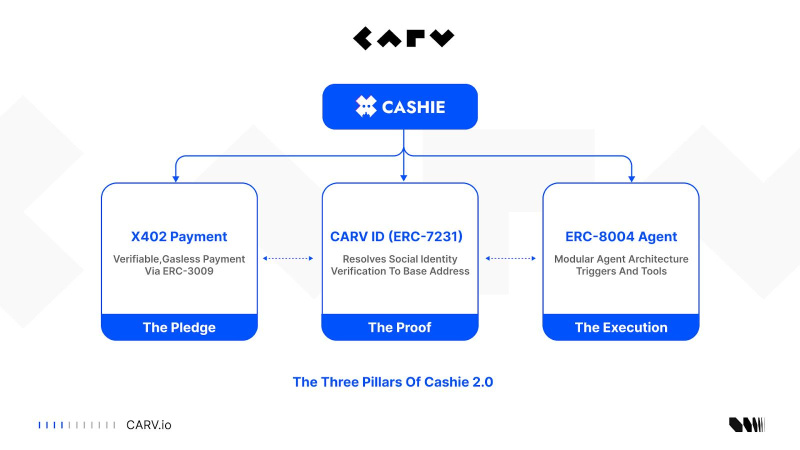
Cashie 2.0 is architected around three foundational pillars:

1. x402 Payment: ‘The Pledge’

Cashie campaigns begin with a single ERC-3009 signature, where a project or KOL pledges funds to a campaign. This is the “X-Payment” proof, and it’s verified on-chain. No gas. No manual transfer. It ensures that funds are committed and can be distributed autonomously.

2. CARV ID: ‘The Proof’

How to reward a retweet or any other engagements? Traditional wallets don’t recognize @handles on social media. Cashie solves this with CARV ID, which maps social actions (like a retweet from @user) to on-chain identities (0xABC). This is the identity oracle that connects the Social Ledger to the Economic Ledger.

3. ERC-8004 Agent: ‘The Executor’

Cashie isn’t a monolithic bot. It’s an AI-powered agent built with modular tools:

  • A Payment Tool to verify and move funds
  • A Twitter Tool to monitor and analyze social activity
  • A Raffle/Quest Tool to select winners or check completions
  • A Distribution Tool to deliver on-chain rewards

All of this happens trustlessly and autonomously, removing manual ops and Sybil vectors.

The Developer Breakthrough: Powering the Agents-to-Agents Economy

To unlock the full potential of sovereign AI Beings and decentralized coordination, infrastructure must evolve, quietly but radically. While the spotlight shines on AI agents and social campaigns, it’s the innovation under the hood that makes everything work. With Cashie 2.0, CARV introduces a new kind of developer stack: one that’s not just programmable, but agent-native.

The CARV x402 Facilitator: Enhancing the Protocol

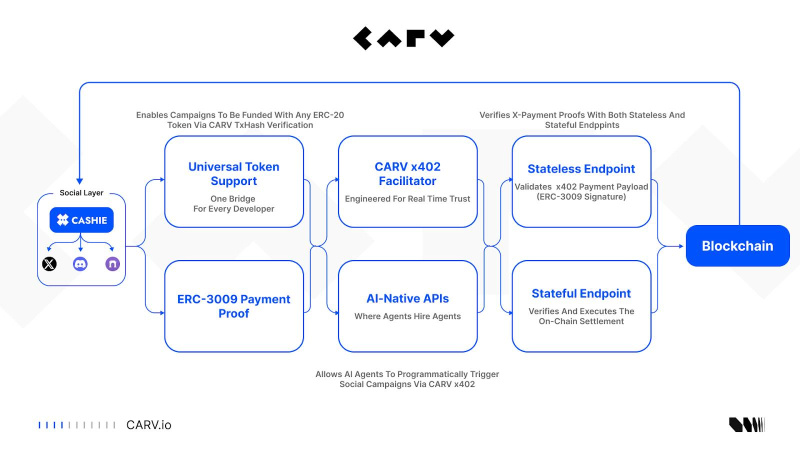
Every action in Cashie starts with a cryptographic promise, but verification is what makes it trustworthy. To enable secure, gasless campaigns at scale, the company built the CARV x402 Facilitator: a high-performance verifier that adds state and nonce tracking to reject replayed signatures instantly, preventing duplicate settlements before gas is spent.

CARV is opening its facilitator endpoints for any developer on Base to build their own x402-powered applications. Developers can start building against their live endpoints today:

  1. A stateless endpoint to validate an x402 paymentPayload (ERC-3009 signature): https://interface.carv.io/cashie/protocol/verify
  2. A stateful endpoint that verifies and executes the on-chain settlement: https://interface.carv.io/cashie/protocol/settle

The AI-Native API: Agents Hiring Agents via x402

True to the ERC-8004 (Trustless Agents) vision, Cashie 2.0 is not just a platform; it’s a programmable tool for other AI agents. CARV are exposing an AI-native HTTP API that fully implements the x402 protocol. This means another AI agent (from Virtual, Base, or anywhere else) can now programmatically hire Cashie to run a campaign. An agent can call the API, receive a 402 Payment Required challenge, and then resubmit its request with its own X-Payment proof to autonomously fund and launch the entire operation. This is agent-to-agent social commerce in action.

Universal ERC-20 Support via TxHash Verification

Web3 is fragmented by token standards. Not every ERC-20 supports gasless approvals or signature-based authorizations. But Cashie was designed for inclusivity. CARV built Cashie for the entire Base ecosystem, not just for tokens with ERC-3009 support. The platform includes a separate, robust txhash-based verification API.

This internal capability will allow any project to sponsor a campaign with their own (and any) native ERC-20 token, even if it doesn’t support permit or authorization. The sponsor simply sends a standard on-chain transfer and provides the txHash as proof. CARV’s system handles secure, on-chain verification and replay protection, making Cashie the most flexible and inclusive social-growth engine on Base, with a clear roadmap to open this universal token support to all builders.
What This Means for Users and Developers

Cashie introduces a new way to engage and earn. Users can receive crypto rewards directly through social actions like retweets or quests, without wallet submission required, with CARV ID ensuring verified ownership and privacy preserved. For developers, Cashie becomes a programmable growth layer where automated campaigns, bounties, and agent-driven incentives can be built without manual wallet collection, enabling new composable experiences across social and onchain environments.

To encourage adoption, CARV launches Cashie 2.0 Creator Campaign with a $45,000 prize pool to incentivize creators and participants. Through this campaign, the Creators (e.g., KOLs and projects) can configure a reward pool, duration, eligibility logic, and then publish a campaign link via a single social post. Read more about this campaign in this link.

What’s Next

Cashie is already driving early campaigns across the Base ecosystem, but this is only the beginning. With upcoming support for self-hosted x402 facilitators, AI-powered campaign agents, and enterprise-grade SDKs for social growth, Cashie will evolve into the coordination engine between agents, humans, and verifiable engagement. As CARV’s AI Being roadmap advances, Cashie plays a key role in building trustless bridges between influence and value.

About CARV

CARV is where Sovereign AI Beings live, learn, and evolve.

What are AI Beings? They are sovereign intelligences born natively on-chain. AI Beings are designed with purpose, autonomy, and the capacity for growth. They possess memory, identity, and the ability to perceive and interact with their environment, not just to execute tasks, but to make independent decisions, adapt over time, and pursue self-defined goals.

Anchored by its proprietary CARV SVM Chain, D.A.T.A. Framework, and CARV ID/Agent ID system (ERC-7231), CARV enables verifiable, consent-based AI Beings that learn, adapt, and co-create with users. Driven by CARV’s AI-first stack, consumer AI apps incubated through CARV Labs launched on Google Play, App Store and beyond, reaching billions of people, bringing agent-powered experiences and real-world incentives into mainstream digital life.

With 8M+ CARV IDs issued, 60K+ verifier nodes, and 1,000+ integrated projects, CARV bridges AI agents, Web3 infrastructure, and real-world utility, fueling the rise of agent-driven economies. At its core, $CARV token powers staking, governance, and coordination across this stack, making CARV the operating system for AI Beings on Web3.

X (Twitter): https://x.com/carv_official

Discord: https://discord.com/invite/carv

Telegram: https://t.me/carv_official_global

Whitepaper: https://docs.carv.io/

Contact

COO
Victor Yu
CARV
[email protected]
Letture associate

Five Core Forms of AI Agent in YC's Eyes

The article outlines five core architectural patterns for effective AI Agents, emerging from tools like Codex and Claude, that move beyond simple prompts towards reusable, process-based capabilities. 1. **Skills**: Reusable, parameterized workflows that function like method calls, allowing a single process (e.g., "/investigate") to handle various tasks based on input parameters. 2. **Thin Harness**: A lightweight execution framework (~200 lines) that manages the AI model's "hands and feet"—handling loops, file I/O, and context—without becoming bloated. 3. **Resolvers**: Routing tables that map tasks to specific Skills, preventing "context corruption" when managing dozens of Skills and ensuring outputs go to the correct locations. 4. **Latent vs. Deterministic Layer**: A critical separation where LLMs handle judgment, synthesis, and pattern recognition, while deterministic code handles tasks requiring precision, consistency, and low cost (like calculations). 5. **Memory**: A persistent, accumulating knowledge base (e.g., a markdown folder) with a "current trusted conclusion" section and an append-only timeline, enabling the system to learn and retain context over time. Together, these patterns create a "process power"—a durable competitive advantage. Unlike one-off prompt-based applications whose value quickly commoditizes, a well-designed AI Agent system encodes experience into reusable, parameterized workflows, offloads stable rules to code, and continuously learns through memory. This creates a structured, hard-to-replicate capability that can provide sustained value for individuals or businesses, such as an accountant automating client reviews while preserving privacy and accumulating expertise.

marsbit39 min fa

Five Core Forms of AI Agent in YC's Eyes

marsbit39 min fa

Tiger Research: On-Chain Risk Operators, The Market Cap Gap Between 147 Trillion and 70 Billion

This report by Tiger Research examines the evolution of risk management in decentralized finance (DeFi) lending. It highlights a power shift from protocol developers to specialized professional risk operators who manage on-chain capital. The era of protocols and community governance solely dictating DeFi lending is ending. A new professional asset management layer has emerged. While the sector is nascent, capital and distribution channels are rapidly consolidating around top risk operator teams, whose past performance is now a key criterion for institutional entry. The industry's development, accelerated by modular infrastructures like Morpho, has led to a clear division of labor mirroring traditional finance: distribution channels (e.g., exchanges), strategy/risk management (the risk operators), and product infrastructure/asset custody (smart contract protocols). This structure lowers the entry barrier for traditional institutions. Currently, the total value managed by risk operators is approximately $70 billion, dominated by a few leading teams like Steakhouse (RWA focus), Sentora (AI models), and Gauntlet (crisis management). Competition now centers on collateral standards, distribution access, and crisis response capabilities. The report outlines three primary entry paths for institutions: 1) **Distribution Model**: Leveraging external risk operators as backend service providers (common for exchanges). 2) **Asset Supply Model**: Onboarding real-world assets to DeFi as collateral. 3) **Independent Operator Model**: Building an in-house team to become a risk operator (e.g., Bitwise). The core opportunity lies in the strategy/risk management layer, where traditional financial institutions can leverage their existing expertise in due diligence and risk assessment without deep technical development. A vast opportunity gap exists: the global traditional asset management industry manages ~$147 trillion, while the entire DeFi sector is only ~$800 billion, with the risk operator niche at ~$70 billion. This disparity signifies immense growth potential. Once robust risk frameworks and clearer regulations are established, even a minor allocation from traditional markets could trigger exponential DeFi growth. Early movers who help build these foundational systems will gain significant rule-setting influence and first-mover advantages.

marsbit46 min fa

Tiger Research: On-Chain Risk Operators, The Market Cap Gap Between 147 Trillion and 70 Billion

marsbit46 min fa

Interview with Circle's Chief Economist: USDC's Entry into Hyperliquid Benefits Circle and HYPE, Stablecoins Are Becoming Marginal Buyers of U.S. Treasuries

In an interview with Circle's Chief Economist Gordon Liao, the conversation covers the strategic significance of USDC replacing USDH as the reference asset on the decentralized perpetual exchange Hyperliquid. This shift, facilitated by Coinbase as the reserve manager and Circle providing technical infrastructure, aims to capture net interest income for the platform, with 90% of reserve earnings directed back to Hyperliquid for HYPE token buybacks. Liao discusses how stablecoins like USDC, with their substantial on-chain settlement volumes (e.g., $21 trillion in Q1 2026), are emerging as marginal buyers of U.S. Treasuries, concentrating on short-term debt and effectively reducing the weighted duration of the market, which may provide underlying support for long-term rates. The dialogue also explores the evolving nature of stablecoins as both a medium of exchange and a vehicle for capital and collateral liquidity. Additionally, the panel touches on the CLARITY Act's legislative progress, noting compromises around "activity-based rewards" and remaining hurdles like ethics concerns. On AI, there's debate over value capture, with predictions that distribution and application layers, rather than foundational model companies like OpenAI, will accrue most value. Regarding the bond market, Liao attributes the rise in 30-year yields primarily to an increased term premium (around 80 bps) driven by supply-demand dynamics, including fiscal expansion and changing investor demand, rather than expectations of Fed rate hikes.

marsbit51 min fa

Interview with Circle's Chief Economist: USDC's Entry into Hyperliquid Benefits Circle and HYPE, Stablecoins Are Becoming Marginal Buyers of U.S. Treasuries

marsbit51 min fa

Trading

Spot
Futures

Articoli Popolari

Come comprare CARV

Benvenuto in HTX.com! Abbiamo reso l'acquisto di Carv (CARV) semplice e conveniente. Segui la nostra guida passo passo per intraprendere il tuo viaggio nel mondo delle criptovalute.Step 1: Crea il tuo Account HTXUsa la tua email o numero di telefono per registrarti il tuo account gratuito su HTX. Vivi un'esperienza facile e sblocca tutte le funzionalità,Crea il mio accountStep 2: Vai in Acquista crypto e seleziona il tuo metodo di pagamentoCarta di credito/debito: utilizza la tua Visa o Mastercard per acquistare immediatamente CarvCARV.Bilancio: Usa i fondi dal bilancio del tuo account HTX per fare trading senza problemi.Terze parti: abbiamo aggiunto metodi di pagamento molto utilizzati come Google Pay e Apple Pay per maggiore comodità.P2P: Fai trading direttamente con altri utenti HTX.Over-the-Counter (OTC): Offriamo servizi su misura e tassi di cambio competitivi per i trader.Step 3: Conserva Carv (CARV)Dopo aver acquistato Carv (CARV), conserva nel tuo account HTX. In alternativa, puoi inviare tramite trasferimento blockchain o scambiare per altre criptovalute.Step 4: Scambia Carv (CARV)Scambia facilmente Carv (CARV) nel mercato spot di HTX. Accedi al tuo account, seleziona la tua coppia di trading, esegui le tue operazioni e monitora in tempo reale. Offriamo un'esperienza user-friendly sia per chi ha appena iniziato che per i trader più esperti.

411 Totale visualizzazioniPubblicato il 2024.12.11Aggiornato il 2025.03.21

Come comprare CARV

Discussioni

Benvenuto nella Community HTX. Qui puoi rimanere informato sugli ultimi sviluppi della piattaforma e accedere ad approfondimenti esperti sul mercato. Le opinioni degli utenti sul prezzo di CARV CARV sono presentate come di seguito.

活动图片