Securitize hires former PayPal exec as US tokenization gains traction

cointelegraphОпубліковано о 2025-12-09Востаннє оновлено о 2025-12-09

Анотація

Securitize, a major tokenization platform, has hired former PayPal executive Jerome Roche as its new general counsel to strengthen its push for tokenized equity in the US. Roche previously led PayPal’s expansion into digital assets, including the PYUSD stablecoin. The company emphasized that tokenized securities are already accessible to US investors, countering the perception that such offerings are primarily available abroad. CEO Carlos Domingo stated that Securitize operates within a clear US regulatory framework using SEC-approved infrastructure, enabling fully compliant access to onchain securities. This development follows Securitize’s recent regulatory approval in the EU and signals growing acceptance of tokenization in the US, further evidenced by the SEC ending its investigation into rival platform Ondo Finance.

Major tokenization platform Securitize has doubled down on its push to bring tokenized equity to US investors, naming a former PayPal executive as its new general counsel.

Securitize on Tuesday announced the appointment of ex-PayPal executive Jerome Roche, who led the company’s expansion into digital asset projects, including the PayPal USD (PYUSD) stablecoin.

Securitize also said its tokenized securities are already available to US investors, challenging the notion that most issuers prefer to offer such products abroad due to local stock access.

“There’s been a perception that tokenized securities must be offered primarily outside the US, but our experience shows the opposite,” Securitize CEO Carlos Domingo told Cointelegraph.

“Clear regulatory path” for tokenized stocks in the US

According to Securitize, operating real-world asset (RWA) tokenization offerings inside the US regulatory perimeter is “not only possible, but scalable, at institutional quality.”

“We’ve demonstrated that there is a clear regulatory path for issuers to natively tokenize assets for US investors,” Domingo said.

“These are not synthetic representations, or derivatives, but real securities onchain,” the CEO said, adding:

“We operate using SEC-regulated infrastructure, including a registered transfer agent broker-dealer, and fund admin, which allows US investors to access and legally hold tokenized securities in a fully compliant framework.”

Securitize’s optimistic outlook on the US tokenization comes days after the platform obtained regulatory approval to operate as an investment company and a trading ánd settlement system in the European Union on Nov. 26. According to the company, the approval positioned it as one of the first operators for regulated digital securities infrastructure in both the US and EU.
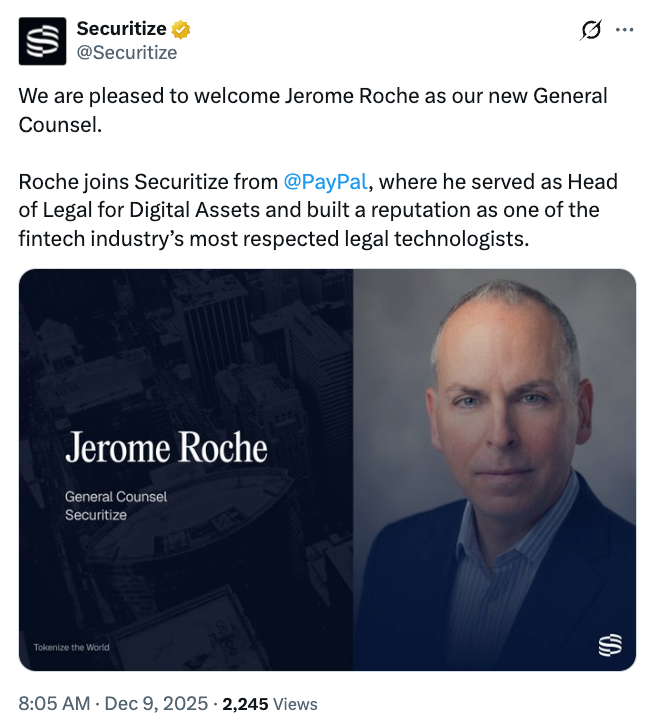
Source: Securitize

“For the first time, modern ledger technology is giving us the ability to record ownership, settle transactions, and move value in ways that are fundamentally better than the fragmented systems we’ve inherited,” Securitize’s newly appointed general counsel, Roche, said in the announcement.

“Innovation only works when it fits squarely within the guardrails of applicable law,” he added, underscoring Securitize’s global push for regulated tokenized securities.

Related: US Treasurys lead tokenization wave as CoinShares predicts 2026 growth

Securitize’s news is another sign of the US warming to tokenization. On Monday, the Securities and Exchange Commission dropped its investigation into rival tokenization platform Ondo Finance.

Ondo said the decision marks a new chapter for tokenized securities in the US, where they are poised to become a “core part of the capital markets.”

Magazine: When privacy and AML laws conflict: Crypto projects’ impossible choice


Пов'язані матеріали

BNB Chain Releases Research Report, Exploring Post-Quantum Cryptography Migration Path for BSC

BNB Chain, a leading Layer-1 blockchain ecosystem, has released a research report exploring the potential migration path for BNB Smart Chain (BSC) to post-quantum cryptography. The study evaluates replacing traditional cryptographic systems with quantum-resistant alternatives, specifically examining the use of ML-DSA-44 for transaction signing and pqSTARK for aggregating validator consensus signatures. While quantum computers are not currently a practical threat to existing blockchain cryptography, the research represents a proactive effort to ensure long-term network security and infrastructure resilience. The report assessed several core areas of the BSC tech stack, including post-quantum transaction signing, validator signature aggregation, transaction validation, public key storage, and network performance under increased data loads. A key finding is that achieving post-quantum readiness is technically feasible today but requires significant trade-offs in scalability. Test data indicates: • Transaction size would increase from ~110 bytes to ~2.5 kilobytes. • Block size would grow from ~110 kilobytes to ~2 megabytes. • Native transfer TPS would decrease from 4,973 to 2,997. The primary performance bottleneck is not signature verification itself, but the increased network transmission overhead caused by larger transaction and block sizes. Conversely, the pqSTARK aggregation technology proved highly efficient, compressing validator signatures by an approximately 43:1 ratio, which helps manage consensus-layer overhead. The report notes that post-quantum alternatives for areas like P2P handshakes and KZG commitments were not within the scope of this evaluation and require further research and broader ecosystem coordination. BNB Chain emphasizes this work is a research-oriented exploration and not a response to any imminent security threat.

marsbit48 хв тому

BNB Chain Releases Research Report, Exploring Post-Quantum Cryptography Migration Path for BSC

marsbit48 хв тому

After Developer Numbers Halved: Crypto Isn't Dead, It's Just Giving Up Talent to AI

The title "After a 50% Drop in Developer Count: Crypto Isn't Dead, It's Just Ceding Talent to AI" suggests a shift, not an end. The article analyzes GitHub data showing a significant drop in overall Crypto developer activity from a peak of 45K monthly active developers in 2022 to about 23K in 2026. However, this masks a deeper trend of "talent deleveraging." The exodus consists mainly of newcomers who entered during the bull market for hype-driven roles (e.g., NFT contracts, forked DeFi protocols), with over 50% of developers with less than one year of experience leaving. In contrast, established developers (2+ years of experience) have hit record highs, contributing roughly 70% of the code. They are consolidating in ecosystems with real users and revenue, like Bitcoin and Solana. These experienced builders possess unique skills forged in Crypto's "code is law" environment: the ability to build trust and functional systems from scratch in the absence of external authority or rules, with zero tolerance for error. The article argues that AI's scaling faces structurally similar trust, coordination, and verification problems—particularly regarding compute aggregation, multi-agent incentive alignment, and autonomous payments. Crypto builders are already applying these skills in AI. Examples include CoreWeave (mining to AI compute), OpenRouter (NFT marketplace routing to AI model routing), and projects like Hyperbolic (using crypto-native mechanisms for decentralized compute verification) and EigenLayer (applying restaking logic to AI agent governance). Stablecoin infrastructure is becoming critical for AI agent micro-payments (e.g., x402 protocol). The role of these builders is evolving from writing smart contracts to "designing trusted mechanisms for autonomous AI systems." This shift is reflected in new hiring trends at major exchanges and significant venture capital flowing into the crypto-AI convergence (e.g., funds from Paradigm, Haun Ventures). The article concludes that while developer numbers have halved, the core density of talent has increased, and their uniquely cultivated skills are finding a new, larger stage in the AI era.

marsbit58 хв тому

After Developer Numbers Halved: Crypto Isn't Dead, It's Just Giving Up Talent to AI

marsbit58 хв тому

Торгівля

Спот
Ф'ючерси
活动图片