Polymarket acquires Brahma to fix ‘liquidity imbalance’: Report

ambcryptoPublicado em 2026-03-19Última atualização em 2026-03-19

Resumo

Polymarket has acquired crypto infrastructure firm Brahma to address liquidity imbalances and improve its on-chain trading systems. While popular markets like elections attract significant activity, niche markets suffer from low participation and unreliable pricing. The acquisition aims to distribute liquidity more evenly and enhance platform efficiency. Despite rapid growth and a valuation of $18–20 billion, driven by the 2024 election cycle, Polymarket faces inconsistent trading activity and a recent drop in market share. Competitor Kalshi, a regulated non-crypto platform, briefly captured 66% market share during the election. Polymarket continues to focus on crypto, with plans for a native token, contrasting with Kalshi’s traditional approach.

In a surprising shift, Polymarket has moved beyond simply hosting bets on future events and is now working to build the full infrastructure behind those wagers.

According to reports, Polymarket has acquired Brahma, a company specializing in crypto and DeFi infrastructure. This means Polymarket wants better technology to make its platform faster, smoother, and more on-chain.

Polymarket has grown rapidly, now valued at an estimated $18–20 billion, boosted by heavy activity during the 2024 elections. Yet with that growth come new challenges.

What is Polymarket trying to revamp with Brahma?

One of the core problems is liquidity imbalance. This means popular wagers, like elections or major sports events, attract a lot of money and activity.

Whereas, smaller or niche wagers struggle because not enough people are betting on them. That makes prices less reliable and the markets less useful.

Citing examples, Fortune added,

Larger event contracts, like those in sports or politics, easily bring lots of money into the pool. But smaller wagers focused on niche areas such as, for instance, the outcome of a bowling match in Spain, struggle to amass a sizable amount of liquidity.

Therefore, by acquiring Brahma, Polymarket is trying to fix this by improving how liquidity is distributed across markets. The plan also focuses on making trading more efficient and strengthening its blockchain-based system.

Remarking on this initiative, Shayne Coplan, founder and CEO of Polymarket, told Fortune,

Building reliable infrastructure across blockchain networks and traditional financial rails is hard—there are no shortcuts.

That said, Brahma, founded in 2021, has already processed over $1 billion in transactions, and by bringing its team in-house, Polymarket is effectively shutting down Brahma’s external operations to focus entirely on its growth.

Polymarket’s metrics paint a confusing picture

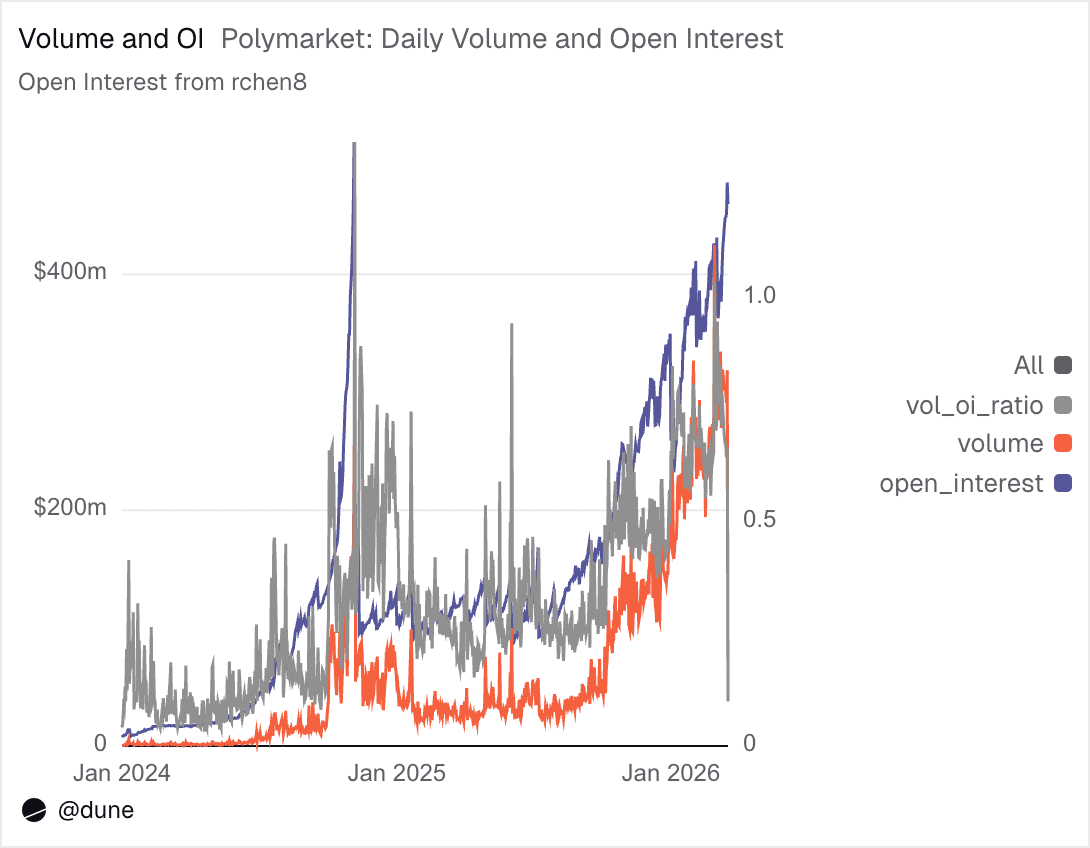
However, the platform’s internal data suggests that growth is not entirely balanced. While more capital is flowing into the system, as seen in the steady rise in Open Interest, actual trading activity remains inconsistent.
Source: Dune

This gap shows that users place long-term bets but trade inconsistently, resulting in low liquidity and one-sided markets.

Even though the platform became very popular during the 2024 election cycle, its dominance didn’t last. Its market share dropped sharply from over 61% to around 32% as the hype faded. However, at press time, Polymarket’s stock price stood at $141.60, marking a more than 20% increase year-to-date.

Is Polymarket losing ground against Kalshi?

In fact, during the 2024 election, its U.S.-based competitor Kalshi took advantage of the slowdown, briefly capturing about 66% market share and handling nearly $1 billion in weekly trading volume.

This competition reflects two very different paths. Kalshi follows a fully regulated approach with no blockchain, DeFi, or token layer.

Polymarket, in contrast, is doubling down on crypto. Besides Brahma, the platform’s CEO is also hinting at a potential POLY token. With a possible 2026 launch, it acts as a strong incentive for users, something regulated platforms like Kalshi are struggling to offer.


Final Summary

  • The Brahma acquisition shows that fixing liquidity and market efficiency is now more important than just attracting users.
  • Competition from regulated players like Kalshi adds pressure, especially as they gain ground during periods of low hype.


Perguntas relacionadas

QWhat is the primary reason Polymarket acquired Brahma, according to the report?

APolymarket acquired Brahma to fix the 'liquidity imbalance' on its platform by improving how liquidity is distributed across markets, making trading more efficient, and strengthening its blockchain-based system.

QWhat specific problem does the 'liquidity imbalance' cause for smaller wagers on Polymarket?

ASmaller or niche wagers struggle to attract enough betting activity, which makes their prices less reliable and the markets less useful due to low liquidity.

QHow did Polymarket's market share change after the hype of the 2024 election cycle faded?

APolymarket's market share dropped sharply from over 61% to around 32% after the hype of the 2024 election cycle faded.

QWhich competitor briefly captured about 66% market share during Polymarket's slowdown, and what is its key operational difference?

AKalshi, Polymarket's U.S.-based competitor, briefly captured about 66% market share. Its key difference is that it follows a fully regulated approach with no blockchain, DeFi, or token layer.

QWhat potential incentive is Polymarket's CEO hinting at to attract users, and how does it contrast with regulated platforms?

APolymarket's CEO is hinting at a potential POLY token, which acts as a strong incentive for users. This is something regulated platforms like Kalshi struggle to offer.

Leituras Relacionadas

OpenAI Bets on 'Robot Army': 23-Year-Old Prodigy Wins Favor from Sam Altman

While OpenAI adjusts its video strategy, Sam Altman is setting his sights on the more ambitious field of "multi-agent systems." According to The Wall Street Journal, OpenAI has secretly invested in Isara, an AI startup founded by 23-year-old researchers Eddie Zhang and Henry Gasztowtt. Despite being established only in June last year in San Francisco, Isara has already recruited over a dozen top researchers from Google, Meta, and OpenAI itself, forming a highly skilled technical team. Isara’s core vision is to develop a system that enables thousands of AI agents to collaborate efficiently. While individual AI assistants are powerful, they often struggle with large-scale industrial challenges such as biotech R&D or complex financial modeling. Isara aims to solve this by creating a framework where diverse AI agents can communicate, align goals, share data, and tackle interconnected problems—functioning like a coordinated "robot army." This multi-agent approach is seen as a critical step toward Artificial General Intelligence (AGI). OpenAI’s endorsement signals industry recognition of distributed intelligence. In biopharma, the system could simulate thousands of protein-folding pathways, with specialized agents identifying patterns. In finance, it could perform real-time stress tests using global market data. Led by young innovators, this shift suggests the next breakthrough in AI lies not in building larger models, but in enabling smarter collective intelligence.

marsbitHá 23m

OpenAI Bets on 'Robot Army': 23-Year-Old Prodigy Wins Favor from Sam Altman

marsbitHá 23m

Trading

Spot
Futuros
活动图片