13 Business Lines Surpass $100 Million in Annualized Revenue, Robinhood Advances Toward a 'Super Financial App'

marsbitPublished on 2026-07-30Last updated on 2026-07-30

Abstract

On July 30th, Robinhood (HOOD) reported its Q2 2026 financial results, showcasing significant growth with record revenue and profits. The company achieved a net revenue of $1.308 billion, a 32% year-over-year (YoY) increase, and a net income of $561 million, up 45% YoY. This strong performance was driven by robust trading activity and expansion into new financial services. A key highlight was the surge in transaction-based revenue, which rose 44% YoY to $776 million. Notably, income from event contracts (prediction markets) skyrocketed over 10x to $156 million, emerging as a major new growth driver alongside strong gains in stock and options trading. However, crypto trading revenue declined by 38%. Beyond trading, Robinhood is successfully diversifying its revenue streams. User assets grew 32% to $369 billion, and the subscription service Robinhood Gold reached a record 4.8 million users. The company revealed that 13 of its business lines now generate over $100 million in annualized revenue, including its new credit card, prediction markets, and Gold subscriptions. Looking forward, Robinhood is strategically investing in AI and blockchain to build a comprehensive financial ecosystem. It has launched AI-powered "Agentic Trading" and the "Robinhood Chain," a layer-2 blockchain network. The company's vision is evolving from a retail trading platform into a "super financial app" that integrates trading, wealth management, payments, and next-generation digital asset services, t...

Author|Azuma(@azuma_eth)

On July 30, Beijing time, the US internet brokerage Robinhood (HOOD) officially released its financial report for the second quarter of 2026.

The report shows, Robinhood achieved net revenue of $1.308 billion in the second quarter, a year-on-year increase of 32%, reaching a record high; net profit attributable to Robinhood common shareholders reached $561 million, a year-on-year increase of 45%; diluted earnings per share (EPS) were $0.62, exceeding market expectations of $0.42.
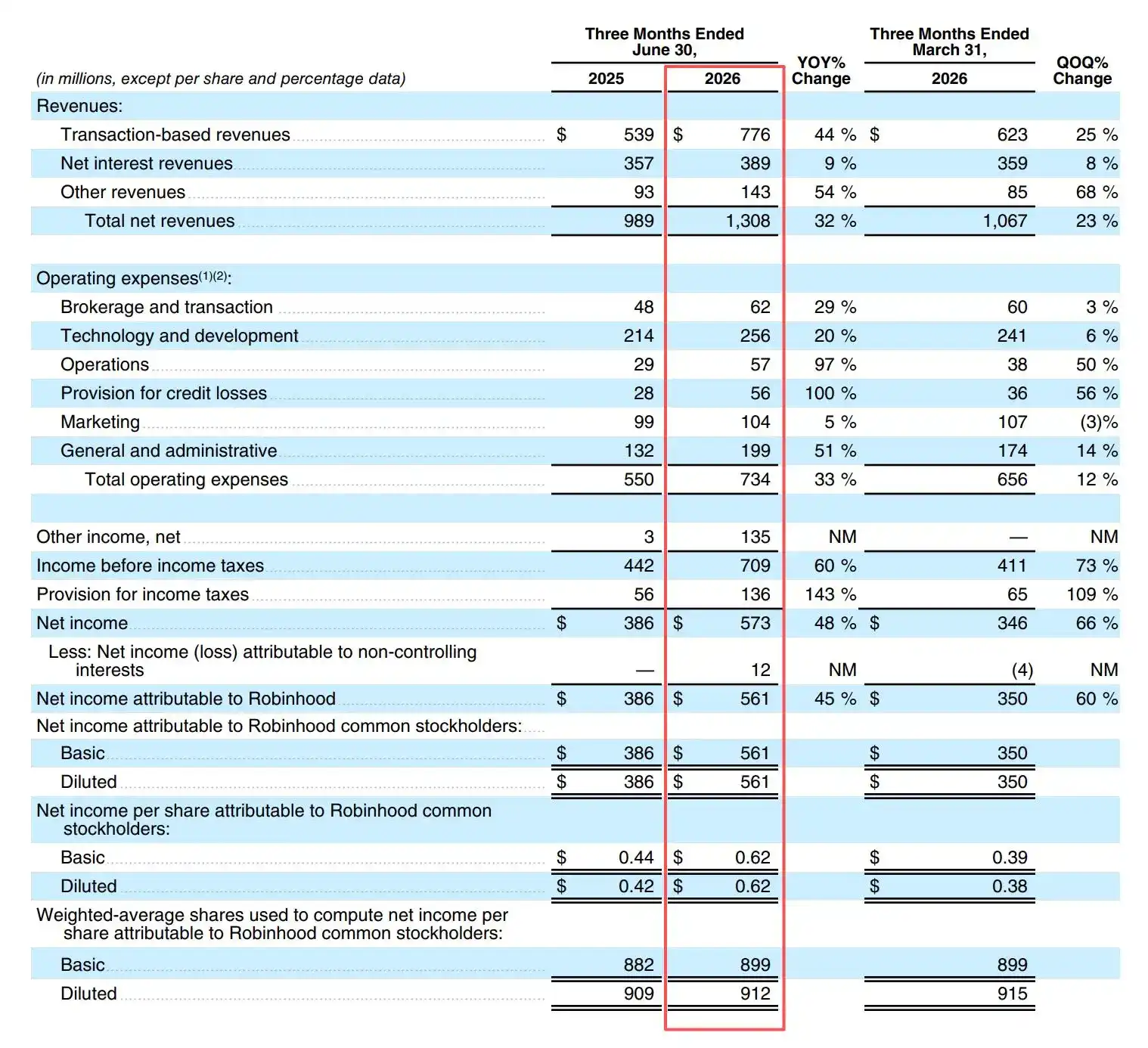
Robinhood's growth this quarter was driven by a combination of trading business, user assets, and subscription services. Specifically:

  • Trading revenue reached $776 million, a year-on-year increase of 44%. Within this, event contract revenue reached $156 million, growing over 10 times year-on-year; options revenue reached $342 million, up 29% year-on-year; equities revenue reached $129 million, up 95% year-on-year.
  • Net interest revenue reached $389 million, up 9% year-on-year. Additionally, other revenue reached $143 million, up 54% year-on-year, reflecting Robinhood's efforts to diversify revenue sources through new services like the Trump account and Gold subscriptions, gradually reducing reliance on a single trading business.
  • User scale and asset deposits also continued to grow. Funded customers reached 28.4 million, a 7% year-on-year increase; Robinhood Gold subscribers reached 4.8 million, a 39% year-on-year increase, setting a new record; total platform assets reached $369 billion, a 32% year-on-year increase; net deposits for the quarter were $21.7 billion, a 28% year-on-year increase.

Compared to the past model that relied on zero-commission trading and young retail investors to drive growth, today's Robinhood is attempting to transform from a 'retail trading platform' into a one-stop financial ecosystem covering trading, wealth management, digital assets, and on-chain finance.

Trading Business Booms Across the Board, Prediction Markets Become Growth Breakout

The most outstanding performance for Robinhood this quarter came from the explosion of its trading business. Data shows, in the second quarter, Robinhood's trading revenue reached $776 million, a year-on-year increase of 44%, becoming the main driver of overall revenue growth.
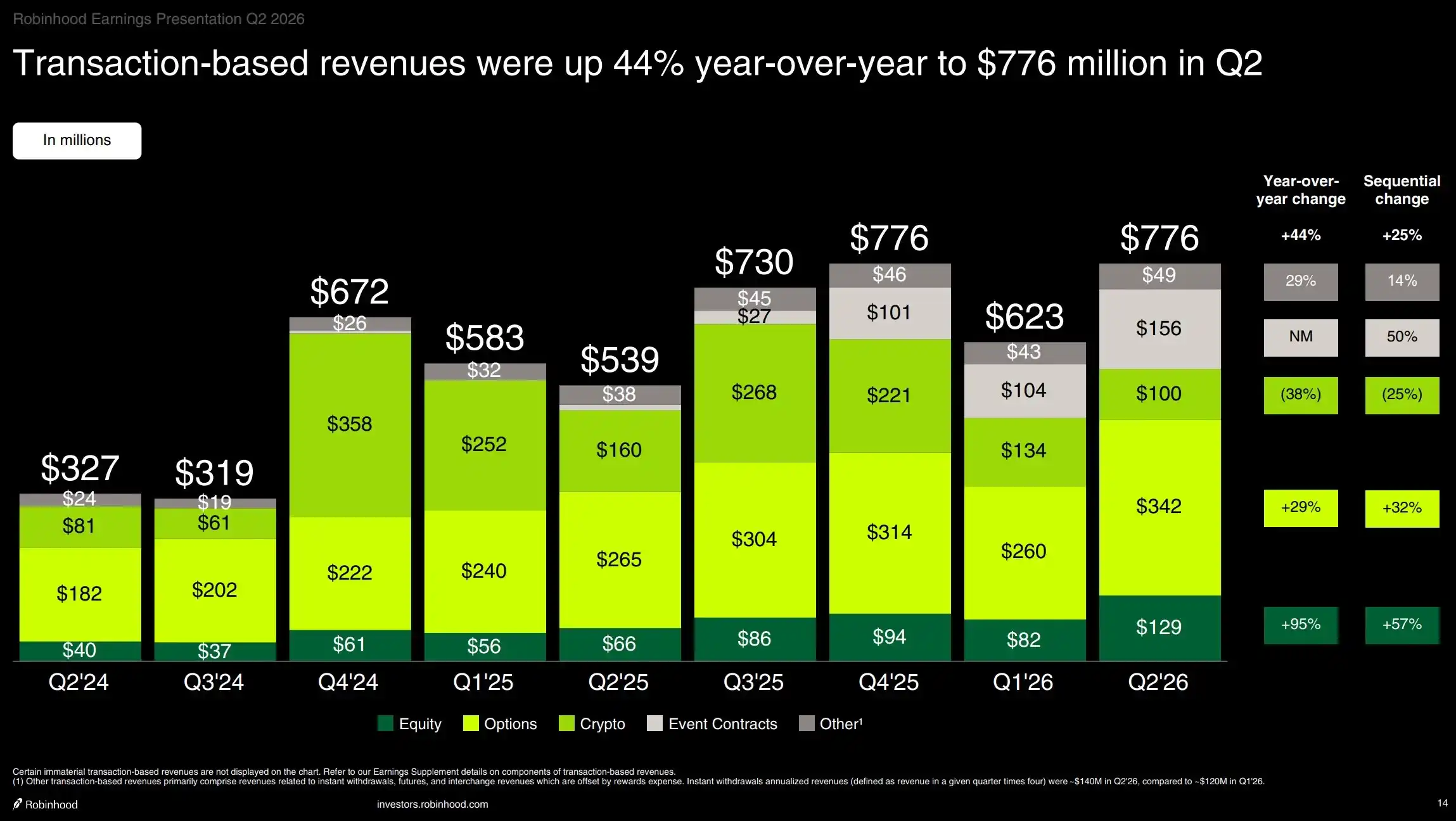
Specifically, the revenue data and growth status for various types of trading services are as follows:

  • Equities trading revenue reached $129 million, up 95% year-on-year;
  • Options trading revenue reached $342 million, up 29% year-on-year;
  • Event contract (i.e., prediction market) revenue reached $156 million, up over 10 times year-on-year;
  • Cryptocurrency trading revenue was approximately $100 million, down 38% year-on-year, the only major trading service to decline......

Benefiting from the favorable environment of the strong US stock market in the second quarter, the overall trading activity on the Robinhood platform also hit a new high. The notional trading volume for equities in Q2 reached $956 billion, an 85% year-on-year increase; options contract volume reached 774 million, a 50% year-on-year increase.

The most noteworthy point in the earnings report is that prediction markets have now become Robinhood's new key focus and the biggest breakout point for this quarter's performance growth — for details, refer to "The First Prediction Market Concept Stock Has Emerged!".

This year, the popularity of prediction markets has continued to rise, experiencing a major boom during the World Cup cycle, while Robinhood has also accelerated its layout. In the second quarter, Robinhood launched its self-built prediction market platform, Rothera — a CFTC-licensed prediction market exchange and clearinghouse jointly established by Robinhood and Susquehanna International Group.

During the World Cup cycle, Robinhood redirected some orders originally destined for Kalshi to be executed on Rothera. Artemis data indicates this move helped Rothera capture nearly 15% of the market share for World Cup-related event contracts.

Compared to traditional stock trading, prediction markets have stronger event-driven attributes and better fit the needs of young users for instant information and trading interaction. For Robinhood, this not only means a new source of revenue but also signifies the company's attempt to broaden user trading scenarios.

Growing User Asset Deposits, Robinhood Seeks a Second Growth Curve

If the trading business is the main driver of Robinhood's current performance growth, then providing deeper financial services centered around user assets is the key to capturing long-term value.

In the past, Robinhood relied more on transaction fees and user activity for growth. However, as the platform scales, the company is now attempting to increase user asset deposits and expand revenue sources through subscriptions, wealth management, credit cards, and other businesses.

  • By the end of the second quarter, Robinhood's funded customers reached 28.4 million, a 7% year-on-year increase; total platform assets reached $369 billion, a 32% year-on-year increase; net deposits for the quarter were $21.7 billion, with net deposits over the past 12 months reaching $75.7 billion.
  • Meanwhile, Robinhood Gold (paid subscription membership) continued its rapid growth. In Q2, Gold subscribers reached 4.8 million, a 39% year-on-year increase, setting a new record.
  • Furthermore, new products launched around high-value users are beginning to scale. The Robinhood Credit Card business has exceeded $100 million in annualized revenue, with Gold Card users surpassing 1 million; Robinhood Strategies has attracted over 300,000 users, managing assets close to $2 billion.
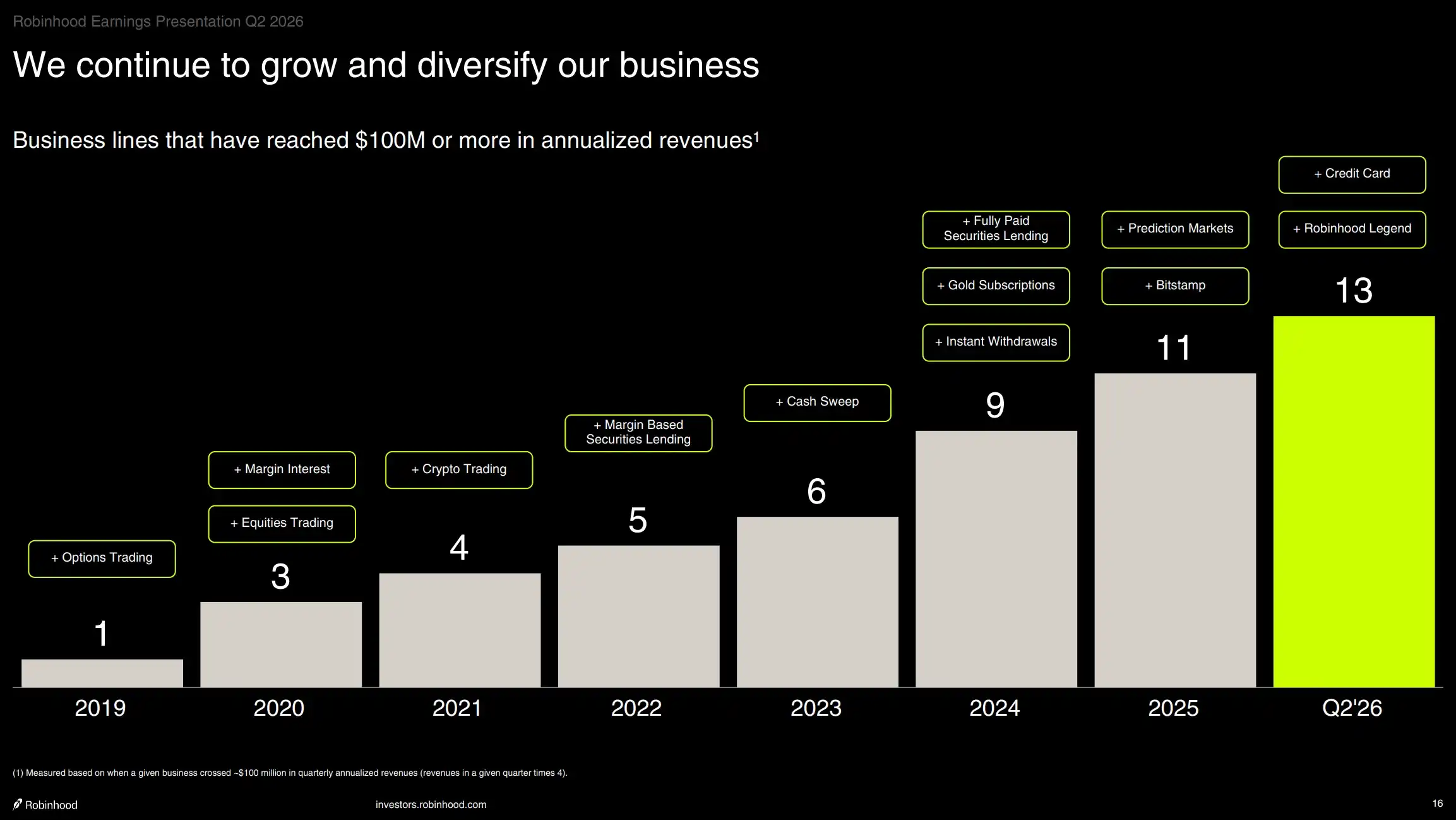
In the earnings presentation, Robinhood revealed that it currently has 13 business lines with annualized revenue exceeding $100 million, including equities trading, options trading, crypto trading, Gold subscriptions, prediction markets, credit cards, and more.

This indicates Robinhood is gradually shifting from a platform dependent on trading cycles to a comprehensive ecosystem covering trading, asset management, payments, and financial services.

AI and Blockchain, Robinhood Bets on Next-Gen Financial Infrastructure

Beyond traditional trading and wealth management businesses, Robinhood is also extending its reach into the fields of AI and blockchain, attempting to lay the groundwork for next-generation financial infrastructure in advance.

In May this year, Robinhood announced the launch of the Agentic Trading feature, allowing users to trade stocks, options, and crypto assets through AI agents. By the end of the second quarter, nearly 100,000 users had activated Agentic Trading accounts, with related asset scale exceeding $100 million.

Unlike simply providing trading tools, Robinhood hopes to embed AI capabilities directly into the investment process, enhancing user engagement frequency through automated analysis and trading assistance. Currently, Agentic Trading is still in its early stages, but its growth rate shows that AI is becoming an important direction for Robinhood to expand its product boundaries.

Simultaneously, Robinhood is accelerating its blockchain layout. In the second quarter, Robinhood launched the Robinhood Chain public mainnet, positioned as an Ethereum Layer 2 network for Real World Assets (RWA). Driven by recent Meme trends, Robinhood Chain has become one of the most active underlying ecosystems in the current Web3 market.

Next Stop, "Super Financial App"

Overall, the biggest change revealed in Robinhood's Q2 earnings report is not just that revenue and profit continue to hit new highs, but that the company's growth logic is changing.

In the past, Robinhood attracted young investors with low-barrier trading and grew rapidly through stocks, options, and crypto trading. Now, the company is continuously expanding user demand boundaries through businesses like Gold subscriptions, credit cards, prediction markets, AI trading, and blockchain. From a long-term strategic perspective, Robinhood is attempting to evolve from a simple "trading platform" into a "Super Financial App" covering investment, wealth management, digital assets, and more financial service scenarios.

The core of this goal is not just to add more products, but to build a more complete financial ecosystem around the user lifecycle: users can complete trading, asset management, cash management, and even participate in future on-chain finance all within the same platform.

Of course, this path is still full of challenges. On one hand, new businesses are still in their early stages, and whether they can sustainably contribute to scaled revenue still needs time to verify. On the other hand, the regulatory environment in areas like prediction markets, crypto assets, and on-chain finance may also affect Robinhood's future expansion pace.

But at least from the Q2 earnings report, Robinhood is no longer content with being just an internet brokerage serving retail traders; it is advancing toward becoming the next-generation financial gateway.


Related Questions

QWhat were the key drivers of Robinhood's revenue growth in Q2 2026 according to the article?

AAccording to the article, the key drivers were: Trading revenue (up 44% year-over-year), particularly from event contracts (up over 10x) and stock trading (up 95%); Net interest income (up 9%); and growth in other income (up 54%) from services like Gold subscriptions and credit cards, reflecting a diversification of revenue sources.

QWhat new service did Robinhood launch in Q2 2026 that became a major growth area, and what regulatory step did they take for it?

ARobinhood launched Rothera, a proprietary prediction market platform. The article states it was launched in partnership with Susquehanna International Group and holds a CFTC license.

QHow is Robinhood's strategic direction shifting as described in the article?

AThe article describes Robinhood's strategic shift from being a 'retail trading platform' reliant on zero-commission trades to transforming into a comprehensive 'super financial app' or one-stop financial ecosystem covering trading, wealth management, digital assets, and on-chain finance.

QWhich Robinhood service saw a significant decline in transaction revenue in Q2 2026?

ACryptocurrency transaction revenue saw a significant decline, decreasing by 38% year-over-year in Q2 2026.

QWhat does the article cite as evidence that Robinhood is diversifying beyond transaction-based revenue?

AThe article cites that Robinhood now has 13 business lines generating over $100 million in annualized revenue, including Gold subscriptions, credit cards, and prediction markets, alongside its core trading services. This shows a move away from dependency on a single type of transaction revenue.

Related Reads

Coinbase Vice President: The Wars Over Cryptocurrency Regulation Are Over

Coinbase's new Vice President, Ryan VanGrak, declared that regulatory wars in the cryptocurrency sector are over. Since taking office on July 9, 2026, he has shifted the company's approach from litigation and sanctions to focusing on growth and innovation. The industry can now concentrate on development rather than fighting for its right to exist. He highlighted that the Digital Asset Market Clarity Act (CLARITY Act), which aims to establish a clear federal regulatory framework dividing oversight between the SEC and CFTC, has gained significant momentum. This framework is intended to provide proper supervision, investor protection, and maintain U.S. leadership in digital assets. VanGrak's appointment marks a strategic shift from a "wartime" to a "peacetime" advisor, replacing former Chief Legal Officer Paul Grewal, who oversaw major litigation, including a dismissed 2023 SEC lawsuit. With his background at Citadel Securities and the SEC, VanGrak brings deep regulatory and institutional finance expertise as Coinbase expands beyond a simple exchange into a broader financial services provider, offering stocks, futures, prediction markets, and AI tools. For investors, bipartisan support for crypto legislation like the CLARITY Act represents a major shift from the enforcement-focused environment of 2023-2024. Lawmakers are now focused on *how* to regulate crypto, not *if* it should exist. However, risks remain, as the bill's passage is not yet guaranteed.

cryptonews.ru23m ago

Coinbase Vice President: The Wars Over Cryptocurrency Regulation Are Over

cryptonews.ru23m ago

Deep Dive into FWA: An Intriguing Experiment Turning NFTs into "On-Chain Gachapon"

A Deep Dive into FWA: The “On-Chain Gacha” Experiment for NFTs Fake World Assets (FWA), created by TokenWorks, introduces an innovative “NFT gacha machine” fully operating on-chain. Users can deposit eligible NFTs paired with ETH (called Backing) to create a Position, acting as a prize pool. Others can then pay a uniform Acquisition Price for a chance to win a random NFT from the pool. The core mechanism features a reverse probability system: Positions with lower Backing have a higher chance of being selected, serving as common prizes, while high-Backing Positions are rare “jackpots.” The acquisition price is calculated based on the harmonic mean of all Backings, keeping entry costs low. When a Position is won, the purchaser must choose: keep the NFT or accept the Standing Bid (85% of the Backing, claimable in ETH or $FWA tokens), returning the NFT to the original depositor. The protocol involves two main roles. Depositors provide liquidity (NFT + ETH), earning a share of fees from each draw, distributed equally per active Position, plus potential $FWA rewards. Purchasers pay to spin the gacha, receiving $FWA rewards for participation. A special “Crown” reward goes to the Position with the highest Backing. The $FWA token has a fixed supply and is initially obtainable only through protocol participation (depositing or purchasing), with external buying disabled early on to reduce sell pressure. Its value is supported by a built-in buy pressure: when purchasers opt for the $FWA settlement on a Standing Bid, the protocol uses the backing ETH to buy $FWA from the market. Revenue for the protocol comes from a 1% fee on each draw, a 1% settlement fee when an NFT is kept, and the 15% discount from Standing Bid settlements (currently allocated to the protocol). The design cleverly blends Uniswap-style liquidity provision, gacha mechanics, and tokenomics to create a novel, self-regulating marketplace for NFT liquidity and engagement.

marsbit37m ago

Deep Dive into FWA: An Intriguing Experiment Turning NFTs into "On-Chain Gachapon"

marsbit37m ago

10,000 Scientists Get 1 Year of Free Access: OpenAI Brings the Scientific Research Pipeline into ChatGPT

OpenAI has launched the "ChatGPT for Academic Researchers" program, offering free one-year access to its flagship models for 100,000 university researchers globally, with 10,000 spots available this summer. Selected institutions include prestigious centers like ENS Paris and the IAS at Princeton. The initiative provides an integrated research workspace within ChatGPT, bundling tools like ChatGPT, ChatGPT Work, and Codex, along with expanded Deep Research capabilities, higher usage limits, and specialized tools for life sciences. The suite connects to platforms like Zotero and GitHub, aiming to streamline the entire research workflow from literature review and coding to data analysis and manuscript drafting. OpenAI notes that about 1.3 million people already use ChatGPT weekly for advanced science and math. The program targets building long-term user dependency by embedding these tools into daily research habits. However, access comes with limitations: it does not include API credits or model weights, and eligibility is restricted to verified academic researchers from supported countries. This approach contrasts with Anthropic's "AI for Science" program, which offers API credits but not an integrated workspace. Both companies emphasize preventing misuse by withholding model weights, a point of contention for AI researchers seeking transparency. The core strategy remains clear: provide a powerful, integrated environment to foster user reliance ahead of the post-free period.

marsbit42m ago

10,000 Scientists Get 1 Year of Free Access: OpenAI Brings the Scientific Research Pipeline into ChatGPT

marsbit42m ago

What's Going On with Gigadevice? Major Shareholder Cashes Out 44 Billion, Then Announces 20 Billion Buyback

Gigadevice Innovation, a leading Chinese memory chip company, has executed a controversial financial maneuver. The company's controlling shareholder and chairman, Zhu Yiming, sold approximately 44 billion RMB worth of his shares between early May and mid-June 2026, capitalizing on a soaring stock price that peaked at 846.66 RMB on June 29th. Following a subsequent stock crash—plummeting to around 350 RMB in 22 trading days and erasing over 330 billion RMB in market value—Zhu announced a combined "market rescue" plan on July 29th. This plan includes his personal commitment to buy back at least 1 billion RMB in shares and a company proposal to repurchase 1 to 2 billion RMB worth of stock. This sequence of high-selling followed by a low-buying plan has confused and unsettled many of the company's 240,000 retail investors. The stock's dramatic decline was attributed to several factors: the successful IPO of its sister company, Changxin Technologies, which ended Gigadevice's status as a primary investment proxy for the domestic memory sector; a Morgan Stanley report warning of a potential peak in the memory chip cycle; and a severe loss of market confidence triggered by the chairman's massive sell-off. While the sell-off was procedurally compliant, its timing has been criticized. The company's fundamentals appear strong, with preliminary H1 2026 results showing revenue up 177% year-on-year to 11.5 billion RMB and net profit skyrocketing 1099% to 6.9 billion RMB, driven by a boom in memory chips and MCU demand. However, a significant portion (2.05 billion RMB) of this profit came from non-recurring gains like securities investment, and the memory industry is notoriously cyclical. Analysts highlight the company's role in the domestic substitution of niche DRAM and NOR Flash memory, with some maintaining bullish price targets. Yet, the recent events underscore key risks: its fabless model creates dependency on foundries like Changxin, and the chairman's actions have raised serious questions about management's alignment with minority shareholders. The promised buybacks cannot commence until December 13th due to a mandatory six-month cooling-off period following an insider sale, leaving the stock vulnerable in the interim.

marsbit42m ago

What's Going On with Gigadevice? Major Shareholder Cashes Out 44 Billion, Then Announces 20 Billion Buyback

marsbit42m ago

Trading

Spot
活动图片