India’s USDT premium surges above 8.5% as regulatory pressure tightens supply

ambcryptoPublished on 2026-06-30Last updated on 2026-06-30

Abstract

India's USDT premium has surged above 8.5% as regulatory pressure tightens the supply of stablecoins domestically. This has pushed the price of USDT to ₹102.88 against an official USD/INR rate of ₹94.65, widening the premium well beyond its typical 3-4% range. The supply contraction, driven by enforcement actions and increased oversight discouraging capital inflows, has created a significant imbalance. Demand from traders, cross-border users, and businesses remains strong for uses like payments and dollar-backed value storage, but compliance risks are hindering arbitrage and new USDT inflows. Market data shows high transaction counts but low volumes, with buy volume severely lagging sell volume, indicating constrained liquidity and reduced market-making capacity. Prolonged regulatory uncertainty risks sustaining elevated premiums, pushing activity toward informal channels or offshore liquidity. The summary concludes that while demand for USDT in India is resilient, clearer regulations and improved compliance pathways are needed to restore supply, efficient pricing, and market efficiency by narrowing the premium.

India’s USDT premium is in the news after it climbed above 8.5% due to a contraction in the availability of stablecoins domestically. As it stands, capital flows into the country are being discouraged by regulators through both enforcement actions and greater oversight.

That imbalance pushed Tether’s value [USDT] to ₹102.88 against an official USD/INR rate of ₹94.65. This shift also led to a widening of the premium well beyond its typical 3–4% range. The growing spread may be a sign that arbitrage has become less effective as compliance risks discourage capital inflows.

Meanwhile, traders, cross-border users, and businesses continue to compete for limited stablecoin supplies. If regulatory uncertainty persists, elevated premiums could remain and encourage greater reliance on informal trading channels.

Otherwise, clearer regulations and improved liquidity may gradually narrow the pricing gap and restore more efficient market conditions.

Regulatory pressure reshapes stablecoin liquidity

That tightening premium is increasingly reflecting deeper changes in India’s stablecoin market structure rather than temporary pricing disruptions. In recent months, regulatory enforcement has slowed down fresh USDT inflows, reducing liquidity across P2P markets, OTC desks, and exchange order books.

Due to this fall in supply, both exchanges and on-chain flows demonstrated that there were minimal top-ups made to local inventory levels. Nonetheless, the total number of active wallet addresses, along with transaction volume, has remained relatively strong.

The resilience of these metrics may be evidence of the demand for using USDT. This includes sending cross-border payments, settling trade, and storing value backed by dollars, which has not abated together with the decrease in supply.

These divergences mean that regulations have constrained the supply of USDT in India greater than they have the end-use or need for it. Should the availability of compliant inflow channels be limited, then the liquidity shortage could continue.

However, regulatory clarity and better market access may gradually restore supply and narrow India’s elevated USDT premium.

Can India’s stablecoin market regain its efficiency?

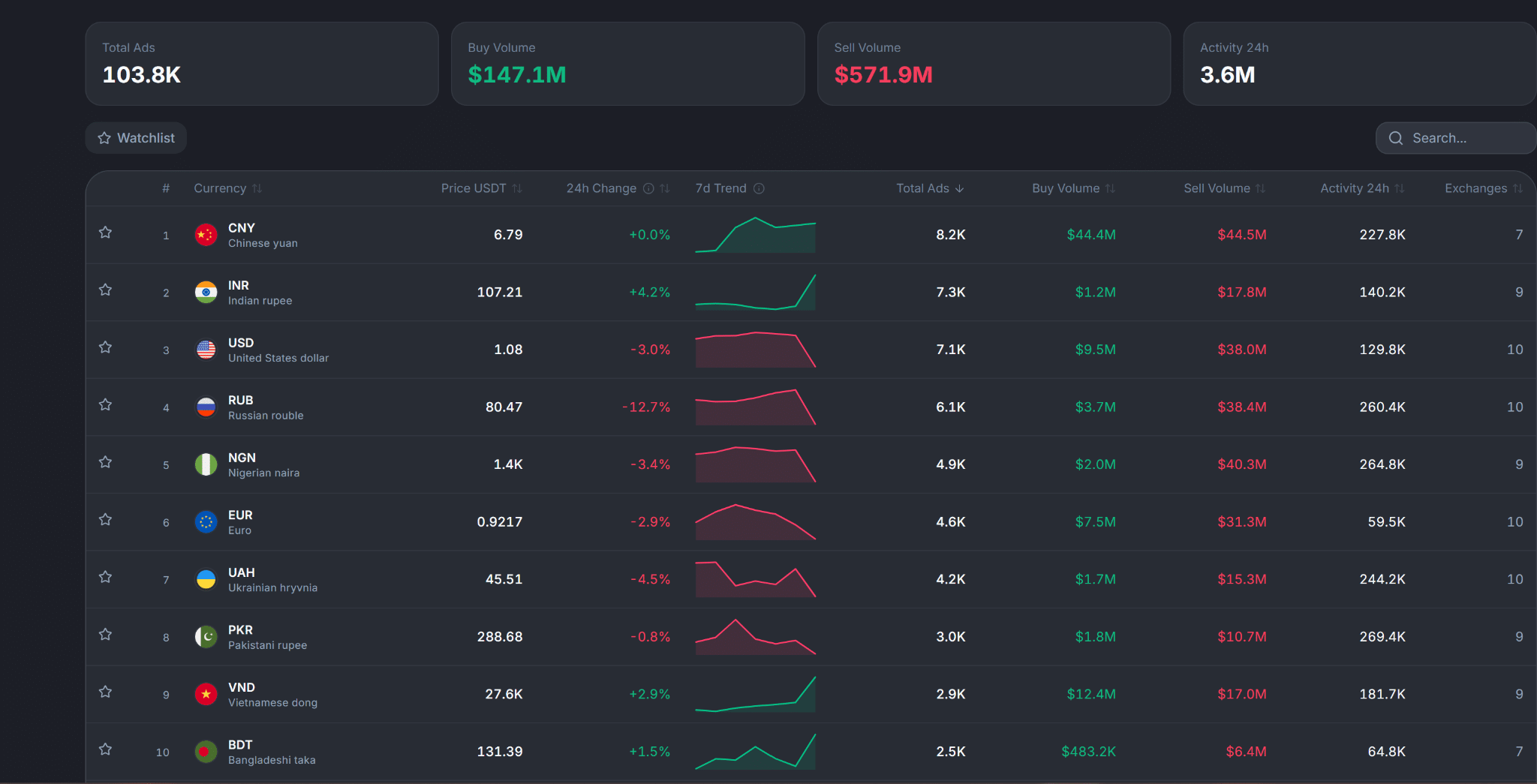
Rather than just driving up the price, the increasing regulatory pressure is also affecting how the Indian stablecoin market operates. According to P2P transaction data, for instance, the INR/USDT rate was approximately at Rs 107.21 at press time.
Source: P2P Army

The daily transaction count was over 140,000, but the amount of money changing hands was relatively low due to reduced liquidity. Meanwhile, buy volume reached only $1.2 million, compared with $17.8 million in sell volume, highlighting constrained market-making capacity.

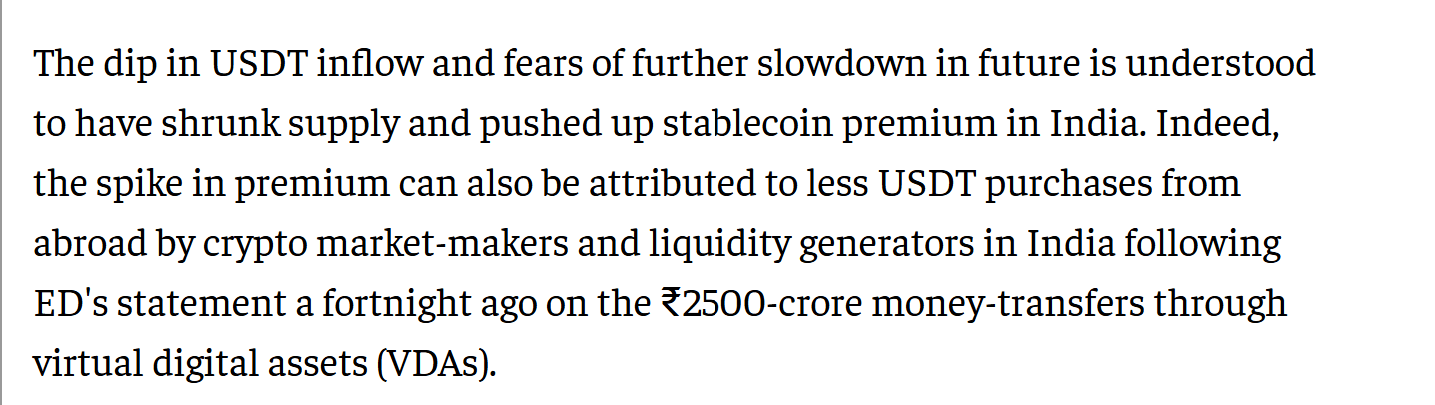
This demonstrated an inability for market makers to operate in this environment. Furthermore, the enforcement actions and scrutiny surrounding ₹2500 crores in VDA transfers. This has additionally led to less new USDT inflow into the Indian market, thereby sustaining the ongoing supply shortages.
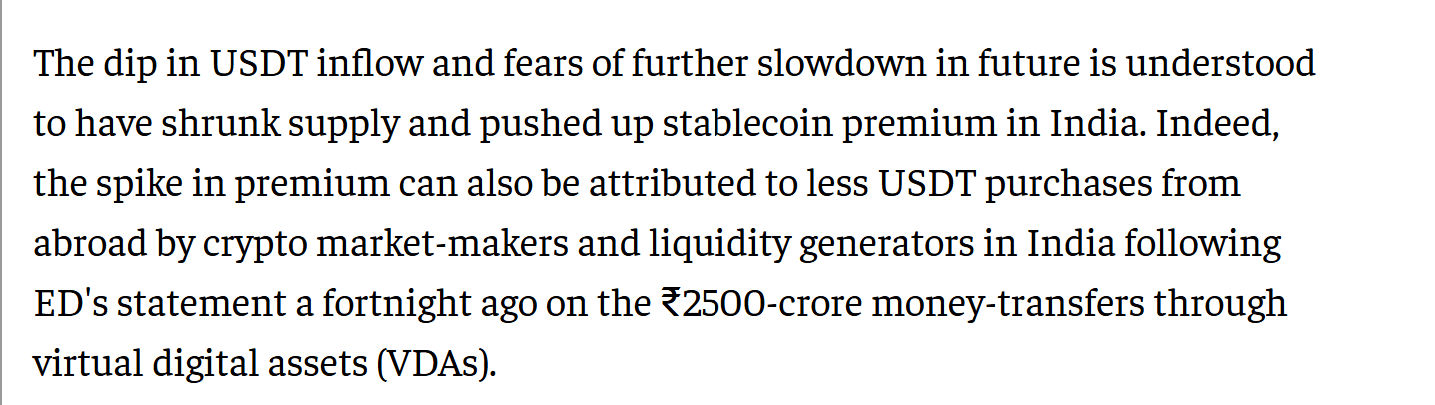
Source: The Economic Times

These imbalances might mean that regulatory uncertainty is currently diminishing market efficiency and increasing cost to acquire dollar liquidity. In the long run, if conditions remain as they are now, it will lead traders to seek alternative means or offshore dollar liquidity.

Clearer regulations would help restore arbitrage opportunities, increase available dollar liquidity, and eventually reduce India’s USDT premium.


Final Summary

  • Tether [USDT] demand remains resilient in India, but prolonged supply constraints could keep domestic premiums elevated.
  • USDT liquidity depends on regulatory clarity, with stronger compliance pathways needed to restore efficient pricing.


Trending Cryptos

Related Questions

QWhy is India's USDT premium surging above 8.5%?

AIndia's USDT premium is surging above 8.5% due to a contraction in the domestic supply of stablecoins. This shortage is caused by regulatory pressure and enforcement actions that discourage capital inflows, creating an imbalance between high demand and limited supply.

QWhat are the main factors driving the persistent high demand for USDT in India?

AThe main factors driving persistent high demand for USDT in India are its use for sending cross-border payments, settling trade, and as a dollar-backed store of value. This demand remains strong despite the regulatory constraints on supply.

QHow have regulatory actions specifically impacted the liquidity of USDT in the Indian market?

ARegulatory actions have slowed down fresh USDT inflows into India, reducing liquidity across P2P markets, OTC desks, and exchange order books. This has led to minimal top-ups of local inventory and constrained market-making capacity, sustaining the supply shortage.

QWhat does the data on P2P transaction volume reveal about the current market dynamics for USDT/INR?

AP2P transaction data reveals high transaction counts but low monetary volume due to reduced liquidity. Specifically, buy volume is significantly lower than sell volume ($1.2 million vs. $17.8 million), highlighting a severe constraint in market-making capacity and a supply-constrained environment.

QWhat is identified as the key long-term solution to reduce India's elevated USDT premium and restore market efficiency?

AThe key long-term solution identified is clearer regulations and improved market access. This would help restore effective arbitrage opportunities, increase the availability of compliant dollar liquidity channels, and gradually narrow the pricing gap to restore efficient market conditions.

Related Reads

Bitmine Increases Holdings to 5.7 Million ETH, Included in Russell 1000 Index, Tom Lee Says Only One Step Away from '5% Target'

Bitmine Increases Ethereum Holdings, Nears 5% Supply Target and Joins Russell 1000 Bitmine Immersion Technologies (BMNR) acquired an additional 27,084 ETH last week, bringing its total holdings to 5,700,040 ETH, which represents 4.7% of Ethereum's total supply. This puts the company at 94% of its goal to own 5% of ETH's circulating supply. Despite a challenging week where ETH price fell 8% and BMNR's stock dropped 13%, Bitmine continues its accumulation strategy, with Chairman Tom Lee attributing the market weakness to quarter-end "window dressing" by investors. In a significant development, Bitmine was added to the Russell 1000 large-cap index on June 26. Lee expects this inclusion to attract hundreds of institutional investors, as passive funds and ETFs rebalance to match the index. The company's total assets, including crypto, cash, and securities, stand at $9.8 billion. Of its ETH holdings, 4,879,157 are currently staked, generating an estimated annualized revenue of $211 million. Lee projects this could rise to $246 million once all ETH is staked through its MAVAN network. Bitmine remains the world's largest corporate Ethereum treasury and the second-largest overall corporate crypto treasury, behind Strategy's substantial Bitcoin holdings. Lee reaffirmed the company's commitment to steady buying throughout 2026, expressing belief that the crypto market is still in the early stages of a spring cycle. At the time of writing, ETH was trading around $1,565, while BMNR stock was near $13.56, down over 90% from its 52-week high.

marsbit26m ago

Bitmine Increases Holdings to 5.7 Million ETH, Included in Russell 1000 Index, Tom Lee Says Only One Step Away from '5% Target'

marsbit26m ago

AGI Countdown: OpenAI's Chief Research Officer Makes Major Statement — The Window for Humanity is 'Very Small'

The countdown to AGI has begun, according to OpenAI's Chief Scientist Mark Chen, who states the window for human-centric progress is "very small." Chen argues that AI is reaching a point where models can perform "self-sustaining research," autonomously driving innovation in fields from mathematics to programming. He points to the proliferation of AI's "superhuman" insights—akin to AlphaGo's legendary "Move 37"—across disciplines as evidence of this shift. Chen firmly dismisses claims that scaling laws are plateauing or that pre-training is dead, asserting the field remains on an exponential curve. He cites OpenAI's successful bet on reasoning models like o1 as proof that fundamental breakthroughs are still possible. The future of research, he suggests, lies with "Vibe Researchers"—humans who provide high-level direction and "taste" while AI handles execution and orchestration of complex, long-horizon tasks. However, significant hurdles remain. Chen highlights a "benchmarking crisis," where models can overfit to existing tests without gaining true generalization. He also notes the "jagged frontier" of AI capabilities, where systems excel at advanced reasoning but struggle with contextual, continual learning from everyday experiences. Despite these challenges, he expresses confidence that these gaps will be closed. In a personal reflection, Chen shares that post-AGI, his wish is to open a noodle shop—a metaphor emphasizing that when AI masters knowledge and innovation, uniquely human experiences, warmth, and storytelling will become the ultimate form of value.

marsbit41m ago

AGI Countdown: OpenAI's Chief Research Officer Makes Major Statement — The Window for Humanity is 'Very Small'

marsbit41m ago

China's No.1, Closing in on OpenAI, Mysterious "Sweeping Monk" Rises to Top Seven Globally

A mysterious Chinese AI project named "MopMonk" (meaning "Sweeping Monk") has achieved a top-ranking result on the globally recognized CyberGym cybersecurity benchmark. With a 73.1% success rate, it ranks seventh worldwide and first among Chinese entries, performing closely behind OpenAI. The significance lies in the benchmark itself. CyberGym, created by UC Berkeley, is considered a premier "Olympics" for AI security. It tests models on over 1500 real-world software vulnerabilities, requiring them to not just identify but actually generate working exploits (PoCs) in a complex, offline environment. This moves beyond simple knowledge to testing an AI's practical "execution" capabilities. MopMonk's approach is notable. It uses the open-source MiniMax M3 model from Shanghai as its powerful reasoning "brain," leveraging its strong coding skills and long context window. However, the key to its performance is a custom-built, multi-agent security framework—its "Harness." This system uses structured "vulnerability memory" to efficiently guide the search for exploits, allowing multiple agents to explore in parallel while sharing lessons learned from failures. This engineering layer effectively translates the model's intelligence into actionable, iterative testing steps. The project remains highly secretive, with no official website or team information, embodying the "dark horse" spirit of its literary namesake. Its success highlights a potential industry shift: beyond simply scaling model size, the engineering of specialized agent systems (the Harness) is becoming a critical differentiator for real-world AI application performance, especially in complex domains like cybersecurity.

marsbit1h ago

China's No.1, Closing in on OpenAI, Mysterious "Sweeping Monk" Rises to Top Seven Globally

marsbit1h ago

Trading

Spot

Hot Articles

Discussions

Welcome to the HTX Community. Here, you can stay informed about the latest platform developments and gain access to professional market insights. Users' opinions on the price of S (S) are presented below.

活动图片