Solana ETF Defies Market Trend with Sustained Inflows: 7 Consecutive Days of Capital Inflow Highlight Institutional Long-Term Confidence

marsbitPublished on 2025-12-14Last updated on 2025-12-14

Abstract

Despite Solana (SOL) facing significant price pressure—down nearly 55% from its January peak—its spot ETF has demonstrated strong capital attraction, with seven consecutive days of net inflows totalling nearly $700 million, according to Farside Investors. The Bitwise BSOL ETF, which stakes 100% of assets for 5-7% annual yield, dominates with over 90% of inflows, offering dual exposure to price and staking returns. This contrasts with Grayscale’s lower staking ratio and higher fees. The divergence between sustained institutional inflows and SOL’s price decline reflects macro pressure, profit-taking, and large sell-offs. However, on-chain data shows accumulation by long-term holders. A key innovation is the compliant integration of staking rewards into traditional finance, allowing passive yield without direct token ownership—a regulatory shift that benefits PoS assets. While institutional views diverge, with some citing meme-driven speculation risks, developments like Western Union’s stablecoin issuance on Solana may strengthen its utility. Continued network growth and enterprise adoption could align ETF inflows with price performance over time.

Despite continued pressure on the price of Solana (SOL) tokens, its spot ETF has demonstrated strong capital attraction capabilities. According to data from Farside Investors, the Solana ETF has achieved net capital inflows for 7 consecutive days, with cumulative net inflows approaching $700 million. The highest single-day inflow occurred on December 12, reaching $16.6 million. This phenomenon contrasts sharply with SOL's weak performance, which has fallen nearly 55% from its January all-time high, reflecting that institutional investors may be positioning themselves in the Solana ecosystem with a long-term perspective.

I. Inflow Structure: Bitwise as the Dominant Force, Staking Mechanism as Key Attraction
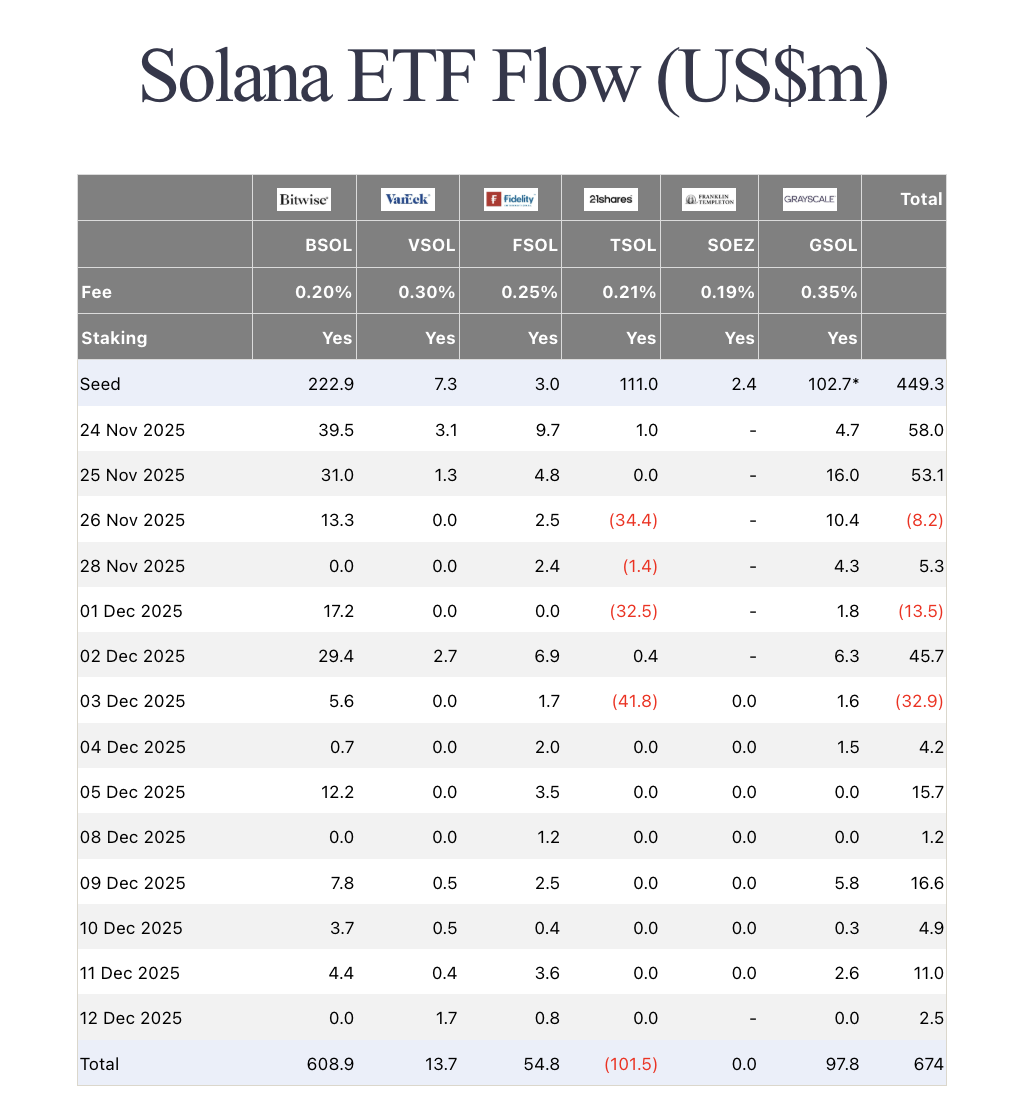
SOL ETF inflow situation. Source: Farside Investors

Solana ETF inflows are highly concentrated, with Bitwise's BSOL ETF being the primary contributor, accounting for over 90% of total inflows, and its assets under management have surpassed $6 billion. This advantage stems from its product design: BSOL utilizes 100% of its custodied assets for on-chain staking, offering an annualized yield of approximately 5%-7%, providing investors with dual returns from "price exposure + staking rewards." In contrast, Grayscale's GSOL stakes only 77% of its assets and has a higher management fee (0.35%), making it less attractive.

Furthermore, the entry of traditional asset management giants like Franklin Templeton has further enriched the product matrix. The staking rewards from these ETFs are directly compounded into the fund's net asset value rather than distributed as cash dividends, better aligning with long-term allocation needs.


II. Price and Flow Decoupling: Short-Term Selling Pressure vs. Long-Term Value Game
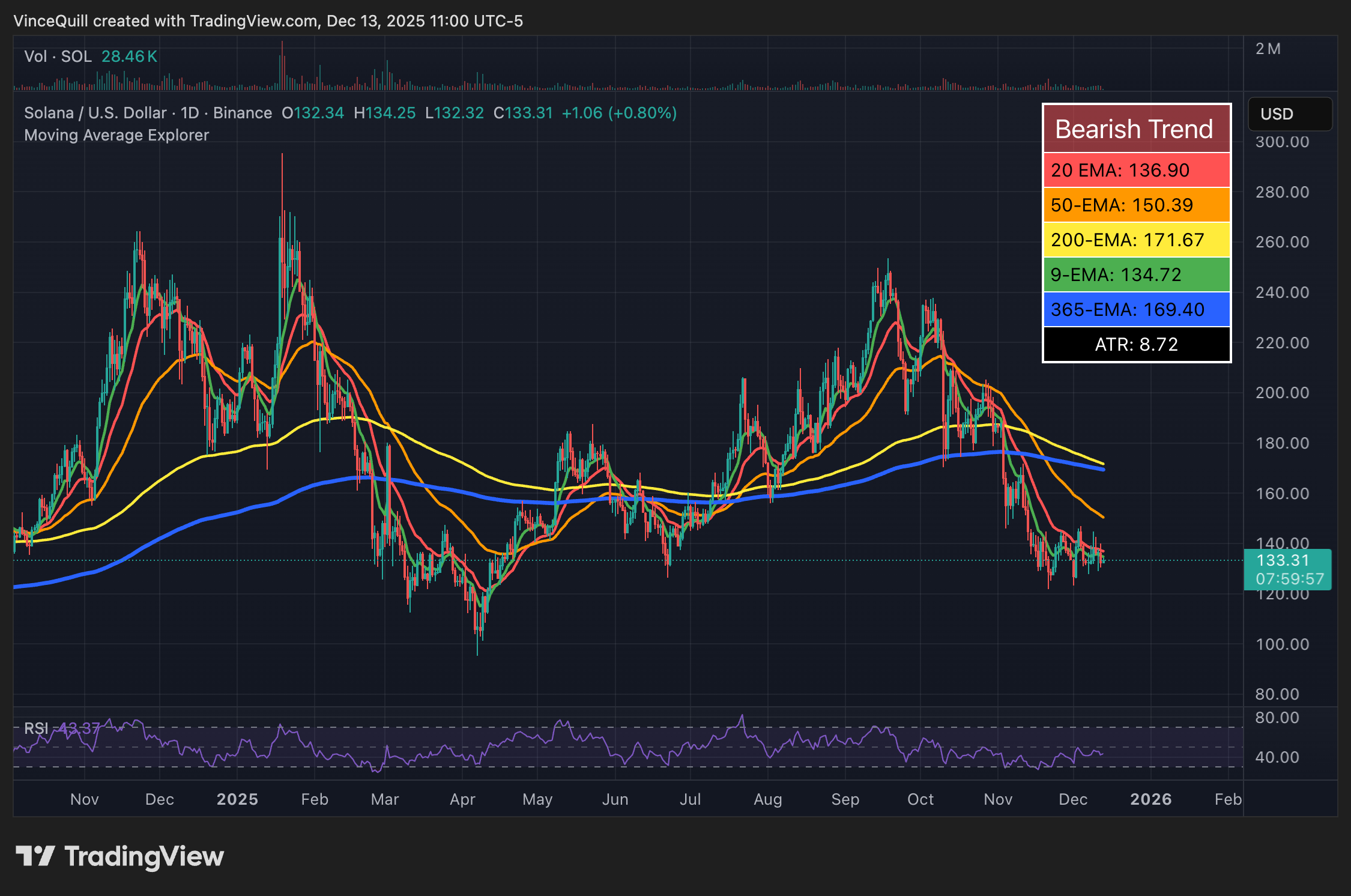
SOL price movement from November 2024 to December 2025. Source: TradingView

Despite continuous ETF inflows, the SOL price remains down roughly 47% from its September local high and has been trading below its 365-day moving average for an extended period. This decoupling is primarily due to three factors:

  1. Macro Market Pressure: Bitcoin and Ethereum ETFs experienced large-scale net outflows during the same period ($3.48 billion and $1.42 billion respectively), dragging down overall crypto market sentiment.
  2. Profit-Taking by Speculators: A concentrated outbreak of "buy the rumor, sell the news" behavior after ETF approval, with some early investors choosing to realize profits.
  3. Whale Selling Impact: For instance, Jump Crypto once sold 1.1 million SOL (approx. $205 million) in a single transaction in late October, creating significant selling pressure in the short term.


However, on-chain data shows that some institutional investors are quietly accumulating during the decline. For example, a mysterious whale cumulatively transferred 1.57 million SOL (approx. $329 million) from platforms like Coinbase to private wallets, hinting at long-term bullish confidence.

III. The Innovative Significance of ETFs: From Price Exposure to Yield Financialization

The core breakthrough of the Solana ETF lies in the compliance of its staking rewards.

By embedding an on-chain staking mechanism into traditional financial products, investors can participate in network governance and earn rewards without directly holding the tokens. This model, referred to as "yield-bearing assets" by Bitwise CIO Matt Hougan, is particularly attractive to traditional financial institutions in a low-interest-rate environment.

Furthermore, the SEC's tacit approval of the staking clauses signals a shift in regulatory attitude. Previously, Ethereum ETFs were forced to remove related clauses due to staking concerns, while the successful listing of Solana ETFs has paved a compliant path for more PoS assets.


IV. Future Outlook: Institutional Divergence and the Battle of Ecosystem Fundamentals

Despite strong inflows, institutional attitudes towards Solana are diverging:

  • Bullish Camp: Grayscale's Head of Research, Zach Pandl, predicts that Solana ETFs could absorb 5% of the total supply (approx. $5 billion).
  • Cautious Camp: Institutions like BlackRock believe the Solana ecosystem is overly reliant on Meme coin trading, posing speculative risks.


Ecosystem fundamentals remain key to long-term value. Western Union's announcement of issuing a stablecoin on Solana, along with improvements in network throughput and developer activity, is gradually strengthening its positioning as "financial infrastructure." If Solana can continue to optimize network stability and expand enterprise-level use cases, the long-term effects of ETF inflows are expected to gradually materialize in the price.



Related Questions

QWhat is the continuous trend of Solana ETF's fund inflows according to Farside Investors data?

ASolana ETF has achieved net capital inflows for 7 consecutive days, with cumulative net inflows approaching $700 million.

QWhich ETF product is the main contributor to Solana ETF inflows and what is its key feature?

ABitwise's BSOL ETF is the main contributor, accounting for over 90% of the total inflows. Its key feature is that it stakes 100% of its custodial assets on-chain, providing an annualized yield of approximately 5%-7%.

QWhat are the three main reasons for the decoupling between SOL's price decline and the ETF's continuous capital inflows?

AThe three main reasons are: 1. Macro market pressure, with Bitcoin and Ethereum ETFs experiencing large net outflows; 2. Profit-taking by speculative traders after the ETF approval; 3. Selling pressure from large holders, such as Jump Crypto's sale of 1.1 million SOL.

QWhat is the core innovation of the Solana ETF highlighted in the article?

AThe core innovation is the合规化 (compliant integration) of staking rewards, allowing investors to gain exposure to price and earn yield without directly holding the token, a model referred to as 'yield-bearing assets'.

QHow do institutional views on Solana's future differ according to the article?

AViews are divided. The bullish camp, like Grayscale's research head, predicts the ETF could attract 5% of the total supply. The cautious camp, including BlackRock, believes the ecosystem relies too heavily on meme coin trading and carries speculative risks.

Related Reads

Anthropic Major Release: "The Founder's Playbook" - All 4 Stages of Entrepreneurship, Completely Reimagined with AI

**Anthropic Releases "The Founder's Playbook," Reimagining the Four Stages of Startups with AI** The logic of entrepreneurship is being fundamentally reshaped by AI. Anthropic's new handbook, "The Founder's Playbook: Building an AI-Native Startup," defines the AI-native startup as a new species: not a traditional company with AI tools, but a venture driven by AI from day one. The founder's role is transforming from a hands-on builder to a conductor or architect, orchestrating AI agents for execution while focusing on high-level judgment and strategy. Anthropic outlines a product matrix of Claude tools for different tasks: Claude Chat for interactive research, Claude Code for generating production-ready code, and Claude Cowork for automating knowledge-intensive workflows. The handbook structures the startup lifecycle into four stages, detailing core goals, pitfalls, and AI applications for each: 1. **Idea Stage**: Focuses on validating a real problem. The core challenge is avoiding confirmation bias. AI practices include using Claude as a "structured devil's advocate" to challenge assumptions and for automated market/competitor research. 2. **MVP Stage**: Aims to gather early signals of Product-Market Fit (PMF). Key risks are technical debt and scope creep due to rapid AI-assisted development. Recommended AI uses include maintaining project memory documents (e.g., CLAUDE.md), using Claude Code for structured coding, and automating user feedback analysis. 3. **Launch Stage**: Centers on establishing scalable growth, operations, and compliance. Challenges include accelerating technical debt and founders becoming bottlenecks. AI should be used to build an "operating system" for launch—automating routine tasks (scheduling, reporting, content) and code audits—freeing founders for critical decisions. 4. **Scale Stage**: Focuses on achieving sustainable business operations. The main challenge is delegating operational control. AI should be leveraged for differentiated marketing, operational optimization, and building competitive moats through data network effects. The handbook concludes that in the AI era, "Can we build it?" is no longer the primary constraint. The advantage shifts back to foundational strengths: **insight, judgment, and a deep understanding of a specific problem and audience.**

marsbit1h ago

Anthropic Major Release: "The Founder's Playbook" - All 4 Stages of Entrepreneurship, Completely Reimagined with AI

marsbit1h ago

Eight Departments Launch Severe Crackdown on Cross-Border Securities Firms, How to Interpret This?

China's top financial regulators, including the CSRC and seven other ministries, have launched a sweeping crackdown on unlicensed cross-border securities operations. The core action involves a joint enforcement plan and the issuance of administrative penalties against major offshore internet brokers like Futu and Tiger Brokers for conducting unauthorized securities business in mainland China without a domestic license. The primary legal basis is China's requirement for securities businesses to operate with proper, locally issued licenses. The crackdown aims to eliminate a major regulatory gray area, plugging channels that allowed massive, unmonitored capital outflows which posed risks to financial stability, currency controls, and foreign exchange reserves. It also seeks to protect mainland investors who previously lacked legal recourse when dealing with offshore platforms and to secure sensitive financial data. The immediate impact is severe for the targeted brokers, including a complete ban on new mainland business, forced liquidation of existing mainland client positions over two years, and the confiscation of illegal profits estimated in the billions. Their U.S.-listed shares plummeted in response. Market analysts warn that the forced sell-off of an estimated 250-280 billion RMB in assets, concentrated in U.S. tech stocks, Chinese ADRs, and Hong Kong equities, could create sustained selling pressure on these markets over the next two years, potentially lowering valuations. For mainland investors, legal cross-border investment channels will become extremely constrained. The high asset threshold for the Stock Connect program and the severe shortage of QDII fund quotas—leading to chronic high premiums on popular U.S.-focused ETFs—mean retail access to overseas markets like the U.S. will be sharply limited. Conversely, some of the returning capital may flow into domestic A-share sectors like AI, semiconductors, and advanced manufacturing. However, this could further inflate valuations in these already elevated sectors. In conclusion, regulators frame this move not as closing off cross-border investment, but as a necessary step to enforce compliance, manage systemic risk, and steer investors toward regulated, protected channels like QDII and Stock Connect for the long-term health of the financial system.

链捕手1h ago

Eight Departments Launch Severe Crackdown on Cross-Border Securities Firms, How to Interpret This?

链捕手1h ago

Trading

Spot
Futures

Hot Articles

Discussions

Welcome to the HTX Community. Here, you can stay informed about the latest platform developments and gain access to professional market insights. Users' opinions on the price of SOL (SOL) are presented below.

活动图片