Ethereum – Why $69B remains locked in DeFi despite weak ETH prices

ambcryptoPublished on 2025-12-24Last updated on 2025-12-24

Abstract

Despite weak ETH prices and technical pressure trading below key resistance levels, Ethereum's foundation remains strong with over $69 billion locked in its DeFi ecosystem—representing 68.2% of the global DeFi TVL. This dominance extends beyond DeFi, as Ethereum also supports over $191 billion in stablecoins and half of the tokenized euro market, reinforcing its role as the preferred settlement layer for institutions due to its security and reliability. Institutional players are actively increasing their exposure, with significant purchases such as Bitmine's acquisition of 68,000 ETH (worth over $200 million) in 24 hours and Fasanara Capital using DeFi protocols to leverage further buying. Concurrently, ETH exchange supply has hit multi-month lows, reducing sell-side pressure. This combination of strong fundamental usage, institutional accumulation, and declining available supply could soon trigger a supply-driven rebound in price.

Ethereum’s [ETH] price looks shaky, but its foundation remains strong.

Behind the short-term pressure, the network is dominating DeFi. ETH is leaving exchanges, so the available supply is decreasing.

What makes this moment stand out, however, is who is stepping in. Institutional players are increasing exposure, even during times of caution.

Price and investor behavior are moving apart. However, that gap may close soon.

Ethereum is hard to ignore

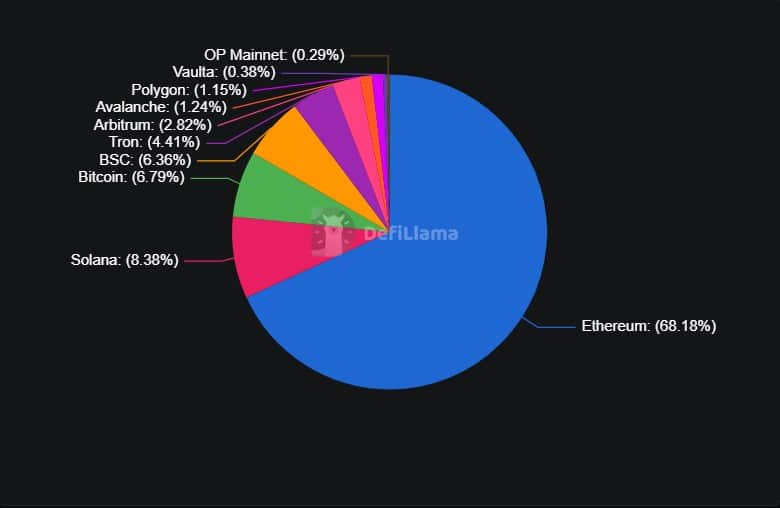
The network now holds nearly 68.2% of global DeFi TVL, with over $69 billion deployed on its smart contracts.

That is more capital than Solana [SOL], Tron [TRX], BNB Smart Chain [BNB], Bitcoin [BTC], Avalanche [AVAX], and every other chain combined.

Source: DeFiLlama

The network’s edge goes beyond DeFi alone. It also hosts more than $191 billion in stablecoins and controls half of the tokenized euro market.

For institutions, this matters because stablecoins are issued where security and reliability are strongest, and Ethereum remains the preferred settlement layer.

Big hands are in!

Source: X

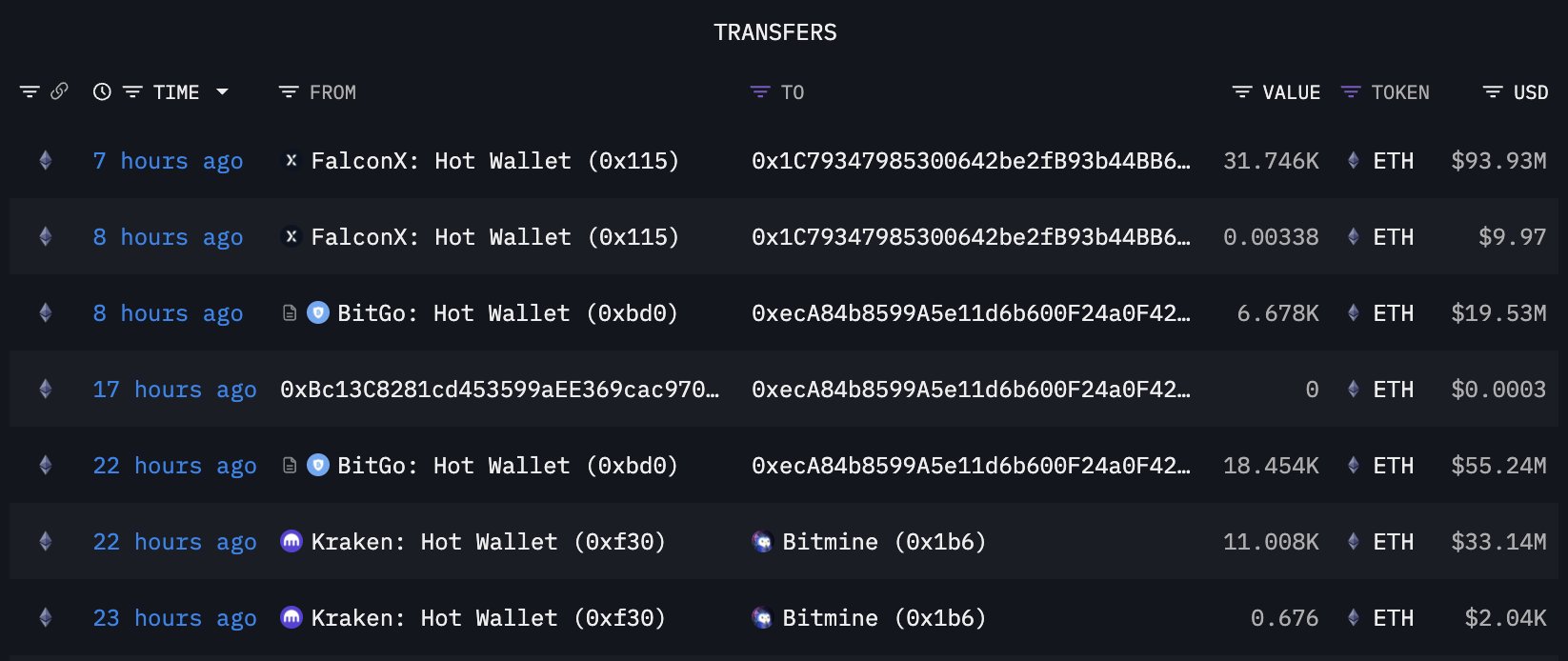
That dominance is translating into real buying, with institutions moving fast to increase exposure. In the past 24 hours alone, Tom Lee’s Bitmine purchased nearly 68,000 ETH, worth over $200 million.

Source: X

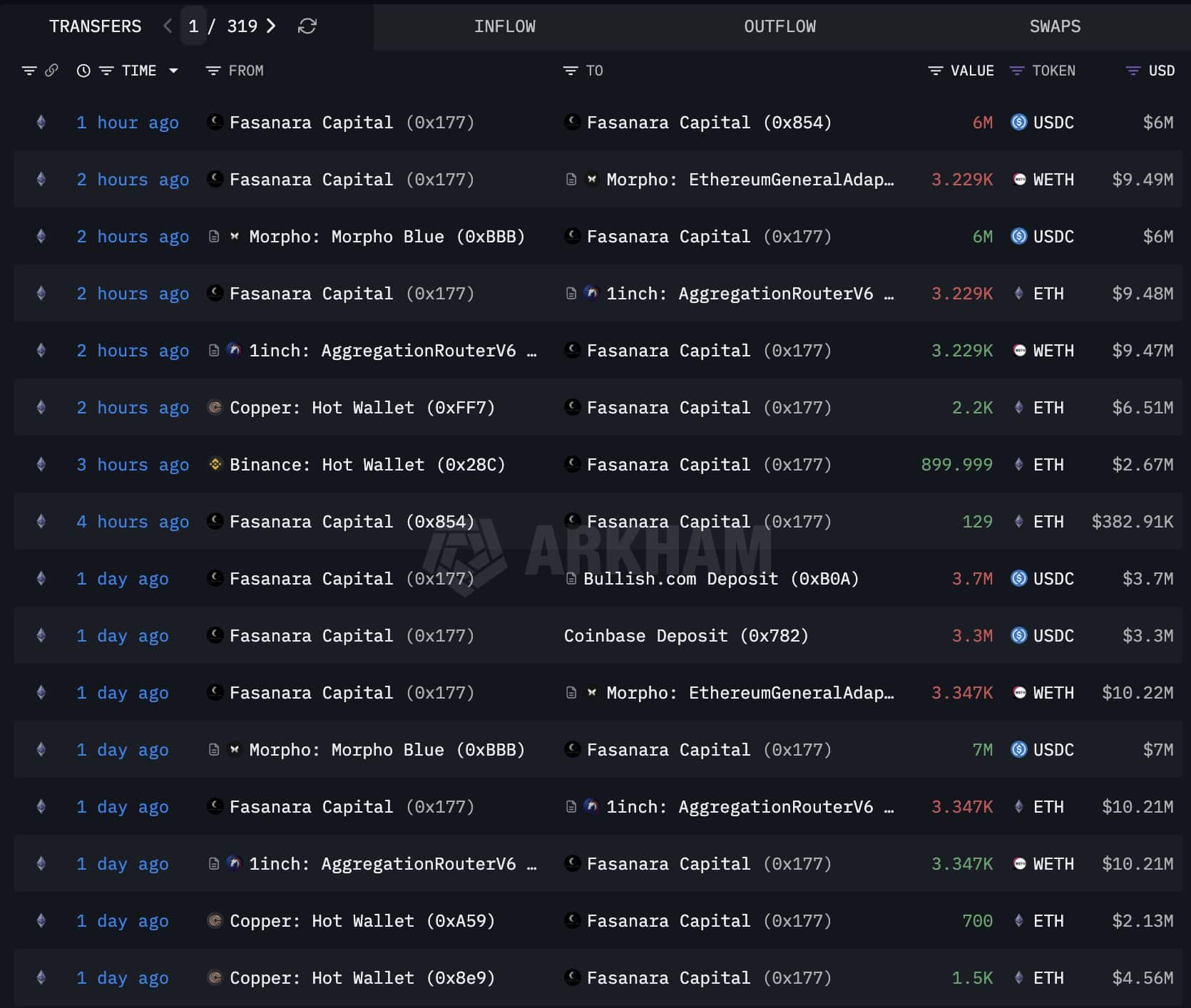
Fasanara Capital followed a similar path, buying ETH, depositing it into DeFi protocols, and borrowing against it to buy even more. This is active positioning.

A supply shock is taking shape

Source: CryptoQuant

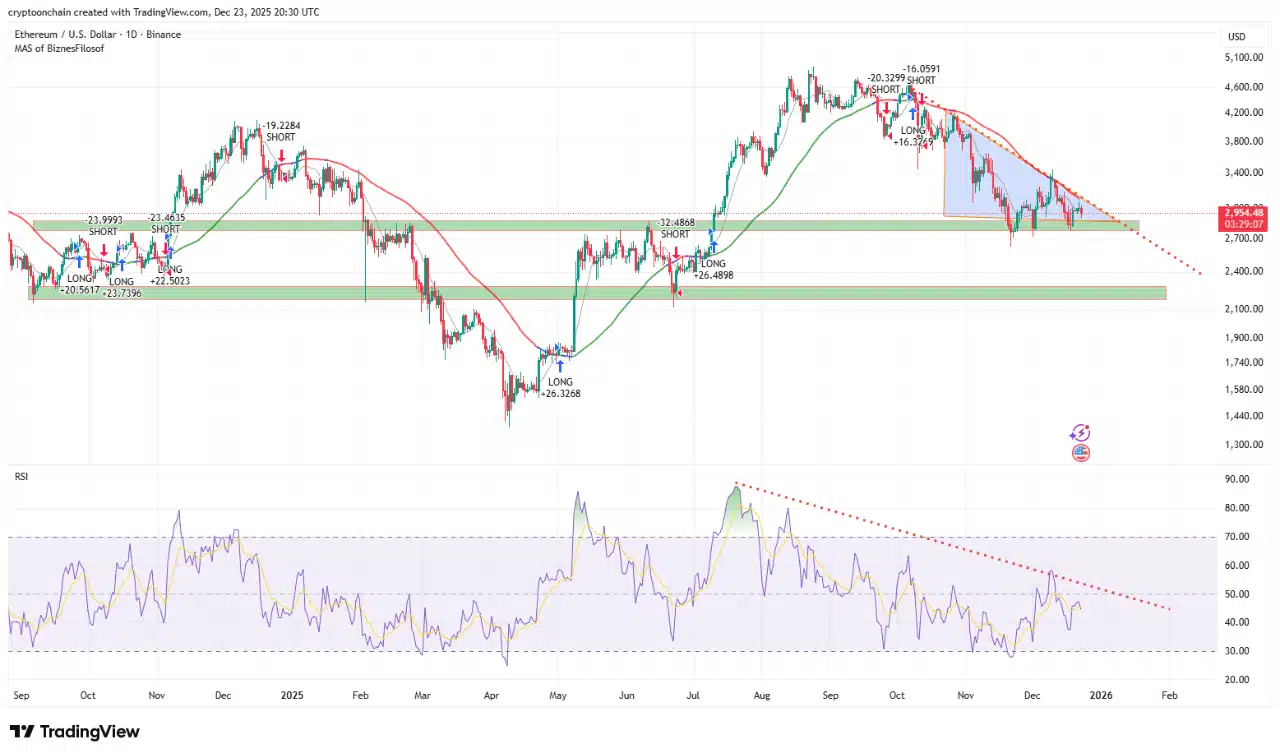
All this buying is happening at a delicate moment for ETH’s price. Ethereum is trading under technical pressure, stuck below key resistance levels with support near $2,800. On its own, it looks fragile, too.

Source: CryptoQuant

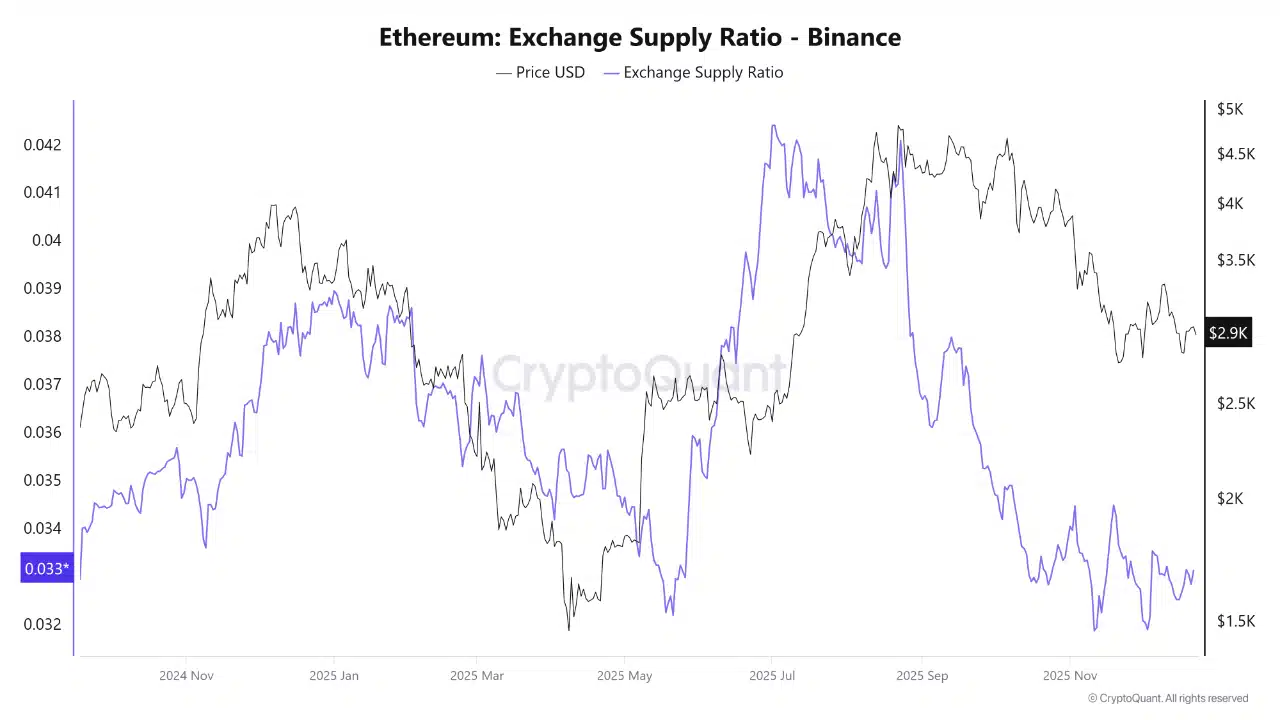
But, Ethereum’s exchange supply ratio on Binance has fallen to 0.032, the lowest since September 2024. Simply put, less ETH is sitting on exchanges ready to be sold.

With this clash, if buyers continue to defend support, a tight supply could quickly flip the narrative.


Final Thoughts

  • Ethereum controls 68%+ of DeFi TVL. Institutions buy even while price struggles.
  • Falling exchange supply and $200M+ ETH buys could cause a supply-driven rebound
Next: Why ‘fear’ right now doesn’t mean ‘buy the dip’
Share
  • Share
  • Tweet

Trending Cryptos

Related Questions

QWhat percentage of global DeFi TVL does Ethereum currently hold, and how much capital is deployed on its smart contracts?

AEthereum currently holds 68.2% of global DeFi TVL, with over $69 billion deployed on its smart contracts.

QWhy are institutional players increasing their exposure to Ethereum despite its current price weakness?

AInstitutions are increasing exposure because Ethereum remains the dominant DeFi platform with strong security and reliability, serving as the preferred settlement layer for stablecoins and tokenized assets.

QHow much ETH did Tom Lee's Bitmine purchase in the past 24 hours, and what was its approximate value?

ATom Lee's Bitmine purchased nearly 68,000 ETH in the past 24 hours, worth over $200 million.

QWhat is significant about Ethereum's exchange supply ratio on Binance falling to 0.032?

AEthereum's exchange supply ratio on Binance falling to 0.032 (the lowest since September 2024) indicates less ETH is available on exchanges for selling, potentially creating a supply shock.

QWhat strategy did Fasanara Capital use to increase their Ethereum exposure?

AFasanara Capital bought ETH, deposited it into DeFi protocols, and borrowed against it to purchase even more ETH, demonstrating active positioning.

Related Reads

Why Zhang Yiming Spends 50% of His Time on Seed?

Why does Zhang Yiming devote 50% of his time to Seed, ByteDance's core AI research team, while the company’s high-profile AI products like Doubao appear less dominant in the current market? An analysis reveals that ByteDance, historically a leader in defining trends (e.g., TikTok, Toutiao), has not set major AI industry agendas in the first half of the year, instead following competitors in areas like Agent and productivity tools. ByteDance’s strategy diverges from peers like Tencent and Alibaba, who are integrating AI into holistic productivity systems. While Doubao is highly successful—with 382 million MAU and leading revenue—its very success may create inertia, focusing iterations on improving the AI assistant rather than pioneering disruptive new entry points like Agent-native desktops. Zhang Yiming’s deep investment in Seed, a team of 300+ top researchers from firms like Google DeepMind, signals a long-term bet on foundational model capabilities as the ultimate competitive moat, reminiscent of ByteDance's past wins through superior underlying tech (e.g., recommendation algorithms). However, in the fast-evolving AI era, superior foundational models risk being outpaced by rapid shifts in product-level interaction paradigms and user habits. Zhang is essentially applying his principle of "delayed gratification" to corporate strategy, gambling that Seed’s breakthroughs will eventually make it the indispensable infrastructure for all AI applications, regardless of which product leads the user interface. The core question remains: is the AI era a race for the best product or the most powerful underlying infrastructure? The answer will define ByteDance’s future position.

marsbit19m ago

Why Zhang Yiming Spends 50% of His Time on Seed?

marsbit19m ago

From 'Speculative Asset' to 'The Next Generation Financial Infrastructure', Crypto is Growing a New TradFi World

From "Speculative Asset" to "Next-Generation Financial Infrastructure": Crypto Is Evolving into a New TradFi World Looking back, the crypto industry has long focused on identifying the "next asset to pump." However, starting around 2026, several developments across different sectors began converging. Stablecoin market cap approached $300 billion, entering a global payments adoption phase. DTCC initiated its first live tokenized asset conversions, while prediction markets expanded into regulated exchanges and brokerages. Simultaneously, AI Agents began using stablecoins autonomously for payments. These seemingly disparate trends share a common thread: the issuance, custody, trading, payment, and settlement capabilities built by the crypto industry over the past decade are now opening to broader financial activities and machine-driven economies. This suggests crypto is maturing beyond a purely speculative market, building a foundational infrastructure layer beneath it. This simultaneous progress occurs because the core components of a new financial system—stablecoins as programmable money APIs, RWA tokenization for traditional assets, prediction markets for price discovery on future events, and AI Agents as new economic actors—have developed independently and are now beginning to interconnect. These elements form the building blocks of a next-generation financial infrastructure. This emerging infrastructure features multi-layered capabilities: 1) Asset issuance and tokenization for a wider range of assets. 2) 24/7 programmable payments and settlement, simplifying global transfers. 3) Continuous trading and price discovery, providing real-time market signals for both humans and software. 4) Advanced identity, permissions, and authorization systems suitable for institutions and AI. 5) Growing connections to real-world legal and regulatory frameworks, providing greater clarity for traditional participants. This shift is reflected in changing funding sources, with more revenue now coming from real-world business flows, an expanding set of participants (including corporate systems and autonomous agents), and more nuanced regulatory discussions focused on rules and boundaries rather than outright prohibition. However, significant challenges remain. Technical confirmation is not legal finality; liability and governance for AI-driven payments are unclear; fragmentation across networks persists; privacy solutions for institutions are needed; and the system currently lacks mature frameworks for credit, insurance, and complex risk management found in traditional finance. In conclusion, 2026 marks a pivotal point where several previously independent pieces of the crypto puzzle started to connect. While far from complete, it signifies crypto's crucial step towards becoming a low-friction, global execution layer for real assets, traditional institutions, and intelligent software, built beneath its vibrant speculative markets.

marsbit1h ago
From 'Speculative Asset' to 'The Next Generation Financial Infrastructure', Crypto is Growing a New TradFi World

marsbit1h ago

Supporters of Bitcoin BIP-110 Update Have Prepared a 'Last Resort' Plan If the Proposal Is Not Adopted: It Could Radically Change BTC's Value

Supporters of the BIP-110 update for Bitcoin have prepared a contingency plan in case the proposal is not adopted, a move that could radically alter BTC's value. Developer Chris Guida has adapted a proof-of-work code originally created by Luke Dashjr in 2017 for the current version of Bitcoin Knots. This adaptation is described as a last-resort measure to be activated if miners do not signal readiness for BIP-110. The proposal itself is a soft fork aimed at temporarily limiting the storage of arbitrary data in Bitcoin transactions. It introduces stricter limits on new transaction outputs, OP_RETURN fields, and witness data, with rules designed to expire after approximately one year. Guida stated this option needs to remain open if miners were to "conspire to betray Bitcoin." Should the contingency code be used, it could change Bitcoin's current mining algorithm. This change would likely prevent existing ASIC miners from generating blocks on the new chain, leading to a large-scale reorganization of the Bitcoin mining network. Luke Dashjr, another Bitcoin Knots developer, contributed to the code and expressed hope it would not be needed, but sees its existence as useful for a potential crisis. A supporter known as Mechanic argued that the mere possibility of a proof-of-work change could act as a deterrent, emphasizing that Bitcoin's rules should be set by participants and node operators, not miners. While miner signals are tracked for BIP-110 activation, data from the proposal's official tracking page indicates support remains limited.

cryptonews.ru4h ago

Supporters of Bitcoin BIP-110 Update Have Prepared a 'Last Resort' Plan If the Proposal Is Not Adopted: It Could Radically Change BTC's Value

cryptonews.ru4h ago

Trading

Spot

Hot Articles

Discussions

Welcome to the HTX Community. Here, you can stay informed about the latest platform developments and gain access to professional market insights. Users' opinions on the price of ETH (ETH) are presented below.

活动图片