Will Ethereum reclaim its highs? 3 reasons why whale execution is bullish

AmbcryptoPublished on 2026-01-23Last updated on 2026-02-23

Abstract

3 reasons why whale execution is bullish.

Despite a broad crypto pullback, aggressive Ethereum accumulation has continued as large buyers step in during weakness rather than retreating.

On-chain data from Lookonchain showed Tom Lee’s Bitmine absorbing nearly 45,000 ETH in rapid succession, sourcing liquidity directly from Kraken and BitGo.

At the same time, an OTC-linked whale added another 10,000 ETH even as broader sentiment weakened.

This behavior signals intent. Instead of waiting for confirmation, large players appear willing to absorb downside volatility.

However, accumulation alone does not guarantee immediate upside. Therefore, the structure of spot demand, order behavior, and leverage positioning now matters more than price reactions.

Large buyers absorb sell pressure

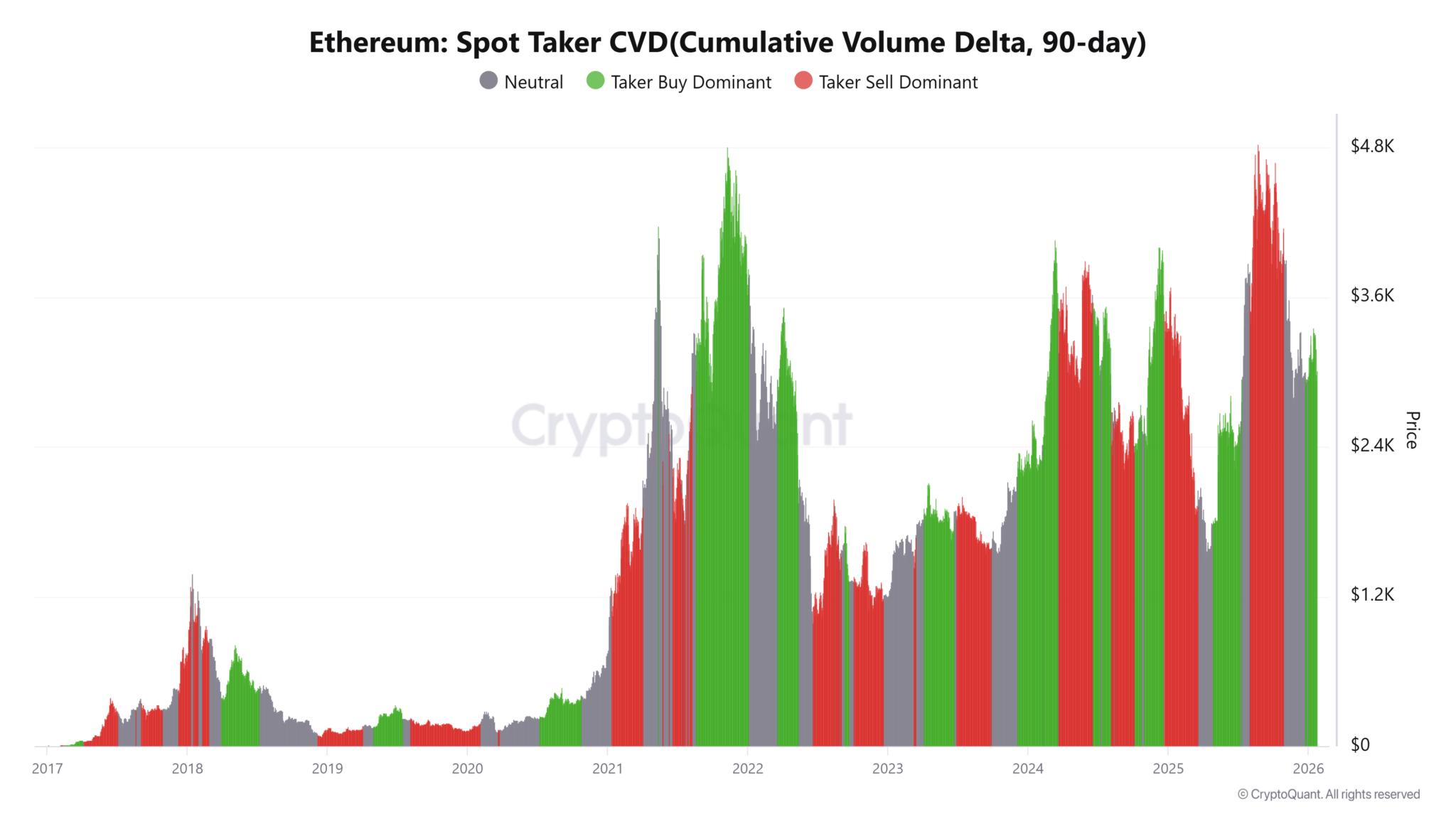
Spot taker CVD continued to print buyer dominance, reinforcing the idea that aggressive participants control execution at market prices.

Buyers do not wait on bids; instead, they cross the spread and absorb available supply. This pattern suggested urgency rather than caution.

Furthermore, buyer-dominant CVD during a market drawdown often reflects conviction rather than speculative chasing. However, this demand does not come from scattered retail flows. Large executions dominate activity.

As a result, the Spot market showed clear absorption rather than distribution. Still, sustained buyer aggression must persist to offset broader risk-off conditions.

Otherwise, sellers could regain short-term control. Therefore, spot taker behavior now acts as the primary stabilizing force for Ethereum’s [ETH] price structure.
Ethereum order sizes reveal whale execution

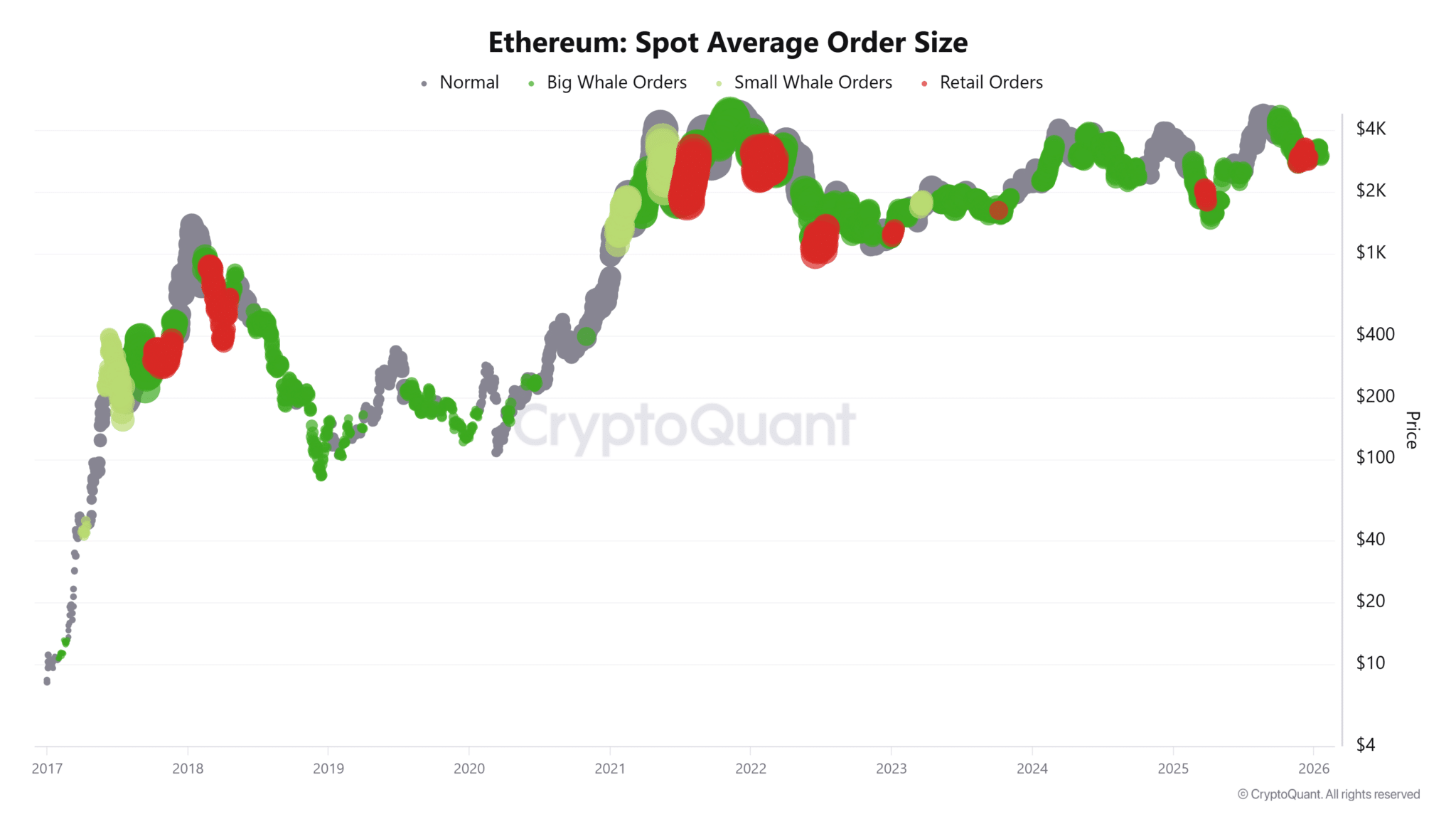
Spot Average Order Size has expanded sharply, pointing directly toward whale-driven participation rather than fragmented retail activity.

Larger order sizes usually reflect institutional desks or OTC-linked execution strategies. In this case, order growth aligns closely with the accumulation flows identified on-chain.

The alignment matters. It shows consistency between wallet-level behavior and exchange-level execution.

However, whales do not chase price blindly. They typically scale into positions while liquidity remains available. Therefore, rising order size during weakness suggests deliberate accumulation rather than panic buying.

At the same time, sustained large orders can compress the available supply. The compression would increase sensitivity to future demand spikes.

Hence, order size now reinforces the broader accumulation narrative already visible on-chain.
Leverage builds as confidence grows

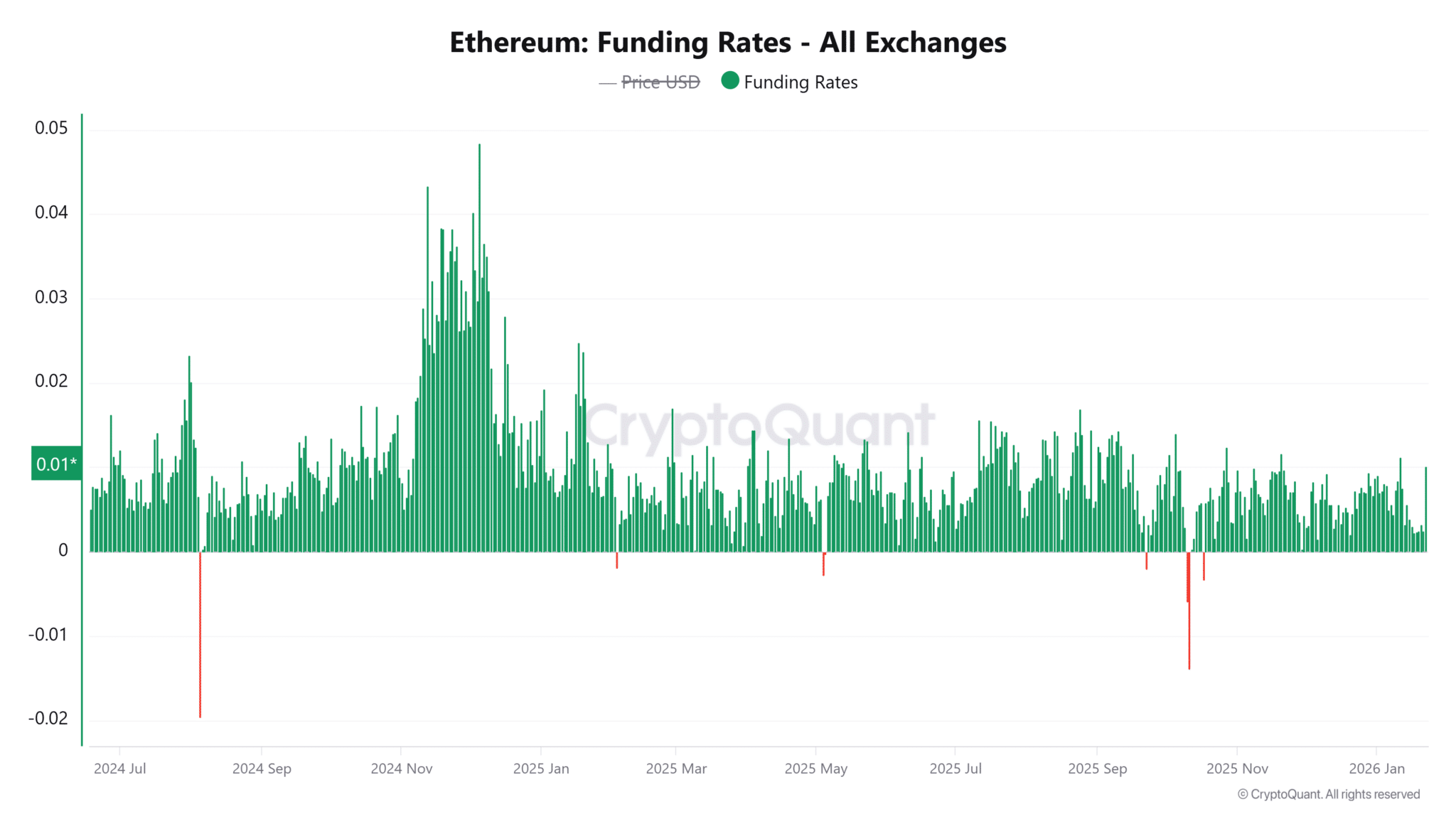
Funding Rates have risen sharply, signaling that traders increasingly favor long exposure. The metric sat around 0.01017, marking a 145.56% increase over the recent baseline.

Traders now pay a clear premium to maintain long positions. This shift reflects growing confidence rather than hesitation.

However, leverage behaves differently from spot demand. While spot buyers absorb supply outright, leveraged traders rely on price continuation.

Therefore, elevated funding strengthens upside pressure only if the price holds steady. If momentum stalls, funding costs could force faster unwinds.

Furthermore, rapid funding expansion often increases short-term volatility. As a result, leverage now adds fuel to Ethereum’s structure but also raises sensitivity to abrupt pullbacks.
Can accumulation stabilize Ethereum?

Ethereum’s structure favored stabilization rather than breakdown. Large buyers continue absorbing supply, Spot demand remains aggressive, and whale-sized executions dominate flows.

However, rising leverage introduces conditional risk. If spot accumulation persists, it would likely anchor the price and limit downside volatility. If Spot demand fades, leverage could magnify weakness.

Therefore, Ethereum’s near-term direction hinges less on sentiment and more on whether aggressive buyers continue absorbing supply under pressure.

Final Thoughts

  • Large players appear comfortable absorbing volatility rather than waiting for confirmation.
  • Leverage adds upside potential but could amplify moves if spot demand weakens.

Related Questions

QWhat on-chain data indicates that large buyers are aggressively accumulating Ethereum during the recent pullback?

AOn-chain data from Lookonchain showed Tom Lee’s Bitmine absorbing nearly 45,000 ETH in rapid succession, and an OTC-linked whale added another 10,000 ETH, signaling aggressive accumulation during market weakness.

QAccording to the article, what does a buyer-dominant Spot Cumulative Volume Delta (CVD) during a market drawdown typically reflect?

AA buyer-dominant Spot CVD during a market drawdown often reflects conviction from aggressive participants who are crossing the spread to absorb supply, rather than speculative chasing or caution.

QWhat does the sharp expansion in Spot Average Order Size suggest about the nature of the current market activity?

AThe sharp expansion in Spot Average Order Size points directly toward whale-driven or institutional participation, rather than fragmented retail activity, indicating deliberate accumulation strategies.

QHow have Funding Rates changed, and what does this signal about trader sentiment?

AFunding Rates have risen sharply to around 0.01017, a 145.56% increase, signaling that traders are increasingly confident and willing to pay a premium to maintain long positions.

QWhat is the primary risk that rising leverage introduces to Ethereum market structure, according to the article?

AThe primary risk is that elevated leverage relies on price continuation; if spot demand weakens and momentum stalls, funding costs could force faster unwinds, amplifying downside volatility and magnifying weakness.

Related Reads

Pharos Establishes RealFi Alliance to Promote Institutional-Grade On-Chain Execution Standardization for RWA

Pharos Network has launched the RealFi Alliance, a strategic ecosystem initiative aimed at unifying institutional asset issuers, financial infrastructure providers, and on-chain builders. The alliance seeks to standardize and scale the execution framework for real-world assets (RWA), moving beyond isolated pilots. Founding members include Chainlink, Asseto Finance, Ember, Faroo, LayerZero, R25, Re7 Labs, TopNod, and Centrifuge. The alliance addresses systemic issues like fragmented liquidity, inconsistent infrastructure standards, and regulatory disconnects by creating a unified operational layer where RWAs remain active, composable, and capable of supporting institutional workflows. It operates on four core pillars: Asset Enablement (bringing real-world value on-chain securely), Infrastructure & Compliance (leveraging Pharos’s parallel execution and built-in compliance modules), Liquidity & Utility (designing clear functional use cases like staking and yield mechanisms), and Market Transparency (establishing trust through clear risk and return benchmarks). Pharos CEO Wish Wu emphasized that the goal is to create a unified environment for assets to operate at scale with institutional reliability. The upcoming Pharos mainnet will launch as a ready-to-use financial environment with integrated liquidity and compliance standards. The alliance plans to expand in structured batches, selecting new members based on asset quality, technical maturity, and ecosystem synergy. Pharos is a financial-grade Layer 1 blockchain designed for RealFi, combining modular architecture, parallel execution, and built-in compliance modules. It is developed by a team with backgrounds from Ant Group and is backed by investors like Hack VC and Faction VC.

marsbit2m ago

Pharos Establishes RealFi Alliance to Promote Institutional-Grade On-Chain Execution Standardization for RWA

marsbit2m ago

Bank of Korea Urges Bank-Led Won Stablecoin Issuance

The Bank of Korea (BOK) has urged that the issuance of Korean won-pegged stablecoins should be led by commercial banks, warning that private issuance could undermine monetary policy and create foreign exchange and financial stability risks. In a report submitted to the National Assembly, the central bank described stablecoins as "currency-like substitutes" and emphasized that their rollout must consider broader economic impacts, not just industrial profits. The BOK expressed concerns that stablecoins could be used to circumvent foreign exchange regulations and stressed that non-bank issuers might conflict with Korea’s separation of banking and commerce principles. It recommended that banks, which are subject to strict regulatory standards, should be the primary issuers, with any expansion beyond banks proceeding cautiously after risk assessments. The report reflects ongoing debates among policymakers about who should be allowed to issue won stablecoins and echoes the BOK’s previous warnings on the matter. While acknowledging stablecoins' potential role in the digital asset revolution, the bank proposed structural safeguards, including a bank-focused consortium model and a statutory interagency policy body for oversight. The BOK cited the U.S. GENIUS Act as an example of cross-agency supervision. However, this bank-led approach has faced opposition from industry members, including some policymakers, who argue that clearer rules for issuers could sufficiently mitigate risks.

TheNewsCrypto11m ago

Bank of Korea Urges Bank-Led Won Stablecoin Issuance

TheNewsCrypto11m ago

The War Between Stablecoins and Banking May Not Actually Exist

The article argues that the perceived war between stablecoins and traditional banking is largely illusory, drawing a parallel to the "Javon's Paradox" where technological efficiency (like ATMs) expands, rather than shrinks, an industry. From the supply side, blockchain and stablecoins are dismantling fragmented global payment infrastructures, replacing them with a single, open ledger. This drastically reduces the cost and complexity of offering financial services, enabling companies like Sling Money to operate globally with a small team. Examples like M-Pesa in Kenya and UPI in India show that lowering transaction costs to near zero leads to a massive expansion in financial inclusion, serving previously unbanked populations. On the cost side, the piece highlights the immense compliance burden on banks, which spend hundreds of billions annually on tasks like auditing and reconciling opaque transactions across correspondent banks. Shared ledger technology directly solves this by providing a single source of truth, eliminating reconciliation layers. Projects like J.P. Morgan's Onyx and the Canton Network demonstrate how banks are using this technology to achieve near-instant settlement and free up trapped capital. The convergence of these forces—lower barriers to entry and reduced internal operational costs—points to a future where more financial services are available to more people at a lower cost, much like cloud computing democratized access to computing power. The conclusion is that stablecoins will not destroy the banking system but will instead become a foundational infrastructure upon which more products are built, ultimately expanding the entire market.

Odaily星球日报16m ago

The War Between Stablecoins and Banking May Not Actually Exist

Odaily星球日报16m ago

Trading

Spot
Futures

Hot Articles

Discussions

Welcome to the HTX Community. Here, you can stay informed about the latest platform developments and gain access to professional market insights. Users' opinions on the price of ETH (ETH) are presented below.

活动图片