Walsh Is Quietly Reshaping the Federal Reserve Through Five Working Groups

marsbitPublished on 2026-07-10Last updated on 2026-07-10

Abstract

In an effort to subtly reshape the Federal Reserve, Chair Kevin Wash has established five "Chair's Advancement of Monetary Policy" working groups. These groups, led entirely by 15 external experts and supported by Fed staff, cover the entire monetary policy "operating system": data inputs, productivity/employment/inflation models, balance sheet tools, and external communications. The initiative centralizes agenda-setting, knowledge production, data access, and public narrative control under the Chair's office, while formal decision-making power remains with the FOMC and Board. Analysts note this mirrors tactics like China's use of central working groups—bypassing bureaucratic inertia, creating parallel reporting channels, and enabling rapid "top-level design" to reset policy agendas. This suggests Wash may hold off on major policy moves until the groups conclude their studies. Key future questions are whether these groups become permanent and if their conclusions effectively become pre-determined policy for the FOMC to ratify.

Author: qinbafrank

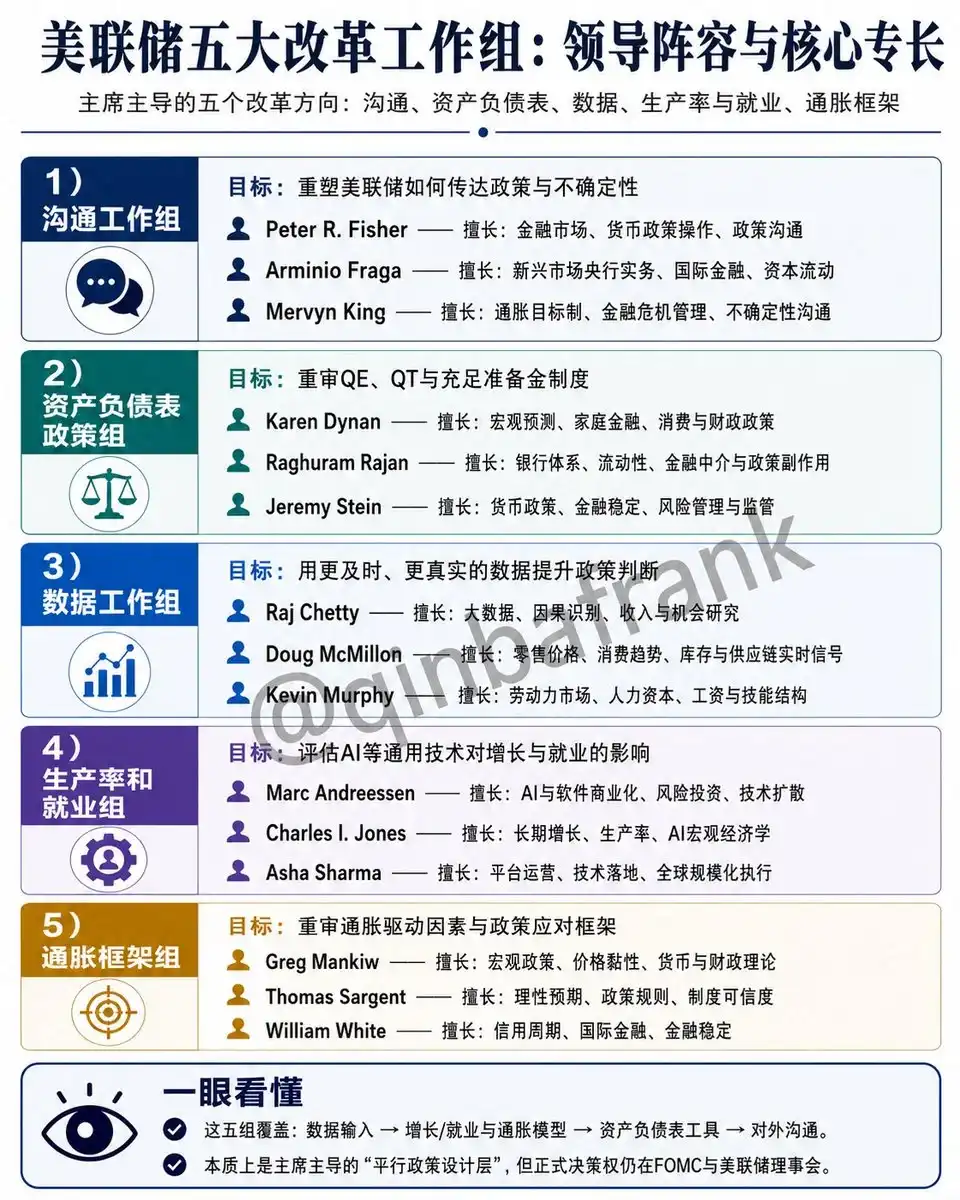
Today, the Federal Reserve announced the leadership lineup for its five major reform working groups. My initial impression is that Kevin Walsh is building a parallel policy design layer dominated by the Fed Chair: statutory decision-making authority remains with the FOMC and the Board of Governors, but agenda-setting power, knowledge production, access to data, and control over the public narrative are clearly shifting towards the Chair and the external experts he selects. There is also a slight hint of the Central Working Group style often used in my Party's institutional reforms.

The Fed has formally named them the "Chair's Working Groups to Advance Monetary Policy." All 15 co-leaders are external individuals, supported by Federal Reserve staff. They will conduct independent research and ultimately submit their conclusions to the FOMC.

These five groups are not five scattered projects; they cover the entire "operating system" of monetary policy:

Data Input → Productivity, Employment, and Inflation Models → Balance Sheet Tools → External Communication.

It must be said that Walsh is highly skillful. The characteristics of these working groups are:

1) Launched personally by the top leader;

2) Transcend existing departmental boundaries;

3) Establish parallel information reporting channels;

4) Bypass the delays and departmental interests of regular bureaucratic procedures;

5) Rapidly reset the policy agenda through "top-level design";

6) Centralize coordination and knowledge authority through a special organization.

Is there a slight hint of the working group style often used in my Party's institutional reforms?

For the future, this means that before the reform working groups produce their research results, the probability of Walsh remaining inactive is very high.

Looking ahead, we can watch to see if the working groups will exist long-term? Will there be a situation where the working groups' conclusions are tantamount to the Chair's predetermined policy? Will the FOMC ultimately be left only with the role of ratification?

Related Questions

QWhat are the five new working groups recently announced by the Federal Reserve, and what is their purpose?

AThe Federal Reserve announced five new 'Chair's Advancing Monetary Policy Working Groups'. Their purpose is to conduct independent research covering the entire monetary policy 'operating system' — from data input and economic models to balance sheet tools and external communication — and to submit their conclusions to the Federal Open Market Committee (FOMC).

QHow does the author perceive Kevin Warsh's role in establishing these Fed working groups?

AThe author believes Kevin Warsh is using these working groups to quietly reshape the Federal Reserve. The analysis suggests Warsh is creating a parallel layer of policy design, centralizing agenda-setting, knowledge production, data access, and public narrative power with the Fed Chair and selected external experts, while the formal decision-making authority remains with the FOMC and the Board of Governors.

QWhat are the key characteristics of these new Federal Reserve working groups, according to the article?

AAccording to the article, the key characteristics of the working groups are: 1) Initiated directly by the top leader; 2) Spanning existing departmental boundaries; 3) Establishing parallel information reporting channels; 4) Bypassing slow bureaucracy and departmental interests; 5) Quickly resetting the policy agenda through 'top-level design'; and 6) Centralizing coordination and knowledge authority through a special organization.

QWhat potential future implications of these working groups does the article raise?

AThe article raises several questions about future implications: Will the working groups become permanent? Could their conclusions become tantamount to the Chair's predetermined policy, with the FOMC merely providing formal ratification? It also suggests that until the groups' research is complete, the Fed Chair is likely to delay major policy moves.

QWhat comparison does the author draw regarding the structure and function of these Fed working groups?

AThe author draws a comparison to the 'central working groups' frequently used in the Chinese Communist Party's institutional reforms, noting a similar organizational approach for implementing major reforms and policy coordination from the top.

Related Reads

How Can iPhone Price Hikes Not Hurt Sales? J.P. Morgan Dissects Apple's 'Monthly Payment Strategy'

Apple's 2026 Fall Event, the first under new CEO John Ternus, featured key pricing and product strategies. The iPhone 18 Pro and Pro Max base models saw a $100 price increase to $1,199 and $1,299 respectively, with significantly larger hikes for higher storage tiers (up to $500), allowing Apple to pass on memory costs. J.P. Morgan highlights that Apple mitigated consumer price sensitivity by introducing the iPhone 18 Pro to its Apple Upgrade (Klarna) monthly lease program and leveraging strong carrier trade-in deals, keeping perceived monthly costs stable. The foldable iPhone Duo, starting at $1,999, was a major focus, priced competitively against rivals like Samsung and emphasizing software integration over specs. J.P. Morgan sees potential for sales to exceed initial 10-million-unit forecasts. Apple Watch Series 12 and Ultra 4 maintained their prices while adding new "Audio Intelligence" AI features, positioning the watch as an AI wearable. Meanwhile, AirPods 5 saw a price reduction, demonstrating Apple's ability to manage costs across its portfolio. J.P. Morgan maintains an Overweight rating, believing Apple is opening three growth paths: higher Pro series ASPs, financing strategies to protect sales volume, and a new high-end category with the Duo. Combined with upcoming Siri AI features, this could drive a more robust iPhone revenue cycle. Early sales data will be a key catalyst to watch.

marsbit45m ago

How Can iPhone Price Hikes Not Hurt Sales? J.P. Morgan Dissects Apple's 'Monthly Payment Strategy'

marsbit45m ago

Capital Pours into Leading ETFs, But Why Is the Altcoin Season Still Nowhere in Sight?

On September 9th, US ETFs tracking Ethereum, XRP, and Solana attracted nearly $59 million in inflows, while Bitcoin products saw outflows of $120.24 million, highlighting a rotation of capital among compliant crypto assets. However, this institutional shift has not translated into a broader market rally. The Altcoin Season Index remains at 37, far below the threshold of 75, indicating that most altcoins are still underperforming Bitcoin. This divergence is characteristic of the expanding crypto ETF market. While investors now have more channels to allocate to assets beyond Bitcoin, capital remains concentrated in a few top-tier products. Over the past 30 days, Bitcoin and Ethereum ETFs dominated inflows, followed distantly by Solana and XRP. All other approved crypto ETFs, such as those for Chainlink, Avalanche, and Dogecoin, have seen minimal or no net inflows, creating a steep hierarchy in assets under management. The article distinguishes between "ETF-level altcoin rotation" and a genuine "altcoin season." The former involves capital moving only among the largest, most institutional-friendly ETF assets (Bitcoin, Ethereum, Solana, XRP), without spilling over to the wider altcoin market. For a true altcoin season to occur, where 75% of the top 50 altcoins outperform Bitcoin over 90 days, capital needs to diffuse beyond this narrow ETF circle. The persistent outflows from Bitcoin ETFs present a key test: if the exiting capital continues to rotate only into other major ETF assets and not into smaller altcoin funds, the market may experience frequent internal rotations but will likely fail to see the anticipated broad-based altcoin rally.

marsbit1h ago

Capital Pours into Leading ETFs, But Why Is the Altcoin Season Still Nowhere in Sight?

marsbit1h ago

Trading

Spot
活动图片