NVIDIA Chose Unitree but Replaced Its Hands

marsbitPublished on 2026-06-10Last updated on 2026-06-10

Abstract

Nvidia selected Unitree, a leading humanoid robotics company, for its Isaac GR00T reference platform but replaced Unitree's own dexterous hand with one from Sharpa, a two-year-old Singapore-based startup with origins in Hesai's robotics team. While Unitree provides the robot body, celebrated for its advanced motion control, the focus shifted to Sharpa's Wave hand. This hand, featuring 22 active degrees of freedom and a high-precision Dynamic Tactile Array (DTA) sensor system for real-time force and texture feedback, demonstrated superior capabilities in complex manipulation tasks like handling playing cards, peeling eggs, and assembling computers. Nvidia's choice highlights a key industry pivot from locomotion to sophisticated, tactile-enabled manipulation. The integration places Sharpa's hardware within Nvidia's Isaac Lab framework, central to simulation and AI training pipelines for embodied intelligence. However, the dexterous hand sector remains highly competitive, with rivals like Lingxin Qiaoshou, Critical Point, and Parxeni Perception rapidly advancing in funding, technology, and product development.

Unitree was selected by NVIDIA, but NVIDIA did not choose Unitree's hands.

While Unitree Technology passed its IPO review on the STAR Market, its H2 Plus robot was also chosen by NVIDIA as the body for NVIDIA's Isaac GR00T reference humanoid robot.
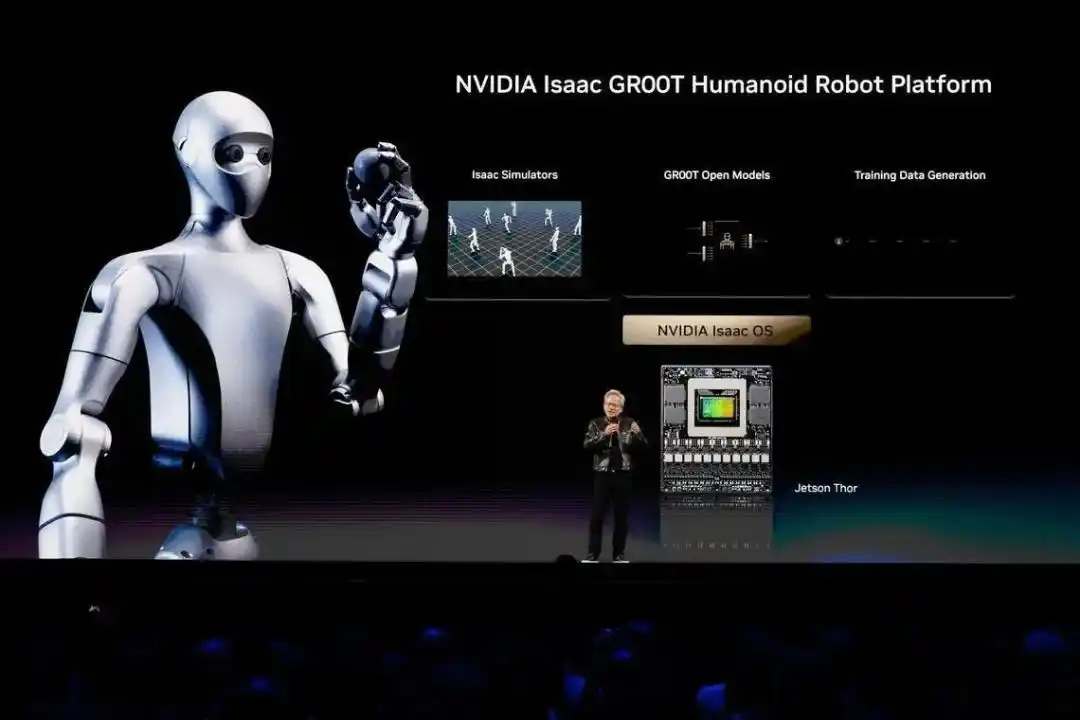
This powerful partnership has ignited excitement in both the Embodied AI and broader AI circles. After all, NVIDIA's leading position in the industry speaks for itself, and Unitree has secured its place in the global top tier of humanoid robots with its outstanding robot locomotion capabilities.

What's truly surprising is that this reference robot does not use Unitree's own dexterous hands; they have been replaced with hands from Sharpa Wave.

Sharpa is a dexterous hand company founded only two years ago, headquartered in Singapore. Its core team originates from the dexterous hand team established by Hesai Technology in 2024. It doesn't have the same high profile as Unitree, nor does it appear frequently in funding news like Lingxin Qiaoshou or Lingjiedian.

Sharpa's dexterous hands also appeared on this year's CCTV Spring Festival Gala in the sketch "My Most Unforgettable Night" featuring Shen Teng and Ma Li. However, within the niche dexterous hand sector, it remains a very low-key player.
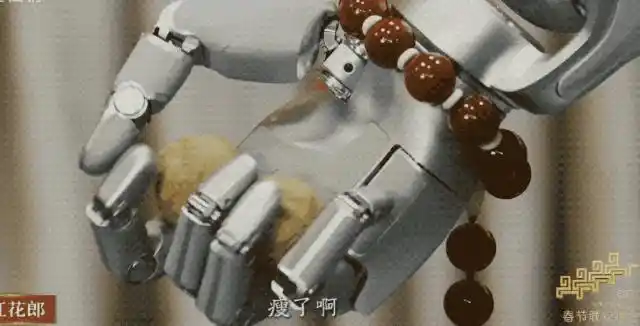
Now, however, it stands alongside Unitree at NVIDIA's embodied AI table.

One is responsible for the body, the other for the hands.

The question is, what makes a two-year-old dexterous hand company worthy of NVIDIA's attention?

Unitree's Hands Lost This Time

In reality, Unitree does have its own dexterous hands.

Judging from its public product lineup, Unitree has already launched the Dex series of dexterous hands, ranging from three-finger to five-finger configurations, and their performance is not bad.

But what NVIDIA wanted this time might not just be "hands that can be mounted on a humanoid robot."

From a technical perspective, Sharpa's dexterous hands indeed have their advantages.

In 2024, Hesai Technology formed a dexterous hand team, which became the predecessor of Sharpa. Transitioning from Hesai's LiDAR for autonomous driving to dexterous hands seems like quite a "crossover" move for Sharpa.

To many, autonomous driving and robotics are two completely different industries.

But for a company like Hesai, there is some common technical accumulation between the two fields.

Autonomous driving requires machines to perceive, understand, and make decisions in real-time within complex environments, demanding high sensor accuracy, system reliability, and engineering capabilities. Robots face similar problems when entering the real world to perform tasks.

The difference lies in that autonomous driving solves "how the vehicle sees the world," while dexterous hands solve "how the robot touches the world."

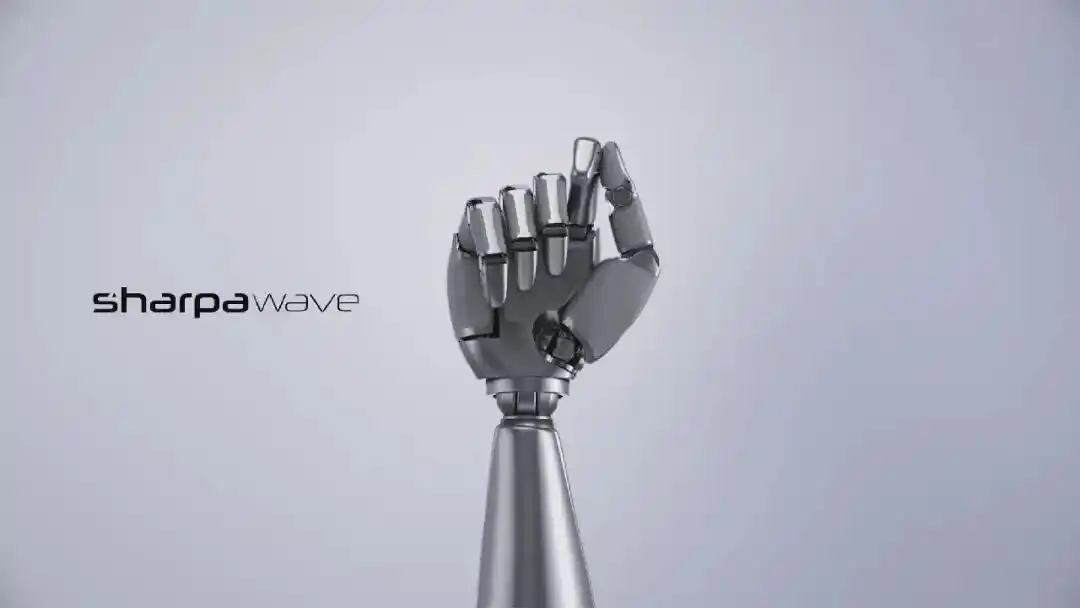
It is precisely because of this that Sharpa migrated its past capabilities to another track. Soon after its founding, Sharpa launched its flagship product, the Sharpa Wave dexterous hand.
In the field of dexterous hands, a long-standing contradiction exists: performance and mass production are often difficult to achieve simultaneously.

Some products use underactuated designs, controlling multiple joints with fewer motors, which lowers costs but limits flexibility and control precision. Others pursue capabilities close to the human hand, resulting in complex structures, high prices, and difficulty in large-scale deployment.

Sharpa chose a middle path.

The Sharpa Wave features 22 active degrees of freedom, with overall dimensions close to a 1:1 ratio with the human hand. To achieve higher control precision, it employs a direct-drive transmission architecture, enhancing joint responsiveness and motion control capability.

However, more crucial than the number of degrees of freedom is Sharpa's investment in its tactile sensing system.

In the humanoid robot industry, an increasingly clear trend is that vision alone is insufficient to meet complex manipulation needs.

Sharpa developed a tactile system called the Dynamic Tactile Array (DTA). It integrates micro-cameras and over 1,000 tactile sensing units inside each fingertip, allowing the robot to perceive pressure changes, recognize textures, slipping, and contact states, thereby gaining a form of "tactile feedback" similar to human fingertips.

According to data disclosed by Sharpa, its tactile sensing precision can reach the 0.005N level, with a refresh rate of 180Hz; the control frequency for the entire hand reaches 500Hz, and the output force of a single fingertip exceeds 20N.

These specifications all point toward the same goal: to truly enable robots to handle objects in the real world.

This is not entirely the same direction as Unitree's own dexterous hands.

Unitree's Dex series is more closely aligned with its own integrated robot system. Whether it's the three-finger or five-finger configuration, the focus is on enabling the robot to perform grasping and manipulation within its own body, locomotion control, and development ecosystem.

In other words, it's not that Unitree's hands are inferior; it's just that for NVIDIA's reference robot, Sharpa's hands better meet the requirements.

Therefore, the value of Sharpa Wave lies in turning "touching the world" into a data entry point that robots can perceive, provide feedback on, and train with.

But specifications are just specifications. To prove that a dexterous hand truly has the ability to "touch the world," it must be demonstrated through specific tasks.

And the reason Sharpa has gained market attention is precisely because it has translated these specifications into a series of operational demonstrations that have caught the eye of its peers.

Sexy Dexterous Hand, Dealing Cards Online

At the IROS 2025 (International Conference on Intelligent Robots and Systems) product exhibition, a demonstration by Sharpa left a deep impression on the industry: a Sharpa dexterous hand drew a single playing card from a deck held in another hand and placed it on a table.
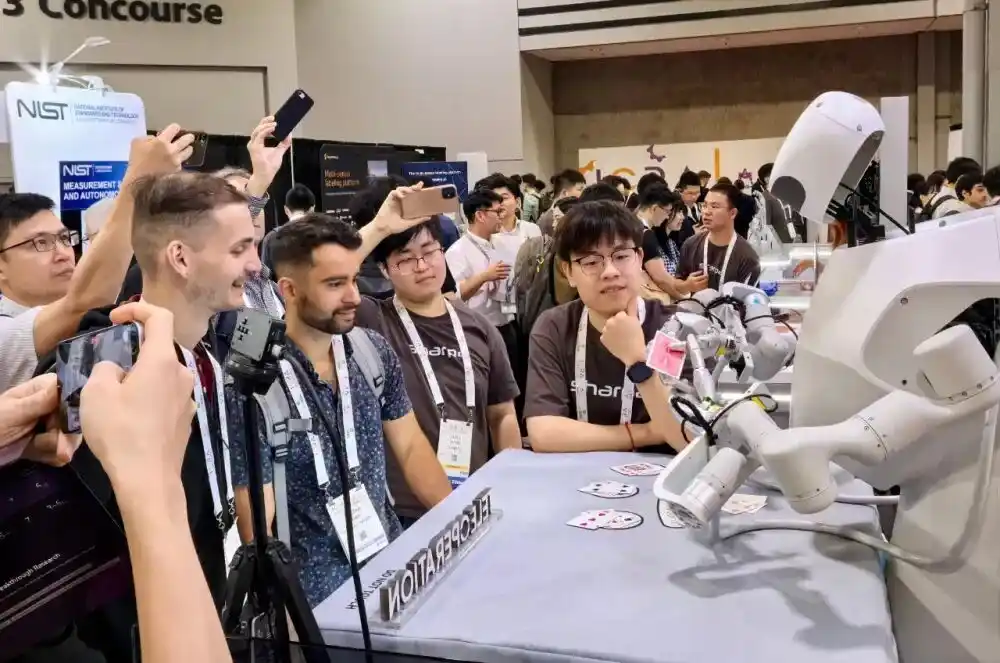
The reason it was so impressive lies in the fact that the action of dealing a playing card places extremely high demands on the force control precision of the dexterous hand and its predictive capability regarding the sliding and extraction of the card.

Furthermore, Sharpa has released a series of demonstration videos: autonomously peeling an eggshell, peeling an apple, dealing playing cards, folding paper pinwheels, and even assembling a computer case—including precisely inserting a graphics card and tightening the securing screws.

These tasks might seem like fun demos, but for the robotics industry, they represent entirely different levels of technical difficulty. Because grasping an object is not difficult; what's truly challenging is controlling the contact process.

A robot can easily pick up an egg but might not know when to increase or decrease force; it can recognize a playing card but may struggle to prevent the paper from slipping or deforming.

Many of the capabilities demonstrated by Sharpa essentially point to the same question: Can a robot adjust its actions in real-time through tactile feedback, just like a human?

This is where the DTA tactile system comes into play.

When the robot makes contact with an object, its fingertips can perceive pressure changes, friction states, and object slipping trends in real-time and feed this back to the control system for dynamic adjustment. Objects like eggs, paper, and fruit—soft or fragile—precisely highlight the value of this system.

At the same time, Sharpa is not content with being just a supplier of dexterous hands. In 2026, the company officially released its first full-body humanoid robot: Sharpa North.

At CES 2026, North demonstrated tasks such as playing table tennis, taking photos with a selfie stick, and dealing playing cards. However, the most representative demonstration was the autonomous assembly of a paper pinwheel, a task involving over 30 steps.

The entire process, from identifying parts and grasping materials to folding, assembling, and final completion, lasted several minutes and involved a large amount of bimanual coordination and sequential action planning. This indicates that the Sharpa robot possesses the potential to complete long-sequence, multi-step tasks.

From dexterous hands to humanoid robots, from a hardware supplier to a full-stack system developer, Sharpa's path is becoming increasingly clear:

It is not satisfied with being just a component of a robot. What it truly aims to do is become part of the next-generation embodied intelligence platform.

And "platform" is also a key word for NVIDIA's reference robot this time.

If the previous demonstrations proved that Sharpa's hands can perform complex manipulations, then the next, more crucial question is: What can such hands bring to NVIDIA?

Peers Are Racing to Flip the Table

For Sharpa, being chosen by NVIDIA is undoubtedly a landmark moment.

But the more critical point is that within this reference robot system, Sharpa occupies a rather pivotal position.

Because NVIDIA's goal with the "reference robot" is to build a reusable development foundation for the embodied intelligence industry, enabling developers, research institutions, and robotics companies to conduct training, verification, and development based on this framework.

In this framework, Unitree provides the body. With its locomotion control capabilities, Unitree solves the problem of how a robot stands up, walks, and moves.

What Sharpa adds is how the robot actually reaches out and does work once it stands in front of an object.

But for NVIDIA, this is not the whole story.

More importantly, Sharpa's product has been integrated into Isaac Lab. This is the most core open-source simulation training framework within NVIDIA's robotics ecosystem.

In the teleoperation phase, a human operator can control the 22-DOF dexterous hand using a data glove, mapping hand movements in real-time to robot joint movements. These recorded movements then become data for imitation learning and policy training, turning into samples that can be trained, reused, and expanded upon later.

Precisely because of this, Sharpa has secured more than just an ordinary hardware seat. It has inserted itself into NVIDIA's entire workflow, from teleoperation data collection, simulation training, policy evaluation, to real-world deployment. This is the core value of its collaboration with NVIDIA.

Of course, being favored by NVIDIA doesn't mean Sharpa has already secured victory, as the dexterous hand sector is evolving rapidly.

Over the past year or so, capital has been chasing this "hand" forward: companies like Lingxin Qiaoshou, Lingjiedian, InSight Robotics, AII Technology, Paxon Perception, etc., are all accelerating iteration around high degrees of freedom, tactile feedback, force control precision, and mass production capabilities.

Some are competing on funding speed and product deployment.

For example, Lingxin Qiaoshou has completed multiple rounds of funding since 2025, with its valuation reportedly reaching $3 billion after its B+ round in 2026, and its target valuation for the next round rumored to be as high as $6 billion. InSight Robotics also completed C1 and C2 funding rounds totaling hundreds of millions of RMB in 2026, continuing to focus on R&D for dexterous manipulation technology, innovation in core components, and product delivery capabilities.

Others are competing on tactile sensing.

Paxon Perception's product line already covers multi-dimensional tactile sensors, the DexH series of tactile dexterous hands, the humanoid robot TORA, and completed a B+ round of over 1 billion RMB in funding in March 2026.

AII Technology's new-generation dexterous hand also prominently features high-density array tactile sensors, pressure sensing capability from 0.1N to 25N, and other selling points.

This means that today's specifications—22 DOF, DTA tactile system, and NVIDIA reference design—could be surpassed tomorrow by new hands with lower costs, higher stability, or stronger data-closing capabilities.

But at least for this moment, NVIDIA has made its judgment clear:

As the industry shifts from "who can make the robot walk" to "who can make the robot work," a pair of sufficiently smart hands has become as important as its legs.

This article is from the WeChat public account "Blue Character Plan," author: Chester

Trending Cryptos

Related Questions

QWhy did NVIDIA choose Unitree's H2 Plus robot as the reference humanoid body for its NVIDIA Isaac GR00T platform, but then replace its hands?

ANVIDIA selected Unitree's H2 Plus for its excellent locomotion and full-body control capabilities, which placed it in the global first tier of humanoid robots. However, NVIDIA replaced Unitree's own Dex-series dexterous hands with Sharpa Wave hands because Sharpa's hands, with their 22 active degrees of freedom, high-precision direct-drive architecture, and advanced Dynamic Tactile Array (DTA) system, were deemed better suited for the complex manipulation tasks and data-collection needs of the reference platform.

QWhat are the key technological features of Sharpa's Wave dexterous hand that distinguished it for NVIDIA's selection?

ASharpa Wave's key features include: 22 active degrees of freedom in a human 1:1 scale, a direct-drive transmission architecture for high-speed response and control precision, and its proprietary Dynamic Tactile Array (DTA) system. The DTA integrates micro-cameras and over 1,000 tactile sensing units in each fingertip, providing high-frequency (180Hz) and high-precision (0.005N) force/tactile feedback. This allows the hand to perceive texture, slippage, and contact states, enabling complex, real-world manipulation tasks.

QHow does Sharpa's background at Hesai Technology relate to its development of advanced robotic hands?

ASharpa's core team originated from the dexterous hand team formed by Hesai Technology (a leading LiDAR company for autonomous vehicles) in 2024. While autonomous driving and robotics seem different, they share common technical challenges: high demands for sensor precision, system reliability, and engineering capabilities in complex, real-world environments. Sharpa leveraged Hesai's expertise in these areas, transferring capabilities from solving 'how vehicles see the world' to solving 'how robots touch and interact with the world.'

QWhat is the strategic significance of Sharpa Wave being integrated into NVIDIA's Isaac Lab framework?

AIntegration into NVIDIA's Isaac Lab—the core open-source simulation training framework for robotics—positions Sharpa not just as a hardware supplier but as a key part of NVIDIA's embodied AI development stack. In this framework, human operators can use data gloves to control the 22-DoF hand for teleoperation, generating real-time manipulation data. This data then becomes foundational for imitation learning and policy training within Isaac Lab, creating a closed-loop from data collection and simulation to real-world deployment. This gives Sharpa a crucial role in NVIDIA's platform ecosystem.

QWhat does NVIDIA's choice of Sharpa over Unitree's own hand signify about the current priorities in the humanoid robotics industry?

ANVIDIA's choice signals a shift in industry focus from 'who can make the robot walk and move' to 'who can make the robot perform useful work.' While stable locomotion (Unitree's strength) remains foundational, advanced manipulation capabilities are now considered equally critical for practical application. The selection highlights the growing importance of high-fidelity tactile sensing, precise force control, and the ability to handle complex, long-horizon manipulation tasks as key differentiators for next-generation embodied intelligence platforms.

Related Reads

Conversation with Co-founder of Hyperdash: Why is Hyperliquid Still Severely Undervalued?

Interview Summary with Hanson Birringer, Co-founder of Hyperdash: Why Hyperliquid Remains Undervalued In an interview on *The Rollup*, Hanson Birringer, Co-founder and Chief Revenue Officer of Hyperdash—a trading data analytics platform for Hyperliquid—shared his investment thesis on the Hyperliquid ecosystem. He described Hyperliquid as a pure play on three key crypto super-trends: perpetual contracts, real-world assets (RWAs), and stablecoins. The platform is an open-source, decentralized, and high-performance financial system uniquely positioned to bridge traditional institutional capital with decentralized finance. Birringer highlighted Hyperliquid's leadership in perpetual DEX trading and its recent innovation of RWA perpetual contracts. He emphasized the significance of USDC becoming a core quoting asset, which, by allocating 90% of its backend yield from assets like US treasuries to a protocol buyback fund, creates substantial, programmatic buy pressure for the Hype token. He addressed regulatory challenges, noting that Hyperliquid's policy team is actively engaging with US regulators like the CFTC to establish clear rules for decentralized venues. Once achieved, regulated brokers could route orders directly to Hyperliquid's backend, tapping into its low-cost liquidity layer. Regarding revenue, Birringer was optimistic, citing the immense size of traditional financial markets. Even capturing a small fraction of global trading volume in products like RWA perpetuals could lead to exponential growth for the protocol. The recently launched Grayscale Hyperliquid ETF, seeded by their SPV (Hyper Holdings Global), provides a compliant on-ramp for institutional investors drawn to the clear "cash flow + token buyback" model. Finally, he discussed Hyperdash's acquisition of Imperator, enhancing its data and node infrastructure to serve both retail traders and traditional asset managers. His bullish case rests on Hyperliquid's potential to provide unprecedented global access to dollar-based capital markets. He struggled to articulate a bear case, seeing the long-term trends of internet adoption and financial inclusion as powerful tailwinds.

marsbit7m ago

Conversation with Co-founder of Hyperdash: Why is Hyperliquid Still Severely Undervalued?

marsbit7m ago

DeepSeek V4 'Full-Blooded Edition' Leaked, Could Be Released As Early As Tomorrow

The highly anticipated full release of DeepSeek V4 is imminent, expected to launch as early as tomorrow after nearly three months of waiting. A select group has already received access to the GA (General Availability) beta, which includes two versions: DeepSeek V4 Flash and DeepSeek V4 Pro. Early testers report that V4's overall performance is close to the level of Opus 4.8, with coding capabilities rivaling GPT-5.6 Sol. Its agent abilities are significantly enhanced, and 3D/SVG generation has improved notably. While it may not surpass the recently released Kimi K3 in performance, its expected price point is significantly lower. The official release will introduce a new "peak/off-peak" pricing model for its API. For example, deepseek-v4-pro will cost $0.87 per million output tokens during standard times and $1.74 during peak hours. The flash version is even more aggressive at $0.28/$0.56 per million tokens, with cached input tokens priced extremely low at $0.0028. This makes V4 a strong contender in terms of cost-effectiveness, potentially offering Opus-level capabilities at a fraction of the cost, continuing DeepSeek's reputation as a "price disruptor" in the AI market. Initial demos showcasing V4's capabilities have begun circulating, including generated 3D simulation games, HTML games blending elements of Minecraft and No Man's Sky, and classic games like a "Cut the Rope" clone. The final GA version is set to replace the older deepseek-chat and deepseek-reasoner models, which will be retired on July 24th.

marsbit16m ago

DeepSeek V4 'Full-Blooded Edition' Leaked, Could Be Released As Early As Tomorrow

marsbit16m ago

WEEX Labs Weekly Observation: The 'Power Restructuring' of AI Infrastructure and the 'Deep Dive Movement' into the Real Economy

WEEX Labs Weekly Review: AI Infrastructure's "Power Restructuring" and the "Deep Dive" into the Real Economy Mid-July 2026 marks a pivotal shift in the global AI industry. The allocation of computing power is transferring from cloud giants to compute resource owners, while the core value of AI is solidifying around its penetration into physical industry, moving beyond the race for model parameters. The era of fragmented model development is over, replaced by a capital-intensive, integrated chain driven by hard tech. Key developments this week include Meta's planned entry into the cloud computing market with "MetaCompute." This move by social media giants with massive GPU clusters challenges traditional cloud providers like AWS, integrating compute, models, and data into one-stop services, which will squeeze smaller rental providers and shift enterprise focus towards underlying model ecosystems. Chinese foundational models like DeepSeek-V4 and Tencent's Hy-3 are pushing towards "utility" status through open-source releases and extreme cost reductions via MoE architectures. This lowers entry barriers for enterprises, allowing them to focus resources on private deployment and deep business integration. Embodied intelligence, particularly humanoid robots, is transitioning from lab demos to real-world factory applications, driven by policies promoting large-scale, practical deployment in logistics and manufacturing. The value focus is shifting from spectacle to stable industrial data and real operational efficiency. Global governance, through forums like WAIC, is evolving from theoretical ethics to practical operational frameworks for "Sovereign AI," raising geopolitical compliance barriers and making auditability and data sovereignty core design requirements from the outset. WEEX Labs Insights: The current transformation shows AI's prosperity is deeply embedding into the fabric of global manufacturing. Strategic recommendations include: 1) leveraging open-source models for private, proprietary knowledge bases; 2) maintaining cloud provider diversity to avoid vendor lock-in from integrated model ecosystems; and 3) seeking opportunities in the "embodied infrastructure" supporting robots, such as data collection, industrial simulation, and factory AI adaptation services.

marsbit32m ago

WEEX Labs Weekly Observation: The 'Power Restructuring' of AI Infrastructure and the 'Deep Dive Movement' into the Real Economy

marsbit32m ago

Is WEEX TradFi Reliable? What You Should Know Before Your First Trade of U.S. Stock Tokens

In recent years, cryptocurrency users have expanded their focus beyond Bitcoin and Ethereum to include popular traditional financial (TradFi) assets like Nvidia, Apple, and Tesla stocks. This shift raises key questions: What do these TradFi assets represent on crypto trading platforms? How do they differ from traditional stock ownership? And how can users assess the reliability of platforms offering such products? TradFi products, such as those offered by WEEX TradFi (including NVDA, MSFT, AAPL, TSLA, and QQQ tokens), are blurring the lines between crypto and traditional markets. They allow users to trade based on the price movements of traditional assets within a familiar digital asset trading environment. However, it's crucial to understand that trading a "stock token" is not equivalent to owning the actual stock. Users are participating in price speculation, not gaining shareholder rights like dividends or voting. A key feature of these products is 7x24 trading, offering flexibility beyond traditional market hours. While convenient, this also introduces unique risks, such as potential liquidity gaps and volatility when underlying markets are closed. For users evaluating TradFi products, reliability hinges on transparency and risk management. Critical factors include understanding the product mechanism, how prices track the underlying assets, and the associated risks—especially when using leverage. Popular stocks and indices are still subject to company performance, macroeconomic shifts, and sector trends. Ultimately, TradFi represents a new gateway connecting crypto users to global markets. The future points toward integrated trading environments where the distinction between "crypto investor" and "traditional investor" fades. For newcomers, a platform's reliability stems not from promises, but from a clear understanding of the product, a comprehensive view of risks, and informed judgment of the platform's capabilities.

marsbit32m ago

Is WEEX TradFi Reliable? What You Should Know Before Your First Trade of U.S. Stock Tokens

marsbit32m ago

Trading

Spot

Hot Articles

Discussions

Welcome to the HTX Community. Here, you can stay informed about the latest platform developments and gain access to professional market insights. Users' opinions on the price of S (S) are presented below.

活动图片