Author: Hristina Vasileva
Compiled by: Deep Tide TechFlow
Deep Tide Intro: During April and May 2026, at least six core members of the Ethereum Foundation (EF) left in rapid succession, spanning protocol engineering, cryptoeconomics research, and management. EF officially frames this within its "Mandate" framework as active downsizing, but the community sees: core developers dropping from 225 to 169, shrinking ETH holdings, and the Glamsterdam upgrade delayed. This Cryptopolitan report details the list of departures, the logic behind EF's restructuring, and the current state of ecosystem developers.
The Ethereum Foundation (EF) has lost several key contributors, sparking renewed questions about the organization's direction and Ethereum's future. This wave of departures follows Tomasz Stańczak's resignation as EF co-Executive Director after just one year in the role.
In April and May, a total of six contributors left or began long-term leave. Departures were concentrated in the foundation's core engineering teams and research department.
Some of the engineers were from the Protocol Cluster responsible for Ethereum's L1 design. This unit underwent restructuring, with engineers Barnabé Monnot and Tim Beiko departing subsequently.
Earlier, Josh Stark announced his departure after seven years at EF, where he served as co-chair of the 'Trillion Dollar Security Initiative.' Trent Van Epps left after five years, having been involved with organizing the Protocol Guild; he will continue contributing to the broader ecosystem part-time.
May Exodus Intensifies
The most recent to leave EF is Carl Beek, a seven-year veteran and a key figure in the Beacon Chain launch phase.
Julian Ma also recently resigned after four years of cryptoeconomics research at EF, focusing on mechanism design.
These two departures sparked greater concern within the Ethereum community, escalating discussions about EF's future direction. The foundation's own public statements have consistently focused on "supporting the ecosystem as a whole," deliberately downplaying its role as a central authority.
The departure of core members doesn't directly indicate problems with Ethereum itself. However, these exits have indeed reignited discussions about leadership, coordination mechanisms, and what the goal of "decentralization" actually entails.
Developer Activity Maintains a Baseline
Despite the high-level personnel turbulence, Ethereum's developer activity retains a solid baseline. Token Terminal data shows the project currently has 169 core developers, a 63% rebound over the past month. However, looking at a longer timeframe, core developers have declined from 225 in May 2025 to 169 as of May 19, 2026.
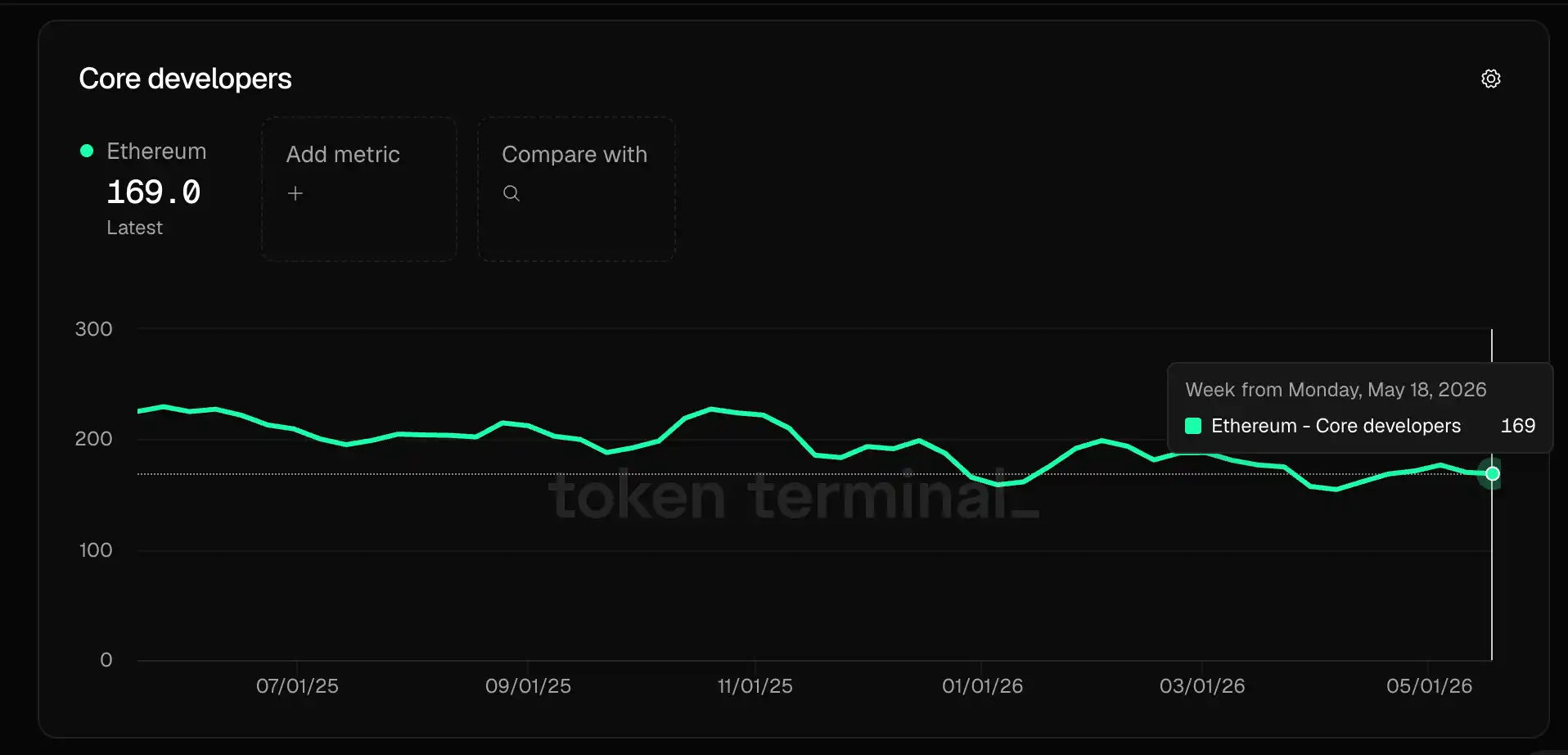
Caption: Ethereum core developers saw a slight uptick over the past month, but have declined from 225 in May 2025 to 169.
Source: Token Terminal
The overall number of ecosystem developers now lags behind Solana. However, according to Chainspect data, the Ethereum ecosystem still boasts 9,744 active developers.
EF is proceeding with a restructuring guided by its newly released Mandate document, adjusting its development focus. One of the Mandate's core objectives is to reduce the foundation's direct influence, which inherently involves parting ways with some key contributors.
Another practical issue facing EF is the shrinking ETH reserves in its organizational wallet. The foundation currently holds 103,660 ETH, having previously staked a portion and sold some reserves to BitMine.
The timing of this exodus is not ideal: Ethereum is being looked to as a critical infrastructure layer for global finance. The team restructuring also coincides with a peak period of concentrated attacks against decentralized projects, with the Ethereum ecosystem bearing the brunt.
Following these reports, ETH price continues to hover in a low range, down 40% over the past year. At the time of writing, ETH is trading at $2,117.02, despite the amount staked in the Beacon Chain contract reaching 31% of the circulating supply.