BTC Market Pulse: Week 3

insights.glassnodePublished on 2026-01-12Last updated on 2026-01-12

Abstract

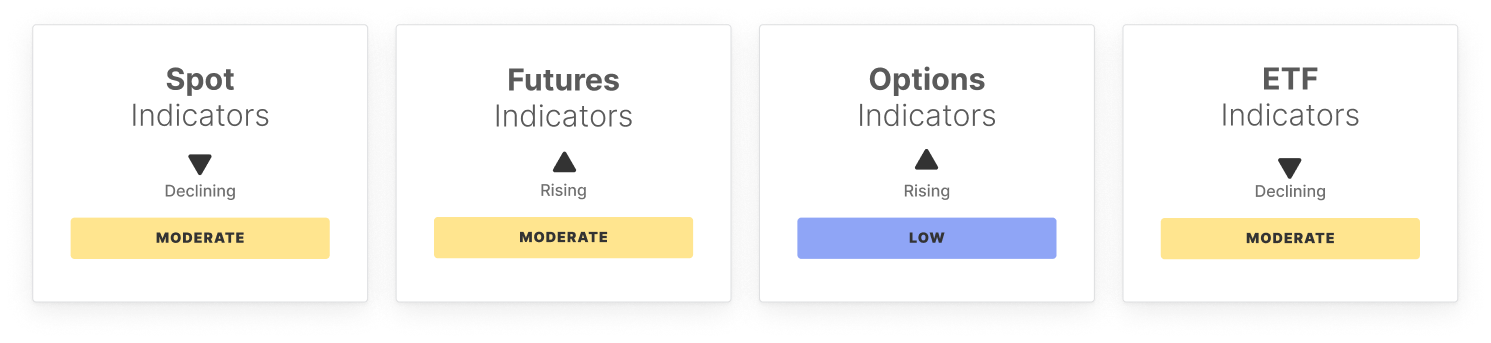
BTC Market Pulse Week 3 indicates a fragile market consolidation. Spot trading volume shows early signs of recovery, but CVD deterioration suggests rising sell-side pressure. Derivatives show mixed signals with higher open interest and bullish funding rates, yet negative CVD points to leveraged selling. Options markets reflect heightened uncertainty with elevated implied volatility and increased demand for downside protection. US spot ETFs experienced significant outflows, signaling institutional de-risking, though trading volume rose. On-chain activity shows modestly lower active addresses but higher transfer volume, indicating capital reallocation. Network fees are near cycle lows. The market requires renewed spot-led demand to establish a sustainable upward trend, as speculative sensitivity and profit-taking risks remain elevated.

Spot market conditions remain fragile. Trading volume has rebounded modestly from cycle lows, pointing to early signs of liquidity rebuilding, however spot CVD has deteriorated, signalling rising sell-side dominance and a more defensive near-term posture. Derivatives positioning is mixed. Futures open interest has edged higher, reflecting a mild rebuild in speculative engagement, while long-side funding has risen sharply, signalling renewed willingness to pay for bullish exposure. In contrast, perpetual CVD has flipped deeply negative, highlighting elevated sell-side aggression across leveraged markets.

Options markets continue to price elevated uncertainty. Options open interest has risen materially, while the volatility spread has widened well beyond its statistical high band, signalling that implied volatility continues to materially outpace realised levels. The 25-delta skew has also trended higher, reflecting a growing bid for downside protection

US spot ETF netflows have reversed into heavy outflows beyond statistical extremes, signalling pronounced institutional de-risking. Despite this, ETF trading volume has risen, highlighting active re- positioning. ETF holder profitability remains elevated, maintaining an elevated profit-taking risk.

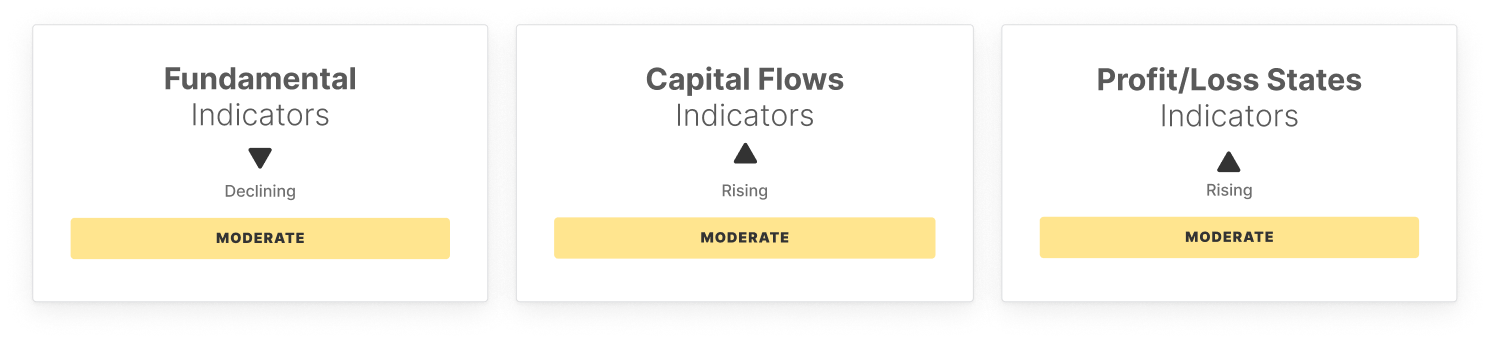
Active addresses have eased modestly, while transfer volume has surged, pointing to heightened capital reallocation. Network fees have drifted toward statistical lows, reflecting a quieter transactional backdrop. Capital flows show early signs of stabilisation, while the share of supply held by short-term participants remains elevated, reinforcing heightened speculative sensitivity.

Overall, the market remains in a fragile consolidation phase. While early signs of engagement rebuilding are emerging, elevated institutional de-risking, defensive options positioning, and persistent speculative sensitivity suggest that renewed spot-led demand remains necessary to re-establish a sustainable upside trend.
On-Chain Indicators
🔗 Access the full report in PDF

Don't miss it!

Smart market intelligence, straight to your inbox.

Subscribe now
  • Follow us and reach out on X
  • Join our Telegram channel
  • For on-chain metrics, dashboards, and alerts, visit Glassnode Studio

Disclaimer: This report does not provide any investment advice. All data is provided for information and educational purposes only. No investment decision shall be based on the information provided here and you are solely responsible for your own investment decisions.

Exchange balances presented are derived from Glassnode’s comprehensive database of address labels, which are amassed through both officially published exchange information and proprietary clustering algorithms. While we strive to ensure the utmost accuracy in representing exchange balances, it is important to note that these figures might not always encapsulate the entirety of an exchange’s reserves, particularly when exchanges refrain from disclosing their official addresses. We urge users to exercise caution and discretion when utilizing these metrics. Glassnode shall not be held responsible for any discrepancies or potential inaccuracies.

Please read our Transparency Notice when using exchange data.

Related Questions

QWhat does the negative spot CVD and perpetual CVD indicate about the current Bitcoin market?

AThe negative spot CVD (Cumulative Volume Delta) indicates rising sell-side dominance and a more defensive near-term posture in the spot market. The deeply negative perpetual CVD highlights elevated sell-side aggression across leveraged derivatives markets.

QHow are options markets reflecting uncertainty in the Bitcoin market?

AOptions markets are pricing elevated uncertainty, with implied volatility materially outpacing realized levels as shown by the widened volatility spread beyond its statistical high band. The rising 25-delta skew also reflects increased demand for downside protection.

QWhat do the US spot ETF netflows reveal about institutional behavior?

AUS spot ETF netflows have reversed into heavy outflows beyond statistical extremes, signaling pronounced institutional de-risking and profit-taking despite elevated ETF holder profitability.

QWhat on-chain indicators suggest heightened capital reallocation?

AThe surge in transfer volume combined with modestly eased active addresses points to heightened capital reallocation, while network fees drifting toward statistical lows reflect a quieter transactional backdrop.

QWhat is the overall market condition according to the report?

AThe market remains in a fragile consolidation phase. While there are early signs of engagement rebuilding, elevated institutional de-risking, defensive options positioning, and persistent speculative sensitivity indicate that renewed spot-led demand is needed to re-establish a sustainable upside trend.

Related Reads

Robinhood Gains a New Batch of Stock Investors, the Oldest is 1 Year Old, the Youngest is -3 Years Old

US Treasury designates Robinhood as broker and initial trustee for "Trump Accounts" (also known as 530A accounts), a tax-advantaged investment program established under the "Big and Beautiful" Act. The initiative, aimed at children born between January 1, 2025, and January 1, 2029, provides each eligible newborn with a $1,000 initial federal deposit. Private donors, such as Michael Dell, have also contributed significantly. The accounts are restricted to low-cost index funds tracking broad market indices like the S&P 500, and funds are locked until the child turns 18. With an estimated 14.4 million children eligible, the program represents a potential $14.4 billion in initial government funding, growing to hundreds of billions with private and family contributions. This creates a long-term, passive investment pool of potentially trillions of dollars. Robinhood, selected over competitors like JPMorgan and Charles Schwab, stands to be a major beneficiary. The deal grants the platform millions of new, long-lifecycle users—the oldest are one year old, the youngest are yet to be born—who are effectively locked into its ecosystem. Upon turning 18, these accounts convert to IRA-like retirement accounts, allowing Robinhood to capture their adult investing activity. The stable, long-term, and predictable nature of these assets also diversifies Robinhood's business beyond its reliance on active retail trading. The government endorsement significantly boosts its institutional credibility and opens new avenues in wealth management.

Odaily星球日报13m ago

Robinhood Gains a New Batch of Stock Investors, the Oldest is 1 Year Old, the Youngest is -3 Years Old

Odaily星球日报13m ago

AI, Why Does It Also Need to Sleep?

Anthropic's accidental leak of Claude Code's source code in 2026 revealed an experimental feature called "autoDream," part of the KAIROS system, which gives AI a sleep-like cycle. Unlike the prevailing AI agent paradigm of continuous, uninterrupted operation, autoDream operates offline when users are inactive. It processes and consolidates daily logs—resolving contradictions, converting vague observations into facts, and discarding redundant information—while avoiding the accumulation of noise in the limited context window, a phenomenon known as "context corruption." This mirrors human brain function: the hippocampus temporarily stores daily experiences, and during rest, the brain prioritizes and transfers important memories to the neocortex through processes like active systems consolidation. Both systems must go offline to perform memory maintenance, as simultaneous processing and consolidation compete for resources. autoDream differs in one key aspect: it labels its outputs as "hints" rather than definitive truths, requiring verification upon use—a cautious approach unlike human memory, which often constructs narratives with high confidence. The emergence of this sleep-like mechanism suggests that, beyond mere biological imitation, intelligent systems may inherently require periodic rest to maintain coherence and performance. It challenges the assumption that more power and continuous operation always lead to greater intelligence, pointing instead to the necessity of rhythmic cycles in advanced cognition.

marsbit1h ago

AI, Why Does It Also Need to Sleep?

marsbit1h ago

Trading

Spot
Futures

Hot Articles

What is $BITCOIN

DIGITAL GOLD ($BITCOIN): A Comprehensive Analysis Introduction to DIGITAL GOLD ($BITCOIN) DIGITAL GOLD ($BITCOIN) is a blockchain-based project operating on the Solana network, which aims to combine the characteristics of traditional precious metals with the innovation of decentralized technologies. While it shares a name with Bitcoin, often referred to as “digital gold” due to its perception as a store of value, DIGITAL GOLD is a separate token designed to create a unique ecosystem within the Web3 landscape. Its goal is to position itself as a viable alternative digital asset, although specifics regarding its applications and functionalities are still developing. What is DIGITAL GOLD ($BITCOIN)? DIGITAL GOLD ($BITCOIN) is a cryptocurrency token explicitly designed for use on the Solana blockchain. In contrast to Bitcoin, which provides a widely recognized value storage role, this token appears to focus on broader applications and characteristics. Notable aspects include: Blockchain Infrastructure: The token is built on the Solana blockchain, known for its capacity to handle high-speed and low-cost transactions. Supply Dynamics: DIGITAL GOLD has a maximum supply capped at 100 quadrillion tokens (100P $BITCOIN), although details regarding its circulating supply are currently undisclosed. Utility: While precise functionalities are not explicitly outlined, there are indications that the token could be utilized for various applications, potentially involving decentralized applications (dApps) or asset tokenization strategies. Who is the Creator of DIGITAL GOLD ($BITCOIN)? At present, the identity of the creators and development team behind DIGITAL GOLD ($BITCOIN) remains unknown. This situation is typical among many innovative projects within the blockchain space, particularly those aligning with decentralized finance and meme coin phenomena. While such anonymity may foster a community-driven culture, it intensifies concerns about governance and accountability. Who are the Investors of DIGITAL GOLD ($BITCOIN)? The available information indicates that DIGITAL GOLD ($BITCOIN) does not have any known institutional backers or prominent venture capital investments. The project seems to operate on a peer-to-peer model focused on community support and adoption rather than traditional funding routes. Its activity and liquidity are primarily situated on decentralized exchanges (DEXs), such as PumpSwap, rather than established centralized trading platforms, further highlighting its grassroots approach. How DIGITAL GOLD ($BITCOIN) Works The operational mechanics of DIGITAL GOLD ($BITCOIN) can be elaborated on based on its blockchain design and network attributes: Consensus Mechanism: By leveraging Solana’s unique proof-of-history (PoH) combined with a proof-of-stake (PoS) model, the project ensures efficient transaction validation contributing to the network's high performance. Tokenomics: While specific deflationary mechanisms have not been extensively detailed, the vast maximum token supply implies that it may cater to microtransactions or niche use cases that are still to be defined. Interoperability: There exists the potential for integration with Solana’s broader ecosystem, including various decentralized finance (DeFi) platforms. However, the details regarding specific integrations remain unspecified. Timeline of Key Events Here is a timeline that highlights significant milestones concerning DIGITAL GOLD ($BITCOIN): 2023: The initial deployment of the token occurs on the Solana blockchain, marked by its contract address. 2024: DIGITAL GOLD gains visibility as it becomes available for trading on decentralized exchanges like PumpSwap, allowing users to trade it against SOL. 2025: The project witnesses sporadic trading activity and potential interest in community-led engagements, although no noteworthy partnerships or technical advancements have been documented as of yet. Critical Analysis Strengths Scalability: The underlying Solana infrastructure supports high transaction volumes, which could enhance the utility of $BITCOIN in various transaction scenarios. Accessibility: The potential low trading price per token could attract retail investors, facilitating wider participation due to fractional ownership opportunities. Risks Lack of Transparency: The absence of publicly known backers, developers, or an audit process may yield skepticism regarding the project's sustainability and trustworthiness. Market Volatility: The trading activity is heavily reliant on speculative behavior, which can result in significant price volatility and uncertainty for investors. Conclusion DIGITAL GOLD ($BITCOIN) emerges as an intriguing yet ambiguous project within the rapidly evolving Solana ecosystem. While it attempts to leverage the “digital gold” narrative, its departure from Bitcoin's established role as a store of value underscores the need for a clearer differentiation of its intended utility and governance structure. Future acceptance and adoption will likely depend on addressing the current opacity and defining its operational and economic strategies more explicitly. Note: This report encompasses synthesised information available as of October 2023, and developments may have transpired beyond the research period.

363 Total ViewsPublished 2025.05.13Updated 2025.05.13

What is $BITCOIN

Discussions

Welcome to the HTX Community. Here, you can stay informed about the latest platform developments and gain access to professional market insights. Users' opinions on the price of BTC (BTC) are presented below.

活动图片