Robinhood Gains a New Batch of Stock Investors, the Oldest is 1 Year Old, the Youngest is -3 Years Old

Odaily星球日报Published on 2026-04-07Last updated on 2026-04-07

Abstract

US Treasury designates Robinhood as broker and initial trustee for "Trump Accounts" (also known as 530A accounts), a tax-advantaged investment program established under the "Big and Beautiful" Act. The initiative, aimed at children born between January 1, 2025, and January 1, 2029, provides each eligible newborn with a $1,000 initial federal deposit. Private donors, such as Michael Dell, have also contributed significantly. The accounts are restricted to low-cost index funds tracking broad market indices like the S&P 500, and funds are locked until the child turns 18. With an estimated 14.4 million children eligible, the program represents a potential $14.4 billion in initial government funding, growing to hundreds of billions with private and family contributions. This creates a long-term, passive investment pool of potentially trillions of dollars. Robinhood, selected over competitors like JPMorgan and Charles Schwab, stands to be a major beneficiary. The deal grants the platform millions of new, long-lifecycle users—the oldest are one year old, the youngest are yet to be born—who are effectively locked into its ecosystem. Upon turning 18, these accounts convert to IRA-like retirement accounts, allowing Robinhood to capture their adult investing activity. The stable, long-term, and predictable nature of these assets also diversifies Robinhood's business beyond its reliance on active retail trading. The government endorsement significantly boosts its institutional credibil...

Original | Odaily Planet Daily (@OdailyChina)

Author | Azuma (@azuma_eth)

On April 6 local time, the U.S. Treasury Department officially announced the latest developments regarding the "Trump Accounts" — The Bank of New York Mellon (BNY) has been selected as the designated financial agent of the U.S. government to manage the initial accounts; Robinhood will cooperate with BNY to serve as the broker and initial custodian of the "Trump Accounts".

All parties will work together to support the Treasury Department's goal of ensuring that every eligible newborn American child can quickly and easily obtain a "Trump Account".

What is the "Trump Account"?

The so-called "Trump Account", also known as the 530A account, is a tax-advantaged investment account plan established on June 9, 2025, by then-President Trump under the authority of the "Big and Beautiful" Act. It aims to set up government-funded savings accounts for the children of U.S. citizens born between January 1, 2025, and January 1, 2029.

The initial funding for the "Trump Accounts" primarily comes from government appropriations, private donations, and family deposits. The federal government will provide $1,000 in initial funding for each account; Dell founder Michael Dell and his wife announced a donation of $6.25 billion in December last year, which will open accounts for 25 million children from families with a regional median income below $150,000, injecting $250 into each account; parents, friends, and other designated individuals can also deposit money into specified accounts, but can deposit up to $5,000 per child per year.
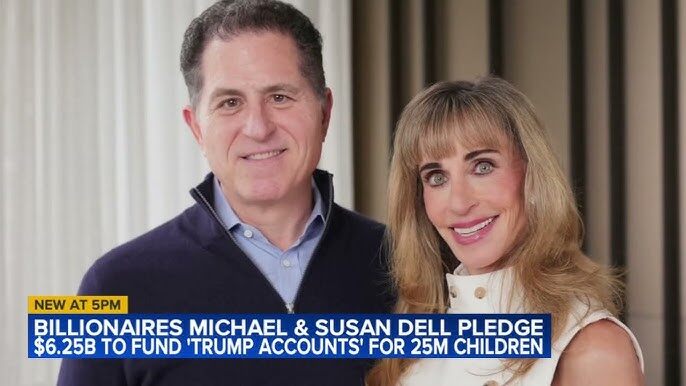
Odaily Note: Michael Dell and his wife, who donated $6.25 billion, were described by Trump as "one of the most generous acts in American history."

In terms of investment, "Trump Accounts" will be limited to investing in low-cost investment funds or exchange-traded funds (ETFs) that track broad stock indices such as the "S&P 500" index, and cannot be used to invest in specific industry or sector indices. The usage of the funds is also restricted. Until the child turns 18 and becomes a legal adult on January 1 of that year, the funds in the account cannot be withdrawn for any reason (unless the child passes away or the funds are transferred to another similar restricted account). After the child turns 18, the account will be treated the same as a traditional Individual Retirement Account (IRA).

According to the current plan, the "Trump Accounts" are tentatively scheduled to begin accepting initial deposits on July 4, 2026 (the 250th anniversary of the Declaration of Independence). This timing coincides with the start of the 2026 midterm elections and is expected to be a key policy "trump card" for the Republican Party to win voters.

What is the Potential Scale?

According to statistics from Statista, since 2020, the annual number of births in the United States has fluctuated around 3.6 million.

Using this data as a benchmark, during the planned coverage period from January 1, 2025, to January 1, 2029, the number of newborn children in the U.S. is expected to be around 14.4 million. If the federal government opens a $1,000 "Trump Account" for each child, this means a massive fund of $14.4 billion; with potential private donations and family deposits, this number will continue to grow to hundreds of billions of dollars; if the plan continues to be promoted as a long-term initiative after 2029, its potential scale will be even more staggering.

Due to its operational characteristics of long-term locking, passive investment, and continuous additions, the "Trump Account" will essentially become a long-term passive fund pool with a potential scale of hundreds of billions of dollars. Compared to its mere child welfare attributes, this更像是 establishes a long-term capital transmission channel between fiscal policy and the capital market, directly integrating the future generation into the stock market system.

The Biggest Beneficiary: Robinhood?

After the "Trump Account" plan was announced, financial institutions such as JPMorgan Chase, Charles Schwab, and Robinhood began to compete fiercely for related services. With the official designation of Robinhood as the broker and initial custodian by the U.S. Treasury Department yesterday, Robinhood, which has obtained the "admission ticket," is poised to become one of the most direct beneficiaries of the plan.

The most直观 benefit lies on the user side. According to the current policy coverage estimate, the "Trump Account" will correspond to tens of millions of newborn accounts, and the interaction portal for these accounts will be completed through a unified application — in other words, Robinhood will acquire a batch of potential users who are bound to the platform from birth. The oldest of these users is only 1 year old, and the youngest hasn't even been born yet... More importantly, these users are not one-time traffic but potential clients with an extremely long lifecycle. The children's accounts will convert into long-term investment accounts similar to IRAs after they turn 18, which means Robinhood has the opportunity to directly承接 these users' investment behaviors into adulthood and further extend into more business scenarios such as ETFs, options, and even crypto assets. From a lifecycle perspective, this is almost the longest user path a broker can obtain.

The benefits on the asset side are equally significant. The funds in the "Trump Account" have obvious long-term locking characteristics, hardly flowing out before the child reaches adulthood, while the investment scope is limited to index funds. For brokers, such funds are extremely high-quality custody assets — low volatility, long retention, and predictable scale. Additionally, Robinhood's core label in the past has been a "retail trading platform," with growth highly dependent on market conditions and trading activity. The "Trump Account" introduces low-frequency, long-term, passive investment funds, which are closer to the capital attributes of traditional wealth management businesses. As the proportion of such funds increases, it will also enrich Robinhood's business diversity to some extent, making up for relative shortcomings.

At the same time, the endorsement at the policy level also has symbolic significance. Participating in an account plan led by the Treasury Department allows Robinhood to enter the U.S. government's financial infrastructure system for the first time, which not only enhances its institutional credibility but also provides new narrative space for its future expansion into retirement accounts, long-term investment, and wealth management businesses.

From a political perspective, the "Trump Account" is an important policy chip for the Republican Party in the midterm elections; from a capital market perspective, this plan introduces an institutionalized long-term source of funds into the U.S. stock market. Robinhood happens to be at the intersection of both — as millions of newborns who have not yet entered society "automatically open accounts," this policy design围绕 votes has quietly laid a growth curve for Robinhood that could last for more than a decade.


Related Questions

QWhat is the 'Trump Account' and what is its purpose?

AThe 'Trump Account', also known as the 530A account, is a tax-deferred investment account plan established under the 'Big and Beautiful' Act. Its purpose is to provide government-funded savings accounts for children born between January 1, 2025, and January 1, 2029, to help them save for the future.

QWhich financial institutions were selected to manage the 'Trump Accounts' and what are their roles?

ABNY Mellon (Bank of New York Mellon) was selected as the designated financial agent for the U.S. government to manage the initial accounts. Robinhood will partner with BNY Mellon, serving as the broker and initial custodian for the 'Trump Accounts'.

QWhat are the sources of initial funding for a 'Trump Account' and what are the contribution limits?

AThe initial funding comes from three sources: a $1000 federal grant for each account, private donations (e.g., a $250 contribution for some children from the Michael Dell family donation), and deposits from parents/friends, who can contribute up to $5000 per child per year.

QWhat is the potential scale of the 'Trump Account' program in terms of the number of children and total assets?

ABased on an estimated 3.6 million annual births, the program could cover approximately 14.4 million children born during the eligible period. With the $1000 federal grant alone, this represents $14.4 billion in assets. Including private donations and family deposits, the total assets are expected to grow to tens of billions of dollars, with a long-term potential to become a multi-hundred-billion-dollar passive fund pool.

QWhy is Robinhood considered a major potential beneficiary of the 'Trump Account' program?

ARobinhood benefits by gaining millions of new, long-term users from birth, with accounts that will transition to IRA-like accounts upon adulthood. It will custody a large pool of stable, long-term, passively invested assets, diversifying its business beyond its traditional retail trading focus. The government endorsement also enhances its institutional credibility and opens new business opportunities in wealth management.

Related Reads

Crypto Market Makers Are Collectively Seeking Change as Money Becomes Harder to Earn

**Summary: Crypto Market Makers Adapt as Margins Shrink** Leading crypto market maker GSR exemplifies a broader industry shift, moving beyond traditional market-making to become a full-service "Web3 investment bank." Its recent strategic acquisitions—including an SEC-registered broker-dealer, rebranded as GSR Securities—and purchases of token advisory firms aim to create an integrated platform covering token design, fundraising, listing, liquidity provision, and asset management. This includes launching an ETF and investing in tokenization platforms like Libeara, backed by a strategic investment from Standard Chartered's SC Ventures. This transformation is not unique to GSR. Other major players like Keyrock, B2C2, Wintermute, and DWF Labs are also expanding geographically, pursuing regulatory licenses (especially under frameworks like MiCA in the EU), and diversifying into over-the-counter (OTC) trading, asset management, and real-world asset tokenization. The driving force behind this collective pivot is a rapidly changing market. Profits from traditional altcoin market-making are declining due to fewer viable projects, reduced client budgets, increased competition, and smarter, more demanding clients. Simultaneously, regulatory pressures are mounting, making compliance a baseline cost. Extreme market events further expose teams lacking robust risk controls. Consequently, the crypto market-making business model is evolving from one reliant on information asymmetry and volatility to a more institutionalized, regulated, and service-diverse industry. Survival now depends on building systemic capabilities beyond mere liquidity provision.

marsbit21m ago

Crypto Market Makers Are Collectively Seeking Change as Money Becomes Harder to Earn

marsbit21m ago

Market Adjusts Following Google's $84.7 Billion Fundraising, AI Valuations Now Focus on Payback Speed

After Alphabet's announcement of an $84.75 billion equity financing round, market focus for AI investment is shifting from pure growth narratives to capital efficiency and payback periods. The core argument is that AI is being re-priced from a software-like growth story into a heavy-asset infrastructure cycle, requiring massive capital expenditure (CapEx) on chips, data centers, and power grids. While Alphabet's financing itself is not a distress signal—part of it is for administrative purposes like tax obligations on stock compensation—it highlights the enormous capital demands of AI infrastructure. This demand extends beyond tech giants to pure-play AI model companies (like OpenAI, Anthropic), data center REITs, and utilities. Major tech firms are projected to spend heavily on AI data centers in 2026, signaling a broad-based capital cycle the market must absorb. Consequently, valuation logic is changing. Investors are moving away from questions about who has the strongest AI narrative and are now prioritizing clear visibility into orders, stable cash flows, and the cost of capital. This has led to recent pressure on high-multiple AI software and semiconductor stocks, while "picks-and-shovels" hardware, data center, and power assets with firmer near-term demand may see relative support. The key going forward will be monitoring whether rising CapEx guidance across companies is matched by a timely monetization of AI investments into revenue and cash flow. The market's tolerance for high spending depends on demonstrable returns. While the long-term AI thesis remains intact, the valuation framework has fundamentally shifted to emphasize capital discipline and payback speed.

marsbit28m ago

Market Adjusts Following Google's $84.7 Billion Fundraising, AI Valuations Now Focus on Payback Speed

marsbit28m ago

Trading

Spot
Futures
活动图片




