Michael Burry, known for successfully predicting the 2008 U.S. housing market crash, warned that Bitcoin has already plummeted 40%, and if it continues to fall, it could cause lasting damage to companies that have heavily accumulated the asset over the past year. He believes Bitcoin has proven to be a purely speculative asset, failing to act as a hedge like precious metals.
In a Substack article published on Monday, Burry pointed out that if Bitcoin falls another 10%, one of the most aggressive Bitcoin-hoarding companies, Strategy Inc., would face billions of dollars in losses and would be largely shut out of capital markets. He warned that a Bitcoin decline could trigger "disastrous consequences," including spillover into broader markets and causing a "collateral death spiral" in tokenized metal futures.
This warning comes as Bitcoin continued its sharp decline on Tuesday, briefly falling below $73,000, erasing all gains since Donald Trump's re-election in November 2024. Since hitting an all-time high in early October, the digital currency has dropped more than 40%.
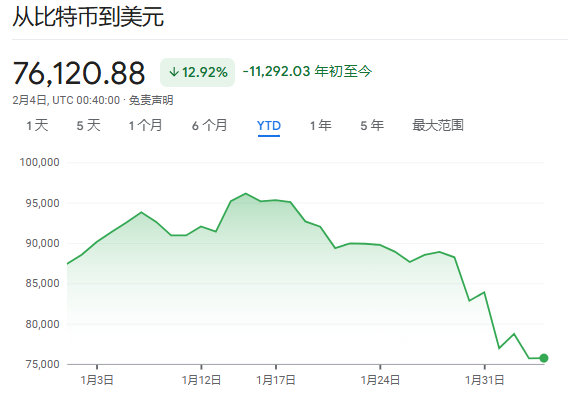
Despite Burry's warning, the cryptocurrency market remains relatively small and is unlikely to cause widespread contagion. With a market capitalization of less than $1.5 trillion, limited household ownership, and narrow corporate adoption, any wealth effects are likely to remain contained.
Bitcoin Exposes Speculative Nature, Fails as Safe-Haven Asset
Burry noted in the article that Bitcoin has failed to respond to typical drivers like a weak U.S. dollar or geopolitical risks, while gold and silver have hit record highs amid global tensions and fears of dollar devaluation. "Bitcoin has no organic use case rationale to slow or stop its decline," Burry said.
According to Bloomberg, analysts attribute Bitcoin's decline to multiple factors, including vanishing inflows, shrinking liquidity, and a broad loss of macro appeal. Many crypto-native traders have also cooled on tokens, shifting to event betting with the rise of prediction markets.
Bitcoin fell over the weekend to its lowest level since last year's tariff-induced turmoil and continued to drop on Tuesday. This performance contrasts sharply with the arguments of its long-term supporters, who believe Bitcoin's fixed supply makes it comparable to gold.
Treasury Companies Face Immense Pressure
Burry warned that the adoption of Bitcoin by corporate treasuries and the launch of new spot cryptocurrency exchange-traded funds (ETFs) are not enough to support its price indefinitely or prevent disastrous consequences in a sharp downturn. He pointed out that nearly 200 publicly traded companies hold Bitcoin.
While this has helped broaden demand, "inventory assets are not permanent," he wrote. Inventory assets must be marked to market and included in financial reports. If Bitcoin's price continues to fall, risk managers will begin advising their companies to sell.
Burry specifically mentioned that if Bitcoin falls another 10%, Strategy Inc., one of the most aggressive Bitcoin-hoarding companies, would be plunged into billions of dollars in losses and find capital markets largely closed to it. He described these "nauseating scenarios as now within reach."
ETFs Amplify Speculation and Increase Market Correlation
Burry added that the emergence of spot ETFs has only intensified Bitcoin's speculative nature while also increasing the token's correlation with the stock market. He wrote that Bitcoin's correlation with the S&P 500 recently approached 0.50. Theoretically, liquidation will kick in aggressively as losing positions start to grow.
Burry noted that since late November, Bitcoin ETFs have been setting some of the largest single-day outflow records, with three occurring in the last 10 days of January.
This trend suggests that institutional investor confidence in Bitcoin is waning, and ETFs, which were originally seen as a tool to broaden Bitcoin adoption, may instead accelerate selling during a market downturn.
Warns of "Collateral Death Spiral" Risk
As Bitcoin continues to fall below certain key levels, Burry believes it is spilling over into broader markets. He noted that the cryptocurrency's decline is partly responsible for the recent crash in gold and silver, as corporate treasurers and speculators need to de-risk by selling profitable positions in tokenized gold and silver futures.
These tokenized metal futures are not backed by actual physical metal and could overwhelm physical metal trading, leading to a "collateral death spiral," he said.
"It appears that at month-end, up to $1 billion in precious metals were liquidated due to falling crypto prices," Burry wrote. If Bitcoin falls to $50,000, miners will go bankrupt, and "tokenized metal futures would collapse into a black hole with no buyers," he stated.
Nevertheless, some market observers point out that past crashes—from Terra to FTX—failed to infect traditional markets. Bulls now point to regulatory clarity and cheap valuations as potential fuel for another rally. But Burry's warning highlights the systemic risks posed by Bitcoin's role as a treasury asset for corporations.