Bitcoin Is Only One Leg From Hitting A Bottom, But How Low Can It Go?

bitcoinistPublished on 2026-05-15Last updated on 2026-05-15

Abstract

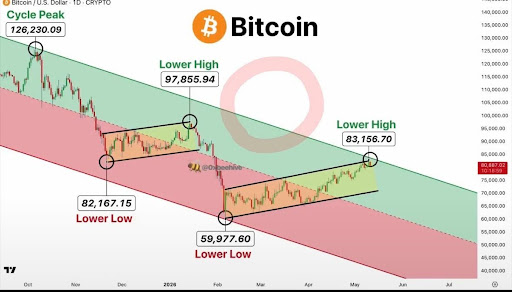
Crypto analyst Bee forecasts a major Bitcoin price bottom is imminent. Despite a recent rally above $83,000, Bee contends BTC remains in a broader bear market, viewing the gains as a temporary bounce within a long-term descending channel. The analysis shows BTC forming lower highs and lower lows since its October 2025 all-time high above $126,200. Following a recent rejection around $83,000, which is marked as another lower high, Bee predicts Bitcoin's price could decline to approximately $43,035, representing a drop of over 45%. The analyst notes that typical bear market cycles last 365 days, and with the current cycle only on day 217, more downside is expected. Only after this final bottom is formed does Bee anticipate a sustained recovery, projecting a potential rally back to $100,000 by 2027.

Crypto analyst Bee has forecasted a major price bottom for Bitcoin (BTC), the world’s largest digital currency. Despite its recent rally above $80,000, the expert still believes that BTC remains in a broader bearish market, likely viewing the latest price gains as a temporary bounce. While some analysts think that Bitcoin’s downtrend is over and others project a bottom around the $50,000 range, Bee expects BTC’s price to decline even lower before a sustained rally can begin.

Bitcoin Price Set To Bottom Around $42,000

In an X post on May 11, Bee said that Bitcoin is just one leg away from reaching its historical cycle bottom. The market expert shared a video chart analysis highlighting technical patterns and historical trends to support their bearish Bitcoin price outlook.

The analyst’s chart shows that Bitcoin has been forming multiple ascending channels within a broader descending channel since reaching a cycle peak above $126,200 in October 2025. After recording this all-time high, Btc crashed to $82,167, forming a lower low, where the first ascending channel began. Within this channel, the cryptocurrency traded sideways for months before rallying again to touch the upper boundary of the pattern at around $97,855.

After that lower high was reached, BTC began crashing again, but this time, the decline was even sharper and more severe. The cryptocurrency had fallen to $59,900 around February 2026, forming a lower low that many analysts still consider BTC’s final cycle bottom.
Source: Chart from Bee on X

Since hitting that floor, Bitcoin has been on a steady upward rally with occasional pullbacks and volatility impacting its price. The latest jump saw the cryptocurrency skyrocketing above $83,000, which Bee marks as the second-lowest high since the 2025 ATH. However, after being rejected at that level, the analyst predicts that Bitcoin’s next move could see its price crash to $43,035. Notably, a decline to this bottom would represent a more than 45% drop from Btc’s price levels above $79,000, at the time of writing.

BTC Rally To $100,000 Will Only Come After Bottom

In the same analysis, Bee explained that bear market cycles typically last 365 days. At the time of his post, he said that Bitcoin’s current bear market is on its 217th day, reinforcing his bearish outlook on its price. Because of this gap, he believes that BTC still has more room for a final flush.

Once a bottom is reached, Bee expects the market to likely reset and begin a sustained recovery back to $100,000 by 2027. However, he boldly projected that this milestone will not be achieved before a bottom is formed. This shows that the analyst still sees Bitcoin’s market structure as heavily bearish despite recent price increases and shifting sentiment.

BTC trading at $79,637 on the 1D chart | Source: BTCUSDT on Tradingview.com

Related Questions

QAccording to the article, what price level does analyst Bee predict for Bitcoin's historical cycle bottom?

AAnalyst Bee predicts that Bitcoin's price could crash to a historical cycle bottom around $42,000 to $43,035.

QWhat is the main reason given by analyst Bee for believing Bitcoin has not yet reached its market bottom?

ABee states that bear market cycles typically last 365 days, and at the time of his analysis, Bitcoin's current bear market was only on its 217th day, indicating more room for a 'final flush' downward before a true bottom.

QWhat does the analyst, Bee, identify as the two significant 'lower highs' for Bitcoin since its 2025 peak?

AThe two significant lower highs identified are the first at around $97,855 and the second at above $83,000 (following the rally in early 2026).

QWhen does analyst Bee project Bitcoin could reach $100,000, and what condition must be met first?

ABee projects that Bitcoin could reach $100,000 by 2027, but only after a market bottom is first formed.

QBased on the chart analysis described, what was the all-time high price for Bitcoin mentioned in the article, and when did it occur?

AAccording to the article, Bitcoin reached a cycle peak (all-time high) above $126,200 in October 2025.

Related Reads

a16z Crypto: A Guide to the CLARITY Act for Crypto Entrepreneurs

The CLARITY Act, a bipartisan crypto market structure bill, has advanced through the Senate Banking Committee, marking a potential historic shift in U.S. digital asset regulation. For years, a lack of clear rules has stifled innovation, pushed development overseas, and exposed consumers to risk. This bill aims to establish a comprehensive framework, providing long-needed regulatory clarity for blockchain networks and digital assets. It builds upon previous legislative efforts like FIT21 and the House version of CLARITY, which gained strong bipartisan support. CLARITY is crucial because it recognizes that blockchain networks are fundamentally different from traditional companies. Networks operate through decentralized, shared rules rather than centralized control. Applying corporate legal frameworks to networks forces them into a centralized model, concentrating power and value. In contrast, decentralized blockchain networks can function as user-owned public infrastructure, distributing value more equitably among participants. The bill seeks to enable the safe launch of networks in the U.S., clarify regulatory jurisdiction between the SEC and CFTC, oversee crypto exchanges, and enhance consumer protections. Its passage would align U.S. law with the nature of decentralized technology, allowing builders to operate transparently and fund projects domestically without structural compromises due to regulatory uncertainty. Similar to the positive impact seen after the stablecoin-focused GENIUS Act, CLARITY could unlock a new wave of innovation, helping the U.S. reclaim leadership in the crypto space while combating fraud and abuse.

链捕手9m ago

a16z Crypto: A Guide to the CLARITY Act for Crypto Entrepreneurs

链捕手9m ago

muShanghai Discusses Consumer AI: After Continuous Iteration of Large Models, Product Competition Moves Towards Scenarios and Experience

The roundtable discussion "Innovative Practices and Path Exploration of the AI Consumption Ecosystem" at muShanghai AI Week, featuring experts from model platforms, cultural apps, the open-source ecosystem, and music creation, delved into the practical paths for consumer AI products. A key consensus emerged: while AI model advancements lower prototyping barriers, the real challenge for enduring products lies beyond raw technology. True differentiation comes from deep scene understanding, data organization, user education, delivering emotional value, and building open ecosystems. The competition is shifting from "who has the stronger model" to "who best understands the specific user and scenario." Participants highlighted that application-layer barriers, such as accumulated contextual data and cultural localization (e.g., FateTell's translation of Eastern metaphysics for global users), are not easily erased by model updates. They cautioned that AI simplifies prototyping but not the core entrepreneurial hurdles: user acquisition, community building, and commercialization. The discussion emphasized that value must return to human needs—like emotional comfort (FateTell) or preserving the creative *process* in music-making, as highlighted by musician-developer Gao Jiafeng, rather than just outputting a final product. With the rise of AI Agents, user education is evolving from manual documentation reading to more guided, interactive learning within the product experience itself. Looking ahead 3-5 years, panelists foresee AI moving into the physical world via hardware and robotics, enabling more personalized services and addressing growing needs for companionship amidst technological anxiety. The future points towards "technology democratization," where AI assists diverse lifestyles, and cultural forms may be recombined, with emotional connection becoming paramount. Ultimately, as models continue to evolve, the products that endure will be those that meet genuine human needs, foster understanding, and build meaningful connections.

marsbit1h ago

muShanghai Discusses Consumer AI: After Continuous Iteration of Large Models, Product Competition Moves Towards Scenarios and Experience

marsbit1h ago

Trading

Spot
Futures

Hot Articles

What is $BITCOIN

DIGITAL GOLD ($BITCOIN): A Comprehensive Analysis Introduction to DIGITAL GOLD ($BITCOIN) DIGITAL GOLD ($BITCOIN) is a blockchain-based project operating on the Solana network, which aims to combine the characteristics of traditional precious metals with the innovation of decentralized technologies. While it shares a name with Bitcoin, often referred to as “digital gold” due to its perception as a store of value, DIGITAL GOLD is a separate token designed to create a unique ecosystem within the Web3 landscape. Its goal is to position itself as a viable alternative digital asset, although specifics regarding its applications and functionalities are still developing. What is DIGITAL GOLD ($BITCOIN)? DIGITAL GOLD ($BITCOIN) is a cryptocurrency token explicitly designed for use on the Solana blockchain. In contrast to Bitcoin, which provides a widely recognized value storage role, this token appears to focus on broader applications and characteristics. Notable aspects include: Blockchain Infrastructure: The token is built on the Solana blockchain, known for its capacity to handle high-speed and low-cost transactions. Supply Dynamics: DIGITAL GOLD has a maximum supply capped at 100 quadrillion tokens (100P $BITCOIN), although details regarding its circulating supply are currently undisclosed. Utility: While precise functionalities are not explicitly outlined, there are indications that the token could be utilized for various applications, potentially involving decentralized applications (dApps) or asset tokenization strategies. Who is the Creator of DIGITAL GOLD ($BITCOIN)? At present, the identity of the creators and development team behind DIGITAL GOLD ($BITCOIN) remains unknown. This situation is typical among many innovative projects within the blockchain space, particularly those aligning with decentralized finance and meme coin phenomena. While such anonymity may foster a community-driven culture, it intensifies concerns about governance and accountability. Who are the Investors of DIGITAL GOLD ($BITCOIN)? The available information indicates that DIGITAL GOLD ($BITCOIN) does not have any known institutional backers or prominent venture capital investments. The project seems to operate on a peer-to-peer model focused on community support and adoption rather than traditional funding routes. Its activity and liquidity are primarily situated on decentralized exchanges (DEXs), such as PumpSwap, rather than established centralized trading platforms, further highlighting its grassroots approach. How DIGITAL GOLD ($BITCOIN) Works The operational mechanics of DIGITAL GOLD ($BITCOIN) can be elaborated on based on its blockchain design and network attributes: Consensus Mechanism: By leveraging Solana’s unique proof-of-history (PoH) combined with a proof-of-stake (PoS) model, the project ensures efficient transaction validation contributing to the network's high performance. Tokenomics: While specific deflationary mechanisms have not been extensively detailed, the vast maximum token supply implies that it may cater to microtransactions or niche use cases that are still to be defined. Interoperability: There exists the potential for integration with Solana’s broader ecosystem, including various decentralized finance (DeFi) platforms. However, the details regarding specific integrations remain unspecified. Timeline of Key Events Here is a timeline that highlights significant milestones concerning DIGITAL GOLD ($BITCOIN): 2023: The initial deployment of the token occurs on the Solana blockchain, marked by its contract address. 2024: DIGITAL GOLD gains visibility as it becomes available for trading on decentralized exchanges like PumpSwap, allowing users to trade it against SOL. 2025: The project witnesses sporadic trading activity and potential interest in community-led engagements, although no noteworthy partnerships or technical advancements have been documented as of yet. Critical Analysis Strengths Scalability: The underlying Solana infrastructure supports high transaction volumes, which could enhance the utility of $BITCOIN in various transaction scenarios. Accessibility: The potential low trading price per token could attract retail investors, facilitating wider participation due to fractional ownership opportunities. Risks Lack of Transparency: The absence of publicly known backers, developers, or an audit process may yield skepticism regarding the project's sustainability and trustworthiness. Market Volatility: The trading activity is heavily reliant on speculative behavior, which can result in significant price volatility and uncertainty for investors. Conclusion DIGITAL GOLD ($BITCOIN) emerges as an intriguing yet ambiguous project within the rapidly evolving Solana ecosystem. While it attempts to leverage the “digital gold” narrative, its departure from Bitcoin's established role as a store of value underscores the need for a clearer differentiation of its intended utility and governance structure. Future acceptance and adoption will likely depend on addressing the current opacity and defining its operational and economic strategies more explicitly. Note: This report encompasses synthesised information available as of October 2023, and developments may have transpired beyond the research period.

363 Total ViewsPublished 2025.05.13Updated 2025.05.13

What is $BITCOIN

Discussions

Welcome to the HTX Community. Here, you can stay informed about the latest platform developments and gain access to professional market insights. Users' opinions on the price of BTC (BTC) are presented below.

活动图片