Selling 32 BTC to Pay Dividends: Strategy Breaks the 'Never Sell' Vow

marsbitPublié le 2026-06-02Dernière mise à jour le 2026-06-02

Résumé

On June 1st, Strategy (formerly MicroStrategy) disclosed in an SEC filing that it sold 32 BTC between May 26-31 for approximately $2.5 million at an average price of $77,135. The proceeds were explicitly used to pay dividends on its preferred stock series. While negligible compared to its 843,706 BTC holdings and recent $2 billion monthly purchases, this move broke its long-standing "never sell" policy, signaling a shift in capital management. This sale is linked to Strategy's substantial dividend obligations from preferred stock issued since early 2025, which have consumed a significant portion of its dedicated $2.25 billion cash reserve. During a recent earnings call, the CEO mentioned "disciplined sale of bitcoin" as a potential tool, foreshadowing this event. Analysts note the financial impact is minimal, but the symbolic precedent is significant, indicating future sales are possible if cash reserves dwindle. The disclosure coincided with Bitcoin's price falling below $72,000 amid broader market weakness, including record monthly outflows from spot Bitcoin ETFs in May. Strategy is not alone; Q1 2026 saw other corporate Bitcoin holders like MARA, Riot Platforms, and Nakamoto Holdings collectively selling tens of thousands of BTC for debt repayment, liquidity, or strategic shifts, reversing the previous "buy and hold" corporate treasury trend.

Original author: ChandlerZ, Foresight News

On June 1, Strategy filed an 8-K form with the SEC, disclosing the sale of 32 bitcoins between May 26 and 31 at an average price of $77,135, totaling approximately $2.5 million. After the sale, the company still holds 843,706 BTC, with a total cost of $63.87 billion and an average cost basis of $75,699.

The 32 BTC represents 0.004% of its total holdings, and the $2.5 million is equivalent to Strategy's average daily purchase volume over the past 12 months. From a financial perspective, this transaction is almost meaningless. However, what it broke is far more significant than the amount realized. Since its first bitcoin purchase in August 2020, Strategy has only sold once before: in December 2022, it sold 704 BTC for $11.8 million at an average price of $16,776 for the purpose of tax-loss harvesting, repurchasing 810 BTC at a lower price two days later. That sale was essentially a tax operation, not a genuine reduction in holdings.

But this time is different. The $2.5 million is explicitly marked for paying preferred stock dividends, and Strategy does not intend to buy them back.

The Dividend Bills Are Coming Due

Strategy began issuing preferred stock intensively from early 2025: STRK with an 8% annual coupon, STRF at 10%, STRD at 10%, and STRC at 11.5%. With these four series stacked together, the company has cumulatively paid over $693 million in dividends so far.

The logic behind these preferred shares is that investors give money to Strategy, Strategy uses it to buy Bitcoin, and then pays fixed-rate dividends from its cash reserves and operating income. If Bitcoin rises, the mNAV premium expands, and Strategy can continue to issue new shares to raise funds and keep the cycle going. If Bitcoin falls or moves sideways, the dividend obligations do not disappear, but the financing window narrows.
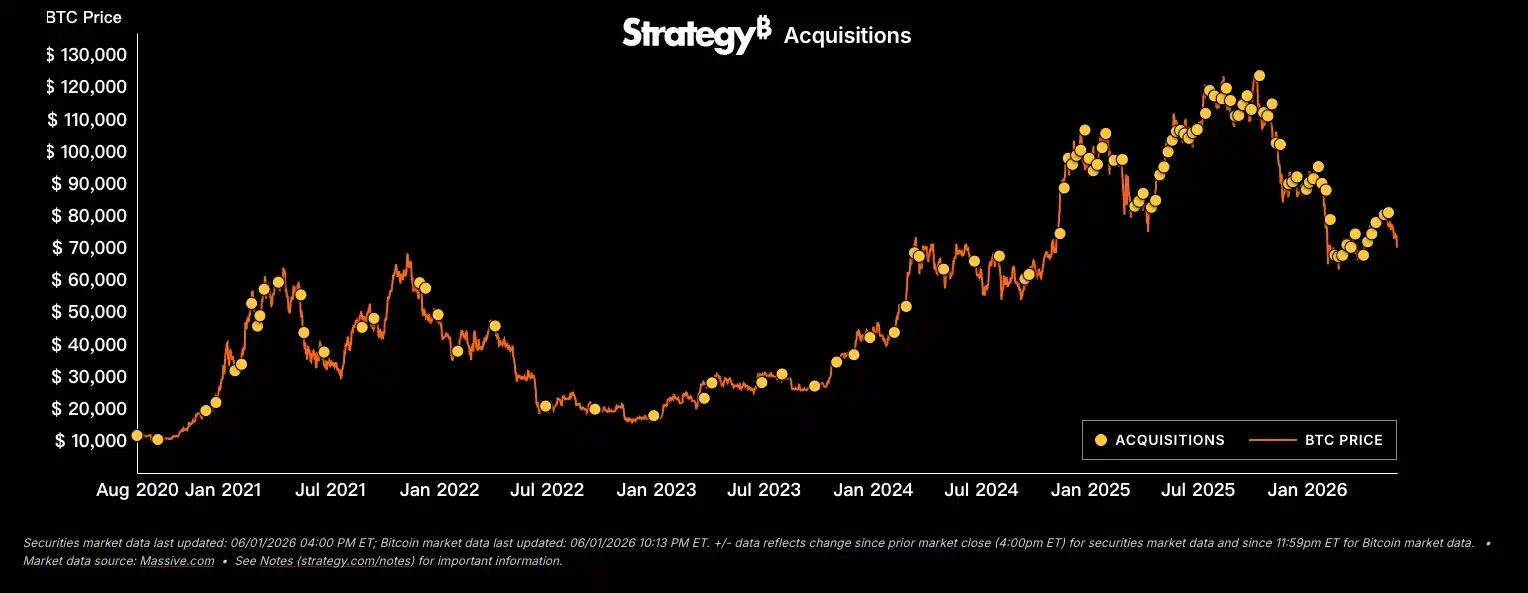
MicroStrategy's Bitcoin Accumulation Pace

In December 2025, Strategy established a $2.25 billion cash reserve specifically to cover dividends and debt payments, which at the time could last about 30 months. But by May 31, 2026, this reserve had fallen to $900 million, a $1.35 billion drawdown in six months.

During the Q1 earnings call, Strategy CEO Phong Le, for the first time in a public setting, listed a 'disciplined sale of bitcoin' as one of the capital management tools. Not many people noticed that statement at the time; in retrospect, it was a preview of this 32 BTC sale.

Saylor posted a tweet on February 2, 2025, saying 'Never sell your bitcoin.' This tweet was widely shared after the 8-K disclosure. He himself only discussed STRC's product positioning in a post afterward, stating Strategy's goal is to make STRC the world's best credit instrument, completely sidestepping the topic of selling Bitcoin.

MSTR's stock price fell about 6% that day. Mizuho maintained its Buy rating but lowered its price target from $320 to $265. Most analysts believe the $2.5 million sale is not materially impactful financially, but the core significance of this event lies in the signal it sends: a crack has been opened. If cash reserves continue to deplete while dividend obligations remain unchanged, the scale of future sales might not stop at 32 bitcoins.

A $110 Million Word Game on Polymarket

Strategy's selling timing also ignited a prediction market on Polymarket.

The market's question was: Will Strategy sell Bitcoin before May 31? The cumulative trading volume currently exceeds $111 million. The 8-K filing shows the transactions occurred between May 26 and 31, with the filing itself timestamped 'May 31, 2026, 4:00 PM ET'. However, the 8-K was only submitted to the SEC on June 1, and the public learned about it after the deadline had passed.
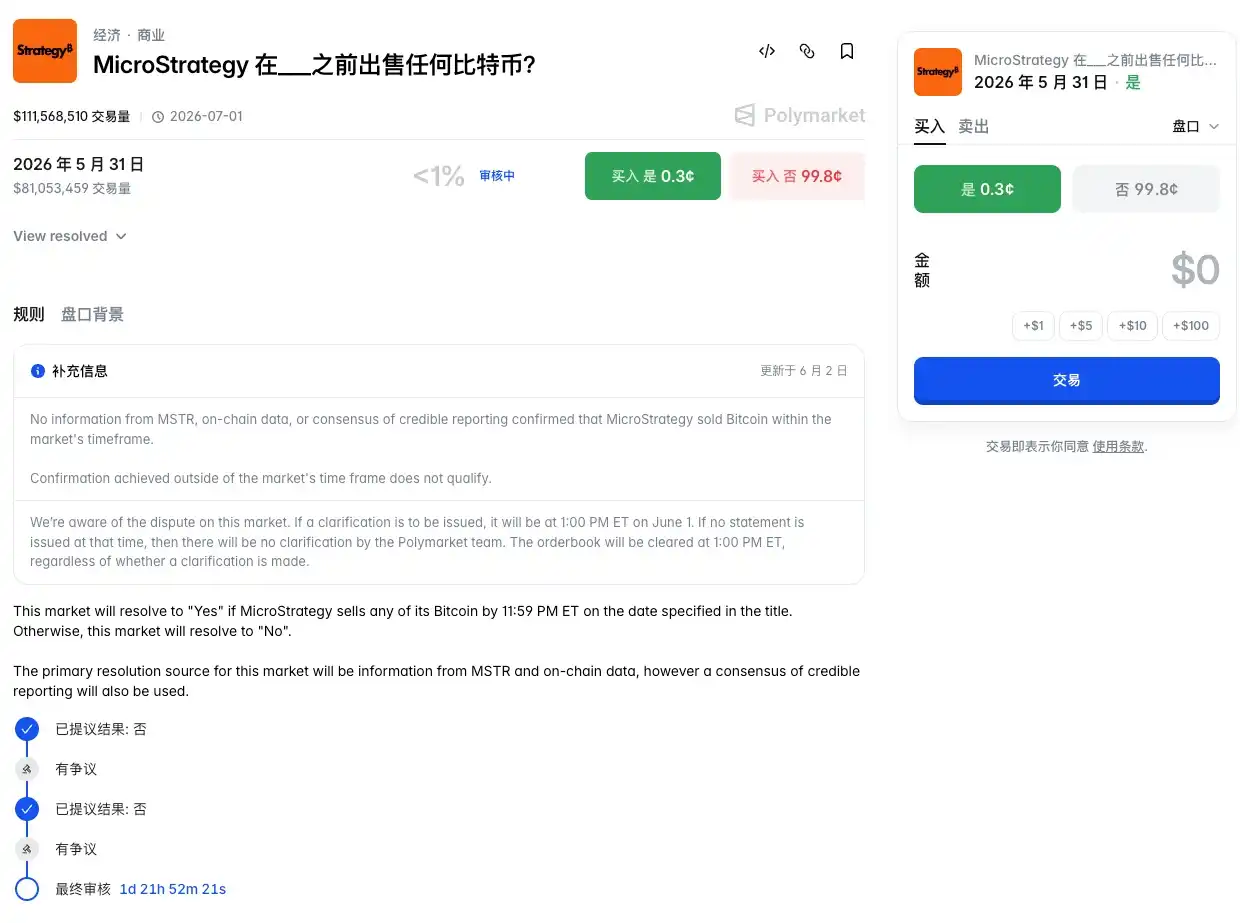
Those who bought 'Yes' argued that the transaction happened before the deadline, as the 8-K clearly states May 31. Those who bought 'No' argued that there was no public information before the deadline proving the sale occurred, so according to the rules, it should be judged as 'No'. After two 'No' proposals were challenged, the dispute escalated to UMA's token-voting arbitration.

Polymarket subsequently added a note to the page, stating that 'consensus from MSTR, on-chain data, or reliable reporting did not confirm that Strategy sold bitcoin within the market's defined time frame. Confirmations obtained outside the market-defined time frame do not satisfy the requirement.'

Behind this controversy lies a deeper issue with Polymarket's arbitration mechanism. A May investigation by *The Wall Street Journal* found that in most of Polymarket's disputed markets, over half of UMA voting power is concentrated in the top 10 largest wallets, approximately 60% of active voters can be linked to Polymarket accounts, and roughly one in five disputes involves voters simultaneously holding positions in the contracts being adjudicated. So far in 2026, Polymarket has generated over 1,150 disputed markets, exceeding the total for all of 2025.

It's Not Just Strategy Selling; Bitcoin Drops Below $72K

Strategy's 8-K disclosure overlapped with an already weak market environment. Bitcoin fell below $72,000 on June 1, hitting its lowest level since April 13. CoinShares data shows digital asset investment products saw net outflows of $1.67 billion last week, the second-largest weekly outflow in 2026. For the entire month of May, Bitcoin spot ETFs saw net outflows of $2.3 billion, the largest monthly net outflow this year. Total digital asset assets under management have dropped to approximately $141 billion, a low since the beginning of the year.

Strategy sold 32 bitcoins, but it is not the first Bitcoin treasury company to make a move. Q1 data shows selling has become a collective behavior. MARA Holdings sold 15,133 BTC between March 4 and 25, raising about $1.1 billion, mostly used to repurchase convertible bonds maturing in 2030 and 2031. Riot Platforms sold 3,778 BTC during the same period, raising $289.5 million, reducing its holdings from 19,223 BTC to 15,680 BTC, a 18% shrinkage. David Bailey's Nakamoto Holdings sold 284 BTC in March, about 5% of its holdings. Empery Digital sold 370 BTC in April to repay loans. Genius Group liquidated its final 84 BTC to repay $8.5 million in debt.

Just MARA, Riot, and Nakamoto collectively offloaded over 19,000 BTC in Q1. On-chain data from CryptoQuant shows that Bitcoin's apparent demand fell to negative 63,000 BTC by late March. This apparent demand (a measure of total demand relative to changes in new supply) turning negative indicates a deep market contraction, with overall selling pressure significantly outweighing buying pressure.

Some companies aren't just selling but are directly abandoning the treasury model. Forum Markets (formerly ETHZilla) liquidated approximately $114 million worth of ETH at the beginning of the year, pivoting to tokenization business. VivoPower, which originally planned to build an XRP treasury, directly pivoted to data centers and AI infrastructure in February, disposing of its entire XRP holdings along the way.

On May 28, French semiconductor company Sequans Communications confirmed it had fully repaid its convertible bonds by selling its Bitcoin holdings, and also planned to gradually liquidate its remaining 658 bitcoins. The company's Bitcoin holdings once peaked at 3,234 BTC.

Sequans had previously publicly stated its intention to accumulate over 3,000 bitcoins as long-term reserve assets. But this so-called 'long-term' ultimately lasted less than a year. The company's stock (ticker SQNS) has fallen 77% year-to-date, with a cumulative decline of 97% over the past five years.

The business model of Bitcoin treasury companies was validated during the upward cycle in the second half of 2025. Rising Bitcoin prices pushed up the mNAV premium, allowing companies to issue new shares or convertible bonds at a premium to raise funds to buy more Bitcoin, further pushing up the price and premium, creating a positive feedback loop. After the market peaked last October, this flywheel reversed. Falling Bitcoin prices compress the premium, narrowing the financing window, while dividend and debt payment obligations do not decrease with the price drop. Selling Bitcoin became the most direct source of liquidity. According to Bitwise statistics, as of the end of Q1, publicly traded companies collectively held about 1.15 million BTC, representing 5.47% of the total supply. This scale itself constitutes a risk. If multiple treasury companies are forced to reduce holdings within the same time window, they, being the largest buyers of Bitcoin, could also become the most concentrated source of selling pressure.

Currently, there are very few companies still buying. Strive accumulated purchases of approximately 1,944 BTC in May, spending about $150 million. Metaplanet bought 5,075 BTC in early April. Strategy itself was also buying in May, accumulating purchases of over 25,000 BTC for the month, worth over $2 billion.

Spending $2 billion to buy while taking out $2.5 million to pay dividends illustrates that Strategy is far from a liquidity crisis at this point. But the signaling significance of the 32 BTC is that even the largest HODLer has begun to acknowledge that selling is an option in the toolbox.


Questions liées

QWhat was the primary reason for Strategy's sale of 32 BTC in late May, and why is it significant?

AStrategy sold 32 BTC to generate approximately $2.5 million in cash specifically for paying preferred stock dividends. This is significant because it breaks the company's long-standing 'never sell' principle regarding its Bitcoin holdings. Unlike its previous sale in 2022 for tax-loss harvesting, this sale represents a real, non-strategic reduction of its Bitcoin treasury to meet a recurring financial obligation.

QAccording to the article, what broader trend is observed among Bitcoin treasury companies in Q1 2026?

AIn Q1 2026, a broader trend of Bitcoin selling was observed among several major treasury companies. Notably, MARA Holdings sold 15,133 BTC, Riot Platforms sold 3,778 BTC, and Nakamoto Holdings sold 284 BTC. Other companies like Empery Digital and Genius Group also sold significant portions or all of their holdings to repay debt or restructure. This collective action indicates a shift from accumulation to distribution due to market pressures.

QWhat controversy erupted on Polymarket related to Strategy's BTC sale, and what core issue does it highlight about the platform?

AA controversy erupted on a Polymarket prediction market asking if Strategy would sell Bitcoin by May 31st, with over $111 million in volume. The dispute centered on whether sales occurring on May 31st but reported on June 1st should count as a 'Yes.' This highlights deeper issues with Polymarket's arbitration mechanism, including centralization of UMA token voting power among a few wallets and potential conflicts of interest where voters also hold positions in the contracts they are arbitrating.

QHow did Strategy's sale and the broader market context impact the Bitcoin price in early June?

AThe disclosure of Strategy's sale, combined with an already weak market environment, contributed to Bitcoin's price dropping below $72,000 on June 1st, reaching its lowest level since April 13th. This was part of a larger trend of outflows, with digital asset investment products seeing a net outflow of $1.67 billion the prior week and Bitcoin spot ETFs experiencing a record monthly net outflow of $2.3 billion in May.

QWhat is the fundamental risk posed by the large Bitcoin holdings of public companies, as described in the article?

AThe fundamental risk is that public companies collectively hold about 1.15 million BTC, or 5.47% of the total supply. If multiple treasury companies are forced to sell in the same time window due to liquidity needs (e.g., to cover dividends or debt), they could transform from being the largest buyers into a concentrated source of significant selling pressure, potentially exacerbating market downturns.

Lectures associées

Trading

Spot
Futures

Articles tendance

Qu'est ce que BITCOIN

Comprendre HarryPotterObamaSonic10Inu (ERC-20) et sa position dans l'espace crypto Ces dernières années, le marché des cryptomonnaies a connu une augmentation de la popularité des monnaies mèmes, suscitant l'intérêt non seulement des traders, mais aussi de ceux qui recherchent un engagement communautaire et une valeur divertissante. Parmi ces jetons uniques, HarryPotterObamaSonic10Inu (ERC-20) est un projet intrigant qui mêle des références culturelles à l'univers des cryptomonnaies. Cet article explore les aspects clés de HarryPotterObamaSonic10Inu, en examinant ses mécanismes, son ethos axé sur la communauté, et son engagement avec le paysage crypto plus large. Qu'est-ce que HarryPotterObamaSonic10Inu (ERC-20) ? Comme son nom l'indique, HarryPotterObamaSonic10Inu est une monnaie mème construite sur la blockchain Ethereum, classée selon la norme ERC-20. Contrairement aux cryptomonnaies traditionnelles qui peuvent mettre l'accent sur l'utilité pratique ou le potentiel d'investissement, ce jeton prospère grâce à sa valeur divertissante et à la force de sa communauté. Le projet vise à favoriser un environnement où des utilisateurs engagés peuvent se rassembler, partager des idées et participer à des activités inspirées par divers phénomènes culturels. Une caractéristique notable de HarryPotterObamaSonic10Inu est son absence de taxe sur les transactions. Cet élément attrayant vise à encourager le trading et l'implication de la communauté, sans frais supplémentaires pouvant décourager les petits traders. L'offre totale de la monnaie est fixée à un milliard de jetons, un chiffre qui marque son intention de maintenir une circulation substantielle au sein de la communauté. Créateur de HarryPotterObamaSonic10Inu (ERC-20) Les origines de HarryPotterObamaSonic10Inu sont quelque peu obscures ; les détails concernant le créateur restent inconnus. Le développement de ce jeton ne comporte pas d'équipe identifiable ou de plan explicite, ce qui n'est pas rare dans le secteur des monnaies mèmes. Au lieu de cela, le projet a émergé de manière organique, son progrès s'appuyant fortement sur l'enthousiasme et la participation de sa communauté. Investisseurs de HarryPotterObamaSonic10Inu (ERC-20) En ce qui concerne les investissements externes et le soutien, HarryPotterObamaSonic10Inu reste également ambigu. Le jeton ne mentionne aucune fondation d'investissement connue ou un soutien organisationnel significatif. Au lieu de cela, le cœur battant du projet est sa communauté de base, qui informe sa croissance et sa durabilité par des actions collectives et un engagement dans l'espace crypto. Comment fonctionne HarryPotterObamaSonic10Inu (ERC-20) ? En tant que monnaie mème, HarryPotterObamaSonic10Inu opère principalement en dehors des cadres traditionnels qui régissent souvent la valeur des actifs. Plusieurs aspects distinctifs définissent comment le projet fonctionne : Transactions sans taxe : Sans frais de taxe sur les transactions, les utilisateurs peuvent acheter et vendre librement le jeton sans se préoccuper de frais cachés. Engagement communautaire : Le projet prospère grâce à l'interaction communautaire, exploitant les plateformes de médias sociaux pour créer du bruit et faciliter l'implication. Les discussions, le partage de contenu et l'engagement sont des éléments cruciaux qui aident à étendre sa portée et à favoriser la loyauté parmi les supporters. Pas d'utilité pratique : Il est important de noter que HarryPotterObamaSonic10Inu n'offre pas d'utilité concrète au sein de l'écosystème financier. Au contraire, il est classé comme un jeton principalement pour des activités de divertissement et communautaires. Référence culturelle : Le jeton intègre habilement des éléments de la culture populaire pour susciter l'intérêt, s'adressant à la fois aux amateurs de mèmes et aux suiveurs de crypto. HarryPotterObamaSonic10Inu illustre comment les monnaies mèmes fonctionnent différemment des projets de cryptomonnaies plus traditionnels, entrant sur le marché en tant que constructions sociales innovantes plutôt qu'actifs utilitaires. Chronologie de HarryPotterObamaSonic10Inu (ERC-20) L'histoire de HarryPotterObamaSonic10Inu est jalonnée de plusieurs étapes notables : Création : Le jeton est né d'un mème viral, captivant l'imagination de nombreux passionnés de crypto. Les dates de création spécifiques ne sont pas disponibles, soulignant son ascension organique. Listing sur les échanges : HarryPotterObamaSonic10Inu a fait son apparition sur divers échanges, permettant un accès et un trading plus faciles par la communauté. Initiatives d'engagement communautaire : Activités en cours visant à améliorer l'interaction communautaire, y compris des concours, des campagnes sur les réseaux sociaux, et la génération de contenu par des fans et des défenseurs. Plans d'expansion futurs : La feuille de route du projet comprend le lancement d'une collection NFT, de marchandises, et d'un site eCommerce lié à ses thèmes culturels, engageant davantage la communauté et tentant d'ajouter plus de dimensions à son écosystème. Points clés concernant HarryPotterObamaSonic10Inu (ERC-20) Nature axée sur la communauté : Le projet privilégie l'apport collectif et la créativité, garantissant que l'implication des utilisateurs est au cœur de son développement. Classification de monnaie mème : Il représente l'apogée de la cryptomonnaie basée sur le divertissement, se distinguant des véhicules d'investissement traditionnels. Pas d'affiliation directe avec Bitcoin : Malgré la similitude dans le nom du ticker, HarryPotterObamaSonic10Inu est distinct et n'a aucun lien avec Bitcoin ou d'autres cryptomonnaies établies. Focus sur la collaboration : HarryPotterObamaSonic10Inu est conçu pour créer un espace de collaboration et de partage d'histoires parmi ses détenteurs, offrant une voie pour la créativité et le lien communautaire. Perspectives d'avenir : L'ambition de s'étendre au-delà de son concept initial vers des NFT et des marchandises dessine un chemin pour le projet afin de potentiellement entrer dans des avenues plus grand public au sein de la culture numérique. Alors que les monnaies mèmes continuent de captiver l'imagination de la communauté des cryptomonnaies, HarryPotterObamaSonic10Inu (ERC-20) se distingue par ses liens culturels et son approche centrée sur la communauté. Bien qu'il ne corresponde pas au modèle typique d'un jeton axé sur l'utilité, son essence réside dans la joie et la camaraderie cultivées parmi ses supporters, soulignant la nature en évolution des cryptomonnaies dans un âge de plus en plus numérique. À mesure que le projet continue de se développer, il sera important de surveiller comment les dynamiques communautaires influencent sa trajectoire dans le paysage toujours changeant de la technologie blockchain.

1.5k vues totalesPublié le 2024.04.01Mis à jour le 2024.12.03

Qu'est ce que BITCOIN

Comment acheter BTC

Bienvenue sur HTX.com ! Nous vous permettons d'acheter Bitcoin (BTC) de manière simple et pratique. Suivez notre guide étape par étape pour commencer votre parcours crypto.Étape 1 : Création de votre compte HTXUtilisez votre adresse e-mail ou votre numéro de téléphone pour ouvrir un compte sur HTX gratuitement. L'inscription se fait en toute simplicité et débloque toutes les fonctionnalités.Créer mon compteÉtape 2 : Choix du mode de paiement (rubrique Acheter des cryptosCarte de crédit/débit : utilisez votre carte Visa ou Mastercard pour acheter instantanément Bitcoin (BTC).Solde :utilisez les fonds du solde de votre compte HTX pour trader en toute simplicité.Prestataire tiers :pour accroître la commodité d'utilisation, nous avons ajouté des modes de paiement populaires tels que Google Pay et Apple Pay.P2P :tradez directement avec d'autres utilisateurs sur HTX.OTC (de gré à gré) : nous offrons des services personnalisés et des taux de change compétitifs aux traders.Étape 3 : stockage de vos Bitcoin (BTC)Après avoir acheté vos Bitcoin (BTC), stockez-les sur votre compte HTX. Vous pouvez également les envoyer ailleurs via un transfert sur la blockchain ou les utiliser pour trader d'autres cryptos.Étape 4 : tradez des Bitcoin (BTC)Tradez facilement Bitcoin (BTC) sur le marché Spot de HTX. Il vous suffit d'accéder à votre compte, de sélectionner la paire de trading, d'exécuter vos trades et de les suivre en temps réel. Nous offrons une expérience conviviale aux débutants comme aux traders chevronnés.

5.2k vues totalesPublié le 2024.12.12Mis à jour le 2026.06.02

Comment acheter BTC

Qu'est ce que $BITCOIN

OR DÉMATÉRIEL ($BITCOIN) : Une Analyse Complète Introduction à OR DÉMATÉRIEL ($BITCOIN) OR DÉMATÉRIEL ($BITCOIN) est un projet basé sur la blockchain opérant sur le réseau Solana, qui vise à combiner les caractéristiques des métaux précieux traditionnels avec l'innovation des technologies décentralisées. Bien qu'il partage un nom avec Bitcoin, souvent appelé “or numérique” en raison de sa perception en tant que réserve de valeur, OR DÉMATÉRIEL est un jeton distinct conçu pour créer un écosystème unique au sein du paysage Web3. Son objectif est de se positionner comme un actif numérique alternatif viable, bien que les spécificités concernant ses applications et fonctionnalités soient encore en développement. Qu'est-ce qu'OR DÉMATÉRIEL ($BITCOIN) ? OR DÉMATÉRIEL ($BITCOIN) est un jeton de cryptomonnaie explicitement conçu pour une utilisation sur la blockchain Solana. Contrairement à Bitcoin, qui joue un rôle de stockage de valeur largement reconnu, ce jeton semble se concentrer sur des applications et caractéristiques plus larges. Les aspects notables incluent : Infrastructure Blockchain : Le jeton est construit sur la blockchain Solana, connue pour sa capacité à gérer des transactions rapides et peu coûteuses. Dynamique de l'Offre : OR DÉMATÉRIEL a une offre maximale plafonnée à 100 quadrillions de jetons (100P $BITCOIN), bien que les détails concernant son offre en circulation soient actuellement non divulgués. Utilité : Bien que les fonctionnalités précises ne soient pas explicitement décrites, il y a des indications que le jeton pourrait être utilisé pour diverses applications, impliquant potentiellement des applications décentralisées (dApps) ou des stratégies de tokenisation d'actifs. Qui est le Créateur d'OR DÉMATÉRIEL ($BITCOIN) ? À l'heure actuelle, l'identité des créateurs et de l'équipe de développement derrière OR DÉMATÉRIEL ($BITCOIN) reste inconnue. Cette situation est typique parmi de nombreux projets innovants dans l'espace blockchain, en particulier ceux alignés avec la finance décentralisée et les phénomènes de meme coin. Bien qu'une telle anonymité puisse favoriser une culture axée sur la communauté, elle intensifie les préoccupations concernant la gouvernance et la responsabilité. Qui sont les Investisseurs d'OR DÉMATÉRIEL ($BITCOIN) ? Les informations disponibles indiquent qu'OR DÉMATÉRIEL ($BITCOIN) n'a pas de bailleurs de fonds institutionnels connus ou d'investissements en capital-risque notables. Le projet semble fonctionner sur un modèle peer-to-peer axé sur le soutien et l'adoption de la communauté plutôt que sur des voies de financement traditionnelles. Son activité et sa liquidité se situent principalement sur des échanges décentralisés (DEX), tels que PumpSwap, plutôt que sur des plateformes de trading centralisées établies, soulignant davantage son approche de base. Comment fonctionne OR DÉMATÉRIEL ($BITCOIN) Les mécanismes opérationnels d'OR DÉMATÉRIEL ($BITCOIN) peuvent être élaborés en fonction de sa conception blockchain et des attributs du réseau : Mécanisme de Consensus : En s'appuyant sur le mécanisme de preuve d'historique (PoH) unique de Solana combiné à un modèle de preuve d'enjeu (PoS), le projet assure une validation efficace des transactions contribuant à la haute performance du réseau. Tokenomics : Bien que des mécanismes déflationnistes spécifiques n'aient pas été largement détaillés, l'immense offre maximale de jetons implique qu'elle pourrait répondre à des microtransactions ou à des cas d'utilisation de niche qui restent à définir. Interopérabilité : Il existe un potentiel d'intégration avec l'écosystème plus large de Solana, y compris diverses plateformes de finance décentralisée (DeFi). Cependant, les détails concernant des intégrations spécifiques restent non spécifiés. Chronologie des Événements Clés Voici une chronologie qui met en évidence des jalons significatifs concernant OR DÉMATÉRIEL ($BITCOIN) : 2023 : Le déploiement initial du jeton a lieu sur la blockchain Solana, marqué par son adresse de contrat. 2024 : OR DÉMATÉRIEL gagne en visibilité en devenant disponible à la négociation sur des échanges décentralisés comme PumpSwap, permettant aux utilisateurs de l'échanger contre SOL. 2025 : Le projet connaît une activité de trading sporadique et un intérêt potentiel pour des engagements dirigés par la communauté, bien qu'aucun partenariat notable ou avancée technique n'ait été documenté jusqu'à présent. Analyse Critique Forces Scalabilité : L'infrastructure sous-jacente de Solana prend en charge des volumes de transactions élevés, ce qui pourrait améliorer l'utilité de $BITCOIN dans divers scénarios de transaction. Accessibilité : Le potentiel faible prix de négociation par jeton pourrait attirer les investisseurs de détail, facilitant une participation plus large grâce aux opportunités de propriété fractionnée. Risques Manque de Transparence : L'absence de bailleurs de fonds, de développeurs ou de processus d'audit connus publiquement peut susciter du scepticisme quant à la durabilité et à la fiabilité du projet. Volatilité du Marché : L'activité de trading dépend fortement du comportement spéculatif, ce qui peut entraîner une volatilité des prix significative et une incertitude pour les investisseurs. Conclusion OR DÉMATÉRIEL ($BITCOIN) émerge comme un projet intrigant mais ambigu au sein de l'écosystème Solana en rapide évolution. Bien qu'il tente de tirer parti du récit de “l'or numérique”, son éloignement du rôle établi de Bitcoin en tant que réserve de valeur souligne la nécessité d'une différenciation plus claire de son utilité prévue et de sa structure de gouvernance. L'acceptation et l'adoption futures dépendront probablement de la résolution de l'opacité actuelle et de la définition plus explicite de ses stratégies opérationnelles et économiques. Remarque : Ce rapport englobe des informations synthétisées disponibles jusqu'en octobre 2023, et des développements peuvent avoir eu lieu au-delà de la période de recherche.

83 vues totalesPublié le 2025.05.13Mis à jour le 2025.05.13

Qu'est ce que $BITCOIN

Discussions

Bienvenue dans la Communauté HTX. Ici, vous pouvez vous tenir informé(e) des derniers développements de la plateforme et accéder à des analyses de marché professionnelles. Les opinions des utilisateurs sur le prix de BTC (BTC) sont présentées ci-dessous.

活动图片