Bitcoin peeled off exchanges this year in ‘positive long-term sign’

cointelegraphPubblicato 2025-12-09Pubblicato ultima volta 2025-12-09

Introduzione

According to Santiment, over 403,000 Bitcoin (BTC) have been moved off exchanges since December 2024, representing a 2% decrease in exchange-held BTC compared to the previous year. This trend is viewed as a positive long-term indicator, as reduced exchange supply historically lowers the risk of major sell-offs and supports price stability. Analysts suggest these outflows are partly due to users moving coins into cold storage for long-term holding. Additionally, institutional accumulation via ETFs is absorbing significant supply—ETFs and public companies now hold more Bitcoin than all exchanges combined. This shift reflects growing institutional ownership, reduced liquid supply, and a strengthening market structure less dependent on trading platforms.

There are at least 400,000 fewer Bitcoin on exchanges compared to the same time last year, in a positive sign for the market, according to the market intelligence platform Santiment.

Over 403,000 Bitcoin (BTC) have moved off exchanges since Dec. 7, 2024, representing roughly 2% of the total supply, Santiment said in an X post on Monday, citing data from its sanbase dashboard.

Users often move their Bitcoin away from exchanges into cold storage wallets, which, in theory, makes it harder to sell and could signal long-term plans to hold.

“In general, this is a positive long-term sign. The less coins exist on exchanges, the less likely we’ve historically seen a major sell-off that causes downside pressure for an asset’s price.”

“As Bitcoin's market value hovers around $90K, crypto’s top market cap continues to see its supply moving away from exchanges,” Santiment added.
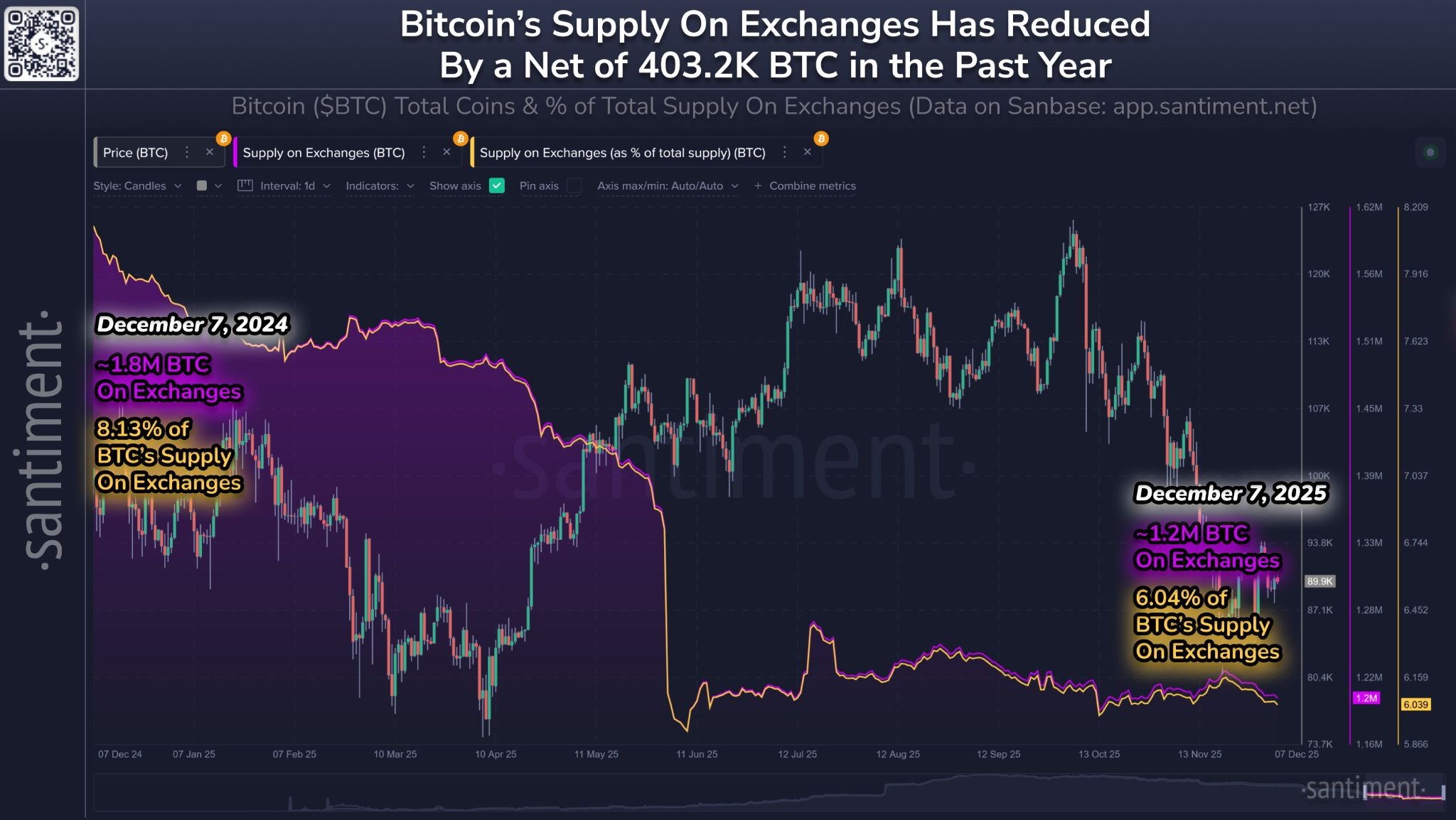
A year ago, there were around 1.8 million Bitcoin on exchanges. Source: Santiment

Bitcoin is also shifting into ETFs

While much of the Bitcoin on exchanges is likely headed back to hodler wallets, Giannis Andreou, the founder and CEO of crypto miner Bitmern Mining, said that exchange-traded funds (ETF) could also be absorbing these coins.

Citing data from BitcoinTresuries.Net, Andreou said ETFs and public companies now hold more Bitcoin than all exchanges combined, after years of outflows and ETFs quietly accumulating in the background.

Related: Strategy’s Bitcoin treasury swells past 660,000 BTC after fresh $962M buy

“Institutional ownership has quietly crossed into a new phase: less liquid supply, more long-term holders, stronger price reflexivity, a market driven by regulated vehicles, not trading platforms,” Andreou said.

“This shift is bigger than people think. Bitcoin isn’t moving to exchanges anymore. It’s moving off them straight into institutions that don’t sell easily. The supply squeeze is building in real time.”

ETFs and private companies hold more Bitcoin than exchanges

Crypto data analytics platform CoinGlass shows the same trend, with Bitcoin held on exchanges sitting at around 2.11 million as of Nov. 22, when Bitcoin was suffering through a correction and trading hands for around $84,600.
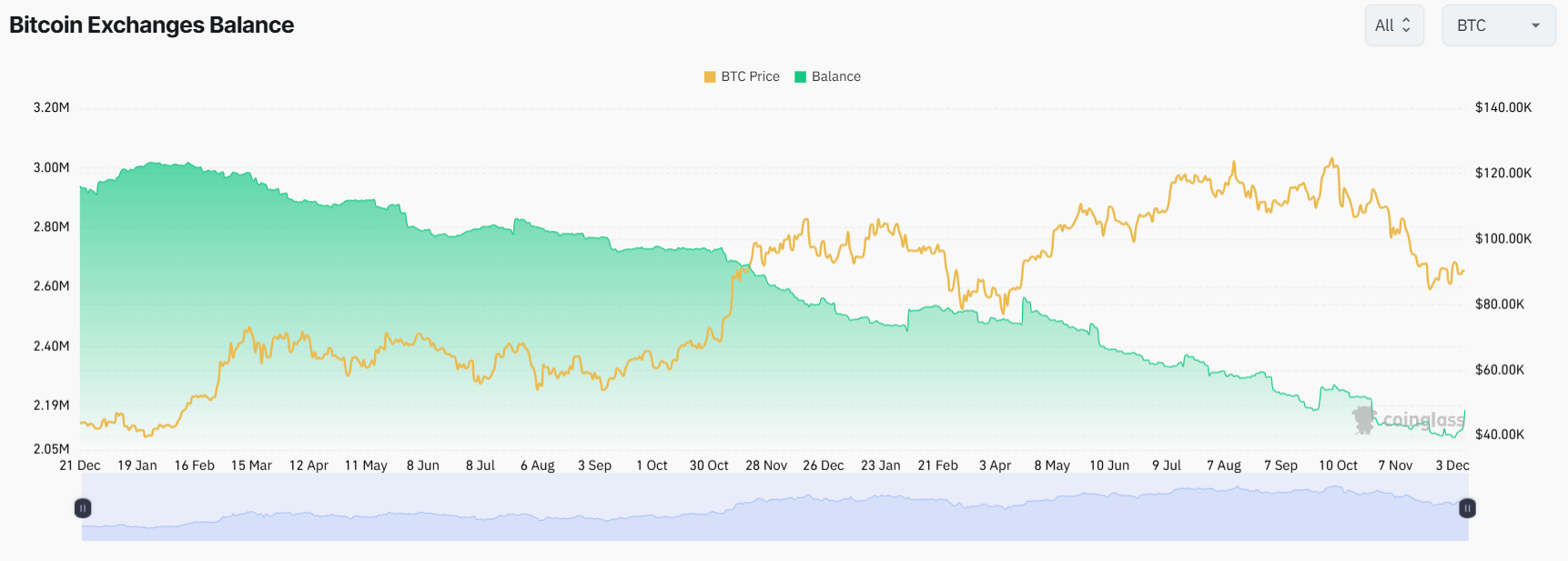
Bitcoin held on exchanges has been steadily falling over the last year. Source: CoinGlass

BitBo lists ETFs as holding over 1.5 million Bitcoin and public companies with over one million, representing nearly 11% of the total supply combined.

Magazine: Koreans ‘pump’ alts after Upbit hack, China BTC mining surge: Asia Express

Letture associate

Ethereum Network Fees Drop 62%: Is ETH Price at Risk?

Ethereum network fees have dropped 62% over the past 30 days, raising questions about potential risks to ETH’s price. Despite this decline, the network shows resilience through strong layer-2 growth and maintained price support levels. Key data from Nansen indicates a significant cooling in Ethereum base-layer activity, with fees falling more sharply than on competing chains like Solana. However, layer-2 solutions such as Base and Polygon have seen substantial transaction volume growth—108% and 81%, respectively—suggesting that Ethereum’s expanding ecosystem remains dynamic. Ethereum’s recent upgrade, Fusaka, may have contributed to lower fees by improving rollup efficiency. Meanwhile, ETH’s price rose over 11% amid softer U.S. employment data, though it remains 32% below its August peak. On-chain metrics show reduced activity in decentralized applications (DApps). DEX trading volume on Ethereum fell to $13.4 billion from $23.6 billion four weeks earlier, and DApp revenue hit a five-month low. Total value locked (TVL) in Ethereum DApps also declined, dropping from $100 billion to $76 billion over two months. Still, Ethereum maintains a dominant 68% market share among smart contract platforms. Perpetual futures funding rates held near 9%, reflecting balanced leverage market sentiment. Broader institutional and regulatory developments, including positive comments from former SEC commissioner Paul Atkins on blockchain adoption, may support longer-term confidence. In summary, while Ethereum’s base-layer demand has softened, strong layer-2 growth and ongoing ecosystem development suggest underlying strength. Current data does not indicate fundamental weakness in ETH’s market structure.

cointelegraph_中文4 min fa

Ethereum Network Fees Drop 62%: Is ETH Price at Risk?

cointelegraph_中文4 min fa

Bitcoin Hits New High Since Mid-November. What About Other Cryptocurrencies?

On the evening of December 9th, Bitcoin (BTC) reached $94.4k, marking its highest price since mid-November. As of the next day, it was trading around $92.6k with a 2.5% daily gain. The total cryptocurrency market cap grew 2.8% to $3.16 trillion. Ethereum (ETH) saw a significant rise of 6.4%, trading near $3.3k. Other top-10 cryptocurrencies also advanced, with Cardano (ADA) leading the group with an 8.6% surge. The top gainer in the top-100 was FET, up 10.5%, while Bitcoin Cash (BCH) was the biggest loser, down 1.8%. U.S. spot Bitcoin ETFs recorded a net inflow of $151 million on December 9th, the largest for December so far, while Ethereum funds attracted $177 million, a high since late October. These inflows are seen as a potential signal of returning liquidity to the crypto market, with some analysts viewing it as a catalyst for Bitcoin to reach around $100k by year-end, though others are more cautious, expecting growth no earlier than next year. The Crypto Fear and Greed Index improved from 22 to 26, moving out of "extreme fear" into "fear," indicating reduced panic but a market still inclined to sell. Analysts at Wintermute noted that cryptocurrencies have recently shown resilience to negative factors. Key upcoming events that could determine market direction include the U.S. Fed's and the Bank of Japan's interest rate decisions on December 10th and 19th, respectively.

RBK-crypto22 min fa

Bitcoin Hits New High Since Mid-November. What About Other Cryptocurrencies?

RBK-crypto22 min fa

Trading

Spot
Futures
活动图片