Bitcoin Close To Setting A New Record Despite Price Crash, But Can This Save BTC?

bitcoinistPublished on 2026-06-10Last updated on 2026-06-10

Abstract

Bitcoin is experiencing a contradictory mix of signals as its price falls sharply while on-chain transaction activity surges toward record levels. Market analyst Darkfost notes the average monthly transaction count is nearing 640,000, close to peaks seen during the 2024 correction. Typically, such high activity aligns with bullish phases, but Bitcoin currently remains in bearish territory. This unusual trend is described as a major "capitulation episode," indicating a significant historic change of hands among holders. Simultaneously, short-term Bitcoin holders are realizing substantial losses. During the recent price drop below $60,000, over 60,200 BTC was moved to exchanges within 24 hours, with more than 59,000 BTC sold at a loss—the largest negative swing for this group since February. This highlights emotional selling by newer participants. The key question is whether this spike in transactional activity can ultimately support a Bitcoin price recovery or prevent further downtrends.

Market experts note that Bitcoin (BTC) is currently showing a strange mix of strength and weakness, with transaction activity climbing toward record levels even as its price continues to fall. At the moment, the market is under severe bearish pressure, yet on-chain data suggests a major shift could be underway. If this bullish trend continues, the key question remains whether it could help support a Bitcoin price recovery and prevent further downtrends.

Bitcoin High Transaction Count To Hit Record Levels Soon

Bitcoin is seeing an unusual spike in on-chain activity even as its price continues to bleed. Sharing a CryptoQuant chart showcasing the sharp spike, crypto analyst Darkfost highlighted that a historic change of hands is now playing out, with BTC transactions approaching an all-time high based on the 30-day Moving Average (MA).

Darkfost noted that Bitcoin’s price decline has accelerated sharply in June, declining by roughly 19% just this week and adding further pressure to its already fragile structure. Despite the downtrend, the analyst noted that the cryptocurrency’s average monthly transaction count is now around 640,000. He noted that this level is close to what was last seen during the 2024 BTC price correction, when the crypto network recorded a whopping 666,000 transactions in September, marking one of its busiest periods.
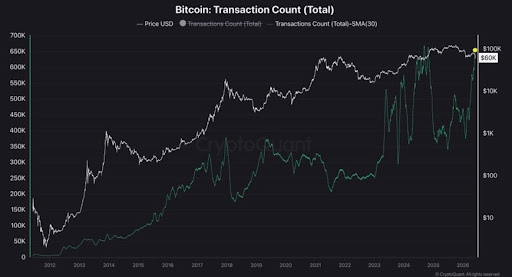
Source: Chart from Darkfost on X

Darkfost noted that the recent surge in BTC on-chain activity is unusual compared to previous cycles, as rising transaction counts typically coincide with bullish phases or market tops. However, the current trend indicates that BTC is firmly in bearish territory and has declined below previously presumed bottom levels.

As a result, the analyst described the current surge in transaction activity as a major “capitulation episode” and one of the most significant “change of hands” in Bitcoin’s history. Given the extent of BTC’s bearish trend, it remains unclear whether increased transaction activity alone can lift the cryptocurrency’s price out of its downtrend.

Short-Term Sellers See Heavy Losses As BTC Price Drop Continues

In a separate analysis, Darkfost noted that short-term Bitcoin holders are facing major losses after reacting strongly to the latest Bitcoin price drop. According to him, holders with positions under six months were hit the hardest when BTC’s price slipped below $60,000 during last week’s correction.

Over a 24-hour window, at the height of the decline, Darkfost stated that more than 60,200 BTC were sent to exchanges by short-term holders. Of that total, over 59,000 BTC were moved at a loss, marking the largest negative returns for this group since February.

The data showed that emotional selling played a major role in the move, with newer market participants locking in losses under pressure. This trend shows how quickly sentiment can shift during sharp corrections, especially among short-term traders.

BTC trading at $62,655 on the 1D chart | Source: BTCUSDT on Tradingview.com

Trending Cryptos

Related Questions

QWhat unusual trend is Bitcoin currently showing according to market experts?

ABitcoin is showing a strange mix of strength and weakness, with transaction activity climbing toward record levels even as its price continues to fall.

QAccording to the analyst Darkfost, what is the current average monthly Bitcoin transaction count, and what historical period is it close to?

AThe average monthly Bitcoin transaction count is now around 640,000, which is close to the level last seen during the 2024 price correction when the network recorded 666,000 transactions in September.

QHow did Darkfost describe the recent surge in BTC on-chain activity, and why is it considered unusual?

ADarkfost described the surge as a major 'capitulation episode' and one of the most significant 'change of hands' in Bitcoin's history. It is unusual because rising transaction counts typically coincide with bullish phases or market tops, not while the price is in a severe bearish trend.

QWhat did the data reveal about the behavior of short-term Bitcoin holders during the recent price drop below $60,000?

AThe data showed that short-term holders (with positions under six months) reacted strongly, sending over 60,200 BTC to exchanges in a 24-hour window. Of that total, over 59,000 BTC were moved at a loss, marking the largest negative returns for this group since February, indicating emotional selling.

QWhat is the key question raised in the article regarding the ongoing bullish on-chain trend?

AThe key question is whether the increased transaction activity and bullish on-chain trend can help support a Bitcoin price recovery and prevent further downtrends, despite the current severe bearish market pressure.

Related Reads

WEEX TradFi Trading Competition Kicks Off, 50,000 USDT Prize Pool First-Come, First-Served, Open a Position and Get 5 U

WEEX Exchange Launches "TradFi Trading Competition" with a 50,000 USDT Prize Pool Amidst a crypto market downturn, WEEX Exchange highlights the growth of tokenized traditional finance (TradFi) assets as a key trend, allowing users to trade stocks, ETFs, and commodities using crypto. The platform has launched a "TradFi Trading Competition" from July 9th to 23rd, featuring a 50,000 USDT prize pool. The campaign offers three reward tiers: 1. **New User Bonus (25,000 USDT pool):** New users depositing ≥100 USDT, completing a specified spot trade, and one TradFi contract trade (margin ≥10 USDT) receive 200 USDT. 2. **Volume-Based Rewards (20,000 USDT pool):** All users can earn tiered bonuses for achieving TradFi contract trading volumes of 5,000 USDT (3 USDT), 20,000 USDT (10 USDT), and 100,000 USDT (50 USDT). Rewards are stackable. 3. **Participation Reward:** Any user opening a TradFi contract trade during the event receives 5 USDT instantly. The article promotes WEEX's TradFi features, which include trading tokenized shares of companies like NVIDIA and Tesla using USDT, 24/7 trading, fractional share investing starting from $5, and high leverage up to 100x for hedging. It positions these features as solutions to traditional investing barriers like high fees, strict trading hours, and high share prices. The summary concludes by encouraging users to join the competition and leverage WEEX's platform to access global TradFi markets.

marsbit30m ago

WEEX TradFi Trading Competition Kicks Off, 50,000 USDT Prize Pool First-Come, First-Served, Open a Position and Get 5 U

marsbit30m ago

Switching Chains for Another Shot at Success: Can It Really 'Change One's Destiny'?

Recent months have witnessed a wave of established blockchain projects migrating to new public chains, notably Base and Arbitrum, coupled with strategic pivots in their business models—essentially "re-starting" elsewhere. Examples include Sophon (moving from ZKsync to Base to cut $3M+ annual costs and focus on consumer apps), Moonbeam (shifting from Polkadot to Base to pursue decentralized AI), and Secret Network (planning a move from Cosmos to Arbitrum to explore privacy-AI integrations, though its token price plunged 30% post-announcement). A common thread is that these migrating projects are primarily layer-1 or layer-2 chains now seeking relevance in AI and real-world consumer applications. This trend highlights the relative stagnation of ecosystems like Polkadot and Cosmos, which are seeing significant outflows. However, the community remains skeptical about whether such chain-hopping truly enables a turnaround. Historical cases like y00ts NFTs (which moved from Solana to Polygon and back to Ethereum) and Synthetix (which retreated from a multi-chain strategy) show that migration often fails to deliver expected benefits and can add complexity. In today's more rational market, devoid of easy narrative or airdrop红利, simply changing chains is unlikely to be a silver bullet. For both migrating projects and destination chains, the real challenge lies not in attracting projects but in developing actual use cases that retain users.

marsbit34m ago

Switching Chains for Another Shot at Success: Can It Really 'Change One's Destiny'?

marsbit34m ago

Does Switching Chains to Re-entrepreneur Really "Change One's Destiny"?

Amid a recent wave of blockchain migrations, several established projects, including Sophon, Moonbeam, and Secret Network, are moving to new ecosystems like Base and Arbitrum. Unlike past migrations driven by hype or security, these moves are often accompanied by strategic pivots, such as shifting focus to consumer applications, AI, or privacy-AI integration, effectively representing a "re-startup" attempt. However, the crypto community has reacted cautiously. Following Secret Network's announcement of its planned migration to Arbitrum, its token price plummeted over 30% in 24 hours. While migrating to more cost-efficient, higher-traffic, or technologically suitable chains can be a pragmatic choice, history shows that such moves rarely guarantee success. Examples like the y00ts NFT project, which moved from Solana to Polygon and then to Ethereum, or Synthetix’s retreat from a multi-chain strategy, illustrate the challenges and often underwhelming results. The current market environment, characterized by greater user rationality and the partial validation of past narratives, makes a successful "pivot via migration" even more difficult. Simultaneously, destination chains themselves face challenges in demonstrating sustainable user adoption beyond merely attracting migrating projects. Ultimately, the competition is shifting from which chain can onboard the most projects to which can genuinely foster real-world application and retain users.

链捕手39m ago

Does Switching Chains to Re-entrepreneur Really "Change One's Destiny"?

链捕手39m ago

June Transaction Volume Doubles: x402 Ecosystem Continues to Expand, Content Monetization Narrative Faces Crucial Test

X402, a protocol for AI and data services, experienced significant growth in June. Its transaction volume doubled compared to May, primarily driven by the AI inference routing service BlockRun. The ecosystem expanded with new integrations: Apify enabled data scraping services, Exa extended its AI search to Solana, and Seal launched 'Hacks', a marketplace for automated AI agents. The protocol itself received crucial upgrades, including 'Builder Codes' for tracking and affiliate systems and 'Batch Settlement' to enable practical micropayments for high-frequency AI tasks. Major external validation came from tech giants. Amazon Web Services (AWS) launched a solution for AI traffic metering at its edge nodes. More significantly, Cloudflare opened its waitlist for a Content Monetization Gateway. This gateway allows websites to charge AI bots and other automated agents for accessing content, using x402 for stablecoin payments. This addresses a core internet monetization problem and represents x402's most promising path to mass adoption, though Cloudflare's CEO noted current blockchain scalability remains a critical hurdle. Current leading use cases are AI inference routing and paid data feeds. However, the large-scale real-world test with Cloudflare's gateway will be decisive in determining if x402 can transition from a useful tool to a fundamental infrastructure component for a new web economy where AI agents pay for the content they consume.

Foresight News1h ago

June Transaction Volume Doubles: x402 Ecosystem Continues to Expand, Content Monetization Narrative Faces Crucial Test

Foresight News1h ago

Trading

Spot

Hot Articles

What is $BITCOIN

DIGITAL GOLD ($BITCOIN): A Comprehensive Analysis Introduction to DIGITAL GOLD ($BITCOIN) DIGITAL GOLD ($BITCOIN) is a blockchain-based project operating on the Solana network, which aims to combine the characteristics of traditional precious metals with the innovation of decentralized technologies. While it shares a name with Bitcoin, often referred to as “digital gold” due to its perception as a store of value, DIGITAL GOLD is a separate token designed to create a unique ecosystem within the Web3 landscape. Its goal is to position itself as a viable alternative digital asset, although specifics regarding its applications and functionalities are still developing. What is DIGITAL GOLD ($BITCOIN)? DIGITAL GOLD ($BITCOIN) is a cryptocurrency token explicitly designed for use on the Solana blockchain. In contrast to Bitcoin, which provides a widely recognized value storage role, this token appears to focus on broader applications and characteristics. Notable aspects include: Blockchain Infrastructure: The token is built on the Solana blockchain, known for its capacity to handle high-speed and low-cost transactions. Supply Dynamics: DIGITAL GOLD has a maximum supply capped at 100 quadrillion tokens (100P $BITCOIN), although details regarding its circulating supply are currently undisclosed. Utility: While precise functionalities are not explicitly outlined, there are indications that the token could be utilized for various applications, potentially involving decentralized applications (dApps) or asset tokenization strategies. Who is the Creator of DIGITAL GOLD ($BITCOIN)? At present, the identity of the creators and development team behind DIGITAL GOLD ($BITCOIN) remains unknown. This situation is typical among many innovative projects within the blockchain space, particularly those aligning with decentralized finance and meme coin phenomena. While such anonymity may foster a community-driven culture, it intensifies concerns about governance and accountability. Who are the Investors of DIGITAL GOLD ($BITCOIN)? The available information indicates that DIGITAL GOLD ($BITCOIN) does not have any known institutional backers or prominent venture capital investments. The project seems to operate on a peer-to-peer model focused on community support and adoption rather than traditional funding routes. Its activity and liquidity are primarily situated on decentralized exchanges (DEXs), such as PumpSwap, rather than established centralized trading platforms, further highlighting its grassroots approach. How DIGITAL GOLD ($BITCOIN) Works The operational mechanics of DIGITAL GOLD ($BITCOIN) can be elaborated on based on its blockchain design and network attributes: Consensus Mechanism: By leveraging Solana’s unique proof-of-history (PoH) combined with a proof-of-stake (PoS) model, the project ensures efficient transaction validation contributing to the network's high performance. Tokenomics: While specific deflationary mechanisms have not been extensively detailed, the vast maximum token supply implies that it may cater to microtransactions or niche use cases that are still to be defined. Interoperability: There exists the potential for integration with Solana’s broader ecosystem, including various decentralized finance (DeFi) platforms. However, the details regarding specific integrations remain unspecified. Timeline of Key Events Here is a timeline that highlights significant milestones concerning DIGITAL GOLD ($BITCOIN): 2023: The initial deployment of the token occurs on the Solana blockchain, marked by its contract address. 2024: DIGITAL GOLD gains visibility as it becomes available for trading on decentralized exchanges like PumpSwap, allowing users to trade it against SOL. 2025: The project witnesses sporadic trading activity and potential interest in community-led engagements, although no noteworthy partnerships or technical advancements have been documented as of yet. Critical Analysis Strengths Scalability: The underlying Solana infrastructure supports high transaction volumes, which could enhance the utility of $BITCOIN in various transaction scenarios. Accessibility: The potential low trading price per token could attract retail investors, facilitating wider participation due to fractional ownership opportunities. Risks Lack of Transparency: The absence of publicly known backers, developers, or an audit process may yield skepticism regarding the project's sustainability and trustworthiness. Market Volatility: The trading activity is heavily reliant on speculative behavior, which can result in significant price volatility and uncertainty for investors. Conclusion DIGITAL GOLD ($BITCOIN) emerges as an intriguing yet ambiguous project within the rapidly evolving Solana ecosystem. While it attempts to leverage the “digital gold” narrative, its departure from Bitcoin's established role as a store of value underscores the need for a clearer differentiation of its intended utility and governance structure. Future acceptance and adoption will likely depend on addressing the current opacity and defining its operational and economic strategies more explicitly. Note: This report encompasses synthesised information available as of October 2023, and developments may have transpired beyond the research period.

705 Total ViewsPublished 2025.05.13Updated 2025.05.13

What is $BITCOIN

Discussions

Welcome to the HTX Community. Here, you can stay informed about the latest platform developments and gain access to professional market insights. Users' opinions on the price of BTC (BTC) are presented below.

活动图片