Even 0.1 $BTC is Financial Independence for Decades. But That's Not Enough

bitcoinistPubblicato 2025-12-12Pubblicato ultima volta 2025-12-12

Introduzione

The article argues that simply holding Bitcoin (BTC) is no longer sufficient for long-term financial gains. While BTC remains a foundational asset, its price volatility and the limitations of its base layer (slow speeds, high fees, lack of programmability) are driving a shift in focus. Capital is now flowing towards infrastructure that enhances Bitcoin's utility, particularly Layer 2 solutions. These projects aim to transform BTC from "digital gold" into a usable asset for daily payments, DeFi, NFTs, and gaming. The piece highlights Bitcoin Hyper as an aggressive example, which uses Solana's Virtual Machine (SVM) to enable fast, low-cost smart contracts on top of Bitcoin. Its modular architecture keeps security on the main chain while moving execution to L2. The project has reportedly attracted significant pre-sale funding, indicating market belief in the need for a Bitcoin execution layer. The core conclusion is that the next wave of ecosystem growth will come from Bitcoin's usefulness, not just its price appreciation.

The idea of "accumulate a little $BTC and wait calmly" sounds convincing again — but the reality of late 2025 shows that simply holding is becoming insufficient. This week, $BTC dipped below $90,000 and returned to the $92,000 area, while the market as a whole is reacting nervously to shifts in risk appetite and the macroeconomic backdrop.

Simultaneously, the demand structure is also changing. After a strong year for US spot ETFs, the capital flow has become less stable, and this is making bounces more "fragile": when inflows don't support the momentum, the price hits sellers faster. Against this backdrop, attention is shifting again from "where the chart will go" to "what can be built around $BTC".

Hence the main takeaway for Bitcoin holders: the next wave of ecosystem growth may come not only from price but also from utility. If $BTC becomes the base collateral for payments, DeFi, NFTs, and games — capital will seek infrastructure that removes the limitations of the first-layer network: delays, fees, and the lack of native programmability.

This is why Layer 2 projects around Bitcoin are again looking like a bet for the next market cycle: they are trying to turn "digital gold" into an asset that can be used daily. In this context, Bitcoin Hyper is one of the most aggressive options, because it bets on the Solana Virtual Machine for smart contract execution on top of Bitcoin and promises minimal transaction processing latency.

BUY BITCOIN HYPER

Why Capital is Looking at Bitcoin Infrastructure Again

When volatility increases, the market usually returns to the "base asset" — and in crypto, that's $BTC. But the more money gets locked into Bitcoin through exchanges, ETFs, and corporate reserves, the stronger the dissonance: the asset appreciates, but it's still inconvenient to use in real applications due to first-layer limitations.

Therefore, infrastructure is not a secondary topic but an attempt to expand the market. Competition between approaches has already formed: Lightning handles micropayments, sidechains and Layer 2s try to provide smart contract compatibility, and separate ecosystems are developing a DeFi showcase on top of Bitcoin. As industry reviews have noted, the Bitcoin Layer 2 and sidechains segment is measured in billions of dollars of locked value.

In practice, this is a race for a simple promise: "let $BTC work as conveniently as assets in smart contract networks." And here Bitcoin Hyper hits the mark as one of the options betting on high throughput and low fees, not just on the ideology of "the most reliable settlement layer."

How Bitcoin Hyper Tries to Give Bitcoin Speed and Smart Contracts

Bitcoin Hyper's key bet is a modular architecture: Bitcoin L1 remains the settlement and trust layer, while execution is moved to Layer 2 in real time. The project emphasizes the integration of the SVM to run smart contracts with minimal latency. It also gives developers familiar tooling, including an SDK and API in Rust.
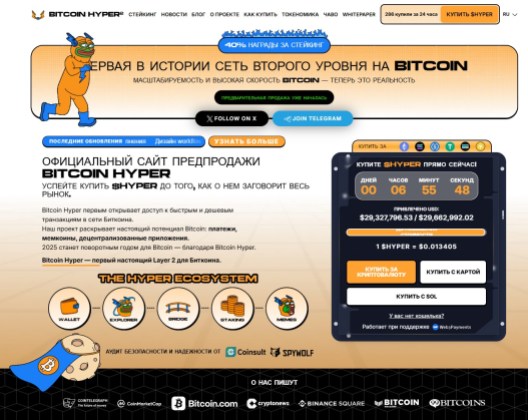
From a user's perspective, this is a story about concrete utility: fast payments in wrapped $BTC with low fees, DeFi scenarios like exchanges and lending, as well as NFTs and games where latency and transaction cost are critical. For bridges, a decentralized "canonical" mechanism for transferring BTC between layers is announced, to avoid relying on a single point of trust for entry and exit.

The market usually votes with money for early infrastructure stories if it sees a combination of technology and demand. Bitcoin Hyper's presale has already raised $29,373,016.54, and the token is valued at $0.013415 — this is a signal that the audience is buying into the idea of "Bitcoin needs an execution layer" in advance. Additionally, trackers noted two large purchases of $396,000, the largest — $53,000 (November 19, 2025), showing interest from large wallets.

If you're looking for a more general breakdown of how to make money in cryptocurrency in 2025, it's worth comparing "hold" strategies and scenarios where income is built around infrastructure.

Domande pertinenti

QAccording to the article, why is simply holding Bitcoin becoming insufficient by the end of 2025?

ABecause the market structure is changing, with capital inflows becoming less stable, making price bounces more fragile. The next wave of ecosystem growth is expected to come not just from price appreciation but from utility, requiring infrastructure that solves the limitations of the base layer like delays, fees, and a lack of native programmability.

QWhat is the article's main argument for the potential of Bitcoin Layer 2 solutions like Bitcoin Hyper?

AThe article argues that Layer 2 solutions are an attempt to expand Bitcoin's market by turning 'digital gold' into an asset that can be used daily for payments, DeFi, NFTs, and gaming. They address the dissonance of a valuable asset that is inconvenient to use by providing high throughput, low fees, and smart contract capabilities.

QWhat specific technical approach does Bitcoin Hyper take to enhance Bitcoin's functionality?

ABitcoin Hyper uses a modular architecture where Bitcoin L1 remains the settlement and trust layer, while execution is moved to a real-time Layer 2. Its key bet is the integration of the Solana Virtual Machine (SVM) to run smart contracts with minimal latency and provide developers with toolkits like Rust SDKs and APIs.

QWhat evidence does the article provide to show investor interest in the Bitcoin Hyper project?

AThe article states that the Bitcoin Hyper presale has raised $29,373,016.54, with its token priced at $0.013415. It also mentions two large purchases tracked, one for $396,000 and the largest single purchase of $53,000 on November 19, 2025, indicating interest from large wallets.

QHow does the changing structure of demand, particularly from US spot ETFs, affect the market according to the text?

AAfter a strong year, capital flow from US spot ETFs has become less stable. This lack of consistent inflow makes price rebounds more 'brittle' because the upward movement is not sustained and the price hits a wall of sellers more quickly.

Letture associate

Public Chain Moat Only 3/10? Alliance DAO Founder's Remarks Ignite Crypto Community Debate

Alliance DAO founder qw (@QwQiao) sparked intense debate in the crypto community by claiming that Layer 1 blockchains have "limited moats," rating them only 3/10 in terms of sustainable competitive advantage. This triggered strong reactions from key industry figures. Dragonfly Capital partner Haseeb strongly disagreed, arguing that Ethereum’s decade-long dominance despite well-funded challengers proves its strong moat. Others, like Multicoin’s Kyle Samani and researchers from Ethereum and Circle, questioned whether liquidity alone constitutes a real moat, with some calling it fleeting and unreliable. In response, qw elaborated on his moat rating framework, giving traditional giants like Microsoft, Apple, and Visa perfect scores (10/10) based on revenue models and infrastructure, while rating top crypto projects around 5/10. He notably rated Bitcoin at 9/10, citing its unique founding story and Lindy effect, but deducted a point due to uncertainties around security and quantum threats. The debate expanded into what truly constitutes a moat in crypto. Critics argued qw’s framework overemphasizes current revenue and undervalues network effects, trust, and technological ethos. Defenders of blockchain moats pointed to elements like developer ecosystems, brand strength, switching costs, and application diversity as core defensive attributes. The article concludes that the crypto industry is still young and small compared to traditional finance and tech giants. Rather than fixating on abstract moat concepts, the priority should be solving real user needs at scale, driving adoption, and expanding overall market reach.

marsbit11 min fa

Public Chain Moat Only 3/10? Alliance DAO Founder's Remarks Ignite Crypto Community Debate

marsbit11 min fa

Trading

Spot
Futures
活动图片