Binance SAFU Fund Adds 4,225 Bitcoin ($300M) As Price Reclaims $70K Level

bitcoinistPublished on 2026-02-10Last updated on 2026-02-10

Abstract

Bitcoin is attempting to reclaim the $70,000 level amid ongoing market volatility and fragile sentiment following a recent drop to $60,000. In this uncertain environment, Binance's SAFU Fund has purchased an additional 4,225 BTC, worth approximately $300 million, bringing its total holdings to 10,455 BTC ($734 million). This institutional accumulation during a corrective phase is seen by some as a potential signal of long-term confidence, though it does not guarantee an immediate market reversal. Analysts remain divided, noting that macro conditions, exchange flows, and derivative markets continue to exert downward pressure. For the current rebound to evolve into a sustained trend, Bitcoin must hold above key resistance levels amid improved liquidity and stronger spot demand.

Bitcoin is struggling to reclaim the $70,000 level after several days of recovery from the recent $60,000 low, reflecting a market still searching for stability. The rebound offered temporary relief following intense selling pressure, yet momentum appears fragile as resistance continues to cap upside attempts. Volatility remains elevated, and sentiment has yet to fully recover from the sharp drawdown that pushed prices toward multi-month lows.

Amid this uncertain backdrop, fresh data indicate that the Binance SAFU Fund has purchased an additional 4,225 BTC, valued at roughly $299.6 million. The move comes at a time when broader market confidence remains subdued, immediately drawing attention from analysts tracking institutional positioning and liquidity dynamics. Historically, large strategic purchases during periods of weakness have sometimes preceded stabilization phases, although they do not guarantee an immediate reversal.
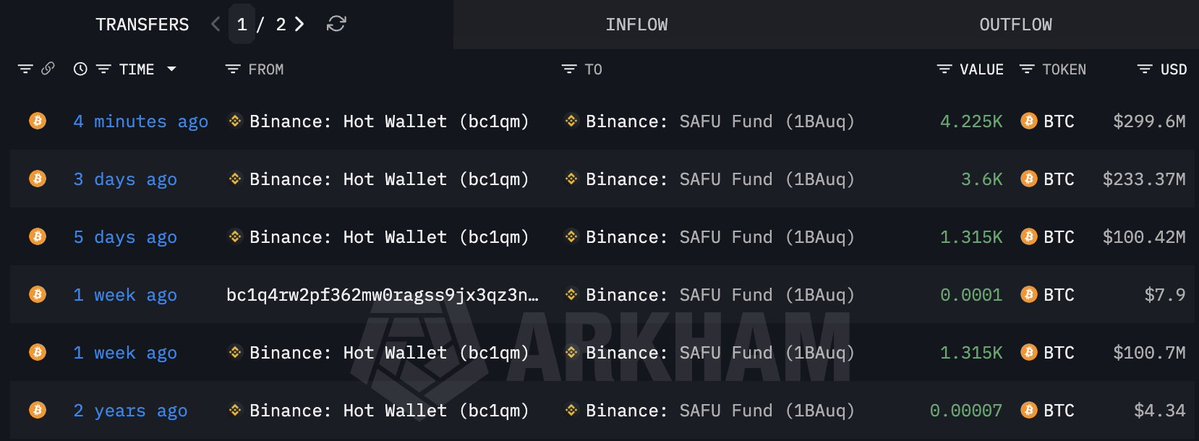
Binance SAFU Fund Bitcoin transfers | Source: Arkham

Market participants are now debating whether this accumulation reflects long-term confidence from major players or simply opportunistic positioning within an ongoing corrective cycle. While some analysts interpret the purchase as a constructive signal, others remain cautious, noting that macro conditions, exchange flows, and derivative positioning continue to exert pressure on price. For now, Bitcoin’s ability to sustain recovery above key resistance levels will likely determine whether this rebound evolves into a trend shift or remains a temporary bounce.

Institutional Accumulation Signals Amid Fragile Market Conditions

Data from Arkham indicates that Binance’s SAFU Fund has now accumulated a total of 10,455 BTC, worth roughly $734 million at current prices. This expansion of reserves is notable because it occurs during a period of persistent market fragility, when liquidity conditions remain tight, and investor sentiment is still recovering from recent drawdowns. Such activity from a major exchange-linked fund tends to attract attention, as it can reflect both strategic treasury management and broader confidence in Bitcoin’s long-term market structure.

From a market perspective, these purchases matter primarily due to their signaling effect rather than immediate supply impact. While the acquired volume represents only a fraction of circulating supply, institutional accumulation during corrective phases has historically coincided with stabilization periods, particularly when retail flows remain defensive.

However, this should not be interpreted automatically as a bullish catalyst. Exchange inflows, derivative positioning, and macroeconomic uncertainty continue to influence short-term price behavior.

Currently, the market remains in a transitional phase characterized by elevated volatility, cautious positioning, and selective accumulation. Large entities adding exposure while prices consolidate below key resistance levels can indicate long-term confidence, but confirmation typically requires improving liquidity conditions, declining exchange sell pressure, and stronger spot demand. Until those factors align, Bitcoin’s recovery remains tentative despite visible institutional participation.

Related Questions

QHow much Bitcoin did the Binance SAFU Fund add, and what was its approximate value?

AThe Binance SAFU Fund added 4,225 BTC, valued at approximately $299.6 million.

QWhat is the total amount of Bitcoin the Binance SAFU Fund now holds, according to Arkham data?

AAccording to Arkham data, the Binance SAFU Fund now holds a total of 10,455 BTC, worth roughly $734 million at current prices.

QWhy is the timing of the SAFU Fund's purchase considered significant by market analysts?

AThe timing is significant because it occurred during a period of persistent market fragility, tight liquidity conditions, and subdued investor sentiment following a sharp price drawdown, making it a potential signal of long-term confidence.

QWhat are the two main interpretations analysts have regarding the SAFU Fund's purchase?

ASome analysts interpret the purchase as a constructive, long-term confidence signal from a major player, while others remain cautious, viewing it as opportunistic positioning within an ongoing corrective cycle that doesn't guarantee an immediate reversal.

QWhat factors, besides institutional accumulation, are needed to confirm a sustained Bitcoin recovery according to the article?

AAccording to the article, a sustained recovery requires improving liquidity conditions, declining exchange sell pressure, and stronger spot demand, in addition to institutional accumulation.

Related Reads

The Next Earthquake in AI: Why the Real Danger Isn't the SaaS Killer, but the Computing Power Revolution?

The next seismic shift in AI is not the threat of "SaaS killers" but a fundamental revolution in computing power. While many focus on how AI applications like Claude Cowork are disrupting traditional software, the real transformation is happening beneath the surface—in the infrastructure that powers AI. Two converging technological paths are challenging NVIDIA’s GPU dominance: 1. **Algorithmic Efficiency**: DeepSeek’s Mixture-of-Experts (MoE) architecture allows massive models (e.g., DeepSeek-V2 with 236B parameters) to activate only a small fraction of "experts" (9%) during computation, achieving GPT-4-level performance at 10% of the computational cost. This decouples AI capability from sheer compute power. 2. **Specialized Hardware**: Inference-optimized chips from companies like Cerebras and Groq integrate memory directly onto the chip, eliminating data transfer delays. This "zero-latency" design drastically improves speed and efficiency, prompting even OpenAI to sign a $10B deal with Cerebras. Together, these advances could cause a cost collapse: training costs may drop by 90%, and inference costs could fall by an order of magnitude. The total cost of running world-class AI may plummet to 10-15% of current GPU-based solutions. This paradigm shift threatens NVIDIA’s valuation, built on the assumption of perpetual GPU dominance. If the market realizes that GPUs are no longer the only—or best—option, the foundation of NVIDIA’s trillions in market cap could crumble. The real black swan event may not be a new AI application, but a quiet technical breakthrough that reshapes the compute landscape.

marsbit33m ago

The Next Earthquake in AI: Why the Real Danger Isn't the SaaS Killer, but the Computing Power Revolution?

marsbit33m ago

Trading

Spot
Futures

Hot Articles

What is $BITCOIN

DIGITAL GOLD ($BITCOIN): A Comprehensive Analysis Introduction to DIGITAL GOLD ($BITCOIN) DIGITAL GOLD ($BITCOIN) is a blockchain-based project operating on the Solana network, which aims to combine the characteristics of traditional precious metals with the innovation of decentralized technologies. While it shares a name with Bitcoin, often referred to as “digital gold” due to its perception as a store of value, DIGITAL GOLD is a separate token designed to create a unique ecosystem within the Web3 landscape. Its goal is to position itself as a viable alternative digital asset, although specifics regarding its applications and functionalities are still developing. What is DIGITAL GOLD ($BITCOIN)? DIGITAL GOLD ($BITCOIN) is a cryptocurrency token explicitly designed for use on the Solana blockchain. In contrast to Bitcoin, which provides a widely recognized value storage role, this token appears to focus on broader applications and characteristics. Notable aspects include: Blockchain Infrastructure: The token is built on the Solana blockchain, known for its capacity to handle high-speed and low-cost transactions. Supply Dynamics: DIGITAL GOLD has a maximum supply capped at 100 quadrillion tokens (100P $BITCOIN), although details regarding its circulating supply are currently undisclosed. Utility: While precise functionalities are not explicitly outlined, there are indications that the token could be utilized for various applications, potentially involving decentralized applications (dApps) or asset tokenization strategies. Who is the Creator of DIGITAL GOLD ($BITCOIN)? At present, the identity of the creators and development team behind DIGITAL GOLD ($BITCOIN) remains unknown. This situation is typical among many innovative projects within the blockchain space, particularly those aligning with decentralized finance and meme coin phenomena. While such anonymity may foster a community-driven culture, it intensifies concerns about governance and accountability. Who are the Investors of DIGITAL GOLD ($BITCOIN)? The available information indicates that DIGITAL GOLD ($BITCOIN) does not have any known institutional backers or prominent venture capital investments. The project seems to operate on a peer-to-peer model focused on community support and adoption rather than traditional funding routes. Its activity and liquidity are primarily situated on decentralized exchanges (DEXs), such as PumpSwap, rather than established centralized trading platforms, further highlighting its grassroots approach. How DIGITAL GOLD ($BITCOIN) Works The operational mechanics of DIGITAL GOLD ($BITCOIN) can be elaborated on based on its blockchain design and network attributes: Consensus Mechanism: By leveraging Solana’s unique proof-of-history (PoH) combined with a proof-of-stake (PoS) model, the project ensures efficient transaction validation contributing to the network's high performance. Tokenomics: While specific deflationary mechanisms have not been extensively detailed, the vast maximum token supply implies that it may cater to microtransactions or niche use cases that are still to be defined. Interoperability: There exists the potential for integration with Solana’s broader ecosystem, including various decentralized finance (DeFi) platforms. However, the details regarding specific integrations remain unspecified. Timeline of Key Events Here is a timeline that highlights significant milestones concerning DIGITAL GOLD ($BITCOIN): 2023: The initial deployment of the token occurs on the Solana blockchain, marked by its contract address. 2024: DIGITAL GOLD gains visibility as it becomes available for trading on decentralized exchanges like PumpSwap, allowing users to trade it against SOL. 2025: The project witnesses sporadic trading activity and potential interest in community-led engagements, although no noteworthy partnerships or technical advancements have been documented as of yet. Critical Analysis Strengths Scalability: The underlying Solana infrastructure supports high transaction volumes, which could enhance the utility of $BITCOIN in various transaction scenarios. Accessibility: The potential low trading price per token could attract retail investors, facilitating wider participation due to fractional ownership opportunities. Risks Lack of Transparency: The absence of publicly known backers, developers, or an audit process may yield skepticism regarding the project's sustainability and trustworthiness. Market Volatility: The trading activity is heavily reliant on speculative behavior, which can result in significant price volatility and uncertainty for investors. Conclusion DIGITAL GOLD ($BITCOIN) emerges as an intriguing yet ambiguous project within the rapidly evolving Solana ecosystem. While it attempts to leverage the “digital gold” narrative, its departure from Bitcoin's established role as a store of value underscores the need for a clearer differentiation of its intended utility and governance structure. Future acceptance and adoption will likely depend on addressing the current opacity and defining its operational and economic strategies more explicitly. Note: This report encompasses synthesised information available as of October 2023, and developments may have transpired beyond the research period.

363 Total ViewsPublished 2025.05.13Updated 2025.05.13

Discussions

Welcome to the HTX Community. Here, you can stay informed about the latest platform developments and gain access to professional market insights. Users' opinions on the price of BTC (BTC) are presented below.

活动图片