Elon Musk Giving 'Serious Thought' to Creating Social Media Platform With Free Speech as Top Priority

newsbtcPublished on 2022-03-28Last updated on 2022-03-28

Abstract

The CEO of Tesla and Spacex, Elon Musk, has been discussing the need for a new social media platform on Twitter over the past couple of days.

Elon Musk Giving 'Serious Thought' to Creating Social Media Platform With Free Speech as Top Priority

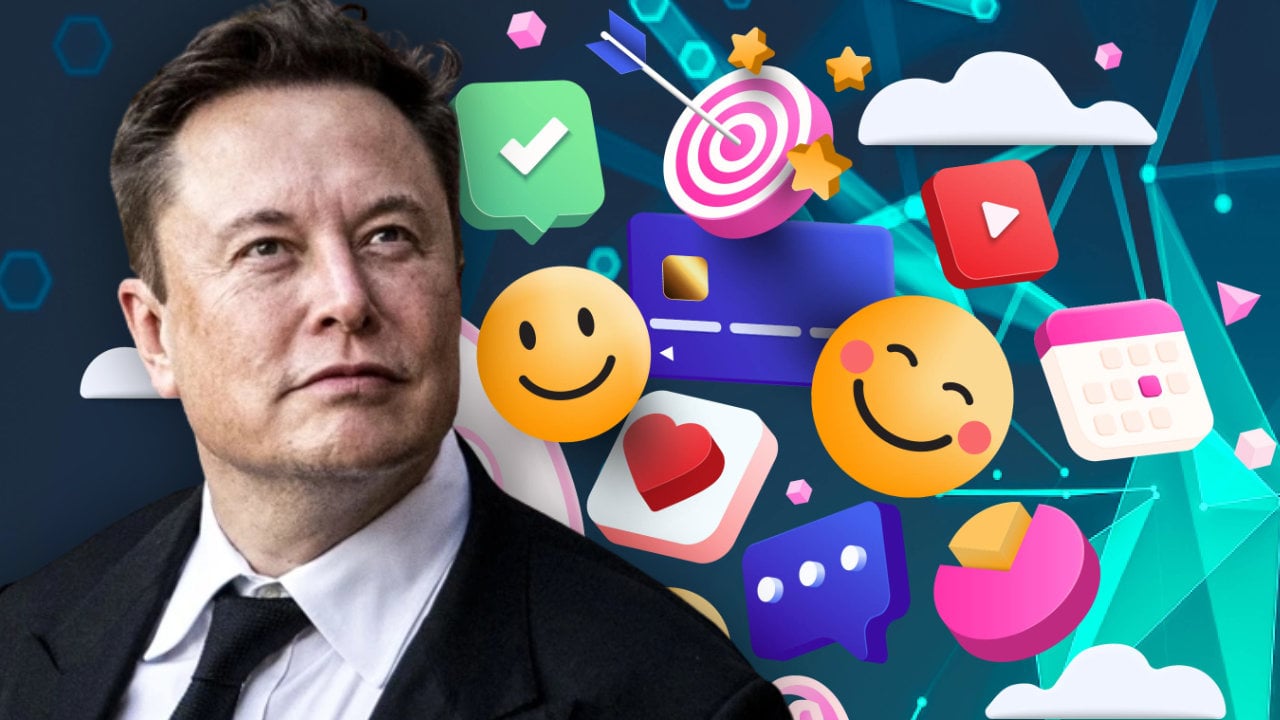
Tesla and Spacex CEO Elon Musk says that he is “giving serious thought to” creating a new social media platform with free speech as a top priority. “Given that Twitter serves as the de facto public town square, failing to adhere to free speech principles fundamentally undermines democracy,” the Tesla billionaire said.

Elon Musk Considers Building New Social Media Platform, Says Free Speech Is Essential to Democracy

The CEO of Tesla and Spacex, Elon Musk, has been discussing the need for a new social media platform on Twitter over the past couple of days. He has recently become more critical of Twitter and its policies, claiming that the social media platform is undermining democracy by failing to adhere to free speech principles.

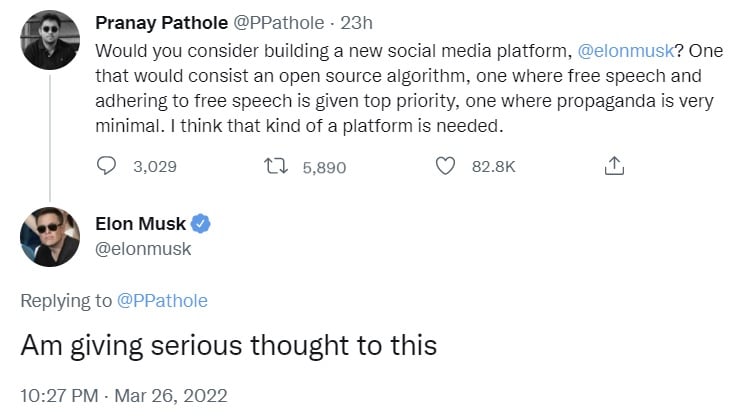
Replying to a question about whether he would consider building a new social media platform with an open source algorithm, where free speech is given top priority and propaganda is minimized, Musk replied: “Am giving serious thought to this.”
Elon Musk Giving 'Serious Thought' to Building Social Media Platform With Free Speech as Top Priority

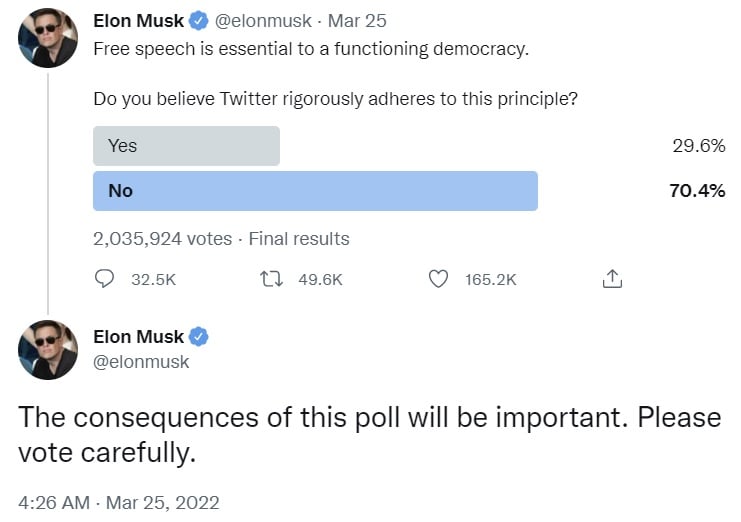
The discussion began when Musk put up a Twitter poll Friday asking his 79.2 million followers to vote whether they believe Twitter adheres to the principle of free speech, which “is essential to a functioning democracy,” he wrote.

The Tesla boss emphasized: “The consequences of this poll will be important. Please vote carefully.” After 24 hours, the poll ended with more than 2 million votes; 70.4% said no.
Elon Musk Giving 'Serious Thought' to Building Social Media Platform With Free Speech as Top Priority

Musk opined:

Given that Twitter serves as the de facto public town square, failing to adhere to free speech principles fundamentally undermines democracy. What should be done?

In a follow-up tweet, the Spacex CEO asked: “Is a new platform needed?”

A few platforms already advertise themselves as free speech alternatives, but none have come close to the size of Twitter. Parler, for example, has gained some traction as a Twitter alternative but it is a similarly centralized service.

Some platforms are built with decentralized, open source protocols, such as Gab and Truth Social, a platform recently launched by former U.S. President Donald Trump after Twitter banned him. Truth Social did not take off and even Trump barely uses it. Several different protocols can be used to build decentralized Twitter alternatives, including Mastodon, Diaspora, Misskey, Friendica, Pleroma, and Twister.
Related Reads

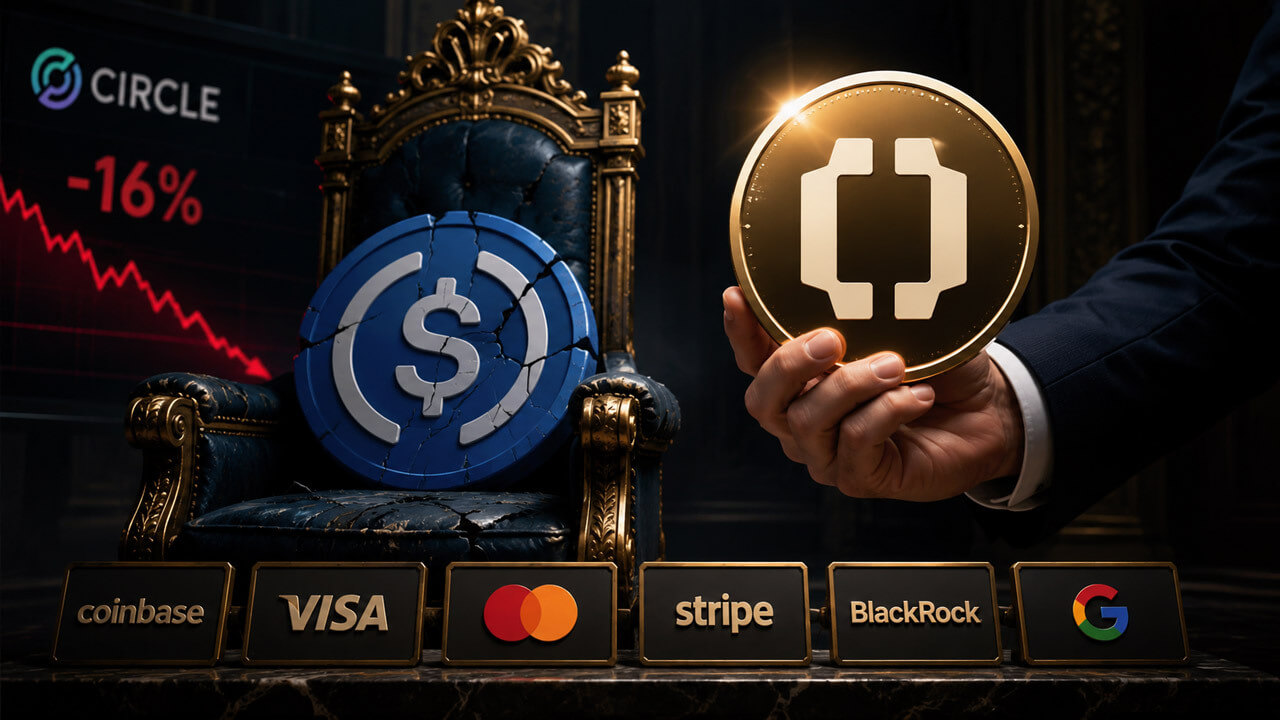
Building USDC by Its Own Hands, Why Does Coinbase Turn to Support Competitor OUSD?

Coinbase, a key distributor of the dominant stablecoin USDC, has joined over 140 major companies—including Visa, Mastercard, and BlackRock—as a founding member of the Open USD (OUSD) alliance, a move that directly challenges the current stablecoin economic model. The new project aims to upend the established profit structure by offering zero minting and redemption fees and allocating the majority of reserve interest earnings to distribution partners, rather than the issuer. This shift highlights a growing power struggle in the $320+ billion stablecoin market, where platforms with massive user bases are demanding a larger share of the revenue generated from the underlying reserves. Circle, the issuer of USDC, saw its stock plummet 16% on the day of the OUSD announcement, reflecting investor concern over the potential strain on its crucial partnership with Coinbase. While Coinbase earned over $900 million from its USDC partnership in 2024, its support for a competing model gives it significant leverage as its revenue-sharing agreement with Circle nears expiration in August 2026. Circle CEO Jeremy Allaire defended the USDC model, emphasizing its decade-long development, deep liquidity, and extensive ecosystem integration, which he argues cannot be easily replicated by a large, potentially slow-moving consortium. He also questioned the sustainability of a zero-fee model and warned that diverting all reserve interest would leave issuers without funds for critical compliance and operational infrastructure. Analysts remain skeptical of OUSD's prospects, citing the "cold start" problem of building liquidity, potential governance challenges within a large alliance, and heightened regulatory scrutiny. The emergence of OUSD signals a broader industry bifurcation, where stablecoins are increasingly viewed as backend settlement tools. The core competition is shifting from technology to a direct negotiation over how profits from the network are distributed between issuers and the powerful distribution channels.

Foresight News1h ago

Building USDC by Its Own Hands, Why Does Coinbase Turn to Support Competitor OUSD?

Foresight News1h ago

Trading

Spot
活动图片