Ethereum price relatively muted, bulls still aim key upside break

newsbtcPublished on 2022-12-26Last updated on 2022-12-26

Abstract

Ethereum is consolidating below the $1,230 resistance against the US Dollar. ETH could start a steady increase if it clears the $1,230 and $1,250 resistance levels.

Ethereum is consolidating below the $1,230 resistance against the US Dollar. ETH could start a steady increase if it clears the $1,230 and $1,250 resistance levels.
“”

  • Ethereum is slowly moving higher from the $1,190 support zone.
  • The price is now trading above $1,210 and the 100 hourly simple moving average.
  • There was a break above a key bearish trend line with resistance near $1,215 on the hourly chart of ETH/USD (data feed via Kraken).
  • The pair could gain bullish momentum if there is a clear move above $1,230 and $1,250.

“”

Ethereum Price Eyes Upside Break

“”
Ethereum price remained well bid above the $1,180 and $1,190 levels. ETH formed a base above the $1,190 level and started an upward move.

“”
There was a clear move above the $1,200 resistance zone and the 100 hourly simple moving average. Ether price climbed above the 50% Fib retracement level of the downward move from the $1,237 swing high to $1,193 swing low.
“”

Besides, there was a break above a key bearish trend line with resistance near $1,215 on the hourly chart of ETH/USD. The pair is now consolidating near the 61.8% Fib retracement level of the downward move from the $1,237 swing high to $1,193 swing low.

“”
An immediate resistance is near the $1,230 level. The next major resistance is near the $1,250 level. A clear upside break above the $1,250 resistance could start a steady increase. In the stated case, the price may perhaps rise towards the $1,300 resistance.
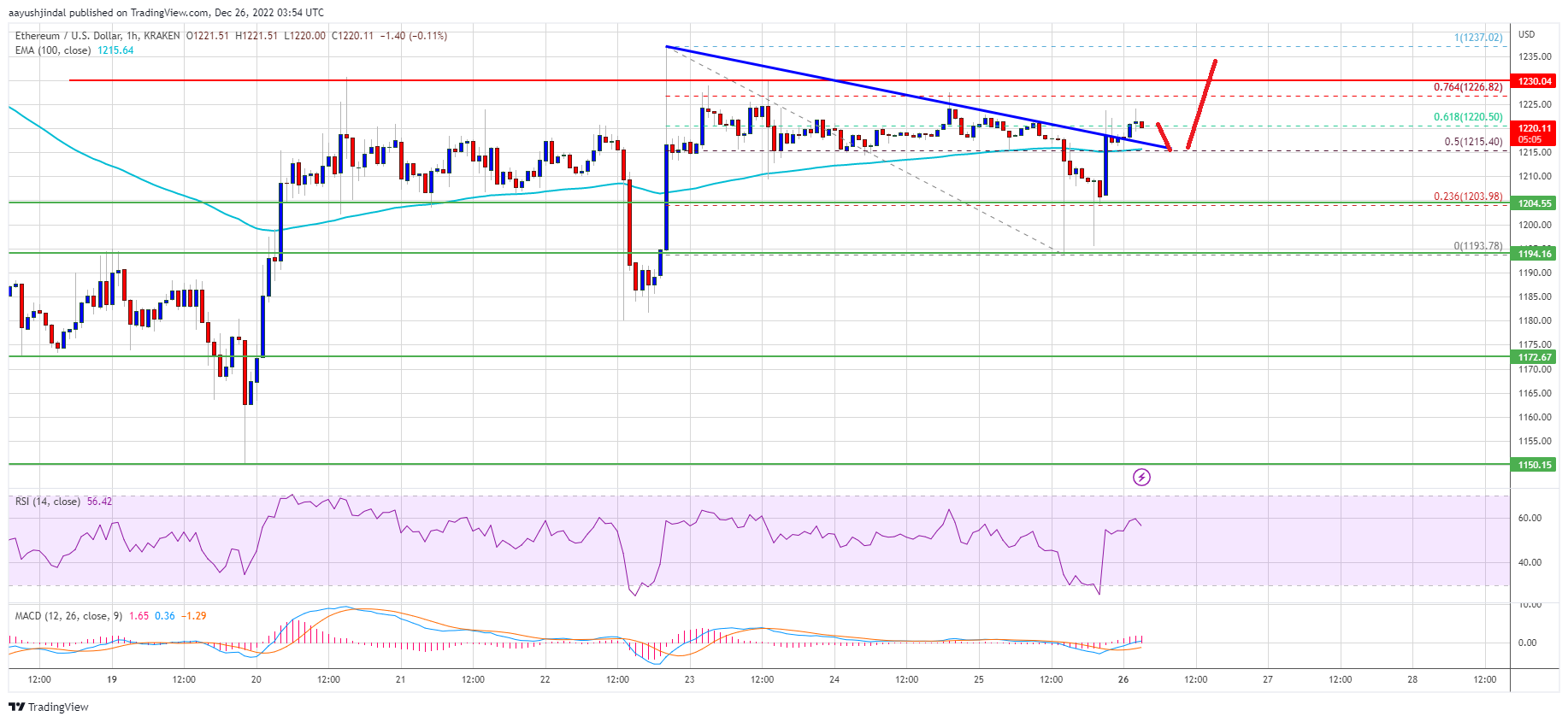
Ethereum Price

Source: ETHUSD on TradingView.com
“”

The next major resistance could be $1,350. If there is an upside break above the $1,350 resistance, the price might rise towards $1,400. Any more gains might send the price towards the $1,500 resistance zone.

“”

ETH Still In a Range?
“”

If ethereum fails to climb above the $1,230 resistance, it could start another drop. An initial support on the downside is near the $1,215 level and the 100 hourly simple moving average.
“”

The next major support is near the $1,200 level. The first major support is near the $1,190 level. A downside break below $1,190 might spark a move towards the $1,150 support. Any more losses could lead the price towards the $1,100 zone.

“”
Technical Indicators
“”

Hourly MACDThe MACD for ETH/USD is now gaining momentum in the bullish zone.
Hourly RSIThe RSI for ETH/USD is now above the 50 level.
Major Support Level – $1,190
Major Resistance Level – $1,230

Related Reads

World Cup Approaches, Prediction Markets Face a Major Test

The 2026 FIFA World Cup represents a major public test for sports prediction markets like Polymarket and Kalshi, which have grown significantly by offering tradable markets on event outcomes. This global event, hosted by the US, Canada, and Mexico, concentrates risks related to sports integrity, cross-border operations, and gambling ecosystems. A key concern is the potential for insider trading on non-public information (e.g., injuries, lineups), which could be exploited in granular prediction markets. FIFA's choice of its official prediction market partner, ADI Predictstreet, has raised significant doubts. The platform, relatively unknown, has faced scrutiny over the integrity of its executives—including past insider trading allegations and associations with a major EU corruption scandal—its rapid licensing in Gibraltar, and the fact its product was not yet live at the time of the announcement. This partnership begins with a "trust deficit." FIFA itself carries historical corruption baggage, and its deepening ties with betting and data industries fuel concerns about maintaining sporting integrity. While FIFA has established monitoring systems, their effectiveness against potential insider trading across decentralized global prediction markets remains unproven. Major US-based prediction platforms have updated rules to prohibit trading based on confidential information. However, the World Cup's complex ecosystem of federations, teams, and officials makes enforcement far more challenging than in domestic leagues. The event will not determine the fate of prediction markets but will critically test whether they can be integrated as a regulated event-trading infrastructure or remain a high-risk gambling-adjacent activity within global sports.

marsbit19m ago

World Cup Approaches, Prediction Markets Face a Major Test

marsbit19m ago

CLARITY Act Passes Crucial Hurdle, But a Long Road Remains Ahead

The CLARITY Act, a major U.S. digital asset market structure bill, has advanced from the Senate Banking Committee with a 15-9 bipartisan vote, ending a four-month legislative standstill. The bill's core aim is to resolve the long-standing jurisdictional conflict between the SEC and CFTC by clearly defining which digital assets are securities or commodities. It also establishes rules for exchanges and custodians while providing protections for non-custodial software developers and blockchain validators, shielding them from being classified as money transmitters. The committee's approval triggered a positive market reaction, with Bitcoin rising and crypto-related stocks outperforming the broader market. However, the passage was secured only after last-minute negotiations and compromises, including the addition of amendments on investor protection, bank activities, and defining "truly decentralized" DeFi projects. Two key Democratic senators provided the crucial swing votes but cautioned that their future support in a full Senate vote is not guaranteed. Significant hurdles remain. The bill must still pass the full Senate, requiring 60 votes, and a major point of contention is a Democratic demand for an ethics clause restricting financial ties between high-level government officials and crypto firms—a provision opposed by Republicans and the White House. Additionally, the bill must be reconciled with a version from the Senate Agriculture Committee. If not passed before the August congressional recess, the next viable legislative window might not open until 2030. The legislation also faced, and ultimately withstood, last-minute lobbying opposition from traditional banking groups concerned about deposit outflows to crypto. If ultimately enacted, the CLARITY Act would initiate a multi-year rulemaking process, with new regulations likely not taking full effect until 2027 or later. While a critical milestone, the path to becoming law remains a challenging race against time.

链捕手36m ago

CLARITY Act Passes Crucial Hurdle, But a Long Road Remains Ahead

链捕手36m ago

A Century Before Swift and Blockchain, China Built Its Own Cross-Border Financial Network

A century before Swift and blockchain, China's cross-border financial miracle: The Qiaopi Network. Driven by the phrase "a promise is greater than life," the Qiaopi (overseas Chinese remittance letter) system was a remarkable, entirely private financial network. Operating for over a hundred years until 1979, it facilitated billions in remittances, at one point constituting over 50% of China's foreign exchange during WWII—all without central banks, official clearing, or government backing. It began with "Shuike" (water guests), couriers who carried cash and letters personally between Southeast Asia and Chinese villages like Chaozhou. Their operation was peer-to-peer, identity-verified through kinship, and had a near-zero default rate, as trust was their sole collateral. This evolved into "Piju" (remittance houses), creating an institutional network. They ingeniously used currencies like the Hong Kong Dollar for settlement and practiced netting clearance, offsetting remittance flows against trade payments to minimize physical cash movement. Its resilience shone in wartime. When Japanese forces cut off main routes, the network forged an underground "Dongxing Remittance Path" through Vietnam. It used coded messages ("a bag of rice" for a sum of silver) to evade interception, reliably delivering funds critical for survival and even clandestine support for the war effort. Unlike Swift (built on state cooperation) or blockchain (relying on cryptography), Qiaopi was founded on clan,乡土 (native place), and human trust—a cultural consensus where违约 meant social death. Modern finance compensates for this lost trust with complex collateral and regulation. The Qiaopi network, powered only by sailing ships, familiar accents, and profound integrity, achieved a feat of decentralized, cross-border finance that remains unparalleled—a poignant story of信用 (trust/credit) in its purest form.

marsbit1h ago

A Century Before Swift and Blockchain, China Built Its Own Cross-Border Financial Network

marsbit1h ago

Trading

Spot
Futures
活动图片