'Metaverse’ a top 3 contender for Oxford’s Word of the Year

CointelegraphPublished on 2022-11-23Last updated on 2022-11-23

Abstract

Oxford University has opened public voting for the first time with polls set to close on Dec. 2.

The word “Metaverse” is one of three in the running to be crowned the Oxford "Word of the Year” (WOTY) in a competition run by the Oxford University Press (OUP), the publisher of the Oxford English Dictionary.

OUP officially announced the launch of the competition and its three finalist words for 2022 on Nov. 22 with this year marking the first time the public can participate in voting for the WOTY.

“Metaverse” will compete against the terms “#IStandWith” and “Goblin Mode”.
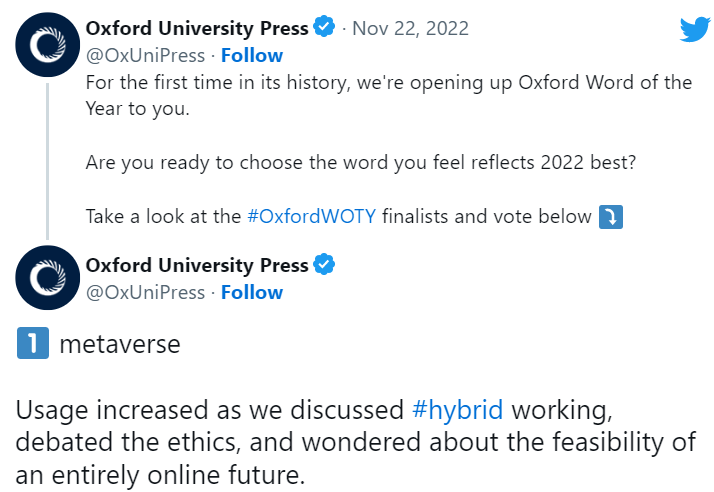
In OUP’s video pitch for the Metaverse, it described it as “a hypothetical virtual reality environment in which users interact with one another’s avatars and their surroundings in an immersive way.”

“The term dates back to the 1990s, with the first recorded use in the Oxford English Dictionary in 1992 in the science fiction novel Snow Crash by Neil Stephenson,” the video stated.

Oxford noted that "Metaverse" has quadrupled in usage in Oct. 2022 compared to that of Oct. 2021. The video stated that more lifestyle and work-related activities taking place in virtual reality environments may bring about “more debates over the ethics and feasibility of an entirely online future.”

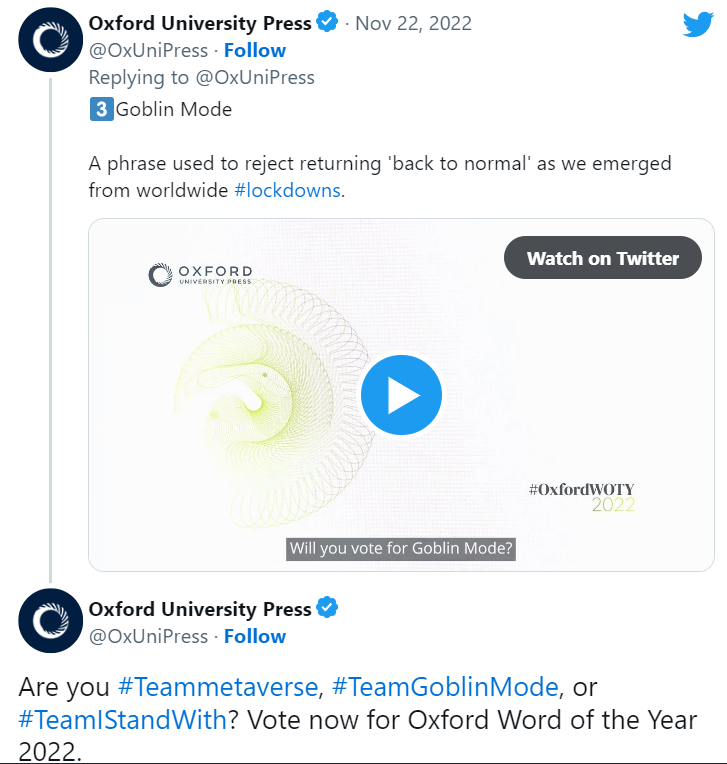
As for the other two WOTY candidates, “#IStandWith” has become an increasingly used phrase for political activism, while “Goblin Mode” emerged as a post-COVID-19 lockdown concept in which one rejects “returning back to normal” and instead does what they want to do.

As for how the three phrases were chosen, OUP stated that they ran an analysis on a language data system in order to narrow down the candidates to three.

In order to officially vote for “Metaverse” or the other two candidates, voters must cast their vote on Oxford Languages’ website.

Over 237,000 votes have been cast so far, with voting set to close Dec. 2.

Oxford did not state when the winning word would be announced.

In what could spell how the votes are panning out, at the time of writing a Twitter poll by OUP shows 63% of 929 voters favored "Goblin Mode", followed by "Metaverse" at 22% then "#IStandWith" at 15%:
Whatever the results of the poll, the Metaverse is predicted to be a significant industry in the near future, with a recent report by international consulting firm McKinsey estimating Metaverse-related technologies to be worth $5 trillion by 2030.

Investment bank Citi upped that prediction, saying the total addressable market for the Metaverse economy may fall within the range of $8-13 trillion over the same time frame.

The understanding of the Metaverse has been most significantly influenced by the blockchain and cryptocurrency industry, along with Meta CEO Mark Zuckerberg’s rebranding of Facebook to Meta in Oct. 2021 and its recent developments on its Metaverse products through its Reality Labs business.


Related Reads

TechFlow Intelligence: Trump-Linked Companies Transfer $12 Million in Assets Before China Visit, 'The Big Short' Protagonist Warns of Stock Market Bubble Again

The article reports multiple developments across tech, crypto, and finance. In AI, Mozilla used AI for large-scale code review, Google confirmed hackers used AI to find zero-day exploits, and OpenAI deployed GPT-5.5 to find errors in math benchmarks. A court ruled Anthropic's scanning and destroying books for AI training as fair use, while its Claude platform launched on AWS. Google's new video model 'Omni' was leaked. In crypto/Web3, Trump-linked companies transferred $12M in crypto assets before a China visit. BlackRock chose Ethereum for tokenized funds, and a hacker stole $174k via a malicious NFT that tricked an AI. Jack Dorsey's first tweet NFT plummeted from $2.9M to under $5. In chips/hardware, TSMC approved an additional $20B for its Arizona plant. Apple's Tim Cook and Elon Musk will accompany Trump to China, while Nvidia's Jensen Huang is notably absent. For markets, Michael Burry warned of parabolic stock rises and suggested near-total sell-offs, with online discussions comparing current sentiment to the 1999 bubble. Other notes include WTI oil surpassing $100, a 20% price hike for Beijing-Shanghai high-speed rail, and new products like Unitree's $26.9k humanoid robot. The underlying theme suggests AI is becoming infrastructure, creating pressure on old systems while a new order is not yet ready, leaving investors anxious.

marsbit24m ago

TechFlow Intelligence: Trump-Linked Companies Transfer $12 Million in Assets Before China Visit, 'The Big Short' Protagonist Warns of Stock Market Bubble Again

marsbit24m ago

2026 New Policy Interpretation: The "Mutual Pursuit" of Intelligent Agents and AI Terminals, and the Three Major Value Reconstructions in the AIoT Industry

In May 2026, China's national ministries released two pivotal policy documents that jointly establish a strategic "dual-track" framework for the AIoT industry. The "Intelligent Agent Standardized Application and Innovation Development Implementation Opinions" defines the "soul"—positioning intelligent agents as core AI products. The "Artificial Intelligence Terminal Intelligence Grading" national standard defines the "body"—establishing a four-tier capability ladder (L1 to L4) for AI hardware. This synchronized policy approach is globally unique, moving beyond market-led (US) or risk-focused (EU) models. It frames AIoT as a new type of "intelligent infrastructure," comparable to electricity or the internet in historical significance. The core analysis identifies a value evolution from IoT 1.0 (connection) to AIoT 4.0 (collaboration, represented by the forward-looking L4 level). This "L4" signifies a paradigm shift: from users operating tools to delegating tasks to agent-like devices ("Intelligent Action of All Things"). The article outlines three strategic paths for companies: becoming Standard Definers, Scenario Integrators (focusing on 19 specified application areas), or Infrastructure Builders. A critical 18-24 month window is identified for strategic positioning. A "Four Levers" strategy is proposed: leveraging Standards (L-level certification), leveraging Scenarios (deep vertical focus), leveraging Open Source (for cost reduction and ecosystem influence), and leveraging Momentum (engaging in global protocol ecosystems). In conclusion, these policies are a starting gun for a decade-long industrial transformation, shifting the industry narrative from "Intelligent Connection of All Things" to "Intelligent Action of All Things," with companies needing to choose their赛道and execution strategy decisively.

marsbit1h ago

2026 New Policy Interpretation: The "Mutual Pursuit" of Intelligent Agents and AI Terminals, and the Three Major Value Reconstructions in the AIoT Industry

marsbit1h ago

Trading

Spot
Futures
活动图片



