Ethereum bears have the upper hand according to derivatives data, but for how long?

CointelegraphОпубліковано о 2022-11-23Востаннє оновлено о 2022-11-23

Анотація

ETH bears continue to suppress Ethereum price, but institutional traders’ buying activity and exchanges’ aiming to provide more transparency could improve investor sentiment.

Ether price experienced an 11.9% decline from Nov. 20 to Nov. 22, bottoming at $1,074 — the lowest level seen since July. Currently, investors have reason to be concerned after crypto lending company Genesis reportedly faced difficulties raising money, triggering rumors of insolvency on Nov. 21.

However, a spokesperson for Genesis told Cointelegraph that there were no plans for imminent bankruptcy because the company continues to hold discussions with its creditors.

Unease about the centralization of decentralized finance (DeFi) surfaced after Uniswap Labs changed the privacy policy on Nov. 17, revealing that it collects publicly-available blockchain data, users' browser information, operating systems data and interactions with its service providers.

Adding to the fracas, the hacker behind the FTX exchange theft of $447 million has been spotted moving their Ether funds. On Nov. 20, the attacker transferred 50,000 ETH to a separate wallet and converted it to Bitcoin using two renBTC bridges.

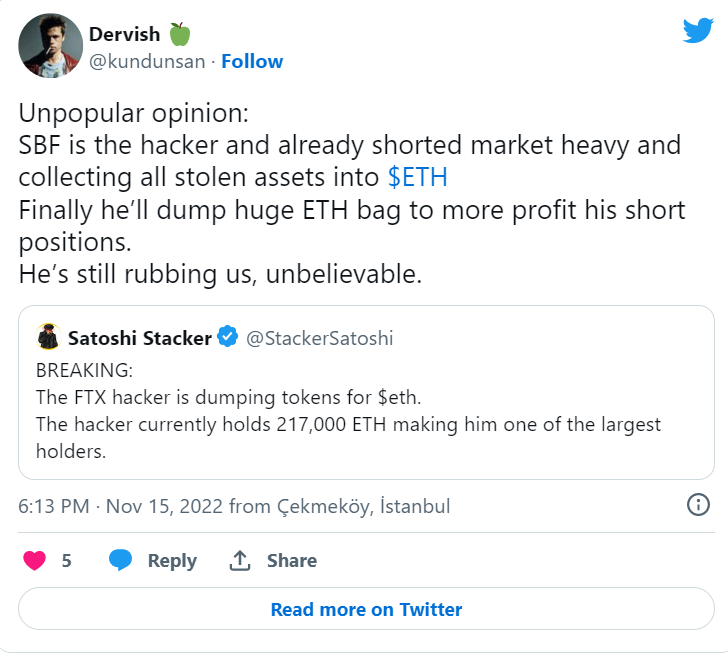
Traders fear that the hacker might be suppressing Ether's price to profit using leveraged short bets. The rumor was raised by @kundunsan on Nov. 15, even though the Twitter post did not gain exposure.
Let's look at Ether derivatives data to understand if the worsening market conditions have impacted crypto investors' sentiment.

Pro traders have been in panic mode since Nov. 10

Retail traders usually avoid quarterly futures due to their price difference from spot markets, but they are professional traders' preferred instruments because they prevent the fluctuation of funding rates that often occurs in a perpetual futures contract.
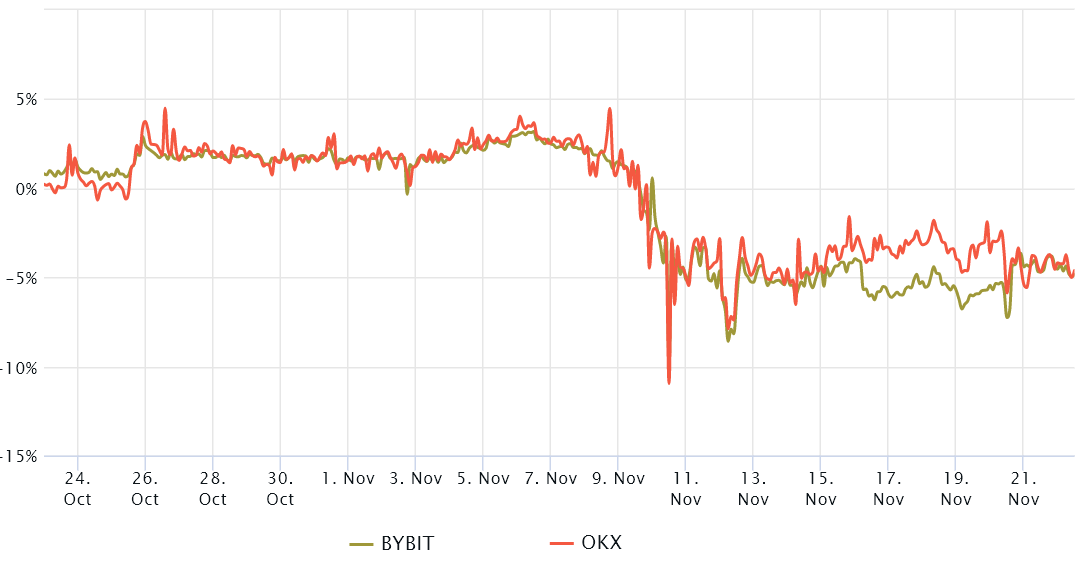
The three-month futures annualized premium should trade between +4% to +8% in healthy markets to cover costs and associated risks. The chart above shows that derivatives traders have been bearish since Nov. 10 since the Ether futures premium was negative.

Currently there is backwardation in the contracts and this situation is atypical and usually deemed bearish. The metric did not improve after ETH rallied 5% on Nov. 22, reflecting professional traders' unwillingness to add leveraged long (bull) positions.

Traders should also analyze Ether's options markets to exclude externalities specific to the futures instrument.

Options traders fear additional crashes

The 25% delta skew is a telling sign when market makers and arbitrage desks are overcharging for upside or downside protection.

In bear markets, options investors give higher odds for a price dump, causing the skew indicator to rise above 10%. On the other hand, bullish markets tend to drive the skew indicator below -10%, meaning the bearish put options are discounted.
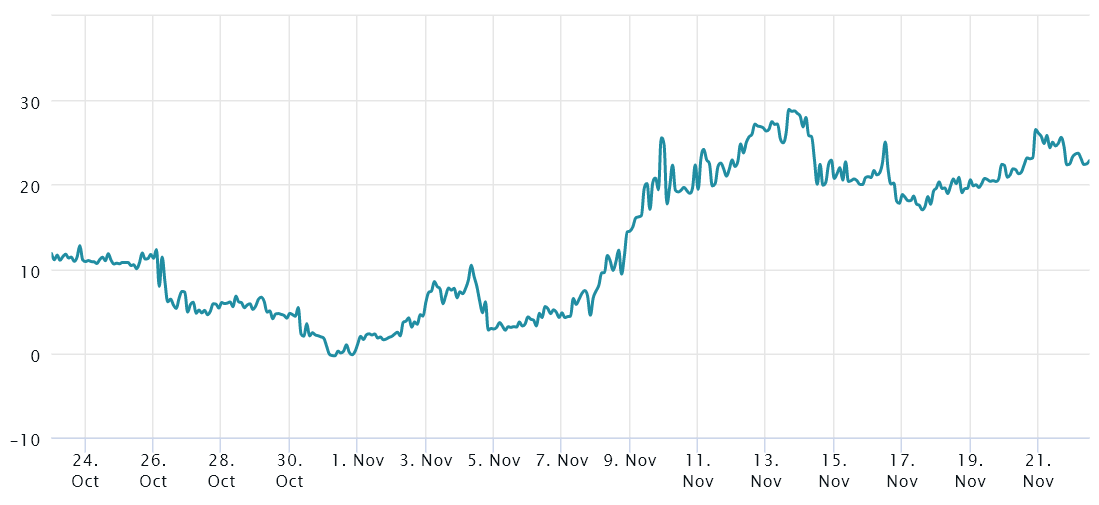
The delta skew has been above the 10% threshold since Nov. 9, signaling that options traders were less inclined to offer downside protection. The situation worsened over the following days as the delta skew indicator surged above 20%.

The 60-day delta skew currently stands at 23%, so whales and market makers are pricing higher odds of price dumps for Ether. Consequently, derivatives data shows low confidence right as Ether struggles to hold the $1,100 support.

According to the data, Ether bulls should not throw in the towel just yet because these metrics tend to be backward-looking. The panic that followed FTX's bankruptcy and the subsequent liquidity issues at Genesis might dissipate quickly if exchanges public proof of reserves and institutional investors addingBitcoin exposure during the dip are interpreted as positives by market participants.

With that said, at the moment Ether bears still have the upper hand according to ETH derivatives metrics.


Трендові криптовалюти

Пов'язані матеріали

When 8 Million ETH Start 'Moving': The Post-Pectra Era Ushers in a Structural Transformation for Staking?

A major shift is underway in Ethereum staking, as Lido begins migrating over 8 million ETH (worth ~$16B) from traditional validators to a new architecture enabled by the Pectra upgrade. This migration involves consolidating over 265,000 legacy validators (using 0x01 withdrawal credentials) into a smaller number of higher-balance "0x02" validators, potentially reducing the total validator count on Ethereum by nearly a third. The core driver is EIP-7251 from the Pectra upgrade, which introduced "compounding validators." These allow a single validator's effective balance to grow up to 2048 ETH, with staking rewards automatically reinvested to compound earnings. This contrasts with the old model, where rewards exceeding 32 ETH were automatically sent to a withdrawal address, creating idle funds and operational complexity for reinvestment. While the direct APR boost from compounding is modest—estimated at a ~4.7% relative improvement for smaller validators—the structural benefits are significant. For large operators like Lido, the primary value is operational efficiency: managing fewer validators reduces node, key management, and network message overhead. For smaller individual stakers, the upgrade lowers the barrier to reinvestment by eliminating the need to manually accumulate 32 ETH for new validators. The migration signifies a deeper change in Ethereum's staking landscape. Competition is evolving beyond simple yield, focusing instead on capital efficiency, liquidity management, risk distribution, and infrastructure optimization. Lido's parallel move to require node operator security deposits further highlights this shift towards more robust, capital-backed services. Ultimately, Pectra's compounding validators represent a key step in maturing Ethereum's staking lifecycle, moving the ecosystem from standardized yield products towards more sophisticated capital management and infrastructure solutions.

marsbit14 хв тому

When 8 Million ETH Start 'Moving': The Post-Pectra Era Ushers in a Structural Transformation for Staking?

marsbit14 хв тому

Double Long Hynix ETF Plummets, Halved and Halved Again

On July 29th, shares of South Korean semiconductor firm SK Hynix plummeted over 19% intraday, marking its largest single-day drop on record. The Hong Kong-listed "CSOP SK Hynix Daily Leveraged (2x) Product" (Stock Code: 07709) tumbled more than 28% intraday before closing 13.99% lower at HK$32.70. This leveraged product, designed to deliver twice the daily return of SK Hynix, has seen a catastrophic decline of over 80% from its June 25th high of HK$193.65, far exceeding the underlying stock's roughly 50% drop from its peak. Its assets under management have shrunk dramatically, falling over 70% from a high of HKD 130 billion in June to approximately HKD 31.9 billion. This steep sell-off occurred despite SK Hynix reporting stellar Q2 2026 earnings, with revenue and operating profit surging 257% and 557% year-over-year, respectively. However, the results fell short of market expectations. Analysts cited concerns about potential oversupply from expansion and noted that long-term supply agreements for its high-bandwidth memory (HBM) chips might limit near-term price increases. In response to heightened volatility and regulatory changes, the product's issuer, CSOP Asset Management, announced a transition to a "flexible leverage mechanism" starting August 3rd. Under new Hong Kong SFC rules, the fund's daily leverage multiplier can now be dynamically adjusted between 1.1x and 2x (or -1.1x to -2x for inverse products) based on market conditions, moving away from a fixed 2x target. The fund's name will also be changed to clarify its nature as a daily trading tool unsuitable for long-term holding. Experts warn that this change means investors can no longer assume constant 2x returns and must check the disclosed leverage ratio daily.

marsbit30 хв тому

Double Long Hynix ETF Plummets, Halved and Halved Again

marsbit30 хв тому

Торгівля

Спот

Популярні статті

Як купити UNI

Ласкаво просимо до HTX.com! Ми зробили покупку Uniswap (UNI) простою та зручною. Дотримуйтесь нашої покрокової інструкції, щоб розпочати свою криптовалютну подорож.Крок 1: Створіть обліковий запис на HTXВикористовуйте свою електронну пошту або номер телефону, щоб зареєструвати обліковий запис на HTX безплатно. Пройдіть безпроблемну реєстрацію й отримайте доступ до всіх функцій.ЗареєструватисьКрок 2: Перейдіть до розділу Купити крипту і виберіть спосіб оплатиКредитна/дебетова картка: використовуйте вашу картку Visa або Mastercard, щоб миттєво купити Uniswap (UNI).Баланс: використовуйте кошти з балансу вашого рахунку HTX для безперешкодної торгівлі.Треті особи: ми додали популярні способи оплати, такі як Google Pay та Apple Pay, щоб підвищити зручність.P2P: Торгуйте безпосередньо з іншими користувачами на HTX.Позабіржова торгівля (OTC): ми пропонуємо індивідуальні послуги та конкурентні обмінні курси для трейдерів.Крок 3: Зберігайте свої Uniswap (UNI)Після придбання Uniswap (UNI) збережіть його у своєму обліковому записі на HTX. Крім того, ви можете відправити його в інше місце за допомогою блокчейн-переказу або використовувати його для торгівлі іншими криптовалютами.Крок 4: Торгівля Uniswap (UNI)Легко торгуйте Uniswap (UNI) на спотовому ринку HTX. Просто увійдіть до свого облікового запису, виберіть торгову пару, укладайте угоди та спостерігайте за ними в режимі реального часу. Ми пропонуємо зручний досвід як для початківців, так і для досвідчених трейдерів.

469 переглядів усьогоОпубліковано 2024.12.12Оновлено 2026.06.02

Як купити UNI

Обговорення

Ласкаво просимо до спільноти HTX. Тут ви можете бути в курсі останніх подій розвитку платформи та отримати доступ до професійної ринкової інформації. Нижче представлені думки користувачів щодо ціни UNI (UNI).

活动图片