1. BTC local turnover rate increased
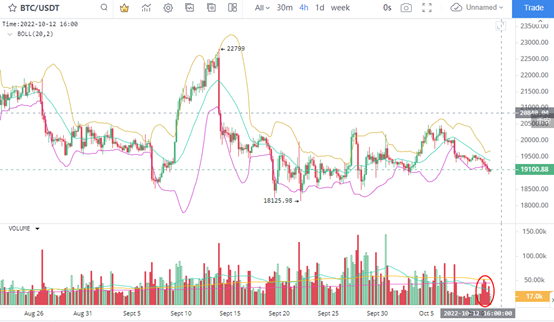
BTC's 4-hour K chart shows that although the recent price decline is limited, the trading volume has obviously rebounded. That is to say, BTC has a clear volume signal in the local price range, driving the price to lower prices. This shows that investors began to gradually increase the trading frequency at the decline stage, but did not obtain the corresponding low suction returns. Therefore, short-term investors can be the driving factor for BTC to decline.
2. BTC whale selling remains high
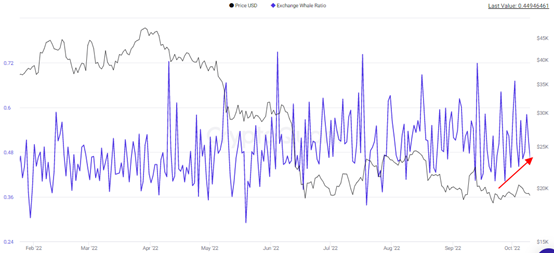
Recently, the proportion of BTC's whale sales has remained at a high level, and the value in the shock remained around 0.48, which means that BTC still faces great downward pressure. Although BTC's recent decline is limited, it is already the seventh trading day in the adjustment stage. At the same time, BTC dropped to about 19000 US dollars, and the rebound has not been confirmed. At present, the possibility of effective support under BTC is reduced, and attention is paid to the risk of sign retreat.
3. The trend of ETH is sluggish, seeking for further exploration
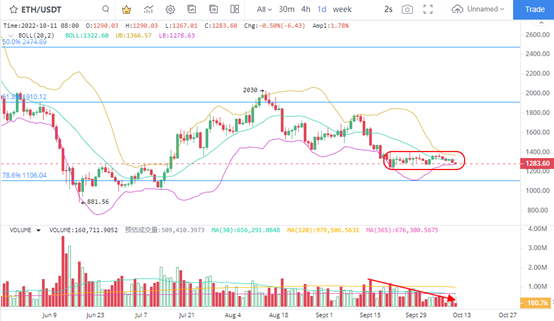
In terms of the daily K line, the ETH price continued to fall, and the closing price did not drop much, but the trend of downturn continued. At present, ETH maintains horizontal operation at the platform of 1280 dollars, and the horizontal trading time has reached 20 trading days, indicating that ETH still tends to shrink. In terms of trading volume, the current low trading volume suggests that investors are less enthusiastic about entering the market, and they still need to pay attention to the downside risk when holding currencies.
4. ETH multi empty ratio is still lower than 1
The strength of the long contract relative to the short contract is still low. After the long short ratio reached 0.897 on October 8, the value is still lower than 1. From October 9 to October 11, the long short ratio of ETH was 1.001, 0.951 and 0.932. According to this judgment, the strength of short sellers has obviously occupied an advantage, making it possible for ETH to break its position and fall for some time. Before ETH continues to fall below $1200, we have to pay attention to the position risk.
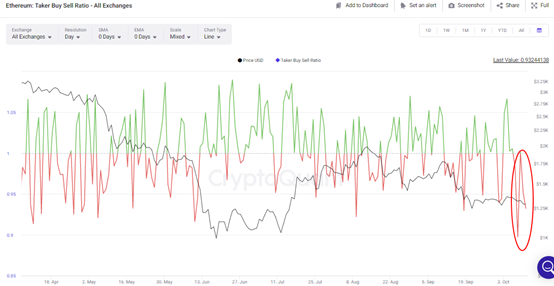
5. The overall market position rebounded
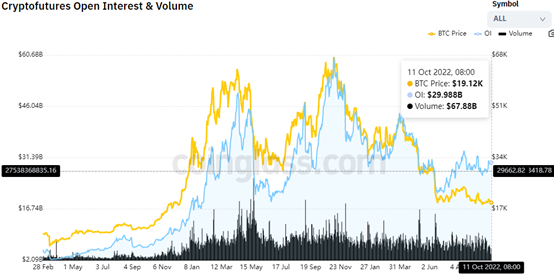
Recently, although the market is in the adjustment stage, the position data has not dropped significantly, but maintained at a short-term high. Numerically, the overall position data displayed on October 11 remained at $29.98 billion, the highest level since May. According to this judgment, although BTC, ETH and other mainstream currencies are in a weak operation stage, the market is on the eve of change. Therefore, in view of the low volatility of BTC and ETH at present, it may already be an important position for position adjustment to anticipate price fluctuation.