ETHW: 90% miners may go bankrupt as forked network sees a rocky start

AmbcryptoPublished on 2022-09-18Last updated on 2022-09-18

Abstract

Sequel to its launch on the mainnet on 15 September, the proper take-off of the forked Ethereum Proof-of-work (ETH-PoW) has been hindered by glitches. As a result, the post-Merge PoW blockchain remains inaccessible just two days after its launch.

Sequel to its launch on the mainnet on 15 September, the proper take-off of the forked Ethereum Proof-of-work (ETH-PoW) has been hindered by glitches. As a result, the post-Merge PoW blockchain remains inaccessible just two days after its launch.

""

In an interview on 16 September, Ethereum miner Chandler Guo made some bold claims about ETHW miners. Guo happens to be the one who led the push for the fork of the Ethereum mainnet network. Chandler Guo confirmed that according to him, 90% of miners on the forked network might go bankrupt. He stated.

""

“Some people (miners) have free electricity and can (continue) to work on that. The other 90%, bankrupt.”

""

ETH-PoW since launch

""

After the transition of Ethereum into a PoS network, the forked network launched on the mainnet. This happened so that miners could continue their work on a PoW consensus mechanism.

""

As per additional data, 1,715,991,282 transactions have been processed on the network since the Merge. However, at press time, 204,368 transactions were pending approval on the chain.

""

Transactions worth 9.54 billion ETHW have been processed on the PoW blockchain since the mainnet launch on 15 September. Further data from OKLink revealed that total addresses on the network stood at 254,528,549, with 9,104 addresses added in the last 24 hours.

""

Active addresses on the network at press time were 46,616, having logged a 56% decline in the last 24 hours. Furthermore, 86,516,070 addresses currently hold the native token (ETHW) of the chain. The number of addressed witnessed an addition of 798 in the last 24 hours.

""

ETHW – much ado about nothing?

""

According to data from CoinMarketCap, ETHW exchanged hands at $10.37. Since the mainnet launch two days ago, the price of the forked asset has declined by a massive 234%.
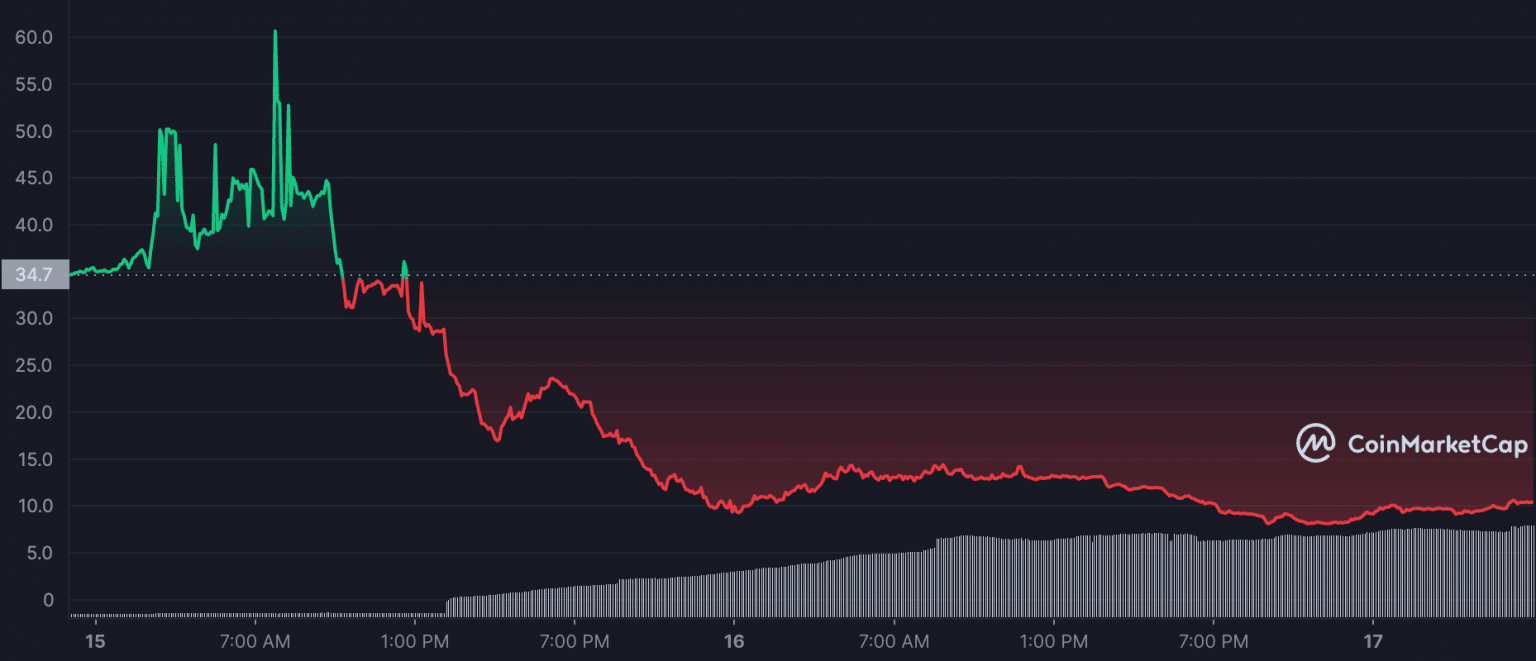
Source: CoinMarketCap

""

In the last 24 hours, ETHW posted a 10% drop in its price. However, within the same period, data from CoinMarketCap revealed a 44% rally in the trading volume of the forked coin. This sort of price-volume divergence indicates buyers’ exhaustion and is a precursor to a continued decline in the price of a cryptocurrency asset.

""

On a daily chart, the ETHW was significantly oversold. The Relative Strength Index (RSI) was positioned at 21. The asset’s Money Flow Index (MFI) was pegged at 14. With a severe decimation to buying pressure, ETHW’s Chaikin Money Flow (CMF) was pegged at -0.49 as of this writing.
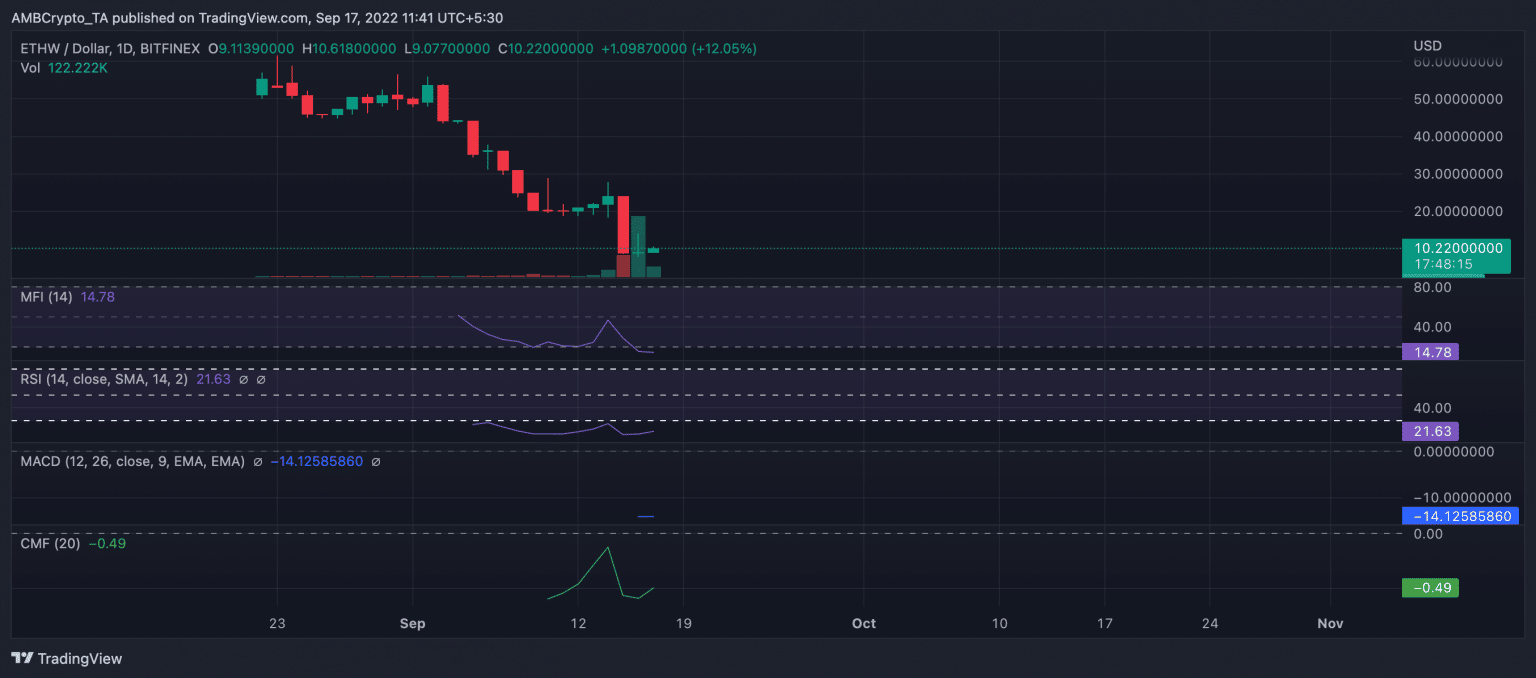
Source: TradingView

""

The spots occupied by these key indicators point at one thing – a heavy distribution of ETHW.

Related Reads

This Chip Sector Is on Fire

The global AI chip market is undergoing a significant paradigm shift, with ASICs (Application-Specific Integrated Circuits) emerging from a niche to a mainstream force, challenging the long-held dominance of GPUs in AI training. This "golden era" for ASICs is primarily driven by the industry's pivot from training to inference, where the cost and energy efficiency advantages of custom chips become critical for scaling to billions of users. Key signals include Google's TPU capturing 78% of its AI server shipments in Q1 2026, OpenAI's plans for a massive custom ASIC cluster with Broadcom, and cloud providers (CSPs) increasingly favoring in-house or custom designs for supply chain control and cost efficiency. Market forecasts are bullish: AI ASIC revenue is projected to hit $300 billion by 2027, with a 34% CAGR, potentially reaching a 45% share of the AI chip market. The competitive landscape is expanding beyond traditional leaders Broadcom and Marvell. MediaTek is aggressively targeting the data center ASIC market, projecting over $10 billion in 2026 revenue, while Qualcomm, leveraging its AlphaWave acquisition, is launching customized inference chips. These mobile chip giants are leveraging their SoC design expertise for a cloud-side transition. In China, companies like VeriSilicon and ASR Microelectronics are capitalizing on this trend as pivotal "enablers," providing full-stack ASIC design services and experiencing explosive order growth, particularly for cloud-side AI projects. However, challenges remain: high development costs, software ecosystem gaps compared to NVIDIA's CUDA, dependency on advanced packaging capacity (like TSMC's CoWoS), and the fundamental trade-off between customization and flexibility. The future is not a simple replacement of GPUs by ASICs but a more specialized coexistence. The consensus points toward "GPUs for training, ASICs for inference," or hybrid clusters. Ultimately, the rise of ASICs represents a democratization of computing power, shifting definition authority from a single chip giant to a broader ecosystem of cloud providers and end-users, offering the industry more choice in the silicon that powers AI.

marsbit8m ago

This Chip Sector Is on Fire

marsbit8m ago

Trading

Spot
Futures
活动图片