Bitcoin price crashed amidst wider sell off, this could be the next stop

newsbtcPubblicato 2022-09-15Pubblicato ultima volta 2022-09-15

Introduzione

Bitcoin price plunged close to 8% over the past day owing to the high Consumer Price Index report. The prices of most altcoins fell on their respective charts after the...

Bitcoin price plunged close to 8% over the past day owing to the high Consumer Price Index report.
""

The prices of most altcoins fell on their respective charts after the CPI showed a 0.1% increase in August, which has now taken the unadjusted value to 8.3%.
""

The annual increase was expected to be 8.1%. Over the last 24 hours, Bitcoin registered a 4% loss.
""

Given that the market is undergoing an extended sell-off, a further fall in BTC’s value could be expected. The technical outlook for the coin was bearish as buyers left the market at the time of writing.
""

Bitcoin price has been struggling at $18,900 for the past month, but it has managed to break through this price level in the last week.
""

Bitcoin has soared past the $22,000 level. The recent blow from the CPI report has pushed the coin downwards.
""

Indicators have chosen to side with the bears given how sellers are dominating the market at press time. The global cryptocurrency market cap today is at $1.04 trillion, with a 2.5% negative change in the last 24 hours.
""

Bitcoin Price Analysis: One Day Chart
Bitcoin Price

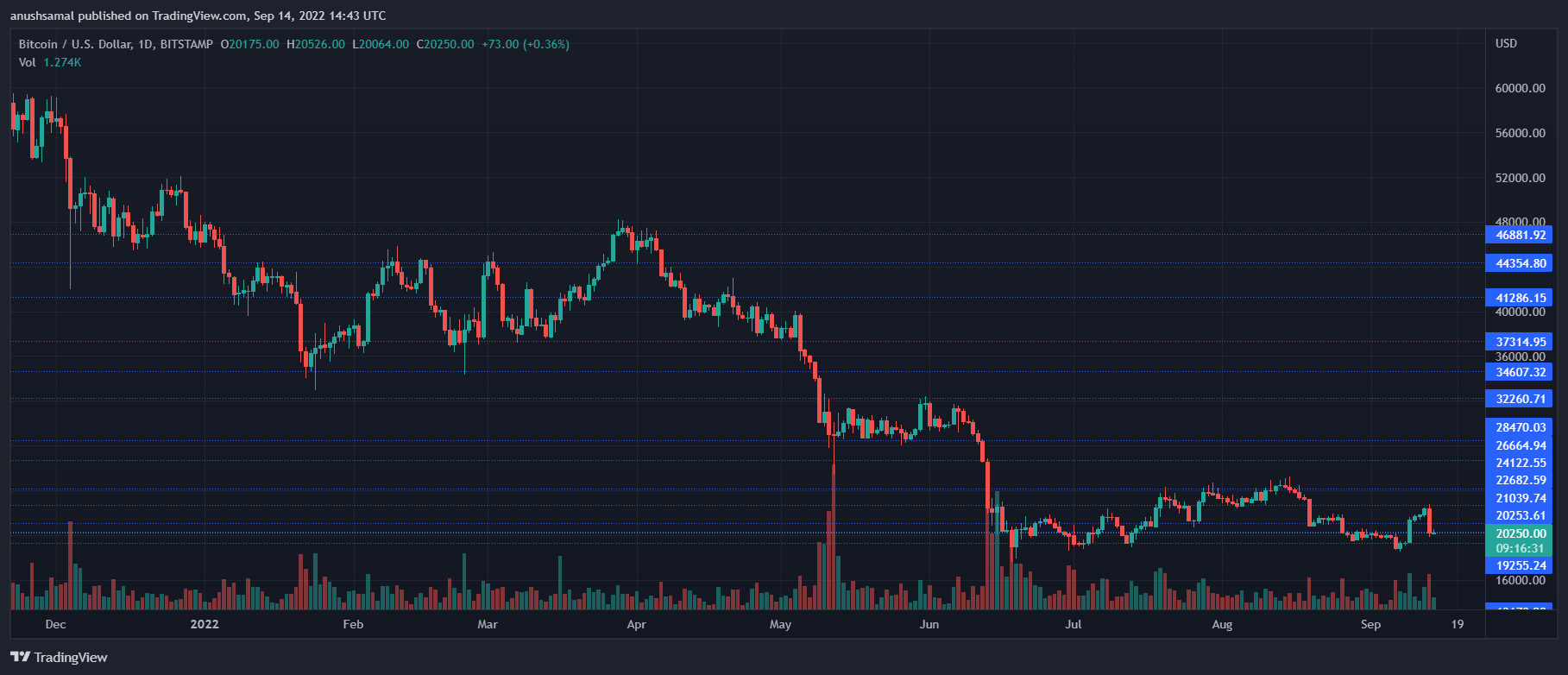
Bitcoin was priced at $20,200 on the one-day chart | Source: BTCUSD on TradingView

""

BTC was trading at $20,200 at the time of writing. The plunge from the $22,000 mark was sudden due to the unanticipated number from the CPI report.
""

Immediate resistance for Bitcoin price was at the $21,000 mark. If BTC manages to topple this level, it can get back to trading above the $22,000 price mark.
""

Local support for BTC was at $19,200. However, with the intense sell-off, the coin could fall to trade near the $18,900 support line.
""

The amount of Bitcoin traded in the past session grew slightly, indicating that there was an influx of buying strength.
""

Technical Analysis
Bitcoin Price

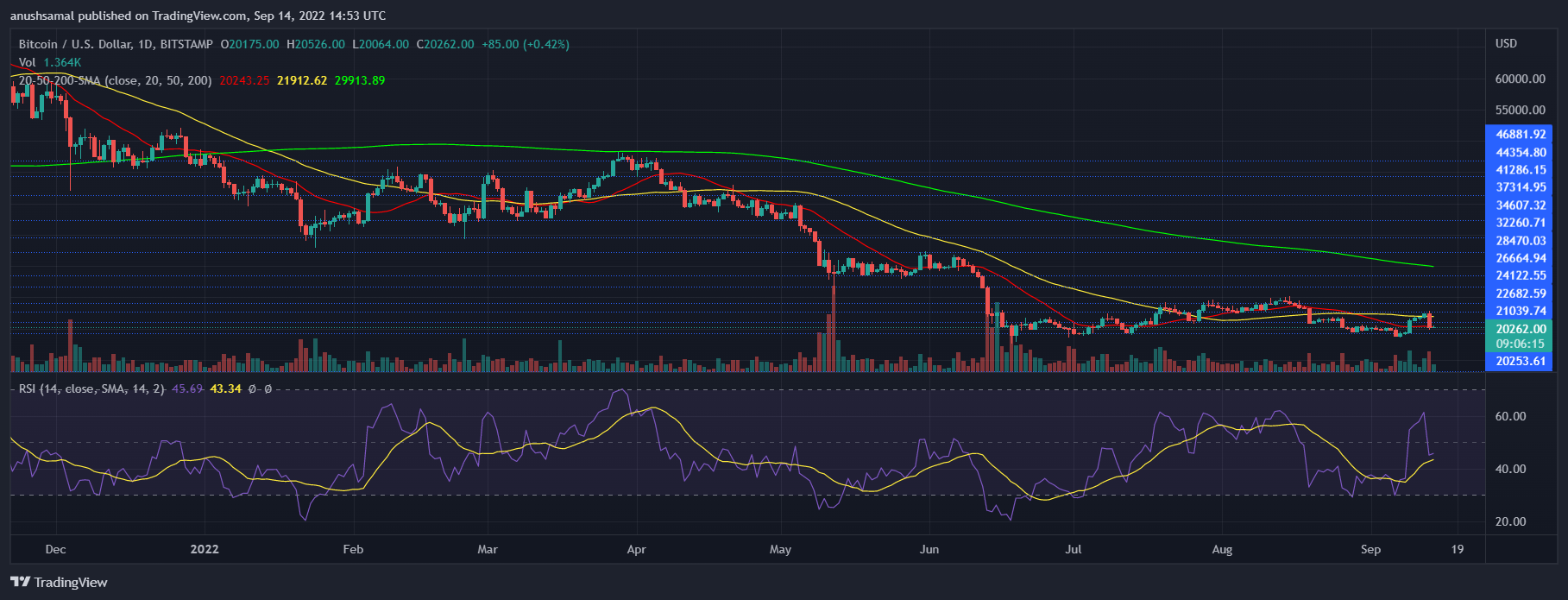
Bitcoin displayed a small uptick in the number of buyers on the one-day chart | Source: BTCUSD on TradingView

""

BTC has registered a sharp fall in buying strength over the last 24 hours. This fall in buyers has further pushed the price near the nearest support line.
""

The Relative Strength Index was seen below the half-line, indicating strong selling strength and, therefore, bea""rishness.

Over the past few trading sessions, RSI noted a small uptick, indicating that the buying strength increased slightly.
""

Bitcoin price just fell through the 20-SMA line, which was also a sign that sellers were driving the price momentum in the market.
Bitcoin Price

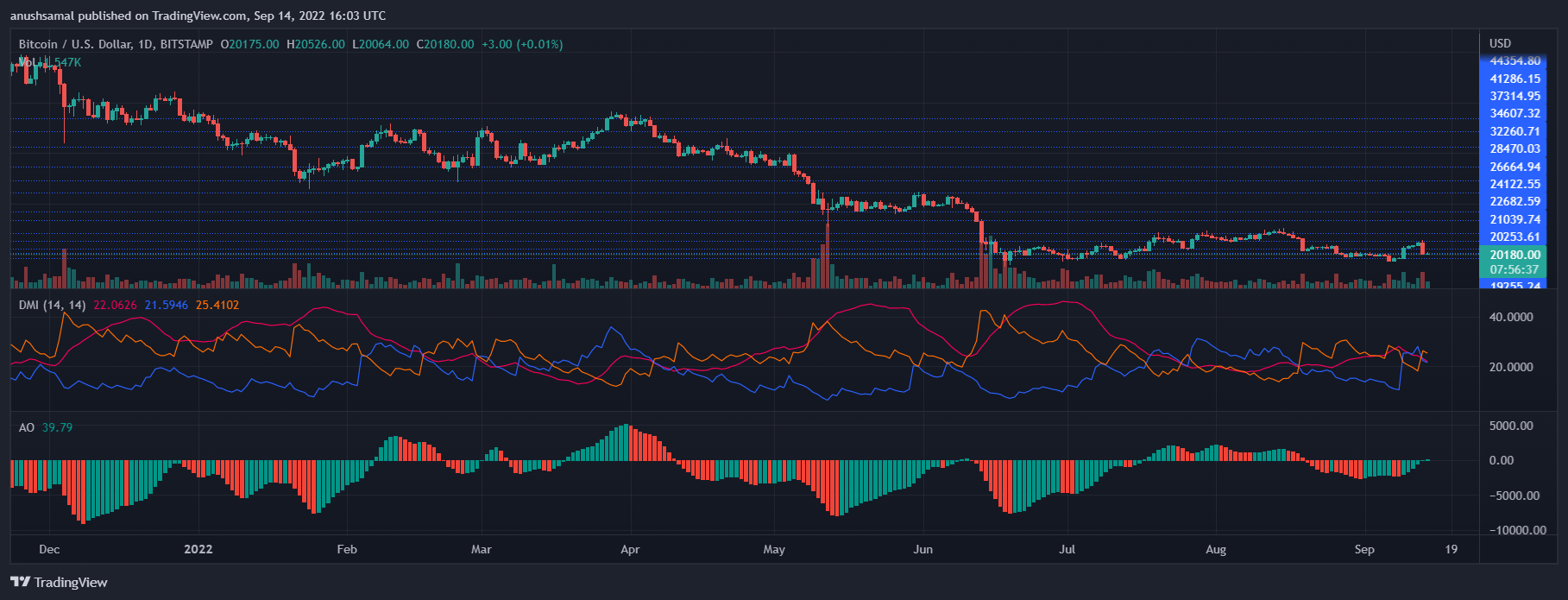
Bitcoin registered buy signal on the one-day chart | Source: BTCUSD on TradingView

""

BTC displayed buy signal despite the market registering a tiny buy signal after buying strength displayed an appreciation.
""

The Awesome Oscillator depicts the overall market strength and the direction of the price. AO climbed above the half-line, indicating that buyers could act on this price action.
""

Even if buyers act on the buy signal, the price of the asset would hardly notice an upward movement. The Directional Movement Index signals the price direction and momentum.
""

DMI was negative as the -DI (orange) line was above the +DI (blue) line. The Average Directional Index (red) was above the 20 mark, which means that the present price direction has gathered strength.


Letture associate

Jito Revives with New Exchange JTX Buyback: Self-Salvation or Lifeline?

Jito, a Solana-based MEV and liquid staking infrastructure protocol, has announced new governance proposal JIP-38 and the launch of a new self-custody trading platform, JTX. The proposal establishes a rigid value-capture mechanism, mandating that 100% of the DAO's share of revenue from JTX—80% of its platform fees—will be used for programmatic, on-chain verifiable open market buybacks and permanent burns of the JTO token. This commitment is set to last at least from JTX's launch until Q4 2027. The move comes as Jito faces significant challenges in its core liquid staking market, with protocol-staked SOL declining from 18 million to under 10 million. Intense competition from protocols like Sanctum and Jupiter, coupled with continuous monthly token unlocks (1.15% of max supply), has pressured JTO's price, which fell over 96% from its all-time high to a low of $0.21 earlier this year, before recovering to around $0.63. JIP-38 formalizes Jito Network as a "token-centric" network, where all major revenue streams flow to the DAO for governance by JTO holders. While the JTX buyback is a firm commitment using new revenue, decisions on other income streams and the post-2027 strategy will be determined by future governance votes. The proposal is seen as a strategic pivot to create a new revenue source and directly align token value with ecosystem growth, though its success depends heavily on JTX's ability to compete effectively in the crowded Solana trading landscape.

Foresight News16 min fa

Jito Revives with New Exchange JTX Buyback: Self-Salvation or Lifeline?

Foresight News16 min fa

The More Proficient AI Becomes at Answering, Why Do Humans Need Deep Thinking More? Fudan Releases the 2026 Blue Book on Intelligent Development in Humanities and Social Sciences

As AI capabilities rapidly expand, particularly in generating sophisticated text, analyzing data, and automating complex tasks, the need for human deep thinking becomes more critical, not less. The "2026 Blue Paper on Intelligent Development for Humanities and Social Sciences" from Fudan University argues that the relationship between AI and these fields is shifting from "one-way empowerment" to "bidirectional fusion." While AI transforms research methodologies, the humanities must guide its purpose, application, and governance. The core challenge is no longer processing vast information, but defining worthwhile problems, establishing genuine causal mechanisms, and constructing verifiable evidence chains. AI excels at producing coherent, fluent outputs but risks oversimplifying complex social realities into standardized formats it can easily process. For instance, in areas like climate-society systems, the difficulty lies not in handling more variables, but in understanding the fundamental mismatches between natural and social systems. Similarly, in automated research, AI can efficiently search for statistically significant results or generate papers quickly, potentially masking flawed assumptions or "packaging" statistical noise as discovery. The speed of paper production does not equate to the speed of genuine knowledge advancement. This underscores the non-transferable human responsibility for judgment. Deep thinking must be embedded into research workflows, governance systems, and organizational structures. Key principles include: * **Maintaining the Evidence Chain:** While AI can handle tasks like data processing, researchers must retain oversight over problem definition, conceptual translation into metrics, causal interpretation, and defining the scope of conclusions. Frameworks like STRIDES aim to document decisions and enable audit trails. * **Ensuring Meaningful Human Oversight:** In public governance, AI systems should operate in an "assistive" rather than an "agentic" mode. Human operators must retain genuine intervention, correction, and explanation rights to prevent "responsibility theater," where humans merely rubber-stamp algorithmic decisions. * **Translating Principles into Practice:** AI governance needs enforceable mechanisms across a system's lifecycle—pre-deployment risk assessment, runtime monitoring and human-in-the-loop controls, and post-hoc review and accountability—tailored to the level of risk involved. * **Defining Direction, Not Just Answers:** Humanities and social sciences provide the essential framework for navigating value conflicts (e.g., efficiency vs. fairness) and analyzing the social consequences of technology, questions AI alone cannot resolve. Building lasting capacity requires more than isolated projects. It demands integrated infrastructure—shared data standards, tools, interdisciplinary training, and collaborative mechanisms—as measured by initiatives like the "Chinese Universities AI4SSH Index." The ultimate imperative is clear: as AI becomes better at answering questions, humans must become more deliberate and responsible in deciding which questions are worth asking, critically evaluating the answers, and steering the technology's impact on society.

marsbit36 min fa

The More Proficient AI Becomes at Answering, Why Do Humans Need Deep Thinking More? Fudan Releases the 2026 Blue Book on Intelligent Development in Humanities and Social Sciences

marsbit36 min fa

Trading

Spot
活动图片