The More Proficient AI Becomes at Answering, Why Do Humans Need Deep Thinking More? Fudan Releases the 2026 Blue Book on Intelligent Development in Humanities and Social Sciences

marsbitPubblicato 2026-07-14Pubblicato ultima volta 2026-07-14

Introduzione

As AI capabilities rapidly expand, particularly in generating sophisticated text, analyzing data, and automating complex tasks, the need for human deep thinking becomes more critical, not less. The "2026 Blue Paper on Intelligent Development for Humanities and Social Sciences" from Fudan University argues that the relationship between AI and these fields is shifting from "one-way empowerment" to "bidirectional fusion." While AI transforms research methodologies, the humanities must guide its purpose, application, and governance. The core challenge is no longer processing vast information, but defining worthwhile problems, establishing genuine causal mechanisms, and constructing verifiable evidence chains. AI excels at producing coherent, fluent outputs but risks oversimplifying complex social realities into standardized formats it can easily process. For instance, in areas like climate-society systems, the difficulty lies not in handling more variables, but in understanding the fundamental mismatches between natural and social systems. Similarly, in automated research, AI can efficiently search for statistically significant results or generate papers quickly, potentially masking flawed assumptions or "packaging" statistical noise as discovery. The speed of paper production does not equate to the speed of genuine knowledge advancement. This underscores the non-transferable human responsibility for judgment. Deep thinking must be embedded into research workflows, governance s...

Once, our expectations of AI were quite simple: writing emails, translating papers, being a chat buddy... Back then, AI was like a green intern, doing exactly as told but often spouting nonsense with a straight face.

In recent years, AI development has surged forward like a tidal wave.

It is no longer content with just writing a few paragraphs for people; it has started taking over entire workflows: writing code, researching information, conducting analysis, generating proposals, and even breaking down tasks, calling tools, arranging steps, and checking results on its own.

Along with this came many amusing and ironic changes. The AI developed by programmers began taking over some of the work originally done by programmers themselves; many white-collar positions also found AI sitting at the desk next door.

The situation in academia is even more interesting. AI has greatly lowered the barrier to writing academic papers. Without needing to understand academic ideals, it can format papers with impressive solemnity.

Thus, some have begun mass-producing papers and mass-submitting them. Overworked reviewers use AI to assist in reviewing; authors, discovering this, embed prompts in their papers that are easily recognized only by machines, hoping the review AI will give positive evaluations. All participants save time, but whether knowledge itself has increased remains a matter of debate.

But the problem lies precisely here: Are we getting more knowledge, or more things that merely look like knowledge? As more and more work can be handed over to AI, what is left for humans?

The 2026 Blue Book on Intelligent Development in Humanities and Social Sciences released by Fudan University attempts to address these very questions.

Compared to the first edition, which primarily observed how AI empowers humanities and social sciences, this edition focuses on the theme of "Rediscovering the Value of Deep Thinking." It further proposes that the relationship between AI and the humanities/social sciences is moving from "one-way empowerment" to "two-way integration": AI changes how humanities and social sciences conduct research, while humanities and social sciences must participate in determining why AI is used, for what purposes, and what constraints it should be subject to.

As a special supporting unit of this book, the Shanghai Institute for Science of Intelligence is also collaborating with Fudan University to continuously explore the path of deep integration between AI and humanities/social sciences.

Why Stronger AI Makes Deep Thinking More Important

After calculators became widespread, people no longer needed to perform complex calculations by hand; after navigation appeared, people no longer needed to remember every route. Following this logic, perhaps after AI can analyze data and generate conclusions, humans could also think a little less.

Unfortunately, social problems are not arithmetic problems.

Taking the climate-society system coupling as an example, the Blue Book points out that the real difficulty is not handling more variables, but understanding the mismatches between natural and social systems in structure, variables, and scale. A model being able to compute does not mean it has understood the problem.
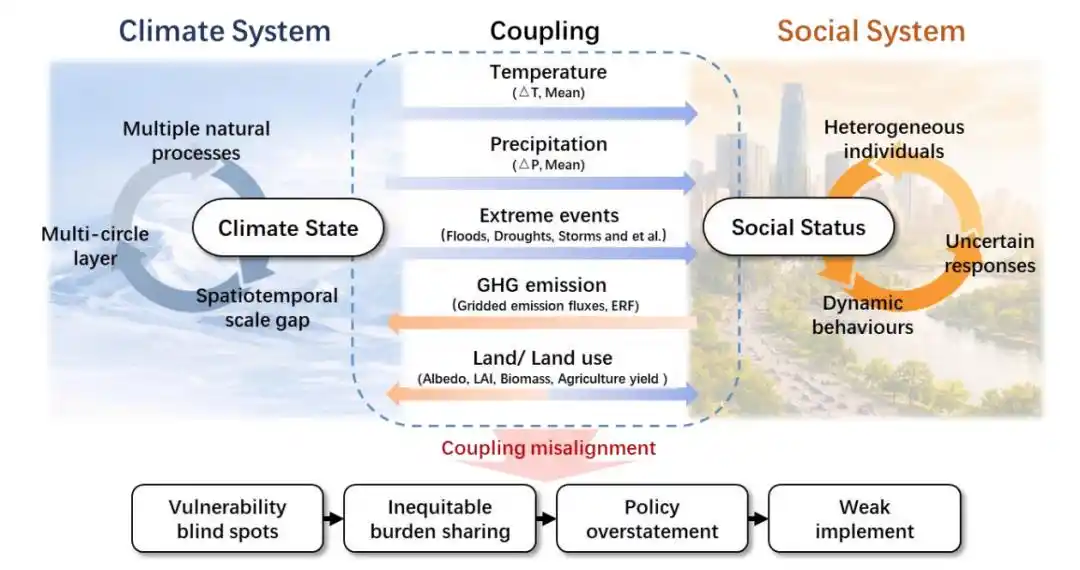
Three types of mismatches in climate-society system coupling: structure, variables, and scale.

Arithmetic problems only require judging if the answer is correct, but knowledge production and public decision-making must continue to ask: Is the reasoning process reliable? Are the underlying assumptions reasonable? Are potential risks controllable? And does the question itself have value in guiding the future?

The Blue Book argues that the research bottleneck is shifting: The past problem was whether we could process enough material; the current problem is whether we can ask good questions, establish real mechanisms, and form verifiable chains of evidence.

Judgments about what questions are worth researching, how observed patterns should be interpreted, whether a certain outcome is fair and just, and what biases are omitted or reinforced in research—these cannot be completely automated. The more capable AI becomes, the greater the human responsibility for judgment.

AI Seems Capable of Everything, But Can It Do Everything Well?

AI is becoming increasingly proficient at speaking, reasoning, and using tools, making it seem more and more like a collaborative "research partner." But is it truly understanding, or is it simulating understanding in a highly sophisticated way?

Over forty years ago, Searle used the "Chinese Room" thought experiment to question whether pure syntactic operations could produce semantic understanding. Today, large language models bring this question to everyone: How do we judge what large models actually understand and what they miss?

An important judgment in the Blue Book is that human intelligence is not a simple "input-output" process. Humans understand the world because perception and attention organize external stimuli into contexts; memory and cognitive maps organize past experiences into structures that can be transferred and reasoned about; emotions and values determine which information is more important and which goals are more worth pursuing.

The first step in human-AI collaboration is not to let AI do the work, but to first clarify the division of labor between humans and AI. AI can help us identify objects, retrieve information, and generate text, but it easily rewrites complex social experience into formats it can easily handle, turning problems that truly require understanding into problems that merely appear answered. We need to move from object recognition to contextual understanding, from information storage to experience organization, from generation to value judgment and self-reflection.

Cognitive science thus becomes particularly important. It tells us that deep thinking is not an ability opposed to AI, but an ability that needs to be more actively activated in human-machine collaboration. Truly valuable cognitive AI should not just provide a single, fluent, definitive answer, but should help people pose questions, compare evidence, and maintain the initiative in judgment.

Papers Are Written Faster and Faster, Who Ensures They Are Credible?

After AI entered scientific research, the most noticeable change is speed. Literature review, data cleaning, code generation, chart creation, and first drafts of papers can all be completed in a very short time. Researchers have no obligation to expend precious time on repetitive labor; whether a scholar has ideas should not be proven by how many times they manually adjusted a reference format.

But the speed of research and the speed of knowledge are not the same. Papers can be generated quickly, but that does not mean concepts have been clarified, data has been understood, or causal relationships have been established. Language models are especially good at organizing scattered materials into coherent narratives, and the most dangerous moment in academic research is often when the narrative appears overly coherent.

Risks also hide in seemingly "technical" steps. Choices like which variables to select, how to construct indicators, which year to start the sample from, and which cases to include all involve theoretical judgment.

The machine, of course, has no conspiracy; it only needs to make a small error in the first step and remain confident throughout the next twenty steps.

Another risk comes from automated model searching. AI can continuously try different variable combinations, parameter settings, and sample ranges until it finds results with stronger significance, better fit, and prettier charts. In the past, "trying until significance is found" was limited by time and energy; now, AI agents can search tirelessly. With increased efficiency, statistical flukes can be more efficiently packaged as theoretical discoveries.

The real challenge of automated research is not just whether machines make mistakes, but whether mistakes can be detected in time, whether the research process can be traced back, and whether final conclusions can be re-evaluated.

When AI Makes Decisions, Who Is Responsible?

AI's ability to recognize and categorize humans is rapidly increasing. It can identify claims, assess risks, review materials, match policies, and provide decision-making references for staff.

The appeal of such systems is obvious: they are faster than humans, do not get tired, and do not change their processing pace due to pressure or emotional fluctuations.

However, not getting tired is not the same as being fair.

Research cited in the Blue Book found that when analyzing health forum posts and international student interviews, human researchers could identify subtle nuances like doctor-patient interaction and cultural responsibility, while large models tended to generalize them into more ordinary, standardized categories.

The model is not completely devoid of understanding. It is just very good at rewriting things it doesn't easily understand into forms it can easily handle.

In public governance, such simplification can directly affect people's rights and treatment. The Blue Book thus distinguishes between two modes of AI embedding.

One is the "agentic" mode. The algorithm becomes the actor, moving from information input all the way to decision output, with humans reappearing only in case of system failure or appeals. The other is the "assistive" mode. AI is responsible for retrieval, calculation, risk alerts, and generating options, but the final decision is made by a human.

The difference between the two modes lies not in how much technology is used, but in whether power has been transferred.

Of course, having "human-in-the-loop" written in policy documents does not guarantee a human is actually in the loop. If staff can only click "confirm" after the algorithm's conclusion, so-called human review is merely using a human finger to execute the machine's decision.

The human role must possess the rights to intervene, correct, and explain. Otherwise, human review becomes a performance of accountability.

When AI begins to affect people's rights, the question cannot stop at "Is the model accurate?" It must also clarify who deploys, who reviews, who explains, who accepts appeals, and who bears ultimate responsibility.

Responsibilities can be divided, but they cannot evaporate simply because the division is too fine.

Deep Thinking: More Than Just "Thinking a Little Longer"

"Deep thinking" sounds like a personal virtue: faced with a problem, don't rush to answer, think a little longer. But truly meaningful deep thinking must be integrated into research processes, governance procedures, and organizational systems. It requires not only greater individual caution but also systems that preserve conditions for caution, questioning, and correction.

AI Can Help, But the Evidence Chain Cannot Be Omitted

Deep thinking does not mean rejecting AI. There is no need to insist on personally sorting through thousands of documents or spending a whole day adjusting reference formats just to prove human dignity.

The key is, work can be delegated to AI, but the evidence chain cannot be delegated along with it. AI can retrieve literature, process data, run code, but researchers still need to judge whether a question is worth asking, whether concepts are accurately translated into indicators, whether data relationships support causal explanations, and to what scope conclusions apply.

The STRIDES framework introduced in the Blue Book attempts to break down complex research into stages like theory, method, data, execution, and review, setting up checkpoints at key nodes: assumptions need to be stated, evidence must be traceable, data and code retain version records, and high-risk or low-confidence conclusions are re-submitted for human judgment.
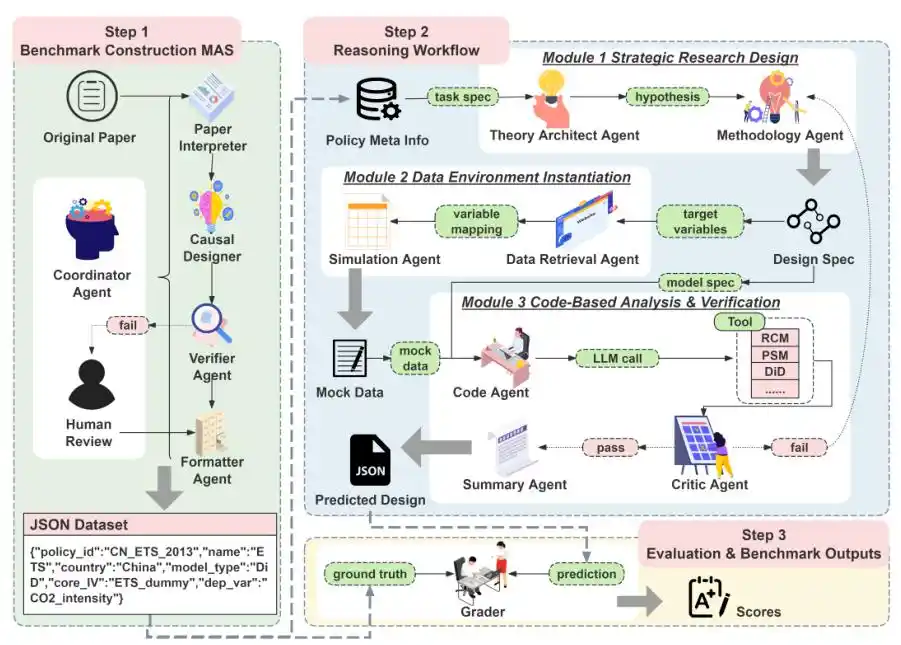
STRIDES System Overview: A workflow closed loop from research design to adversarial review.

After AI participates in research, the research output should not be just a final paper. The research question, data dictionary, analysis scripts, execution logs, review comments, and human adjudications should also be preserved, allowing others to see where results came from, at which step errors might occur, and what modifications were made.

Science is credible not because conclusions come quickly, but because others can retrace the chain of evidence.

In an interview, the team gave a simple self-check: After turning off the model, can you explain in your own words what the problem is, where the evidence comes from, what assumptions the conclusion relies on, what possible counterexamples exist, and what its boundaries of applicability are?

If you can only say "it sounds very reasonable" but cannot explain why; if the problem is gradually transformed into one the model can easily answer; if the writing becomes more fluent while your own viewpoint becomes fuzzier, then AI has likely shifted from being an expression assistant to a judgment agent.

Rules Cannot Be Just Written in Slogans

Regarding AI governance, many correct principles have been proposed: fairness, transparency, safety, human-centricity, privacy protection, accountability.

The problem is, if principles cannot be turned into procedures, they easily only exist in meetings and documents.

A system with only principles and no implementation mechanisms is like a person with only ideals and no alarm clock. They plan to do the right thing every day, but simply never wake up at the right time.

The Blue Book emphasizes that AI governance must cover the entire lifecycle of a system: assessing risks and applicable boundaries before deployment; recording key decisions, monitoring anomalies, and preserving avenues for human intervention during operation; and enabling review, correction, and accountability when problems arise.

Systems with different risk levels should not be governed identically. Ordinary information retrieval and text organization can have lower thresholds; systems involving public safety, important rights, and critical decisions should be subject to stricter testing, auditing, and deployment requirements.

Governance also cannot stop at "informed." Affected individuals should know on what basis decisions are made, what they can challenge, to whom they should raise objections, be able to request human review, and receive actual redress when errors occur. Otherwise, the duty to inform can easily become a technical document nobody understands, and appeal channels may be reduced to a mere webpage.

Of course, governance is not about putting the brakes on technology. It is more like building roads: where can speed be increased, where must it be limited, where are guardrails needed, and who is responsible after an accident. A road without rules does not represent freedom; it usually only means the strong drive faster, and everyone else must look out for themselves.

AI Can Organize Answers, But Humans Must Still Decide Direction

AI is very good at answering questions that have already been posed. But the truly difficult questions in society are often not ones without answers, but ones without a single standard answer everyone agrees on.

When efficiency conflicts with fairness, which should be prioritized? When technological innovation brings overall benefits but makes some bear greater costs, what is considered reasonable? Where should the boundary be drawn when public interest clashes with individual rights?

These problems will not disappear automatically by scaling up parameters.

The Blue Book concretely summarizes the "reverse empowerment" of AI by humanities and social sciences: It is not about standing next to technology and offering abstract moral opinions, but about transforming value conflicts into analyzable trade-offs, social consequences into measurable indicators, and providing a more directional and explanatory knowledge framework for technological development.

Models can tell us the possible consequences of different choices, but they cannot, by themselves, decide which group of people should pay the price for overall efficiency, nor can they decide if a certain price is worth paying.

The early Chinese civilization large model discussed in the Blue Book is an example. Historical documents, excavated texts, artifact images, site information, and geographical data were previously scattered across different archive systems and expert knowledge; multimodal models can organize them into the same knowledge space, allowing evidence from different sources to cross-reference each other.

Its significance lies not only in improving retrieval efficiency but in changing how evidence is organized. However, the more materials are connected, the more experts need to judge: which connections have historical significance, and which are merely superficial similarities; which narratives are built on reliable evidence, and which are merely made more fluent by the model.

This is precisely why humanities and social sciences cannot be reduced to "finding faults in AI." They are responsible not only for pointing out biases, risks, and flaws, but also for explaining value conflicts, analyzing systemic consequences, understanding specific human situations, and helping society form judgments it can collectively bear.

Technology solves "what can be done"; humanities and social sciences continue to ask "why should it be done," "to what extent should it be done," and "who bears the cost."

Relying on a Few Teams Is Not Enough

When discussing the integration of AI and humanities/social sciences, people easily think of a few labs, some star achievements, and a handful of researchers who understand both technology and social science.

This is, of course, important, but it cannot rely solely on these.

For a field to develop long-term capacity, it requires support from data, computing power, models, toolchains, talent cultivation, organizational collaboration, and evaluation systems. The Blue Book specifically reminds that AI4SSH infrastructure is not about buying more machines or putting several models on the same webpage, but the holistic construction of a multimodal data foundation, computing environment, domain-specific models, agents, toolchains, and collaboration mechanisms.

Buying computing power is relatively easy; establishing common data rules is hard. Releasing a model is relatively easy; making different disciplines truly understand each other's problems is hard. The real challenge is transforming scattered projects into sustainable organizational capabilities.

More importantly, emerging disciplines like cognitive science also need joint planning. Cognitive science connects philosophy, psychology, neuroscience, computing science, linguistics, and social sciences. It helps us understand human intelligence and also helps us reflect on and calibrate machine intelligence. For universities, building such foundational disciplines may not immediately correspond to a demonstrable application, but it determines whether future human-AI collaboration can move from tool use to paradigm innovation.

The Blue Book thus constructs the "Chinese Universities AI4SSH Index", expanding from three dimensions: core research capability, innovative development potential, and social dissemination capability, including 3 first-level indicators, 7 second-level indicators, and 10 third-level indicators.
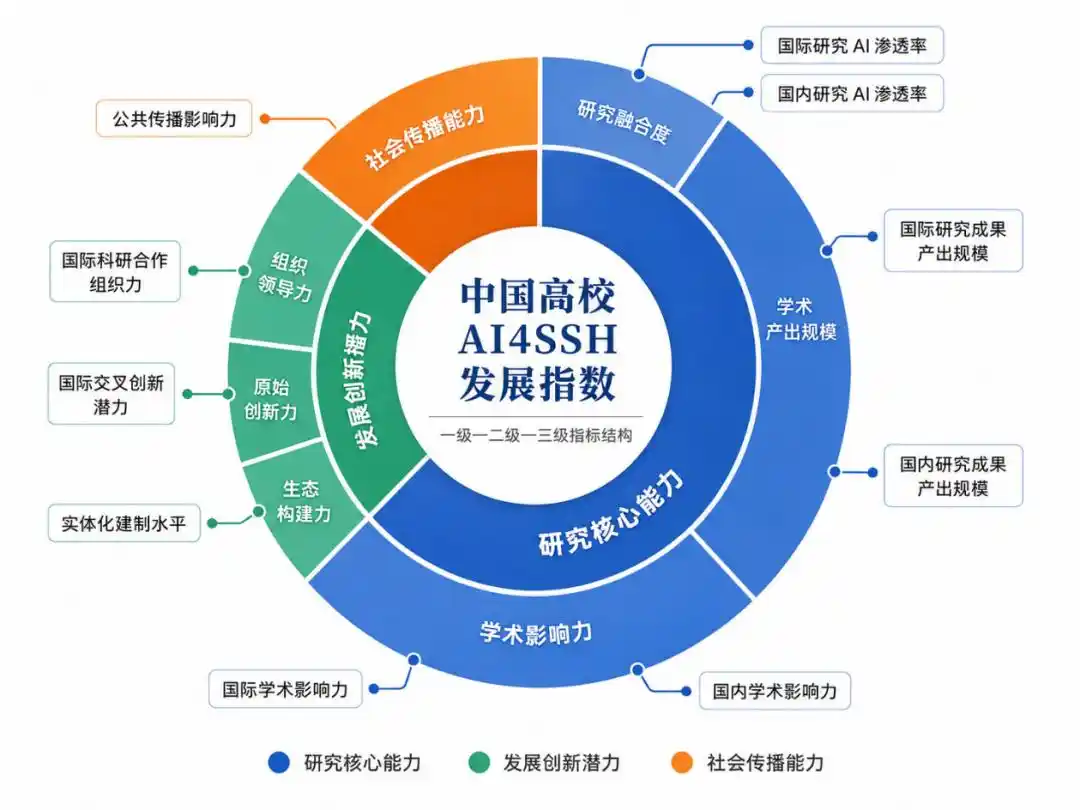
Chinese Universities AI4SSH Index Framework

It provides a structured observation window: which universities have formed stable interdisciplinary research systems, which remain at scattered project stages; which have research output but lack institutional support; which have academic achievements but have not yet translated them into public impact and social service.

The Blue Book's overall judgment is that the development of AI4SSH in Chinese universities presents a pattern of "initial system construction, distinct tiers." Research output and local integration progress relatively quickly, but international academic influence, source innovation, institutional support, and social service transformation still have shortcomings.

Therefore, measuring AI4SSH development cannot rely solely on model, paper, and project counts. One must also examine whether data, tools, norms, talent, and collaboration mechanisms can operate long-term. Technology can upgrade rapidly, but systems and organizations can only learn slowly; what truly determines how far AI and humanities/social sciences can go are precisely these parts less easily turned into demo videos.

Conclusion: The More Proficient AI Becomes at Answering, the More Humans Need to Know What to Ask

In the foreword to the Blue Book, Qiu Xin, Party Committee Secretary of Fudan University, writes to readers: in the intelligent era, we should "always safeguard thought, hone thinking, retain the composure and steadfastness for independent contemplation, rational judgment, inquiry into values, and discerning choices, guiding the transformation of intelligence with the depth of thought."

This is also the attitude this Blue Book hopes to convey. It is not merely an observation of a wave of technological change, but also a collective reflection by Fudan's humanities in facing the intelligent age.

What truly matters is judging what questions are worth posing before automatic generation; continuing to question whether evidence is credible after a model gives conclusions; clarifying its boundaries and responsibilities before technology enters society; and preserving human value judgments and directional choices among many possible futures.

We no longer need to prove in which tasks humans are faster than machines, but to reaffirm the non-transferable judgment and responsibility of humans in knowledge production and social operation.

Machines can help us reach many places. As for why we set out, where we should go, and what kind of life we want to live upon arrival—these things probably still cannot be entirely entrusted to it.

The Blue Book will be officially released on July 17 at the WAIC 2026 "Global AI Governance and Sustainable Development" forum. For the full text download, please follow the official account of the Fudan University National Development and Intelligent Governance Comprehensive Laboratory.

This article is from the WeChat public account "Almost Human" (ID: almosthuman2014), author: Focus on AI.


Crypto di tendenza

Domande pertinenti

QAccording to the 2026 Humanities and Social Sciences Intelligent Development Blue Paper by Fudan University, why is deep thinking becoming more important as AI becomes more capable of answering questions?

AThe Blue Paper argues that as AI takes over more procedural and information-processing tasks, the core research bottleneck shifts from handling materials to posing good questions, establishing authentic mechanisms, and forming verifiable evidence chains. Social problems are not arithmetic exercises. Tasks like judging what problems are worth studying, interpreting observed patterns, assessing the fairness of outcomes, and identifying biases or omissions in research cannot be fully automated. Therefore, the stronger AI becomes, the greater the human responsibility for judgment and direction-setting becomes, making deep thinking more critical.

QWhat are the two modes of AI embedding in public governance discussed in the Blue Paper, and what is their key difference?

AThe Blue Paper distinguishes between 'Agent-Type' and 'Assistive-Type' modes of AI embedding. The key difference is not the amount of technology used, but whether power transfer occurs. In the 'Agent-Type' mode, the algorithm acts as the decision-maker from input to output, with humans intervening only in case of system failures or appeals. In the 'Assistive-Type' mode, AI handles tasks like retrieval, calculation, risk prompting, and generating options, but the final decision is made by a human. The paper warns that simply having a human 'in the loop' on paper is not enough if they can only click 'confirm' on the algorithm's conclusion.

QWhat is the STRIDES framework mentioned in the article, and what is its main purpose in AI-assisted research?

AThe STRIDES framework is introduced as a system to decompose complex research into stages like theory, methodology, data, execution, and review. Its main purpose is to embed checks at key nodes within the research workflow. It requires explicit hypotheses, traceable evidence, versioned data and code, and mandates that high-risk or low-confidence conclusions be re-submitted for human judgment. The goal is to ensure that while work can be delegated to AI, the evidence chain and critical reasoning cannot be. It aims to preserve research integrity and verifiability in an automated context.

QHow does the Blue Paper define the 'reverse empowerment' of humanities and social sciences on AI development?

AThe 'reverse empowerment' is defined not as offering abstract moral opinions on technology, but as concretely transforming value conflicts into analyzable trade-offs, translating social consequences into measurable indicators, and providing a more directional and explanatory knowledge framework for technological development. It involves humanities and social sciences addressing fundamental questions that AI cannot answer on its own, such as 'why to do something,' 'how far it should go,' and 'who bears the costs,' thereby guiding the purpose and boundaries of AI application.

QWhat is the significance of the 'China University AI4SSH Index' constructed in the Blue Paper?

AThe 'China University AI4SSH Index' provides a structured observation framework to assess the development of AI for Social Sciences and Humanities (AI4SSH) in Chinese universities. It evaluates institutions across three dimensions: core research capability, developmental innovation potential, and social dissemination capacity, using multiple tiers of indicators. Its significance lies in moving beyond counting models, papers, or projects to reveal which universities have built sustainable interdisciplinary systems, robust institutional support, and the ability to convert academic成果 into public impact. It highlights that long-term progress depends on foundational elements like data, tools, norms, talent, and collaboration mechanisms, not just technological demonstrations.

Letture associate

Jito Revives with New Exchange JTX Buyback: Self-Salvation or Lifeline?

Jito, a Solana-based MEV and liquid staking infrastructure protocol, has announced new governance proposal JIP-38 and the launch of a new self-custody trading platform, JTX. The proposal establishes a rigid value-capture mechanism, mandating that 100% of the DAO's share of revenue from JTX—80% of its platform fees—will be used for programmatic, on-chain verifiable open market buybacks and permanent burns of the JTO token. This commitment is set to last at least from JTX's launch until Q4 2027. The move comes as Jito faces significant challenges in its core liquid staking market, with protocol-staked SOL declining from 18 million to under 10 million. Intense competition from protocols like Sanctum and Jupiter, coupled with continuous monthly token unlocks (1.15% of max supply), has pressured JTO's price, which fell over 96% from its all-time high to a low of $0.21 earlier this year, before recovering to around $0.63. JIP-38 formalizes Jito Network as a "token-centric" network, where all major revenue streams flow to the DAO for governance by JTO holders. While the JTX buyback is a firm commitment using new revenue, decisions on other income streams and the post-2027 strategy will be determined by future governance votes. The proposal is seen as a strategic pivot to create a new revenue source and directly align token value with ecosystem growth, though its success depends heavily on JTX's ability to compete effectively in the crowded Solana trading landscape.

Foresight News56 min fa

Jito Revives with New Exchange JTX Buyback: Self-Salvation or Lifeline?

Foresight News56 min fa

Trading

Spot

Articoli Popolari

Cosa è GROK AI

Grok AI: Rivoluzionare la Tecnologia Conversazionale nell'Era Web3 Introduzione Nel panorama in rapida evoluzione dell'intelligenza artificiale, Grok AI si distingue come un progetto notevole che collega i domini della tecnologia avanzata e dell'interazione con l'utente. Sviluppato da xAI, un'azienda guidata dal rinomato imprenditore Elon Musk, Grok AI cerca di ridefinire il modo in cui interagiamo con l'intelligenza artificiale. Mentre il movimento Web3 continua a prosperare, Grok AI mira a sfruttare il potere dell'IA conversazionale per rispondere a query complesse, offrendo agli utenti un'esperienza che è non solo informativa ma anche divertente. Cos'è Grok AI? Grok AI è un sofisticato chatbot di intelligenza artificiale conversazionale progettato per interagire dinamicamente con gli utenti. A differenza di molti sistemi di intelligenza artificiale tradizionali, Grok AI abbraccia un'ampia gamma di domande, comprese quelle tipicamente considerate inappropriate o al di fuori delle risposte standard. Gli obiettivi principali del progetto includono: Ragionamento Affidabile: Grok AI enfatizza il ragionamento di buon senso per fornire risposte logiche basate sulla comprensione contestuale. Supervisione Scalabile: L'integrazione dell'assistenza degli strumenti garantisce che le interazioni degli utenti siano sia monitorate che ottimizzate per la qualità. Verifica Formale: La sicurezza è fondamentale; Grok AI incorpora metodi di verifica formale per migliorare l'affidabilità delle sue uscite. Comprensione del Lungo Contesto: Il modello di IA eccelle nel trattenere e richiamare una vasta storia di conversazione, facilitando discussioni significative e consapevoli del contesto. Robustezza Adversariale: Concentrandosi sul miglioramento delle sue difese contro input manipolati o malevoli, Grok AI mira a mantenere l'integrità delle interazioni degli utenti. In sostanza, Grok AI non è solo un dispositivo di recupero informazioni; è un partner conversazionale immersivo che incoraggia un dialogo dinamico. Creatore di Grok AI Il cervello dietro Grok AI non è altri che Elon Musk, un individuo sinonimo di innovazione in vari campi, tra cui automotive, viaggi spaziali e tecnologia. Sotto l'egida di xAI, un'azienda focalizzata sull'avanzamento della tecnologia AI in modi benefici, la visione di Musk mira a rimodellare la comprensione delle interazioni con l'IA. La leadership e l'etica fondamentale sono profondamente influenzate dall'impegno di Musk nel superare i confini tecnologici. Investitori di Grok AI Sebbene i dettagli specifici riguardanti gli investitori che sostengono Grok AI rimangano limitati, è pubblicamente riconosciuto che xAI, l'incubatore del progetto, è fondato e supportato principalmente dallo stesso Elon Musk. Le precedenti imprese e partecipazioni di Musk forniscono un robusto sostegno, rafforzando ulteriormente la credibilità e il potenziale di crescita di Grok AI. Tuttavia, al momento, le informazioni riguardanti ulteriori fondazioni di investimento o organizzazioni che supportano Grok AI non sono facilmente accessibili, segnando un'area per potenziali esplorazioni future. Come Funziona Grok AI? Le meccaniche operative di Grok AI sono innovative quanto il suo framework concettuale. Il progetto integra diverse tecnologie all'avanguardia che facilitano le sue funzionalità uniche: Infrastruttura Robusta: Grok AI è costruito utilizzando Kubernetes per l'orchestrazione dei container, Rust per prestazioni e sicurezza, e JAX per il calcolo numerico ad alte prestazioni. Questo trio garantisce che il chatbot operi in modo efficiente, si scaldi efficacemente e serva gli utenti prontamente. Accesso alla Conoscenza in Tempo Reale: Una delle caratteristiche distintive di Grok AI è la sua capacità di attingere a dati in tempo reale attraverso la piattaforma X—precedentemente nota come Twitter. Questa capacità consente all'IA di accedere alle informazioni più recenti, permettendole di fornire risposte e raccomandazioni tempestive che altri modelli di IA potrebbero perdere. Due Modalità di Interazione: Grok AI offre agli utenti la scelta tra “Modalità Divertente” e “Modalità Normale”. La Modalità Divertente consente uno stile di interazione più giocoso e umoristico, mentre la Modalità Normale si concentra sulla fornitura di risposte precise e accurate. Questa versatilità garantisce un'esperienza su misura che soddisfa varie preferenze degli utenti. In sostanza, Grok AI sposa prestazioni con coinvolgimento, creando un'esperienza che è sia arricchente che divertente. Cronologia di Grok AI Il viaggio di Grok AI è segnato da traguardi fondamentali che riflettono le sue fasi di sviluppo e distribuzione: Sviluppo Iniziale: La fase fondamentale di Grok AI si è svolta in circa due mesi, durante i quali sono stati condotti l'addestramento iniziale e il perfezionamento del modello. Rilascio Beta di Grok-2: In un significativo avanzamento, è stata annunciata la beta di Grok-2. Questo rilascio ha introdotto due versioni del chatbot—Grok-2 e Grok-2 mini—ognuna dotata delle capacità per chattare, programmare e ragionare. Accesso Pubblico: Dopo lo sviluppo beta, Grok AI è diventato disponibile per gli utenti della piattaforma X. Coloro che hanno account verificati tramite un numero di telefono e attivi per almeno sette giorni possono accedere a una versione limitata, rendendo la tecnologia disponibile a un pubblico più ampio. Questa cronologia racchiude la crescita sistematica di Grok AI dall'inizio all'impegno pubblico, enfatizzando il suo impegno per il miglioramento continuo e l'interazione con gli utenti. Caratteristiche Chiave di Grok AI Grok AI comprende diverse caratteristiche chiave che contribuiscono alla sua identità innovativa: Integrazione della Conoscenza in Tempo Reale: L'accesso a informazioni attuali e rilevanti differenzia Grok AI da molti modelli statici, consentendo un'esperienza utente coinvolgente e accurata. Stili di Interazione Versatili: Offrendo modalità di interazione distinte, Grok AI soddisfa varie preferenze degli utenti, invitando alla creatività e alla personalizzazione nella conversazione con l'IA. Avanzata Struttura Tecnologica: L'utilizzo di Kubernetes, Rust e JAX fornisce al progetto un solido framework per garantire affidabilità e prestazioni ottimali. Considerazione del Discorso Etico: L'inclusione di una funzione di generazione di immagini mette in mostra lo spirito innovativo del progetto. Tuttavia, solleva anche considerazioni etiche riguardanti il copyright e la rappresentazione rispettosa di figure riconoscibili—una discussione in corso all'interno della comunità AI. Conclusione Come entità pionieristica nel campo dell'IA conversazionale, Grok AI incarna il potenziale per esperienze utente trasformative nell'era digitale. Sviluppato da xAI e guidato dall'approccio visionario di Elon Musk, Grok AI integra conoscenze in tempo reale con capacità di interazione avanzate. Si sforza di spingere i confini di ciò che l'intelligenza artificiale può realizzare, mantenendo un focus su considerazioni etiche e sicurezza degli utenti. Grok AI non solo incarna il progresso tecnologico, ma rappresenta anche un nuovo paradigma conversazionale nel panorama Web3, promettendo di coinvolgere gli utenti con sia conoscenze esperte che interazioni giocose. Man mano che il progetto continua a evolversi, si erge come testimonianza di ciò che l'incrocio tra tecnologia, creatività e interazione simile a quella umana può realizzare.

518 Totale visualizzazioniPubblicato il 2024.12.26Aggiornato il 2024.12.26

Cosa è GROK AI

Cosa è ERC AI

Euruka Tech: Una Panoramica di $erc ai e delle sue Ambizioni in Web3 Introduzione Nel panorama in rapida evoluzione della tecnologia blockchain e delle applicazioni decentralizzate, nuovi progetti emergono frequentemente, ciascuno con obiettivi e metodologie uniche. Uno di questi progetti è Euruka Tech, che opera nel vasto dominio delle criptovalute e del Web3. L'obiettivo principale di Euruka Tech, in particolare del suo token $erc ai, è presentare soluzioni innovative progettate per sfruttare le crescenti capacità della tecnologia decentralizzata. Questo articolo si propone di fornire una panoramica completa di Euruka Tech, un'esplorazione dei suoi obiettivi, della funzionalità, dell'identità del suo creatore, dei potenziali investitori e della sua importanza nel contesto più ampio del Web3. Cos'è Euruka Tech, $erc ai? Euruka Tech è caratterizzato come un progetto che sfrutta gli strumenti e le funzionalità offerte dall'ambiente Web3, concentrandosi sull'integrazione dell'intelligenza artificiale nelle sue operazioni. Sebbene i dettagli specifici sul framework del progetto siano piuttosto sfuggenti, è progettato per migliorare l'engagement degli utenti e automatizzare i processi nello spazio crypto. Il progetto mira a creare un ecosistema decentralizzato che non solo faciliti le transazioni, ma incorpori anche funzionalità predittive attraverso l'intelligenza artificiale, da cui il nome del suo token, $erc ai. L'obiettivo è fornire una piattaforma intuitiva che faciliti interazioni più intelligenti e un'elaborazione delle transazioni più efficiente all'interno della crescente sfera del Web3. Chi è il Creatore di Euruka Tech, $erc ai? Attualmente, le informazioni riguardanti il creatore o il team fondatore di Euruka Tech rimangono non specificate e piuttosto opache. Questa assenza di dati solleva preoccupazioni, poiché la conoscenza del background del team è spesso essenziale per stabilire credibilità nel settore blockchain. Pertanto, abbiamo classificato queste informazioni come sconosciute fino a quando dettagli concreti non saranno resi disponibili nel dominio pubblico. Chi sono gli Investitori di Euruka Tech, $erc ai? Allo stesso modo, l'identificazione degli investitori o delle organizzazioni di supporto per il progetto Euruka Tech non è prontamente fornita attraverso la ricerca disponibile. Un aspetto cruciale per i potenziali stakeholder o utenti che considerano di impegnarsi con Euruka Tech è la garanzia che deriva da partnership finanziarie consolidate o dal supporto di società di investimento rispettabili. Senza divulgazioni sulle affiliazioni di investimento, è difficile trarre conclusioni complete sulla sicurezza finanziaria o sulla longevità del progetto. In linea con le informazioni trovate, anche questa sezione rimane allo stato di sconosciuto. Come funziona Euruka Tech, $erc ai? Nonostante la mancanza di specifiche tecniche dettagliate per Euruka Tech, è essenziale considerare le sue ambizioni innovative. Il progetto cerca di sfruttare la potenza computazionale dell'intelligenza artificiale per automatizzare e migliorare l'esperienza dell'utente all'interno dell'ambiente delle criptovalute. Integrando l'IA con la tecnologia blockchain, Euruka Tech mira a fornire funzionalità come operazioni automatizzate, valutazioni del rischio e interfacce utente personalizzate. L'essenza innovativa di Euruka Tech risiede nel suo obiettivo di creare una connessione fluida tra gli utenti e le vaste possibilità presentate dalle reti decentralizzate. Attraverso l'utilizzo di algoritmi di apprendimento automatico e IA, mira a ridurre le sfide degli utenti alle prime armi e semplificare le esperienze transazionali all'interno del framework Web3. Questa simbiosi tra IA e blockchain sottolinea l'importanza del token $erc ai, fungendo da ponte tra le interfacce utente tradizionali e le avanzate capacità delle tecnologie decentralizzate. Cronologia di Euruka Tech, $erc ai Sfortunatamente, a causa delle limitate informazioni disponibili riguardo a Euruka Tech, non siamo in grado di presentare una cronologia dettagliata dei principali sviluppi o traguardi nel percorso del progetto. Questa cronologia, tipicamente preziosa per tracciare l'evoluzione di un progetto e comprendere la sua traiettoria di crescita, non è attualmente disponibile. Man mano che le informazioni su eventi notevoli, partnership o aggiunte funzionali diventano evidenti, gli aggiornamenti miglioreranno sicuramente la visibilità di Euruka Tech nella sfera crypto. Chiarimento su Altri Progetti “Eureka” È importante sottolineare che più progetti e aziende condividono una nomenclatura simile con “Eureka.” La ricerca ha identificato iniziative come un agente IA della NVIDIA Research, che si concentra sull'insegnamento ai robot di compiti complessi utilizzando metodi generativi, così come Eureka Labs ed Eureka AI, che migliorano l'esperienza utente nell'istruzione e nell'analisi del servizio clienti, rispettivamente. Tuttavia, questi progetti sono distinti da Euruka Tech e non dovrebbero essere confusi con i suoi obiettivi o funzionalità. Conclusione Euruka Tech, insieme al suo token $erc ai, rappresenta un attore promettente ma attualmente oscuro nel panorama del Web3. Sebbene i dettagli sul suo creatore e sugli investitori rimangano non divulgati, l'ambizione centrale di combinare intelligenza artificiale e tecnologia blockchain si erge come un punto focale di interesse. Gli approcci unici del progetto nel promuovere l'engagement degli utenti attraverso l'automazione avanzata potrebbero distinguerlo mentre l'ecosistema Web3 progredisce. Con l'evoluzione continua del mercato crypto, gli stakeholder dovrebbero tenere d'occhio gli sviluppi riguardanti Euruka Tech, poiché lo sviluppo di innovazioni documentate, partnership o una roadmap definita potrebbe presentare opportunità significative nel prossimo futuro. Così com'è, attendiamo ulteriori approfondimenti sostanziali che potrebbero svelare il potenziale di Euruka Tech e la sua posizione nel competitivo panorama crypto.

542 Totale visualizzazioniPubblicato il 2025.01.02Aggiornato il 2025.01.02

Cosa è ERC AI

Cosa è DUOLINGO AI

DUOLINGO AI: Integrare l'apprendimento delle lingue con Web3 e innovazione AI In un'era in cui la tecnologia rimodella l'istruzione, l'integrazione dell'intelligenza artificiale (AI) e delle reti blockchain annuncia una nuova frontiera per l'apprendimento delle lingue. Entra in scena DUOLINGO AI e la sua criptovaluta associata, $DUOLINGO AI. Questo progetto aspira a fondere la potenza educativa delle principali piattaforme di apprendimento delle lingue con i benefici della tecnologia decentralizzata Web3. Questo articolo esplora gli aspetti chiave di DUOLINGO AI, esaminando i suoi obiettivi, il framework tecnologico, lo sviluppo storico e il potenziale futuro, mantenendo chiarezza tra la risorsa educativa originale e questa iniziativa indipendente di criptovaluta. Panoramica di DUOLINGO AI Alla sua base, DUOLINGO AI cerca di stabilire un ambiente decentralizzato in cui gli studenti possono guadagnare ricompense crittografiche per il raggiungimento di traguardi educativi nella competenza linguistica. Applicando smart contracts, il progetto mira ad automatizzare i processi di verifica delle competenze e le allocazioni di token, aderendo ai principi di Web3 che enfatizzano la trasparenza e la proprietà da parte degli utenti. Il modello si discosta dagli approcci tradizionali all'acquisizione linguistica, facendo forte affidamento su una struttura di governance guidata dalla comunità, che consente ai detentori di token di suggerire miglioramenti ai contenuti dei corsi e alle distribuzioni delle ricompense. Alcuni degli obiettivi notevoli di DUOLINGO AI includono: Apprendimento Gamificato: Il progetto integra traguardi blockchain e token non fungibili (NFT) per rappresentare i livelli di competenza linguistica, promuovendo la motivazione attraverso ricompense digitali coinvolgenti. Creazione di Contenuti Decentralizzati: Apre opportunità per educatori e appassionati di lingue di contribuire con i propri corsi, facilitando un modello di condivisione dei ricavi che beneficia tutti i collaboratori. Personalizzazione Guidata dall'AI: Utilizzando modelli avanzati di machine learning, DUOLINGO AI personalizza le lezioni per adattarsi ai progressi individuali, simile alle funzionalità adattive presenti nelle piattaforme consolidate. Creatori del Progetto e Governance A partire da aprile 2025, il team dietro $DUOLINGO AI rimane pseudonimo, una pratica comune nel panorama decentralizzato delle criptovalute. Questa anonimato è inteso a promuovere la crescita collettiva e il coinvolgimento degli stakeholder piuttosto che concentrarsi su sviluppatori individuali. Lo smart contract distribuito sulla blockchain di Solana annota l'indirizzo del wallet dello sviluppatore, che segna l'impegno verso la trasparenza riguardo alle transazioni, nonostante l'identità dei creatori sia sconosciuta. Secondo la sua roadmap, DUOLINGO AI mira a evolversi in un'Organizzazione Autonoma Decentralizzata (DAO). Questa struttura di governance consente ai detentori di token di votare su questioni critiche come l'implementazione di funzionalità e le allocazioni del tesoro. Questo modello si allinea con l'etica dell'empowerment della comunità presente in varie applicazioni decentralizzate, enfatizzando l'importanza del processo decisionale collettivo. Investitori e Partnership Strategiche Attualmente, non ci sono investitori istituzionali o capitalisti di rischio identificabili pubblicamente legati a $DUOLINGO AI. Invece, la liquidità del progetto proviene principalmente da scambi decentralizzati (DEX), segnando un netto contrasto con le strategie di finanziamento delle aziende tradizionali di tecnologia educativa. Questo modello di base indica un approccio guidato dalla comunità, riflettendo l'impegno del progetto verso la decentralizzazione. Nel suo whitepaper, DUOLINGO AI menziona la formazione di collaborazioni con “piattaforme educative blockchain” non specificate, mirate ad arricchire la sua offerta di corsi. Sebbene partnership specifiche non siano ancora state divulgate, questi sforzi collaborativi suggeriscono una strategia per mescolare innovazione blockchain con iniziative educative, ampliando l'accesso e il coinvolgimento degli utenti attraverso diverse vie di apprendimento. Architettura Tecnologica Integrazione AI DUOLINGO AI incorpora due componenti principali guidate dall'AI per migliorare la sua offerta educativa: Motore di Apprendimento Adattivo: Questo sofisticato motore apprende dalle interazioni degli utenti, simile ai modelli proprietari delle principali piattaforme educative. Regola dinamicamente la difficoltà delle lezioni per affrontare le sfide specifiche degli studenti, rinforzando le aree deboli attraverso esercizi mirati. Agenti Conversazionali: Utilizzando chatbot alimentati da GPT-4, DUOLINGO AI offre una piattaforma per gli utenti per impegnarsi in conversazioni simulate, promuovendo un'esperienza di apprendimento linguistico più interattiva e pratica. Infrastruttura Blockchain Costruito sulla blockchain di Solana, $DUOLINGO AI utilizza un framework tecnologico completo che include: Smart Contracts per la Verifica delle Competenze: Questa funzionalità assegna automaticamente token agli utenti che superano con successo i test di competenza, rinforzando la struttura di incentivi per risultati di apprendimento genuini. Badge NFT: Questi token digitali significano vari traguardi che gli studenti raggiungono, come completare una sezione del loro corso o padroneggiare competenze specifiche, consentendo loro di scambiare o mostrare digitalmente i loro successi. Governance DAO: I membri della comunità dotati di token possono partecipare alla governance votando su proposte chiave, facilitando una cultura partecipativa che incoraggia l'innovazione nell'offerta di corsi e nelle funzionalità della piattaforma. Cronologia Storica 2022–2023: Concettualizzazione I lavori per DUOLINGO AI iniziano con la creazione di un whitepaper, evidenziando la sinergia tra i progressi dell'AI nell'apprendimento delle lingue e il potenziale decentralizzato della tecnologia blockchain. 2024: Lancio Beta Un lancio beta limitato introduce offerte in lingue popolari, premiando i primi utenti con incentivi in token come parte della strategia di coinvolgimento della comunità del progetto. 2025: Transizione DAO Ad aprile, avviene un lancio completo della mainnet con la circolazione di token, stimolando discussioni nella comunità riguardo a possibili espansioni nelle lingue asiatiche e ad altri sviluppi dei corsi. Sfide e Direzioni Future Ostacoli Tecnici Nonostante i suoi obiettivi ambiziosi, DUOLINGO AI affronta sfide significative. La scalabilità rimane una preoccupazione costante, in particolare nel bilanciare i costi associati all'elaborazione dell'AI e nel mantenere una rete decentralizzata reattiva. Inoltre, garantire la creazione e la moderazione di contenuti di qualità in un'offerta decentralizzata presenta complessità nel mantenere standard educativi. Opportunità Strategiche Guardando al futuro, DUOLINGO AI ha il potenziale per sfruttare partnership di micro-credentialing con istituzioni accademiche, fornendo validazioni verificate dalla blockchain delle competenze linguistiche. Inoltre, l'espansione cross-chain potrebbe consentire al progetto di attingere a basi utenti più ampie e a ulteriori ecosistemi blockchain, migliorando la sua interoperabilità e portata. Conclusione DUOLINGO AI rappresenta una fusione innovativa di intelligenza artificiale e tecnologia blockchain, presentando un'alternativa focalizzata sulla comunità ai sistemi tradizionali di apprendimento delle lingue. Sebbene il suo sviluppo pseudonimo e il modello economico emergente comportino alcuni rischi, l'impegno del progetto verso l'apprendimento gamificato, l'istruzione personalizzata e la governance decentralizzata illumina un percorso per la tecnologia educativa nel regno di Web3. Man mano che l'AI continua a progredire e l'ecosistema blockchain evolve, iniziative come DUOLINGO AI potrebbero ridefinire il modo in cui gli utenti interagiscono con l'istruzione linguistica, potenziando le comunità e premiando il coinvolgimento attraverso meccanismi di apprendimento innovativi.

498 Totale visualizzazioniPubblicato il 2025.04.11Aggiornato il 2025.04.11

Cosa è DUOLINGO AI

Discussioni

Benvenuto nella Community HTX. Qui puoi rimanere informato sugli ultimi sviluppi della piattaforma e accedere ad approfondimenti esperti sul mercato. Le opinioni degli utenti sul prezzo di AI AI sono presentate come di seguito.

活动图片