Từ đầu cơ đến quản lý rủi ro: Các thị trường dự đoán đang lấp đầy khoảng trống bảo hiểm thương mại

marsbitPublished on 2026-08-17Last updated on 2026-08-17

Abstract

Từ đầu cơ đến quản lý rủi ro: Thị trường dự đoán đang lấp đầy khoảng trống bảo hiểm thương mại Bài viết phân tích sự phát triển của thị trường dự đoán (prediction markets), đặc biệt là công cụ quản lý rủi ro AI Blanket, trong việc trở thành một công cụ phòng ngừa rủi ro thay thế cho doanh nghiệp. Thay vì dựa vào công ty bảo hiểm truyền thống, doanh nghiệp có thể sử dụng các hợp đồng sự kiện (như trên nền tảng Kalshi) để bảo vệ trước các rủi ro như biến động giá năng lượng, thời tiết bất thường hay thay đổi chính sách. Phân tích dữ liệu từ tháng 8/2025 đến tháng 8/2026 trên 1265 thị trường Kalshi so sánh hành vi giao dịch trong ba lĩnh vực: Hợp đồng thời tiết trên Kalshi, hợp đồng thể thao trên Kalshi (chủ yếu đầu cơ) và hợp đồng tương lai truyền thống (CME). Ba chỉ số chính được xem xét: 1. **Tỷ lệ luân chuyển hàng ngày trung bình:** Hợp đồng thời tiết có tỷ lệ thấp nhất (0.210), cho thấy xu hướng giữ vị thế lâu hơn so với hợp đồng thể thao (0.315). 2. **Tỷ lệ giữ đến khi đáo hạn:** Hợp đồng thời tiết có tỷ lệ này rất cao (>0.5), trong khi hợp đồng thể thao rất thấp (0.012-0.033). Điều này cho thấy nhiều vị thế thời tiết được nắm giữ ổn định đến cuối, phù hợp với hành vi phòng ngừa rủi ro. 3. **Thời điểm thiết lập vị thế:** Vị thế trong hợp đồng thời tiết thường được thiết lập sớm hơn nhiều so với ngày đáo hạn, tương tự thị trường phòng ngừa rủi ro truyền thống, khác biệt rõ rệt với hợp đồng thể thao. Kết luận cho thấy thị trường thời tiết trên Kalshi không phải là thuầ...

Tác giả: G_Gyeomm

Biên dịch: AIdidiaoJP, Foresight News

I. Một loại bảo hiểm mới được định giá trực tiếp bởi thị trường

Công cụ quản lý rủi ro AI Blanket mới ra mắt gần đây đang cố gắng biến các thị trường dự đoán thành một công cụ bảo hiểm thực sự hữu ích cho doanh nghiệp. Logic rất đơn giản: Doanh nghiệp nhập thông tin kinh doanh của mình, hệ thống tự động chẩn đoán các rủi ro chính, sau đó đề xuất các hợp đồng sự kiện Kalshi tương ứng để giúp doanh nghiệp phòng ngừa những rủi ro này.

Cơ chế phòng ngừa rủi ro tự thân không phức tạp. Cấu trúc hợp đồng của thị trường dự đoán cực kỳ rõ ràng — sự kiện xảy ra thì thanh toán 1 USD, không xảy ra thì thanh toán 0 USD. Giá thực thời của hợp đồng chính là sự đánh giá tập thể của thị trường về xác suất xảy ra sự kiện đó.

Chính cấu trúc đơn giản này đã cho phép các thị trường dự đoán có tiềm năng trở thành công cụ phòng ngừa rủi ro thực tế. Doanh nghiệp có thể mua trước các hợp đồng sự kiện có thể ảnh hưởng đến hoạt động kinh doanh của mình, chẳng hạn như thời tiết bất thường, biến động giá năng lượng hoặc thay đổi chính sách thuế quan. Một khi những rủi ro này thực sự xảy ra, khoản thanh toán từ hợp đồng có thể bù đắp một phần hoặc toàn bộ thiệt hại kinh doanh.

Lấy một ví dụ cụ thể: Một cửa hàng kem, gặp phải mùa hè mát mẻ, doanh thu sẽ giảm khoảng 20.000 USD.

Thao tác phòng ngừa rủi ro như sau: Mua 20.000 hợp đồng nhiệt độ với giá 0,30 USD mỗi hợp đồng. Nếu nhiệt độ trung bình mùa hè thấp hơn ngưỡng đã định trước, mỗi hợp đồng sẽ thanh toán 1 USD. Tổng chi phí là 6.000 USD.

Kết quả chỉ có hai khả năng:

  • Mùa hè mát mẻ: Nhiệt độ thấp hơn ngưỡng, doanh thu giảm 20.000 USD, nhưng hợp đồng thanh toán một lần 20.000 USD. Cuối cùng, tổn thất ròng bị khóa ở mức 6.000 USD — chính xác là số tiền đã chi để mua hợp đồng ban đầu.
  • Mùa hè nóng bức: Nhiệt độ cao hơn ngưỡng, doanh thu không bị ảnh hưởng, nhưng hợp đồng hết hạn và trở về 0, 6.000 USD chi phí mất trắng.

Dù kết quả nào, tổn thất cuối cùng cũng bị khóa chặt ở 6.000 USD. 6.000 USD này về bản chất chính là phí bảo hiểm. Và mức phí này được định không phải bởi chuyên gia tính toán rủi ro của công ty bảo hiểm, cũng không phải bởi bất kỳ tổ chức bảo hiểm truyền thống nào, mà chính là bởi thị trường — mức giá được công bố theo thời gian thực bằng tiền thật từ vô số người mua và người bán.

II. Thị trường phòng ngừa rủi ro có thực sự đang vận hành?

Các thị trường dự đoán đã tích lũy đủ nhu cầu đầu cơ. Ban đầu, nó tạo dựng danh tiếng nhờ dự đoán bầu cử, sau đó mở rộng suôn sẻ sang lĩnh vực thể thao, vấn đề khối lượng giao dịch cơ bản đã được giải quyết. Ngành công nghiệp phổ biến tin rằng không gian tăng trưởng tiếp theo nằm ở việc mở rộng thêm nhiều kịch bản sử dụng thực tế, và nhu cầu phòng ngừa rủi ro được nhắc đến nhiều lần, là một trong những hướng đi đáng mong đợi nhất.

Về lý thuyết, giá trị của nó thực sự rất lớn. Các khu vực trống không được các công cụ phòng ngừa rủi ro hiện có bao phủ khá rộng. Bảo hiểm gián đoạn kinh doanh trong bảo hiểm thương mại truyền thống thường yêu cầu tổn thất vật chất làm tiền đề. Một cửa hàng trượt tuyết bị mất doanh thu vì cả mùa đông hầu như không có tuyết — loại "rủi ro kinh doanh" thuần túy này, trên thị trường hầu như không tìm được sản phẩm bảo hiểm phù hợp để bảo vệ.

Thị trường kỳ hạn (futures) thì có các công cụ phòng ngừa rủi ro trưởng thành, nhưng ngưỡng không thấp: cần ký kết thỏa thuận ISDA, mở tài khoản giao dịch kỳ hạn chuyên dụng, nộp tiền ký quỹ và có các hạn chế về quy mô hợp đồng tối thiểu. Những điều kiện này không phải là vấn đề đối với các tổ chức lớn, nhưng đối với các doanh nghiệp vừa và nhỏ bình thường, gần như không thể đạt được. Goldman Sachs có thể nuôi một đội ngũ giao dịch phái sinh chuyên nghiệp, nhưng một quán cà phê ở góc phố rõ ràng không làm được.

Vấn đề là, giữa tính hợp lý về lý thuyết và việc sử dụng thực tế, luôn tồn tại một khoảng cách rõ rệt. Các thị trường dự đoán lâu nay bị gán mác "cờ bạc", liệu nó có thực sự có thể hoạt động như một thị trường phòng ngừa rủi ro độc lập — chứ không chỉ là công cụ đầu cơ — chưa bao giờ được xác minh một cách có hệ thống.

Câu hỏi thực sự cần trả lời là: Các thị trường dự đoán có thực sự được sử dụng để phòng ngừa rủi ro không? Nhu cầu phòng ngừa rủi ro thực tế có tồn tại không? Bản thân hành vi giao dịch có thể cung cấp manh mối. Chúng tôi chọn ba nhóm dữ liệu để so sánh.

Nhóm thứ nhất là hợp đồng tương lai ngũ cốc CME — một thị trường phòng ngừa rủi ro truyền thống điển hình, chủ yếu được sử dụng để giảm bớt tổn thất do biến động giá nông sản và sản phẩm chăn nuôi.

Nhóm thứ hai là thị trường thể thao Kalshi — nơi nhu cầu phòng ngừa rủi ro cực kỳ hạn chế, giao dịch hầu hết đều do động cơ đầu cơ thúc đẩy.

Nhóm thứ ba là thị trường thời tiết Kalshi — nó xử lý rủi ro thời tiết theo cách tương tự như hợp đồng tương lai thời tiết CME, đồng thời chia sẻ chính xác cấu trúc hợp đồng sự kiện và môi trường giao dịch giống hệt với thị trường thể thao Kalshi. Điều này biến nó thành một mẫu thử nghiệm tuyệt vời — để xem hành vi giao dịch của nó cuối cùng gần giống bên nào hơn.

Người phòng ngừa rủi ro và người đầu cơ thường biểu hiện các đặc điểm giao dịch khác nhau. Người phòng ngừa rủi ro có xu hướng thiết lập vị thế sớm trước khi cửa sổ rủi ro thực sự đến, sau đó giữ cho đến ngày đáo hạn; người đầu cơ thì vào ra thường xuyên hơn, đuổi theo giá, tỷ lệ luân chuyển rõ ràng cao hơn.

Nếu tỷ lệ luân chuyển và hành vi nắm giữ vị thế của thị trường thời tiết Kalshi đều gần với thị trường phòng ngừa rủi ro truyền thống hơn là thị trường thể thao, thì nhu cầu phòng ngừa rủi ro là có thật.

Ngược lại, nếu nó không khác gì thị trường thể thao, thì việc sử dụng thực tế sẽ gần với đầu cơ thuần túy hơn. Trong trường hợp này, các công cụ như Blanket, có thể chỉ đáp ứng những tưởng tượng tốt đẹp trong ngành, chứ không phải nhu cầu thực tế được xác minh bởi dữ liệu.

Bộ dữ liệu phân tích này bao phủ 1265 thị trường Kalshi được thanh toán từ tháng 8 năm 2025 đến tháng 8 năm 2026. Tiêu chí lọc là: khối lượng giao dịch tích lũy ít nhất 500 hợp đồng và giao dịch kéo dài ít nhất ba ngày.

III. Dữ liệu một: Tỷ lệ luân chuyển trung bình hàng ngày

Đầu tiên, xem xét tần suất các vị thế trên mỗi thị trường được giao dịch. Tỷ lệ luân chuyển được định nghĩa là khối lượng giao dịch hàng ngày chia cho số lượng vị thế mở (OI) trong ngày đó. Chúng tôi tính tỷ lệ luân chuyển hàng ngày cho mỗi hợp đồng trên mỗi thị trường, sau đó lấy trung vị cho toàn bộ chu kỳ giao dịch.

Kết quả rõ ràng: Hợp đồng thời tiết Kalshi có tỷ lệ luân chuyển thấp nhất, chỉ 0,210. Sản phẩm phòng ngừa rủi ro truyền thống là hợp đồng tương lai ngô là 0,266, hợp đồng thể thao Kalshi cao nhất, đạt 0,315.
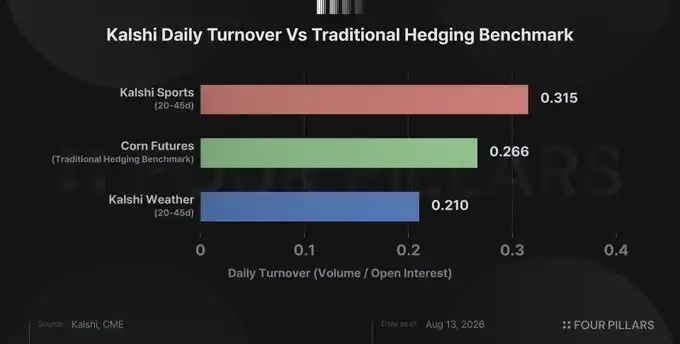
Tốc độ luân chuyển của hợp đồng thể thao cao gấp khoảng 1,5 lần hợp đồng thời tiết. Điều này cho thấy hợp đồng thời tiết có xu hướng nắm giữ lâu hơn tương đối, gợi ý ban đầu có thể tồn tại nhu cầu phòng ngừa rủi ro thực tế.

Tuy nhiên, cần lưu ý: Tỷ lệ luân chuyển của hợp đồng tương lai ngô nằm ở giữa, và sự khác biệt giữa ba nhóm dữ liệu không quá chênh lệch. Chỉ riêng chỉ số tỷ lệ luân chuyển này, chưa thể hoàn toàn khẳng định thị trường thời tiết có nhu cầu phòng ngừa rủi ro. Hiện tại, dữ liệu này có thể cho chúng ta biết rõ ràng rằng, tỷ lệ luân chuyển của hợp đồng thời tiết thấp hơn đáng kể so với hợp đồng thể thao.

IV. Dữ liệu hai: Tỷ lệ nắm giữ đến ngày đáo hạn

Chỉ số then chốt thứ hai là tỷ lệ nắm giữ đến ngày đáo hạn — đo lường có bao nhiêu vị thế còn lại trên thị trường vào lúc thanh toán mà chưa bị động chạm. Cách tính là số lượng vị thế mở cuối cùng của mỗi hợp đồng chia cho khối lượng giao dịch tích lũy. Giá trị càng cao, càng cho thấy nhiều vị thế được kiên định nắm giữ cho đến ngày đáo hạn.
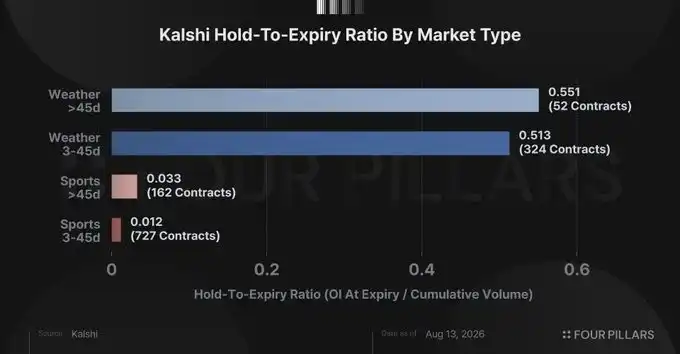
Kết quả khác biệt rất ấn tượng: Bất kể giao dịch kéo dài bao lâu, tỷ lệ nắm giữ đến ngày đáo hạn của hợp đồng thời tiết đều vượt quá 0,5. Ngược lại, hợp đồng thể thao lần lượt chỉ có 0,012 và 0,033. Trong khoảng thời gian giao dịch từ 3 đến 45 ngày, hợp đồng thời tiết cao gấp 42,8 lần thể thao; trong khoảng trên 45 ngày, chênh lệch vẫn là 16,7 lần.

Điều này cho thấy rõ ràng: Hợp đồng thời tiết có xu hướng "mua vào và không động đậy" cao hơn nhiều so với hợp đồng thể thao. Người phòng ngừa rủi ro nắm giữ hợp đồng, nhằm mục đích nhận được khoản thanh toán nếu rủi ro xảy ra, chứ không phải để mua đáy bán đỉnh kiếm chênh lệch. Do đó, tỷ lệ nắm giữ đến ngày đáo hạn cao, ủng hộ mạnh mẽ cho nhận định rằng thị trường thời tiết có nhu cầu phòng ngừa rủi ro thực tế.

Tất nhiên, điều này không thể hiểu trực tiếp rằng toàn bộ thị trường thời tiết đang được sử dụng để phòng ngừa rủi ro. Dữ liệu này không theo dõi được danh tính của bên mua và bên bán trong từng vị thế riêng lẻ, vì vậy không thể đơn giản coi đây là tỷ lệ người mua ban đầu nắm giữ đến ngày đáo hạn. Hiện tại có thể xác nhận rằng, hành vi nắm giữ vị thế của hợp đồng thời tiết khác biệt rõ ràng so với hợp đồng thể thao.

V. Dữ liệu ba: Vị thế được thiết lập khi nào?

Câu hỏi cuối cùng là: Những vị thế này được thiết lập khi nào? Chúng tôi chia số lượng vị thế mở hàng ngày của mỗi hợp đồng cho số lượng vị thế mở đỉnh của hợp đồng đó, sau đó chuyển đổi thời gian từ khi ra mắt đến ngày đáo hạn thành thanh tiến trình từ 0% đến 100%, và vẽ đường cong trung vị.

Tiêu chí đánh giá là xem thời điểm đạt được một nửa số lượng vị thế mở đỉnh. Nếu đạt được một nửa khi còn nhiều thời gian hơn đến ngày đáo hạn, điều đó cho thấy vị thế được thiết lập sớm hơn — điều này phù hợp hơn với mô hình hành vi của người phòng ngừa rủi ro.
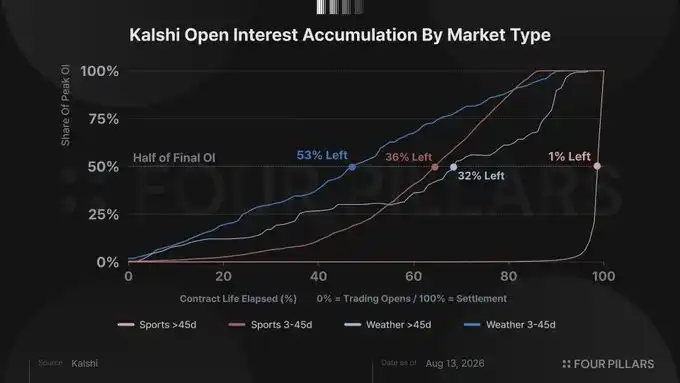
Các hợp đồng thời tiết có giao dịch kéo dài từ 3 đến 45 ngày, khi vòng đời đạt 47% đã đạt được một nửa số lượng vị thế mở đỉnh, lúc này còn 53% thời gian đến ngày đáo hạn. Các hợp đồng thể thao trong cùng khoảng thời gian phải đến 65% mới đạt một nửa, thời gian còn lại chỉ còn 36%.

Trong các hợp đồng kéo dài hơn 45 ngày, sự khác biệt còn đáng kinh ngạc hơn. Hợp đồng thời tiết đạt một nửa khi còn 32% thời gian đến ngày đáo hạn, hợp đồng thể thao chỉ còn 1,3%. Dù ở khoảng thời gian nào, vị thế thời tiết cũng được thiết lập sớm hơn nhiều so với vị thế thể thao.
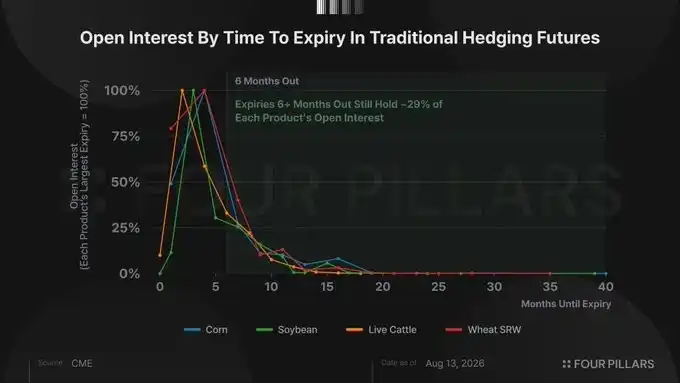
Hành vi "bố trí sớm" này chính là đặc trưng điển hình của thị trường phòng ngừa rủi ro truyền thống. Tính đến ngày 11 tháng 8 năm 2026, trong các hợp đồng tương lai ngũ cốc và sản phẩm chăn nuôi của CME, các hợp đồng còn sáu tháng nữa mới đáo hạn đã tích lũy số lượng vị thế mở khổng lồ. Hợp đồng tương lai ngô thậm chí vẫn nắm giữ 65.127 vị thế trên các hợp đồng còn 16 tháng nữa mới đáo hạn.

Điều này phản ánh xu hướng hành động sớm trước khi rủi ro thực sự ập đến. Và mô hình hành vi của hợp đồng thời tiết Kalshi, rõ ràng gần với thị trường phòng ngừa rủi ro truyền thống hơn, chứ không phải thị trường thể thao.

VI. Phòng ngừa rủi ro dựa vào thanh khoản do đầu cơ tạo ra

Nói về kết luận: Thị trường thời tiết Kalshi không phải là một thị trường phòng ngừa rủi ro thuần túy, cũng không phải là thị trường đầu cơ thuần túy như thể thao. Nhu cầu đầu cơ vẫn đóng góp một phần thanh khoản đáng kể, nhưng trên cơ sở đó, nhu cầu phòng ngừa rủi ro cũng đã xuất hiện tương đối rõ ràng.

Ba chỉ số hướng đến cùng một hướng: Hợp đồng thời tiết giao dịch ít thường xuyên hơn, giữ lại nhiều vị thế hơn khi thanh toán, vị thế được thiết lập sớm hơn. Một chỉ số đơn lẻ không thể xác nhận 100% ý định giao dịch, nhưng sự nhất quán cao của những hành vi này cùng nhau ủng hộ một đánh giá — trong thị trường thời tiết Kalshi thực sự tồn tại nhu cầu nắm giữ khác biệt với thể thao, trong đó một phần đáng kể rất có thể là nhu cầu phòng ngừa rủi ro thực tế.

Quan trọng hơn, nhu cầu đầu cơ không hẳn là điểm yếu của thị trường dự đoán, mà có lẽ là tiền đề để chức năng phòng ngừa rủi ro được thiết lập. Một thị trường chỉ có người phòng ngừa rủi ro, không có người đầu cơ, rất khó tìm đủ đối tác và duy trì thanh khoản liên tục.

Trong thị trường dự đoán, người đầu cơ chịu trách nhiệm định giá và cung cấp thanh khoản, còn người phòng ngừa rủi ro trên cơ sở đó chuyển những rủi ro mà họ không muốn gánh chịu. Rủi ro không còn được các công ty bảo hiểm trực tiếp bảo hiểm, mà được phân tán một cách tự nhiên giữa những người tham gia thị trường thông qua giao dịch.

Vì vậy, tăng trưởng ở giai đoạn tiếp theo của thị trường dự đoán, mấu chốt không nằm ở việc "loại bỏ" đầu cơ, chuyển hướng hoàn toàn sang phòng ngừa rủi ro. Điều thực sự quan trọng là: Trên nền tảng thanh khoản đã được đầu cơ xây dựng sẵn, có thể bổ sung thêm bao nhiêu nhu cầu phòng ngừa rủi ro thực tế của doanh nghiệp. Đây mới là biến số cốt lõi quyết định liệu nó có thể nâng cấp từ một "công cụ đầu cơ thú vị" thành một "cơ sở hạ tầng quản lý rủi ro có thể sử dụng được" hay không.


Trending Cryptos

Related Questions

QCông cụ quản lý rủi ro AI Blanket đang thử biến thị trường dự đoán thành công cụ bảo hiểm cho doanh nghiệp bằng cách nào?

ABlanket phân tích thông tin kinh doanh của doanh nghiệp để chẩn đoán rủi ro chính, sau đó đề xuất các hợp đồng sự kiện trên nền tảng Kalshi tương ứng để doanh nghiệp phòng ngừa rủi ro đó. Doanh nghiệp mua hợp đồng dự đoán các sự kiện như thời tiết bất thường hay biến động giá năng lượng. Nếu rủi ro xảy ra, khoản thanh toán từ hợp đồng sẽ bù đắp một phần hoặc toàn bộ thiệt hại kinh doanh.

QBài viết đã so sánh hành vi giao dịch của những thị trường nào để xác định nhu cầu phòng ngừa rủi ro thực sự trong thị trường thời tiết Kalshi?

ABài viết so sánh ba nhóm: 1) Hợp đồng tương lai ngũ cốc trên CME - đại diện cho thị trường phòng ngừa rủi ro truyền thống. 2) Thị trường thể thao Kalshi - nơi giao dịch chủ yếu do đầu cơ thúc đẩy. 3) Thị trường thời tiết Kalshi - mẫu thử nghiệm chính, xem xét hành vi giao dịch của nó giống với bên nào hơn để xác định có tồn tại nhu cầu phòng ngừa rủi ro hay không.

QChỉ số nào trong phân tích dữ liệu cho thấy sự khác biệt rõ ràng nhất giữa hợp đồng thời tiết và hợp đồng thể thao trên Kalshi, ủng hộ giả thuyết tồn tại nhu cầu phòng ngừa rủi ro?

AChỉ số 'Tỷ lệ nắm giữ đến khi đáo hạn' (holding-to-expiration ratio) cho thấy sự khác biệt rõ rệt nhất. Hợp đồng thời tiết có tỷ lệ này luôn trên 0.5, trong khi hợp đồng thể thao chỉ ở mức 0.012 và 0.033. Điều này có nghĩa là các vị thế trong hợp đồng thời tiết có xu hướng được giữ nguyên cho đến ngày thanh toán cao hơn rất nhiều so với hợp đồng thể thao, phù hợp với hành vi của người phòng ngừa rủi ro.

QVai trò của nhà đầu cơ trong việc phát triển thị trường dự đoán thành công cụ quản lý rủi ro là gì?

ANhà đầu cơ đóng vai trò then chốt trong việc cung cấp tính thanh khoản và định giá cho thị trường. Một thị trường chỉ có người phòng ngừa rủi ro sẽ thiếu tính thanh khoản và đối tác giao dịch. Các nhà đầu cơ tạo ra nền tảng thanh khoản, cho phép những người phòng ngừa rủi ro có thể tham gia để chuyển giao rủi ro họ không muốn chịu. Do đó, nhu cầu đầu cơ là tiền đề để chức năng phòng ngừa rủi ro của thị trường dự đoán tồn tại.

QTheo bài viết, yếu tố cốt lõi nào sẽ quyết định việc thị trường dự đoán có thể nâng cấp từ 'công cụ đầu cơ thú vị' thành 'cơ sở hạ tầng quản lý rủi ro khả dụng'?

AYếu tố cốt lõi là khả năng chồng thêm bao nhiêu nhu cầu phòng ngừa rủi ro thực tế của doanh nghiệp lên trên nền tảng thanh khoản vốn đã được xây dựng bởi hoạt động đầu cơ. Sự tăng trưởng của thị trường dự đoán không nằm ở việc loại bỏ hoàn toàn đầu cơ, mà là tận dụng nền tảng đó để đáp ứng nhu cầu quản lý rủi ro thực sự từ các doanh nghiệp.

Related Reads

Treasury Secretary's Move to Suppress Treasury Yields Ignites 'Currency Debasement Trade'! Gold Hits Three-Month High, Bitcoin Surges Over 25% in a Single Week

US Treasury Secretary Besant's efforts to lower long-term Treasury yields by announcing expanded buybacks had only a brief market impact. However, this move fueled a "currency devaluation trade," weakening the US dollar while boosting both gold (to a three-month high) and Bitcoin (up over 25% for the week). Analysts attribute this reaction to deepening market concerns over the massive US fiscal deficit and structural pressures keeping long-term rates elevated, including fierce competition for capital from global government borrowing and massive AI sector financing. Despite the Treasury's actions, fundamental forces like growth, inflation, and capital demand are seen as limiting its ability to sustainably suppress yields. Bitcoin's strong positive correlation with gold has reinforced its narrative as a hedge against devaluation. While equity markets have shown resilience, some strategists warn that Treasury yields nearing 5% increase pressure on the dollar and high-leverage assets. Figures like Ray Dalio have advised reducing bond exposure in favor of gold and some Bitcoin, citing US debt risks. Market opinions are divided on the sustainability of the devaluation trade, with some noting the lack of a near-term catalyst for its next leg higher. The underlying tension between the Treasury's desire for lower borrowing costs and the Federal Reserve's focus on inflation and reducing market intervention remains a key theme. Upcoming events like Nvidia's earnings and the Jackson Hole symposium will test whether AI profits can continue supporting stocks and if the Fed aligns more with Washington's preference for easier financial conditions.

华尔街日报1h ago

Treasury Secretary's Move to Suppress Treasury Yields Ignites 'Currency Debasement Trade'! Gold Hits Three-Month High, Bitcoin Surges Over 25% in a Single Week

华尔街日报1h ago

Alexander Shokhin: Business Needs an Interest Rate Below 10% and the Dollar at 90-95 Rubles

Alexander Shokhin, head of the Russian Union of Industrialists and Entrepreneurs (RSPP), has advocated for potentially using "non-market" tools to keep the ruble within a target exchange rate corridor. This, he argues on August 21, would help avoid excessive volatility, though he called the topic a separate discussion. Shokhin had previously raised the idea of a currency corridor in late May, noting the ruble's current exchange rate is not fully market-driven due to a limited currency segment and reduced foreign currency demand. He stated that many business community colleagues propose fixing a corridor, even through non-market methods, to ensure predictability. The business community's key targets, as outlined by Shokhin in late December 2025, are a Central Bank key rate of 12%, inflation of 4–5%, and a US dollar exchange rate of 90–95 rubles by the end of 2026. A turning point for investment, he said, would be lowering the rate to 12% with 6% inflation, though truly comfortable business conditions would require a rate below 10%. He stressed the critical importance of currency predictability for corporate investment decisions. From a data analysis perspective, the idea of a ruble corridor is not new. A similar mechanism was used in Russia from 1995 to 1998, where the central bank held the dollar within fixed boundaries through regular interventions. This regime lasted three years before ending abruptly during the 1998 default, illustrating the fragility of rigid targets under external shocks. The macro-economic link is clear: stricter corridors require more reserves to defend against currency pressure. The key unresolved technical aspect is the specific sources and volume of such interventions given the current market's limited liquidity. Whether this discussion remains theoretical or leads to concrete corridor parameters will be seen in the coming months.

cryptonews.ru2h ago

Alexander Shokhin: Business Needs an Interest Rate Below 10% and the Dollar at 90-95 Rubles

cryptonews.ru2h ago

Trading

Spot

Hot Articles

What is G$

Understanding GoodDollar ($G$): A Blueprint for Decentralized Universal Basic Income Introduction In the ever-evolving landscape of cryptocurrency and blockchain technology, initiatives that seek to address pressing social issues have garnered increased attention. One such project is GoodDollar ($G$), a Web3-based universal basic income (UBI) solution. GoodDollar endeavors to tackle inequality and bridge the wealth gap by creating and distributing accessible economic resources to those most in need. Through its innovative use of decentralized finance (DeFi), GoodDollar presents a unique model that could potentially reshape the way financial assistance is perceived and delivered globally. What is GoodDollar ($G$)? GoodDollar is a cryptocurrency protocol that facilitates the issuance and distribution of digital tokens, referred to as $G$, to its registered users on a daily basis. These tokens function as a form of universal basic income, promoting financial empowerment for individuals from various backgrounds, especially those traditionally excluded from the financial system. Operating on the blockchain, GoodDollar utilizes multiple chains, including Ethereum, Celo, and Fuse, ensuring broad access and usability. The fundamental goal of GoodDollar is to make cryptocurrency accessible and beneficial to everyone, irrespective of their economic starting point. The Creator of GoodDollar ($G$) Details concerning the creator of GoodDollar remain somewhat obscure. However, it is notably highlighted that the project has strong backing from eToro, a widely recognized investment platform that provided the initial funding and foundational support for GoodDollar's development. The vision behind the project is not solely profit-driven but leans heavily towards social entrepreneurship, aiming for a systemic change in economic accessibility. Investors of GoodDollar ($G$) GoodDollar enjoys the financial backing and operational support of eToro. This partnership has played a significant role in launching the protocol and its subsequent developments. While eToro was instrumental in establishing the foundation of the project, GoodDollar envisions transitioning towards a model funded by its community in the long run. This shift to community funding is in line with GoodDollar's commitment to decentralization, allowing its users to have a direct stake in the project's future. How Does GoodDollar ($G$) Work? GoodDollar's operational framework relies heavily on DeFi principles to generate interest from staked cryptocurrencies. This mechanism allows the project to mint and distribute $G$ tokens as a digital basic income for users worldwide. Several key features contribute to GoodDollar's uniqueness and innovation: Universal Basic Income (UBI): Every day, registered users receive free tokens, establishing an automatic income stream intended to alleviate financial pressures. Sustainable Economic Model: The project’s tokenomics aim to balance supply and demand for $G$ tokens, ensuring that the value remains stable over time. Reserve-Backed Tokens: Each $G$ token is backed by a reserve of cryptocurrencies, providing it with inherent value and reliability, a crucial aspect for maintaining user trust. Decentralized Governance: GoodDollar incorporates a democratic approach to decision-making through token-powered decentralized governance. This allows community members to actively participate in the shaping of the project's trajectory, making it truly community-driven. Global Accessibility: GoodDollar has established a considerable community footprint, boasting over 640,000 members spanning 181 countries. Such widespread reach is instrumental in facilitating UBI on a global scale. Timeline of GoodDollar ($G$) The evolution of GoodDollar is marked by several significant milestones throughout its history: 2019: The launch of the GoodDollar wallet marked the first step in operationalizing its vision of delivering UBI through cryptocurrency. 2020: Following the successful wallet rollout, the GoodDollar protocol officially debuted. This marked a crucial phase in its mission to provide daily distributed income. 2021: The project advanced further with the introduction of its Decentralized Autonomous Organization (DAO), fostering a greater level of community involvement and governance. 2022: GoodDollar unveiled its DeFi-friendly version 2 (V2), striving for enhanced user engagement and operational efficiency. The same year also saw the transition to a decentralized governance structure via GoodDAO. 2022: A new roadmap was conceptualized, focusing on initiatives like a grant program designed to promote $G$-related entrepreneurial ventures and an upgraded GoodDollar Marketplace. Key Features of GoodDollar ($G$) The GoodDollar project introduces numerous critical features aimed at redefining the landscape of basic income: Universal Basic Income: Delivering daily free tokens to its users fundamentally underscores its mission to eliminate economic precarity. Multi-Chain Operation: Leveraging multiple blockchain networks enhances accessibility and scalability, ensuring broader participation. Engagement with Decentralized Finance: The use of DeFi allows for sustainable funding of the UBI model, reinforcing its viability as an economic solution. Community Engagement and Governance: GoodDollar envisions a model where the community influences operations through democratic participation, fostering transparency and accountability. Global Community: Boasting a diverse global community enables the project to implement UBI solutions tailored to various cultural and economic contexts. Conclusion GoodDollar represents a transformative leap towards incorporating the principles of universal basic income through the innovative lens of blockchain technology. By harnessing decentralized finance, the project not only provides a solution to financial inequality but also actively engages users in its governance and operations. With a growing community and evolving roadmap, GoodDollar stands as a significant player in the intersection of cryptocurrency and social good, paving the way for a more equitable financial future. As it continues to evolve, GoodDollar’s journey may ultimately inspire other initiatives to consider similar models, furthering the cause of economic empowerment for all.

1.5k Total ViewsPublished 2024.04.01Updated 2024.12.03

What is G$

How to Buy G

Welcome to HTX.com! We've made purchasing Gravity (G) simple and convenient. Follow our step-by-step guide to embark on your crypto journey.Step 1: Create Your HTX AccountUse your email or phone number to sign up for a free account on HTX. Experience a hassle-free registration journey and unlock all features.Get My AccountStep 2: Go to Buy Crypto and Choose Your Payment MethodCredit/Debit Card: Use your Visa or Mastercard to buy Gravity (G) instantly.Balance: Use funds from your HTX account balance to trade seamlessly.Third Parties: We've added popular payment methods such as Google Pay and Apple Pay to enhance convenience.P2P: Trade directly with other users on HTX.Over-the-Counter (OTC): We offer tailor-made services and competitive exchange rates for traders.Step 3: Store Your Gravity (G)After purchasing your Gravity (G), store it in your HTX account. Alternatively, you can send it elsewhere via blockchain transfer or use it to trade other cryptocurrencies.Step 4: Trade Gravity (G)Easily trade Gravity (G) on HTX's spot market. Simply access your account, select your trading pair, execute your trades, and monitor in real-time. We offer a user-friendly experience for both beginners and seasoned traders.

6.7k Total ViewsPublished 2024.07.18Updated 2026.06.02

How to Buy G

What is @G

Graphite Network, $@G: Bridging TradFi and Web3 Introduction to Graphite Network, $@G In the vibrant world of cryptocurrencies and web3 projects, Graphite Network emerges as a beacon of innovation. With its native token, $@G, this Layer-1, Proof-of-Authority (PoA) blockchain is tailored to bridge the gap between traditional finance (TradFi) and the rapidly evolving Web3 ecosystem. As digital currencies gain traction, Graphite Network strives to offer a blockchain platform that prioritizes security, compliance, and speed, presenting itself as a facilitator of trust and accountability. What is Graphite Network, $@G? Graphite Network is not merely another blockchain project; it aims to redefine how decentralization, security, and user accountability are perceived in the digital finance realm. The project boasts a series of distinctive features: Reputation-Based Blockchain: At its core, Graphite Network implements a one-user, one-account policy, fortified with integrated Know Your Customer (KYC) verification and scoring mechanisms. This design ensures a balance between user privacy and transparency—a critical aspect of financial operations in today’s digital world. Entry-Point Node Income: The network incentivizes users to set up entry-point nodes, allowing operators to earn rewards from network transactions. This income generation model not only boosts user engagement but also reinforces network health and decentralization. EVM Compatibility: With an Ethereum-compatible virtual machine (VM), Graphite Network enables seamless integration of existing Solidity decentralized applications (dApps) and smart contracts, thereby inviting developers to leverage its capabilities without extensive modifications. KYC Integration: In an era where compliance is paramount, the integrated KYC framework with multiple verification tiers enhances the control over financial operations without mandatory participation, setting a precedent for user autonomy. Who is the Creator of Graphite Network, $@G? The Graphite Network is borne out of the endeavors of the Graphite Foundation, a non-profit organization dedicated to the development, maintenance, and evolution of the Graphite Network. The foundation’s commitment underscores the project’s vision to create a secure and sustainable blockchain environment focused on genuine user engagement and compliance. Who are the Investors of Graphite Network, $@G? Currently, there is limited information available on the specific investors backing the Graphite Network initiative. The founding organization, the Graphite Foundation, functions independently in fostering the project’s growth while seeking partnerships that resonate with its vision of a compliant and accessible blockchain platform. How Does Graphite Network, $@G Work? Graphite Network’s operation is grounded in its unique Proof-of-Authority consensus mechanism, which strikes an impressive balance between high throughput and decentralization. Let's delve into the various components that define its operation: Transport Nodes: Serving as the entry-point nodes, these are critical to the ecosystem. Operators can earn revenue from transactions that traverse the network, which not only empowers individual users but also bolsters network decentralization. Authorized Nodes: At the heart of the Graphite Network are core validators who undergo rigorous compliance tests, encompassing robust KYC verification along with technical assessments. This layer of trust is essential for ensuring that transactions within the network maintain a high level of integrity. Ticker System: Graphite Network employs a distinctive ticker system for its wrapped tokens, denoted as @G. This feature enhances clarity in asset integration, making user transactions comprehensible and straightforward. Graphite Network’s innovative approach reflects a significant step in addressing the crucial issues of digital finance, positioning itself favorably for the future as more users transition from traditional forms of finance into the world of decentralized applications. Timeline of Graphite Network, $@G To understand the progression and milestones of Graphite Network, it is beneficial to overview key events in its timeline: 2021: The inception of Graphite Network by the Graphite Foundation marks the commencement of a new chapter in blockchain development, focusing on compliance and user empowerment. Key Developments: Following its launch, the introduction of entry-point node income, the establishment of a reputation-based model, integrated KYC verification, and the provision of EVM compatibility represent significant advancements in the project. Recent Activities: The continuous development and nurturing efforts of the Graphite Foundation have focused on augmenting network features while fostering the ecosystem's growth, demonstrating a long-term commitment to sustainability and innovation. Additional Key Points Beyond its foundational components, Graphite Network encompasses several tools and features that bolster its usability: Graphite Wallet: A user-friendly Chrome extension that facilitates access to various network features and applications across Ethereum-compatible chains, enhancing user convenience. Graphite Bridge: This utility allows seamless transfers of Graphite assets across different networks, fostering an integrated and interoperable ecosystem. Graphite Explorer: Serving as an essential tool within the ecosystem, this feature enables users to view and verify smart contract source code, track transactions, and explore other vital information in real-time. Graphite Testnet: The project provides a robust testing environment for developers, allowing them to ensure stability and scalability prior to mainnet deployment. This initiative not only empowers developers but also enhances the reliability of the entire network. Conclusion Graphite Network, with its native token $@G, represents a significant stride toward bridging traditional finance and cutting-edge blockchain technology. By focusing on security, compliance, and decentralization, this innovative platform is set to lead the transition into the Web3 era. As user engagement grows and more projects leverage its capabilities, Graphite Network is poised to make lasting contributions to the rapidly evolving digital landscape. In conclusion, Graphite Network stands as a testament to what can be achieved when innovative thinking meets the growing demands of modern finance and technology. As the world explores the potential of decentralized finance, Graphite Network will undoubtedly remain a noteworthy player in this arena.

959 Total ViewsPublished 2025.01.06Updated 2025.01.06

What is @G

Discussions

Welcome to the HTX Community. Here, you can stay informed about the latest platform developments and gain access to professional market insights. Users' opinions on the price of G (G) are presented below.

活动图片












