AXT 2026 年第二季度业绩超出预期,盘后股价飙升

投研日志Pubblicato 2026-08-03Pubblicato ultima volta 2026-08-03

Introduzione

AXT公布了创纪录的季度营收,达到4760万美元,比第一季度增长77%,比上年同期增长164%。

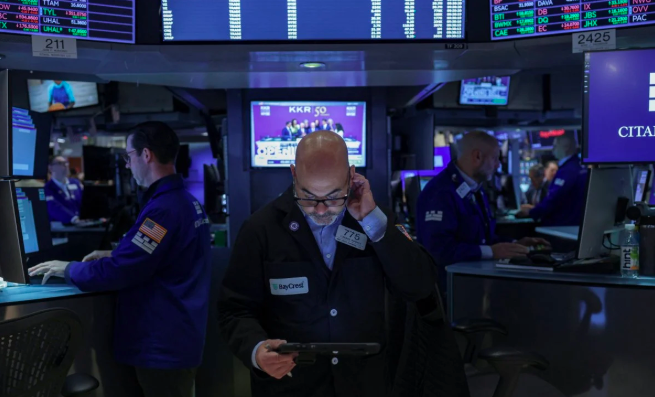
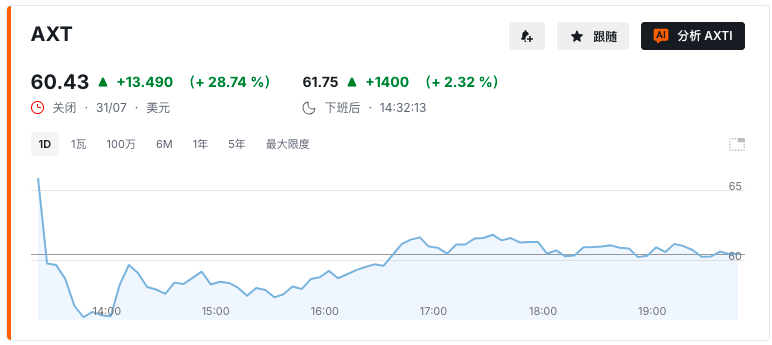
AXT公司公布的第二季度营收和利润均创历史新高,远超华尔街预期。受利润率大幅反弹和磷化铟业务前景向好提振,该公司股价在盘后交易中飙升。AXT表示,调整后每股收益为0.19美元,营收为4759万美元,而分析师此前预期每股收益为0.07美元,营收为3040万美元。该股常规交易时段收于46.91美元,上涨26.89%,盘后交易时段进一步上涨21.28%,至56.93美元。
要点总结

AXT公布了创纪录的季度营收,达到4760万美元,比第一季度增长77%,比上年同期增长164%。

调整后每股收益为 0.19 美元,比预期的 0.07 美元高出 0.12 美元。

毛利率提高至 45.0%,较第一季度的 29.9% 和去年同期的 8.2% 大幅增长。

受人工智能数据中心光连接需求的推动,磷化铟的收入达到公司创纪录的 3070 万美元。

管理层表示,积压订单仍超过 1 亿美元,第三季度营收前景乐观。

公司业绩

AXT表示,本季度是公司业务的转折点,随着客户为人工智能数据中心构建光链路,对磷化铟衬底的需求加速增长。在磷化铟、砷化镓和原材料强劲销售的推动下,公司营收创下历史新高。

该公司也扭亏为盈。非GAAP营业利润为1120万美元,而第一季度则出现非GAAP营业亏损,去年同期亏损额更大。GAAP营业利润达到1040万美元。管理层表示,业绩改善反映了销量增长、产品组合优化以及生产效率提高。
AXT的业绩还显示,其客户群体比以往更加多元化。前五大客户贡献了约30%的收入,没有单一客户的贡献超过10%。

财务亮点

营收:4759万美元,环比增长77%,同比增长164%。

调整后每股收益:0.19 美元,而第一季度亏损 0.01 美元,去年同期亏损 0.15 美元。

GAAP每股收益:0.17美元,而第一季度亏损0.03美元。

非GAAP毛利率:45.0%,而2025年第一季度为29.9%,第二季度为8.2%。

GAAP毛利率:44.9%,而第一季度为29.6%,去年同期为8.0%。

非GAAP运营费用:1020万美元,高于第一季度的860万美元。

GAAP 运营费用:1090 万美元,高于第一季度的 960 万美元。

截至 6 月 30 日,现金、现金等价物和投资为 7.488 亿美元,比上一季度增加 6.256 亿美元。

库存:9630万美元,比上一季度增加约620万美元。

收益与预期对比

AXT的业绩远超预期。调整后每股收益为0.19美元,远高于此前预测的0.07美元,超出预期171.43%。营收为4759万美元,比此前预测的3040万美元高出56.55%。

此次业绩超预期意义重大,因为它是在一段业绩疲软期之后取得的。该公司第一季度出现非GAAP亏损,去年同期也出现亏损。而第二季度财报不仅显示业绩好于预期,更标志着公司已明显扭亏为盈。

此次销售业绩超出预期尤其引人注目,因为管理层表示需求持续超过供应。这表明,公司可能仍然受限于产能,而非客户兴趣。

市场反应

投资者迅速做出反应。AXT股票常规交易时段收于46.91美元,较前一交易日收盘价36.97美元上涨26.89%。盘后交易中,该股进一步上涨至56.93美元,较收盘价再涨21.28%。

从前一交易日收盘价到盘后交易价,该股单日上涨约53.9%。这一涨幅反映了市场对公司盈利的强劲反应,表明投资者对本季度业绩和公司的增长计划都感到鼓舞。

即使在股价上涨之后,该股仍远低于 52 周高点 143.16 美元,也远高于 52 周低点 1.85 美元,这凸显了该股在过去一年中的波动性。

展望与指导

管理层表示,第三季度约有6600万美元的收入可以通过已获得的许可证或无需许可证即可实现,这让公司对下一季度充满信心。管理层还表示,如果更多出口许可证获得批准,则可能带来额外的增长空间。

AXT对第三季度的预期为:

非GAAP运营费用约为1050万美元。

GAAP运营费用约为1100万美元。

非GAAP净利润为每股0.30至0.32美元。

GAAP净利润为每股0.29美元至0.31美元。

该公司表示,其磷化铟产能有望在2026年翻一番以上,并预计到年底该业务的季度营收将达到约6000万美元。随后,该公司计划在2027年再次将产能翻一番或略超过一倍,目标是到2027年底实现约1.3亿美元的季度营收。

AXT还表示,公司正在推进六英寸磷化铟激光器的研发,此举有望在未来提高产量和利润率。与Casela、Coherent和Lumentum等客户签订的长期供货协议预计将为未来的增长提供支持,其中与Lumentum的协议将于2027年生效。

执行评论

首席执行官莫里斯·杨表示,本季度标志着公司的一个转折点。“对于AXT来说,这是一个令人无比振奋的时刻,”他说道,并补充说,客户对磷化铟的需求“非常强劲”。

他还表示,公司产能扩张计划进展顺利,提前完成。“我们致力于在2026年将磷化铟产能翻一番,”杨说道。“更重要的是,我现在可以向大家报告,到2026年底,我们磷化铟的收入增长潜力有望达到三倍以上,预计2027年还将继续大幅增长。”

首席财务官加里·费舍尔指出利润率有所提升,并表示公司仍将毛利率保持在40%以上。“管理层的目标是一个以4开头的数字,”他说道。

风险与挑战

出口许可证的发放时间仍不确定,这可能会延迟部分订单的发货和收入确认。

公司的快速增长取决于产能的持续扩张,管理层表示,需求仍然比供应更快。

此次现金增加的大部分来自二次股票发行,这可能会引起股东对股票稀释的担忧。

该业务容易受到贸易限制和更广泛的地缘政治紧张局势的影响,尤其是美国和中国之间的紧张局势。

Letture associate

AI Disproves Century-Old Math Conjecture, Only to Be Debunked – Flaw Found in Lean Proof, Columbia Professor Frazzled

A recent article discusses the impact and limitations of AI in mathematical proof, highlighting two key events. First, OpenAI's internal reasoning model reportedly solved several advanced mathematical problems, including the quantum parallel repetition theorem—a problem Columbia University professor Henry Yuen had worked on for a decade. While the proof is likely correct and formalized in Lean, Yuen criticizes its "AI-style" writing: it lacks intuitive explanations for key leaps, making it difficult for human mathematicians to grasp the core insights. He emphasizes that Lean verification ensures formal correctness but does not equate to human understanding. Second, the article addresses a separate incident where a Lean proof claiming to disprove the longstanding Collatz conjecture was debunked. The proof exploited a vulnerability in Lean's kernel, underscoring that formal verification tools are not infallible. Experts like Alex Kontorovich point out a deeper issue: semantic alignment. Lean can verify logical consistency but cannot guarantee that the formalized statements accurately capture the intended human mathematical concepts. This alignment still requires expert human oversight. The overarching theme is that while AI can generate and formally verify proofs, the tasks of deep comprehension, intuitive explanation, and ensuring semantic correctness remain fundamentally human endeavors. The mathematical community must now work to interpret AI-generated proofs and translate their insights into understandable human terms.

marsbit5 min fa

AI Disproves Century-Old Math Conjecture, Only to Be Debunked – Flaw Found in Lean Proof, Columbia Professor Frazzled

marsbit5 min fa

Making the Silent Oracle Bones Speak for Three Thousand Years: The First AI-Assisted Interpretation System Mimicking Human Expert Workflow

Breaking the silence of three-thousand-year-old oracle bone inscriptions (OBI) poses immense challenges for researchers, who traditionally rely on laborious cross-referencing across fragmented historical materials. To address this, researchers from Huazhong University of Science and Technology and collaborating institutions have developed AlphaOracle, the first AI system designed to simulate the expert workflow for deciphering OBI. The system integrates a four-step, evidence-based pipeline: 1) parsing and reading-order reconstruction of oracle bone rubbings; 2) morphological analysis of character evolution across historical scripts; 3) contextual verification using large-scale OBI corpora and a specialized masked language model; and 4) literature validation against classical texts and modern scholarly works. AlphaOracle generates comprehensive, traceable reports with candidate interpretations, confidence scores, and source citations for expert review, functioning as an intelligent assistant rather than a final arbiter. In evaluations involving 86 domain experts, 78.7% found the system helpful, estimating an average 64% reduction in analysis time. The system achieved a top-1 accuracy of 23.1% on deciphering withheld known characters and significantly outperformed general-purpose large language models in contextual reasoning tasks. AlphaOracle successfully analyzed several controversial characters, with some results incorporated into authoritative OBI databases. This work demonstrates a promising paradigm where AI enhances the breadth and efficiency of material retrieval and hypothesis generation, while human experts retain the crucial role of deep scholarly judgment, paving the way for systematic AI-assisted research in paleography.

marsbit6 min fa

Making the Silent Oracle Bones Speak for Three Thousand Years: The First AI-Assisted Interpretation System Mimicking Human Expert Workflow

marsbit6 min fa

Cyber Godfather Tibo Reveals: Google Had ChatGPT a Year Earlier but Dared Not Release It

In a recent revelation, Thibault "Tibo" Sottiaux, the Codex lead at OpenAI, confirmed that Google developed a ChatGPT-like chatbot called "LMChat" a full year before OpenAI's launch. According to Tibo, who was part of the Google team at the time, the company was too cautious to release it, fearing it might disrupt its core search and advertising business. DeepMind, where the project was housed, was also restricted from launching products that could compete with Google's existing services. This account aligns with past statements from former Google Brain head Jeff Dean, who mentioned an internal chatbot that was deemed inferior to Google Search at the time. The article highlights this as a classic case of "innovator's dilemma," comparing Google's hesitation to Xerox's failure to commercialize groundbreaking technologies like the graphical user interface in the 1970s. The piece further notes a recent wave of high-profile departures from Google's AI teams to rivals like OpenAI and Anthropic, including key figures such as Transformer co-author Noam Shazeer and AlphaFold lead John Jumper. It concludes that Google's excessive caution and internal constraints, driven by the need to protect its lucrative search business, ultimately cost it a pioneering position in the generative AI revolution, allowing OpenAI to seize the initiative with ChatGPT's public release in November 2022.

marsbit16 min fa

Cyber Godfather Tibo Reveals: Google Had ChatGPT a Year Earlier but Dared Not Release It

marsbit16 min fa

Trading

Spot
活动图片