Cyber Godfather Tibo Reveals: Google Had ChatGPT a Year Earlier but Dared Not Release It

marsbitPubblicato 2026-08-03Pubblicato ultima volta 2026-08-03

Introduzione

In a recent revelation, Thibault "Tibo" Sottiaux, the Codex lead at OpenAI, confirmed that Google developed a ChatGPT-like chatbot called "LMChat" a full year before OpenAI's launch. According to Tibo, who was part of the Google team at the time, the company was too cautious to release it, fearing it might disrupt its core search and advertising business. DeepMind, where the project was housed, was also restricted from launching products that could compete with Google's existing services. This account aligns with past statements from former Google Brain head Jeff Dean, who mentioned an internal chatbot that was deemed inferior to Google Search at the time. The article highlights this as a classic case of "innovator's dilemma," comparing Google's hesitation to Xerox's failure to commercialize groundbreaking technologies like the graphical user interface in the 1970s. The piece further notes a recent wave of high-profile departures from Google's AI teams to rivals like OpenAI and Anthropic, including key figures such as Transformer co-author Noam Shazeer and AlphaFold lead John Jumper. It concludes that Google's excessive caution and internal constraints, driven by the need to protect its lucrative search business, ultimately cost it a pioneering position in the generative AI revolution, allowing OpenAI to seize the initiative with ChatGPT's public release in November 2022.

What, Google really made ChatGPT a year earlier than OpenAI?

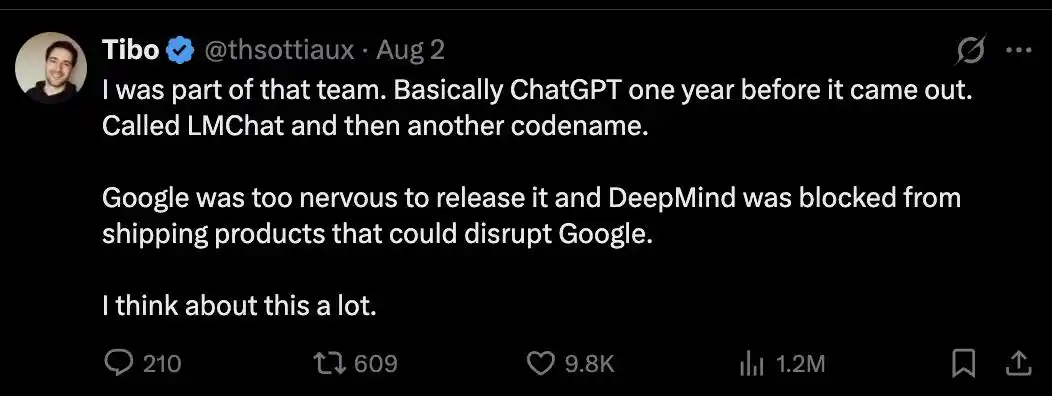
This isn't Google making excuses after the fact. This time, it's confirmed by an OpenAI insider, Codex lead Tibo:

That was basically ChatGPT a year early. It was initially called LMChat, and later had another codename.

Google was too nervous to release it, and DeepMind was prohibited from launching products that could impact Google's business.
But why does Tibo know such an old story so well?

The answer: He was on that Google team at the time.

I was a member of that team back then.

Yes, the Tibo who is now building "Infinite Tokens" for OpenAI was a firsthand participant in that Google project.

Netizens were shocked that Tibo had such a history:

No way, I thought you were just a reset button for Codex (just kidding).

Jeff Dean: I'm Not Convinced!!

Here's how it happened. A Midjourney engineer recently dug up an old interview with former Google Brain head Jeff Dean on X:

I sometimes think about that Jeff Dean interview where he said they had an internal Chatbot before ChatGPT, but felt using it was worse than just using Google Search.
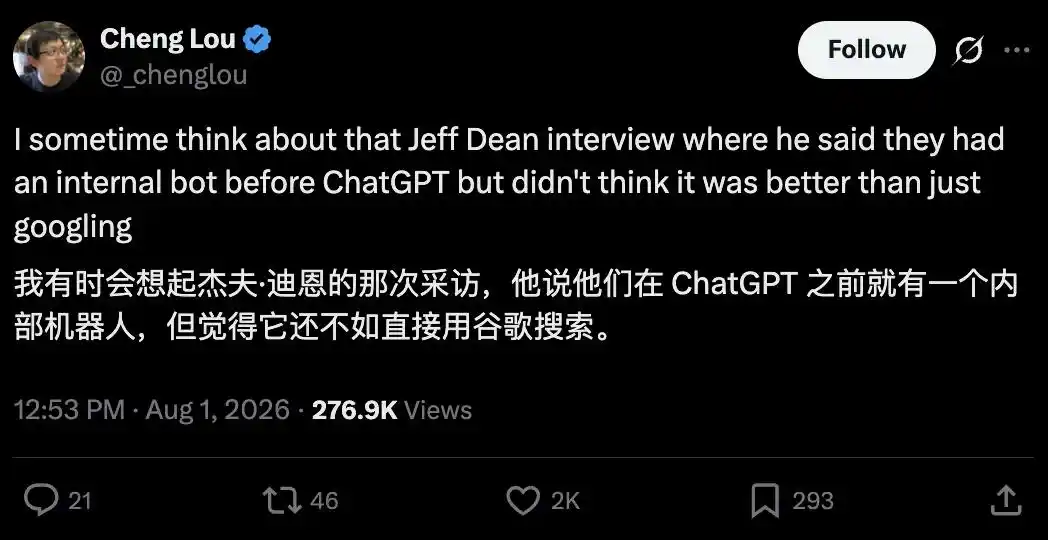
Unexpectedly, Tibo personally responded, engaging in a cross-air dialogue with Jeff Dean:

The project Jeff mentioned did exist. It was initially called LMChat and was almost exactly ChatGPT a year earlier.

As for why it wasn't released, Tibo helplessly stated that DeepMind didn't have the authority. LLMs would impact Google Search, and the bosses were too nervous to greenlight it.

After recounting this past event, Tibo left only a sigh:

Sigh, I often think about this.

Netizens were speechless upon hearing it...

Your former boss at Google absolutely should not touch anything business-related ever again.

Coincidentally, Google's AI lead Demis Hassabis also said in a biography that OpenAI didn't do anything revolutionary. Many people at the time realized the power of LLMs, but Sam Altman had the guts to release it without considering safety at all.

But you can't really blame Google. "Google Search" set a very high bar as a benchmark. If it was just for search, Google Search was already very mature.

And what about the 2023 large models? They got almost everything wrong, full of hallucinations whenever it involved timely content.

But now, Scaling has solved everything.

"Better than Google Search" – this acceptance criteria Google set for itself ultimately cost it an unprecedented price.

The Unfinished Google Journey

Tibo, real name Thibault Sottiaux, Codex lead, possessor of Infinite Token capability, aka "Cyber Godfather".

(ps: Reset reset o(╥_╥)o, I accidentally used them all up over the weekend!!!)

In 2015, Tibo joined Google, initially working on Google Maps-related projects, then transferred to DeepMind.

At the time, DeepMind was still a fairly pure research lab, with AlphaGo, reinforcement learning, and AGI research at its peak of attention.

At DeepMind, Tibo was mainly responsible for building the AI and machine learning infrastructure used by researchers.

According to Tibo's recollection, DeepMind internally developed a chat product called LMChat, which later had another codename. Its experience was already very similar to ChatGPT.

But Google was extremely cautious, given the direct impact on existing business, and DeepMind didn't have enough authority. Ultimately, the product never truly reached the public.

November 2022, ChatGPT exploded onto the scene.

Tibo saw it and was floored.

In 2024, he ended his nearly nine-year Google career and officially joined OpenAI.

As it turned out, Tibo's choice was correct.

This kind of abortion of projects like LMChat wasn't a one-off; like Vibe Coding, it's either zero times or countless times (just kidding).

This small story ultimately became a microcosm of Google's situation throughout the AI era.

Now, falling behind in the coding battlefield is triggering an even more brutal talent exodus within Google.

June 18th, Noam Shazeer announced joining OpenAI.

This name needs no introduction. One of the core authors of the 2017 Transformer paper "Attention Is All You Need" that ignited the entire AI era. He left Google in 2021 to found Character.AI. In 2024, Google spent $2.7 billion to buy back him and his company, having him co-lead Gemini.

Result: The person bought back for $2.7 billion, didn't even stay two years.

June 19th, John Jumper announced moving to Anthropic.

DeepMind VP, a core general handpicked by Hassabis himself – tasked with leading the AlphaFold team just six months after earning his PhD.

In 2024, he and Hassabis jointly won the Nobel Prize in Chemistry for their groundbreaking work on AlphaFold in protein structure prediction.

But now, the Nobel laureate has chosen a competitor.

After these two heavy blows, Google continues to bleed talent.

June 24th, two new names appeared on Google's talent "wanted list": Jonas Adler and Alexander Pritzel.

Both are core contributors to Gemini. Adler leads Google's AI coding direction, Pritzel works on pre-training. Both were involved in AlphaFold research, colleagues of John Jumper.

Destination: also Anthropic.

One More Thing

In the comments of the post, someone asked a very interesting question:

If Google had released GPT first, how would things be different now?

Unfortunately, hardly anyone replied.
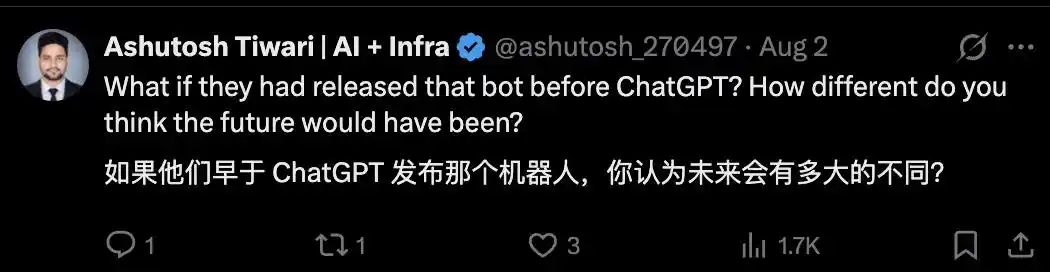
But I know this one!!

Isn't this just the tech world's most classic old story.

In the 1970s, Xerox PARC developed the graphical user interface, mouse, and Ethernet. These guys basically held all the cards for the PC era, a pure royal flush.

And the result? Xerox didn't take it seriously at all.

Because Xerox sales did the math: Can this fancy interface help me sell two more toner cartridges, two more packs of A4 paper? No. Then why bother?

...

And so, Xerox watched as Steve Jobs visited, went back, created the Macintosh, and ascended to the throne.

Ever since, Xerox became Silicon Valley's "scapegoat." Every time the industry undergoes a paradigm shift, big shots drag Xerox out for a whipping:

See, this is big company disease! (piapiapia, whip sounds)

But seriously, anyone sitting in that position, looking at billions in annual printer profits, who would be willing to disrupt themselves...

Replace "toner and A4 paper" with "search and ads," replace "graphical interface" with "ChatGPT" –

That Google, which wrote Transformer in 2017 and held a full set of god-tier gear, ultimately in the AGI marathon...

Earned the title of "America's Doubao."

Reference link:[1]https://x.com/thsottiaux/status/2083596911060324570

This article is from the WeChat public account "QbitAI" (ID: QbitAI), author: Jay

Crypto di tendenza

Domande pertinenti

QWho is Tibo and what role does he play in this story about Google's early chatbot?

ATibo, whose real name is Thibault Sottiaux, is the Codex lead at OpenAI and is referred to as the 'Cyber Godfather.' He is a former Google employee who was part of the team that developed an early ChatGPT-like product called LMChat within DeepMind. He personally confirmed that Google had created this technology about a year before ChatGPT was released.

QAccording to the article, why did Google decide not to release its early chatbot, LMChat?

AAccording to Tibo's account, Google did not release its early chatbot (LMChat, and later another project) because the company was too cautious and nervous. The leadership was concerned that large language models (LLMs) would disrupt Google's core search and advertising business. Additionally, DeepMind did not have the authority to launch products that could impact Google's existing operations.

QWhat historical parallel does the article draw to explain Google's missed opportunity with AI?

AThe article draws a parallel to the 1970s when Xerox PARC invented foundational technologies like the graphical user interface, mouse, and Ethernet but failed to commercialize them effectively because they were focused on their profitable printer and copier business (selling toner and paper). Similarly, Google, with its hugely profitable search and ads business, hesitated to launch a disruptive AI product, allowing others like OpenAI to seize the initiative.

QWhich high-profile AI researchers recently left Google, as mentioned in the article?

AThe article mentions several high-profile departures from Google: Noam Shazeer, a co-author of the 'Attention Is All You Need' paper, left for OpenAI. John Jumper, a DeepMind VP and Nobel laureate for AlphaFold, left for Anthropic. Additionally, core Gemini contributors Jonas Adler and Alexander Pritzel also left for Anthropic.

QWhat was Jeff Dean's reported view on Google's internal chatbot before ChatGPT's release?

AJeff Dean, the former head of Google Brain, reportedly stated in an old interview that Google had an internal chatbot before ChatGPT but felt that using it was not better than simply using Google Search. This view reflects the high internal benchmark Google set for itself, which ultimately contributed to its hesitation to release the product.

Letture associate

Soaring 20% Then Dropping 5%: When Will the Bottom of the Korean Stock Market Be?

"South Korean stocks face a turbulent period as the KOSPI index, after a 20% surge, fell 5% to 6257 points. The market is grappling with severe issues: over 500,000 leveraged retail accounts have been liquidated, and more than 24 trillion won has flowed from stocks into bank deposits for safety. This reflects a significant loss of market liquidity and shaken investor confidence. In response, Korean financial regulators are taking action. They have tripled the minimum保证金 (margin) requirement for single-stock leveraged ETF trades to 30 million won and are considering granting themselves "emergency intervention" powers. These could include capping leverage ratios and setting investment limits on these ETFs, seen by many as amplifying market volatility. Initial results show a 75% drop in these products' trading volume post-regulation. The market downturn has political repercussions, pushing President Yoon Suk-yeol's approval rating to a new low. Meanwhile, foreign investors made a record net purchase of 7.18 trillion won during a recent rebound, while domestic retail investors sold off massively. Morgan Stanley has upgraded South Korean stocks to "overweight," citing the ongoing "leverage unwinding" and potential for a 36% upside, with giants like Samsung Electronics and SK Hynix providing valuation support. However, analysts caution that the market's structure remains vulnerable to foreign capital flows, and the current low may not be the bottom."

marsbit4 min fa

Soaring 20% Then Dropping 5%: When Will the Bottom of the Korean Stock Market Be?

marsbit4 min fa

Goldman Sachs Stakes a Clear Position: This Is the Largest Capital Demand Cycle in Human History, and the Fed Is Just an Observer

Goldman Sachs argues that the world is entering the most capital-intensive investment cycle in history, driven by concurrent massive demands from AI infrastructure, reindustrialization, defense reinvestment, power grid rebuilding, supply chain realignment, and sovereign debt financing. This structural competition for capital is pushing its cost higher, fundamentally altering investment paradigms. Goldman's Mark Wilson states that the Federal Reserve is merely a "passenger, not the driver" in this shift, with rising yields rooted in these real economy demands rather than just monetary policy. While major indices appeared calm in July, underlying market movements were historic, featuring extreme stock dispersion and a severe momentum factor crash, leading to significant de-risking by fund managers. Wilson cautions against expecting a quick reversal in August, citing ongoing digestion of higher rates, disrupted risk models, and typically muted market performance ahead of US midterm elections. Corporate fundamentals remain robust with strong earnings, though growth rates are peaking in the US while accelerating in Europe. Notably, hyperscale cloud companies like Amazon and Microsoft are announcing staggering capital expenditure projections for 2027-2028, justified by explosive AI-related revenue growth and high returns. Amazon revealed its AI revenue run-rate exceeds $25 billion, growing triple-digits annually, and expressed confidence that AWS could become a trillion-dollar revenue business. The report concludes that a transitional period is underway, marked by a growing tension between aggressively investing private tech giants and increasingly capital-constrained sovereign governments. The AI super-cycle continues, with August likely being a consolidation phase.

marsbit9 min fa

Goldman Sachs Stakes a Clear Position: This Is the Largest Capital Demand Cycle in Human History, and the Fed Is Just an Observer

marsbit9 min fa

Outflow of Stablecoins from South Korea Continues for 18 Consecutive Months, Exceeding $360 Million in June

In June 2026, South Korea experienced a net outflow of stablecoins to overseas crypto exchanges, amounting to 560.3 billion won ($367 million). This represents approximately 78% of the net value of foreign stocks purchased by Korean investors in the same period. According to the Financial Supervisory Service (FSS), this marks the 18th consecutive month of net outflows, a trend ongoing since January 2025. The FSS reported that 2.76 trillion won ($1.8+ billion) in stablecoins were withdrawn from the country's five major exchanges to foreign platforms in June, while 2.2 trillion won ($1.4 billion) flowed back in. The second quarter of 2026 saw a significant net outflow of 1.69 trillion won (~$1.1 billion), surpassing net sales of foreign stocks in the same period. Analysts cite access to unavailable domestic financial instruments as a primary driver. Foreign platforms offer crypto derivatives, spot and futures products tied to major Korean stocks like Samsung and Hyundai, along with RWA tokenization, DeFi, staking, and leveraged products. Lawmaker Lee Jong-wook warned that the stablecoin outflows constitute capital flight, exposing investors to risks on unregulated foreign platforms. He called for accelerated regulatory reform and enhanced investor protection measures. The government is reportedly working on a digital assets law to foster the blockchain sector.

cryptonews.ru13 min fa

Outflow of Stablecoins from South Korea Continues for 18 Consecutive Months, Exceeding $360 Million in June

cryptonews.ru13 min fa

Trading

Spot

Articoli Popolari

Cosa è DOGE M

Doge Matrix ($doge m): La Nuova Razza di Criptovaluta Guidata dalla Comunità Introduzione Nel panorama in continua evoluzione delle criptovalute, nuovi progetti emergono costantemente, ciascuno con l'obiettivo di catturare l'interesse di investitori ed appassionati. Uno degli ultimi ingressi in questo dominio è Doge Matrix, rappresentato dal simbolo ticker $doge m. Questo progetto ha attirato attenzione grazie alle sue radici nella popolare cultura dei meme che circonda Dogecoin, stabilendo il suo posto all'interno dello spazio web3. Questo articolo mira a fornire un'analisi completa di Doge Matrix, coprendo la sua panoramica, il creatore, gli investitori, la funzionalità, la cronologia e gli aspetti notevoli. Cos'è Doge Matrix ($doge m)? Doge Matrix è un progetto di criptovaluta guidato dalla comunità che apparentemente si basa sull'ampio appeal di Dogecoin, una valuta digitale nota per il suo mascotte Shiba Inu e le sue origini nei meme. Sebbene gli obiettivi generali di Doge Matrix non siano ampiamente definiti, è caratterizzato da un impegno a sfruttare il coinvolgimento e il supporto della comunità. A differenza delle criptovalute tradizionali che spesso enfatizzano l'utilità o il valore intrinseco attraverso tecnologie sottostanti, Doge Matrix si posiziona all'interno di uno spazio che abbraccia il fenomeno culturale delle criptovalute, particolarmente attraente per coloro che risuonano con l'etica degli asset basati sui meme. Attraendo i punti di forza della comunità di Dogecoin, Doge Matrix opera come parte di un ecosistema più ampio, invitando alla partecipazione e all'impegno degli utenti che condividono un interesse per le criptovalute e il panorama digitale. Chi è il Creatore di Doge Matrix ($doge m)? L'identità del creatore di Doge Matrix rimane sconosciuta. Questa mancanza di trasparenza non è un evento raro nello spazio delle criptovalute, dove alcuni progetti vengono lanciati senza rivelare le identità dei loro fondatori. L'assenza di informazioni riguardanti il team fondatore può sollevare domande tra i potenziali investitori sulla responsabilità e la direzione del progetto. Chi sono gli Investitori di Doge Matrix ($doge m)? Al momento, non ci sono informazioni pubblicamente disponibili che dettagliano gli investitori o le fondazioni di investimento che supportano Doge Matrix. Il progetto sembra fare affidamento principalmente sul supporto della comunità piuttosto che su investimenti istituzionali. Questo modello si allinea con la natura guidata dalla comunità dell'iniziativa, favorendo un ambiente in cui la direzione del progetto è plasmata dai suoi partecipanti piuttosto che essere dettata da un selezionato gruppo di finanziatori. Come Funziona Doge Matrix ($doge m)? I dettagli riguardanti i meccanismi operativi di Doge Matrix sono piuttosto vaghi, riflettendo una tendenza più ampia di progetti nello spazio delle meme coin in cui le funzionalità innovative non sono sempre chiaramente articolate. Tuttavia, Doge Matrix sembra essere progettato per sfruttare l'ecosistema esistente delle criptovalute incoraggiando la partecipazione degli utenti mentre attinge ai riferimenti culturali familiari associati a Dogecoin. Le sue potenzialmente uniche caratteristiche derivano dalle interazioni della comunità piuttosto che dai progressi tecnologici, enfatizzando esperienze condivise e collaborazione tra i detentori di token. Sebbene le esatte innovazioni non siano state esplicitamente delineate, il progetto sembra creare uno spazio in cui i membri della comunità possono impegnarsi, condividere idee e promuovere il potenziale del progetto. Cronologia di Doge Matrix ($doge m) Riflettendo sulla cronologia del progetto, emergono eventi notevoli che hanno definito il suo percorso fino ad ora: 25 Novembre 2024: Doge Matrix ha raggiunto il suo valore massimo storico, segnando un traguardo significativo nella sua storia iniziale. 1 Gennaio 2025: Al contrario, Doge Matrix ha toccato il suo valore minimo storico, illustrando la volatilità spesso associata alle criptovalute, specialmente nelle prime fasi del ciclo di vita di un progetto. In Corso: Il progetto continua ad essere attivamente scambiato e supportato dalla sua comunità, sebbene specifici traguardi o obiettivi futuri debbano ancora essere divulgati. Punti Chiave su Doge Matrix ($doge m) Focus sulla Comunità Al centro di Doge Matrix c'è un impegno per il coinvolgimento della comunità. Il progetto prospera sulla premessa della collaborazione e degli obiettivi condivisi tra i suoi membri, enfatizzando l'importanza dello sforzo collettivo. A differenza dei progetti centralizzati che spesso hanno una struttura di leadership definita, Doge Matrix attualmente mostra un approccio più fluido alla governance, dove la voce di ogni membro della comunità conta. Volatilità Il mercato delle criptovalute è noto per la sua volatilità, e Doge Matrix non fa eccezione. La sua storia dei prezzi riflette fluttuazioni significative tra valori alti e bassi, il che è tipico di molte nuove criptovalute ma sottolinea i rischi associati all'investimento in token emergenti. Mancanza di Informazioni Dettagliate Una delle caratteristiche più sorprendenti di Doge Matrix è la scarsità di informazioni dettagliate riguardanti le sue fondamenta tecnologiche e i meccanismi operativi. Questa ambiguità richiede che i potenziali investitori conducano un'accurata due diligence prima di impegnarsi con il progetto. Conclusione In sintesi, Doge Matrix ($doge m) illustra una nuova ondata di progetti di criptovaluta che si basano fortemente sul coinvolgimento della comunità e sulla rilevanza culturale. Sebbene manchi di alcuni dettagli—come una leadership chiara, obiettivi definiti e funzionalità dettagliate—il progetto è riuscito a generare interesse all'interno della comunità crypto, sfruttando l'appello consolidato della cultura dei meme. Come per qualsiasi investimento nello spazio delle criptovalute, comprendere i rischi intrinseci e condurre una ricerca approfondita è essenziale per i potenziali partecipanti. Doge Matrix si erge come un promemoria della natura dinamica, a volte imprevedibile, dell'industria crypto, caratterizzata da un'evoluzione costante e dall'entusiasmo per le iniziative guidate dalla comunità.

433 Totale visualizzazioniPubblicato il 2025.02.03Aggiornato il 2025.02.03

Cosa è DOGE M

Cosa è $M

Comprendere Mantis ($M): Una Nuova Era nell'Interoperabilità Cross-Chain Nel panorama in continua evoluzione del Web3 e delle criptovalute, nuovi progetti si sforzano di offrire soluzioni innovative mirate a migliorare l'esperienza dell'utente e ad ampliare le possibilità funzionali all'interno dell'ecosistema finanziario decentralizzato. Uno di questi progetti che sta attirando attenzione è Mantis ($M), un protocollo pionieristico fondato sui principi dell'interoperabilità cross-chain e dei pagamenti basati sull'intento. Questo articolo esplora gli aspetti essenziali di Mantis, inclusa la sua funzionalità principale, i creatori, il supporto agli investimenti, le caratteristiche innovative e le tappe fondamentali. Che cos'è Mantis ($M)? Mantis è descritto come un protocollo di regolamento dell'intento multi-dominio che semplifica le interazioni cross-chain, consentendo agli utenti di eseguire transazioni finanziarie complesse su varie piattaforme blockchain senza soluzione di continuità. Il protocollo opera attraverso tre livelli principali: Espressione dell'Intento: Gli utenti possono articolare i loro obiettivi di transazione utilizzando un linguaggio naturale facilitato dal DISE LLM, un avanzato modello di linguaggio AI. Ad esempio, un utente potrebbe esprimere il desiderio di scambiare Ethereum (ETH) con Solana (SOL) con una tolleranza di slippage specifica dell'1%. Esecuzione: Questo livello impiega una rete di risolutori che competono per soddisfare gli intenti degli utenti. Le transazioni vengono eseguite utilizzando meccanismi come la Coincidenza dei Desideri (CoWs) e le Aste sul Flusso degli Ordini (OFAs), che garantiscono che le richieste degli utenti siano soddisfatte in modo ottimale. Regolamento: Sfruttando il protocollo di Comunicazione Inter-Blockchain (IBC), Mantis consente transazioni atomic cross-chain, permettendo agli utenti di operare su varie catene supportate, tra cui Ethereum, Solana e Cosmos. Mantis è progettato per introdurre generazione di rendimento nativa per asset inattivi, impiegando prove crittografiche per mantenere l'integrità delle transazioni durante l'intero processo. Creatori e Team di Sviluppo Mantis è stato concepito dalla Composable Foundation, un'organizzazione orientata alla ricerca nota per il suo focus sulle soluzioni di interoperabilità blockchain. Questa fondazione collabora con istituzioni accademiche di prestigio, tra cui l'Università di Harvard e l'Università di Lisbona, contribuendo a sforzi di ricerca e sviluppo estesi che informano l'architettura e la funzionalità di Mantis. L'impegno della Composable Foundation a promuovere l'innovazione nello spazio blockchain posiziona Mantis come una soluzione robusta per la crescente domanda di interoperabilità tra più reti blockchain. Investitori e Supporto Sebbene i dettagli specifici sugli investitori individuali non siano stati resi pubblici, Mantis gode di un sostegno sostanziale da parte di vari enti, tra cui: Sovvenzioni ecosistemiche da catene abilitate IBC, che supportano la crescita e l'integrazione del protocollo all'interno degli ecosistemi finanziari decentralizzati. Partnership strategiche con fornitori di infrastrutture che migliorano le capacità di rete e le strategie di distribuzione di Mantis. Finanziamenti attraverso il tesoro della Composable Foundation, garantendo un supporto finanziario sostenuto per lo sviluppo continuo e i costi operativi. Questi sforzi collaborativi riflettono un consenso tra le parti interessate sull'importanza di migliorare la funzionalità cross-chain e il potenziale utilizzo delle innovazioni infrastrutturali di Mantis. Innovazioni Chiave Mantis si distingue attraverso diverse innovazioni pionieristiche che migliorano la sua funzionalità e utilità: Intenti Agnostici alla Catena: Gli utenti possono avviare transazioni da qualsiasi catena supportata mentre si regolano su un'altra. Questa flessibilità potenzia gli utenti, aumentando l'interazione tra diverse piattaforme. Interfaccia Potenziata dall'AI: L'integrazione del DISE LLM consente agli utenti di condurre operazioni DeFi complesse utilizzando un linguaggio naturale, semplificando così le interazioni e rendendo la tecnologia blockchain accessibile a un pubblico più ampio. Cattura MEV Cross-Domain: Mantis crea un mercato interno per il valore massimamente estraibile (MEV) attraverso competizioni tra risolutori. Questo approccio innovativo consente una maggiore efficienza e estrazione di valore in transazioni complesse. Strato di Regolamento Modulare: Il protocollo supporta vari metodi di verifica, comprese le prove a conoscenza zero e i rollup ottimistici, fornendo un framework versatile che può adattarsi alle tecnologie blockchain emergenti. Cronologia Storica Lo sviluppo di Mantis è contrassegnato da diverse tappe fondamentali che tracciano la sua traiettoria e crescita: | Anno | Tappa | |————|————————————————————————| | 2022 | Sviluppo del concetto iniziale all'interno della divisione di ricerca della Composable Foundation. | | Q3 2024 | Lancio del testnet con capacità di bridging tra Solana ed Ethereum. | | Q1 2025 | Evento di Generazione di Token (TGE) previsto insieme al lancio della mainnet. | | Q2 2025 | Integrazione attesa del DISE LLM e espansione delle capacità cross-chain. | | 2025 H2 | Supporto pianificato per oltre 15 catene attraverso ulteriori aggiornamenti IBC. | Questa cronologia delinea l'evoluzione di Mantis, dalle discussioni concettuali all'implementazione attiva e alle fasi di crescita future. Strategia di Crescita dell'Ecosistema La strategia di Mantis per la crescita dell'ecosistema include diverse iniziative progettate per incoraggiare la partecipazione degli utenti e il coinvolgimento degli sviluppatori: Sistema di Crediti: Gli utenti possono guadagnare crediti del protocollo fornendo liquidità e partecipando a programmi di referral. Questi crediti sono riscattabili per incentivi futuri, promuovendo una comunità utente robusta. Kit di Sviluppo Software Modulare (SDK): Questo toolkit consente agli sviluppatori di creare applicazioni basate su modelli guidati dall'intento utilizzando l'infrastruttura di Mantis, promuovendo così l'innovazione all'interno del suo ecosistema. Modello di Governance: Man mano che il protocollo matura, i detentori di token $M avranno voce in capitolo nella governance del protocollo, consentendo loro di votare su aggiornamenti e modifiche proposti, migliorando così il coinvolgimento della comunità e la decentralizzazione. Mantis rappresenta un significativo avanzamento nel campo dell'architettura cross-chain. Integrando senza soluzione di continuità algoritmi AI avanzati con un robusto framework di regolamento, Mantis cerca di affrontare i problemi di frammentazione all'interno degli ecosistemi multi-chain. Il suo approccio innovativo prioritizza il miglioramento delle esperienze degli utenti, mantenendo i principi fondamentali di decentralizzazione e sicurezza, stabilendo un nuovo standard per l'interoperabilità futura delle tecnologie blockchain. Man mano che Mantis continua il suo percorso di crescita e implementazione, promette di essere un progetto da seguire da vicino nel competitivo panorama del Web3 e della finanza decentralizzata. Con il suo focus sul superamento dei confini e sull'elevazione del coinvolgimento degli utenti, Mantis è destinato a diventare una parte integrante dei futuri sviluppi nel campo delle criptovalute.

94 Totale visualizzazioniPubblicato il 2025.03.18Aggiornato il 2025.03.18

Cosa è $M

Come comprare M

Benvenuto in HTX.com! Abbiamo reso l'acquisto di MemeCore (M) semplice e conveniente. Segui la nostra guida passo passo per intraprendere il tuo viaggio nel mondo delle criptovalute.Step 1: Crea il tuo Account HTXUsa la tua email o numero di telefono per registrarti il tuo account gratuito su HTX. Vivi un'esperienza facile e sblocca tutte le funzionalità,Crea il mio accountStep 2: Vai in Acquista crypto e seleziona il tuo metodo di pagamentoCarta di credito/debito: utilizza la tua Visa o Mastercard per acquistare immediatamente MemeCoreM.Bilancio: Usa i fondi dal bilancio del tuo account HTX per fare trading senza problemi.Terze parti: abbiamo aggiunto metodi di pagamento molto utilizzati come Google Pay e Apple Pay per maggiore comodità.P2P: Fai trading direttamente con altri utenti HTX.Over-the-Counter (OTC): Offriamo servizi su misura e tassi di cambio competitivi per i trader.Step 3: Conserva MemeCore (M)Dopo aver acquistato MemeCore (M), conserva nel tuo account HTX. In alternativa, puoi inviare tramite trasferimento blockchain o scambiare per altre criptovalute.Step 4: Scambia MemeCore (M)Scambia facilmente MemeCore (M) nel mercato spot di HTX. Accedi al tuo account, seleziona la tua coppia di trading, esegui le tue operazioni e monitora in tempo reale. Offriamo un'esperienza user-friendly sia per chi ha appena iniziato che per i trader più esperti.

530 Totale visualizzazioniPubblicato il 2025.07.02Aggiornato il 2026.06.02

Come comprare M

Discussioni

Benvenuto nella Community HTX. Qui puoi rimanere informato sugli ultimi sviluppi della piattaforma e accedere ad approfondimenti esperti sul mercato. Le opinioni degli utenti sul prezzo di M M sono presentate come di seguito.

活动图片