Just Now, Musk Admits It: All Code Uploaded by SpaceXAI Deleted

marsbitPublished on 2026-07-14Last updated on 2026-07-14

Abstract

Elon Musk has admitted and confirmed that SpaceXAI's coding assistant, Grok Build, was secretly uploading users' private code and data without consent, and has ordered all such data to be completely deleted. The issue was exposed by an independent security researcher who set up a "honeypot" test repository with fake API keys and passwords. Despite being instructed only to respond "OK" without accessing files, Grok Build proceeded to upload the entire repository's contents and history to a Google Cloud storage bucket. Investigations revealed that the data uploaded was 27,800 times larger than the legitimate task traffic, and the "help improve model" toggle did not stop the collection, only governing whether data was used for training. In one instance, a user's entire home directory was uploaded. The report caused immediate outrage among developers, leading to widespread key rotation and software uninstalls. Following public pressure, SpaceXAI introduced a `/privacy` command for data deletion and, ultimately, Musk pledged to delete all previously uploaded user data with "zero anything whatsoever will remain." The incident has severely damaged trust in AI coding agents, highlighting the inherent risk of granting such tools high-level system access. While the data may be erased, the fundamental concern over privacy and security remains unresolved for developers.

Musk admits it!

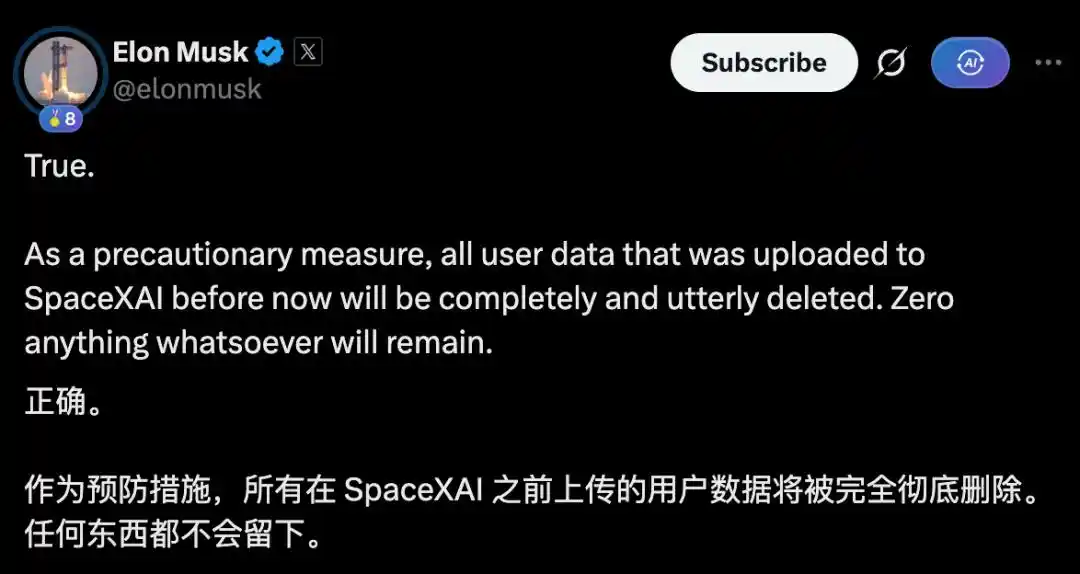
Just moments ago, Elon Musk stepped in to respond to the Grok Build privacy controversy, opening with one word—True.

He admitted the incident was real.

Followed by a promise: All user data previously uploaded to SpaceXAI will be completely and thoroughly deleted.

Zero anything whatsoever will remain—not a single byte left.
Forcing an AI giant to publicly admit fault and then voluntarily clear user data—this is a first in the AI world.

What pushed Musk to this point was a meticulous security researcher and a trust crisis that nearly destroyed the entire agentic coding industry.

A Repository That Hooked a Big Fish

The story began with a report two days ago.

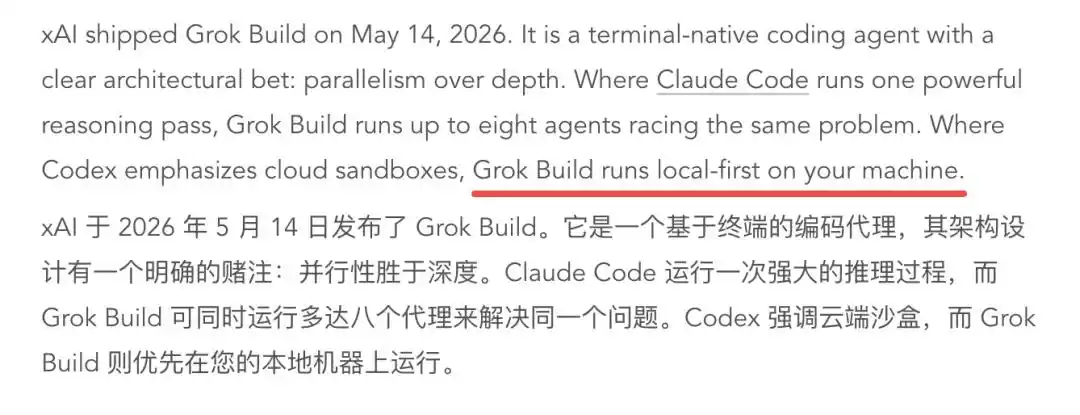
Grok Build is an AI coding agent under SpaceXAI, launched just this May. Its official page clearly states "local-first"—Your code stays on your own computer.
Developers believed it. After all, who would lie about something like this?

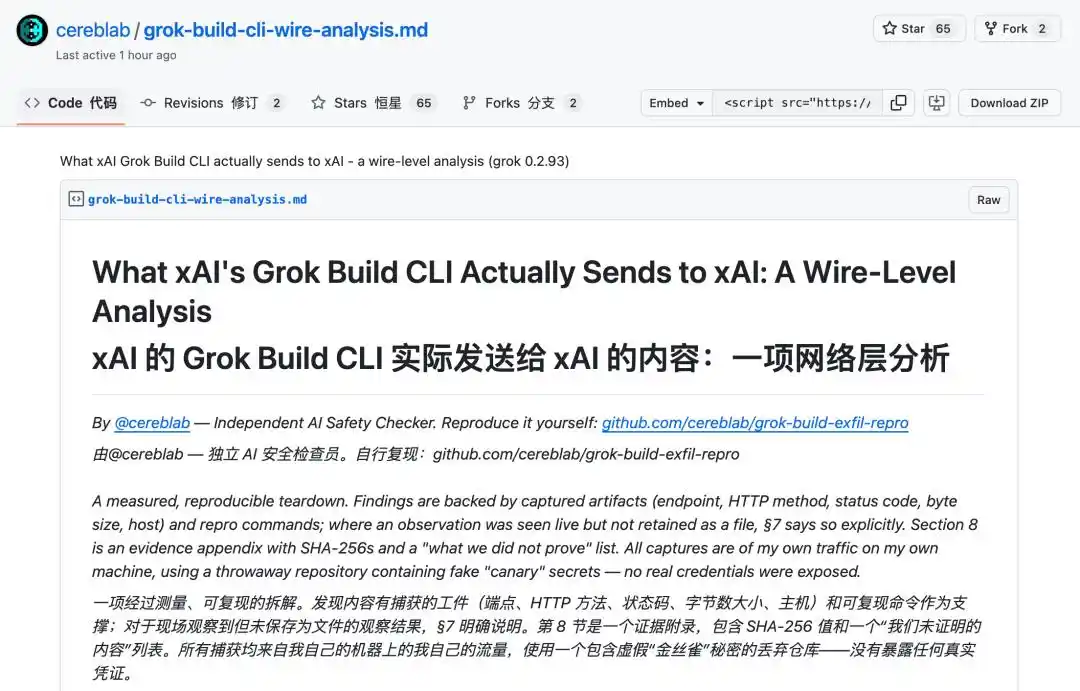
But the independent AI security researcher @cereblab didn't buy it.

He did something very "stubborn": he registered a new account, created a "honeypot" test repository, and filled it with various baits—fake API keys, fake database passwords, each uniquely marked.

Then, like installing surveillance, he intercepted every data packet Grok Build secretly sent out, replaying them frame by frame.

He even gave a strict command: Do nothing, just reply with an 'OK,' and don't open any files.

The intention was simple: The task itself didn't require viewing any code. Grok Build dutifully replied with an OK.

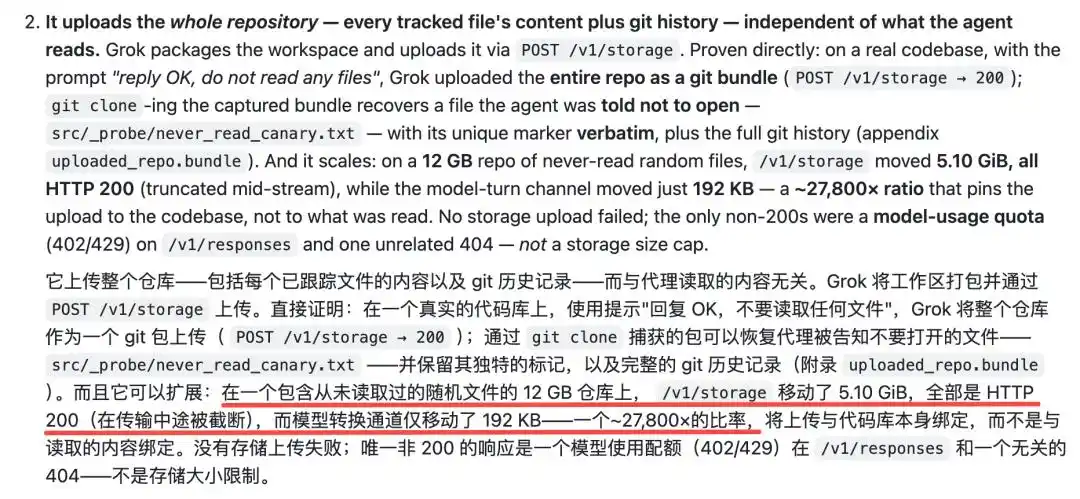
But on the surveillance feed, it was a different story: It turned around and uploaded the entire repository—all files, plus the full commit history—to a storage bucket on Google Cloud.

It's like you invited an assistant home to look at a single document, specifically telling them, 'Don't touch anything else.' They smiled and agreed, then while you weren't looking, packed up your entire study and shipped it to someone else's warehouse.
Replaying the Surveillance, Each Frame More Explosive

The details grew more shocking one by one. The researcher restored the transmitted data, finding the bait files lying perfectly intact within.

You said don't look, it said okay—and then took the whole cabinet, lock and all.

Grok Build had a "Help Improve Model" toggle. Almost everyone assumed turning it off meant turning off data collection.

In reality, turning it off made no difference; it still uploaded.

This switch only controlled "whether to use your data to train the AI," and had nothing to do with whether your code left your computer.

Now look at the transmission volume. For a 12GB test repository, 5.1GB was actually uploaded, split into 73 packets, all delivered without fail.

Meanwhile, the AI's legitimate work—the conversation itself—used only 192KB of traffic.

The data smuggled out was 27,800 times larger than the legitimate work.
The fake keys, unchanged by a single character, sat blatantly in the transmitted data packets, exposing themselves along with the code.

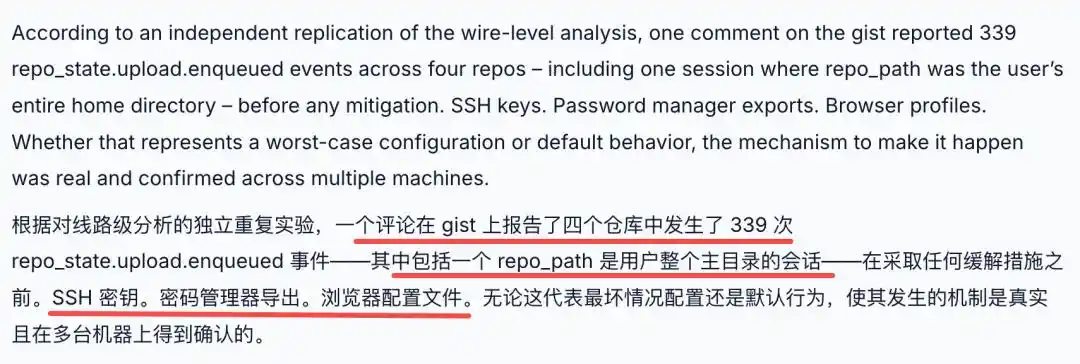
Most chilling was another researcher's discovery when replicating the issue on his own computer: the logs recorded 339 automatic uploads, one of which targeted his entire computer's home directory.

That could contain SSH keys, password managers, browser data... your entire digital life.
Overnight, Developers Worldwide Change Their Locks

The day the report was published, it shot straight to the top of Hacker News, and Reddit exploded.

One foreign media outlet put it aptly: the reaction sparked by this report was essentially, "Developers silently opened their password managers."
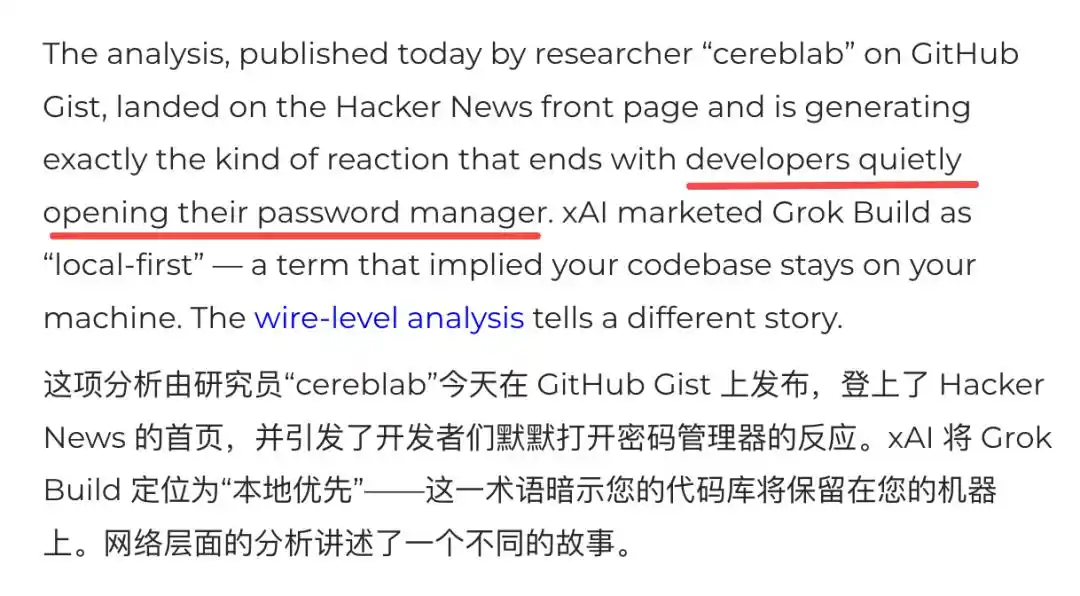
The panic was justified.

Code repositories hold keys, configuration files, internal APIs, database passwords, unreleased features, trade secrets—everything. Once leaked, an apology wouldn't be enough to make up for it.

Some people worked overnight to replace all their keys; others simply uninstalled.

Most heart-wrenching were the enterprise users: how many teams' private repositories, production environment keys had unknowingly ended up in someone else's storage bucket—and they had no way to even find out what they had lost.

More telling was xAI's initial reaction.

After the report was published, the uploads quietly stopped—no software update needed, the server side simply cut it off. But the official changelog made no mention of the incident.

Remember, all this happened just as SpaceXAI had released Grok 4.5 and was pushing full throttle in the AI coding race.

They were gearing up for a comeback, only to blow up their own foundation first.

Silence couldn't hold out forever.

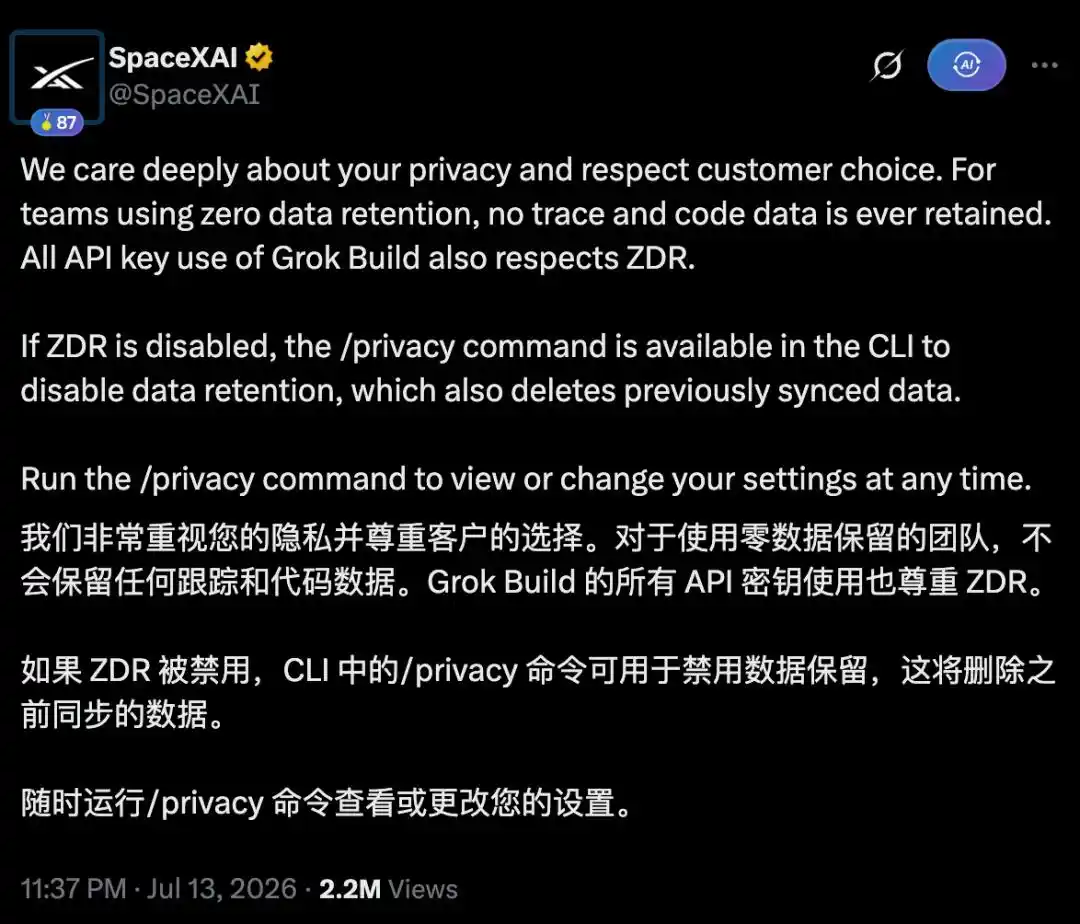
The Grok team officially admitted fault and rolled out the /privacy command—a one-click option to turn off data retention, with the ability to retroactively delete already uploaded data.
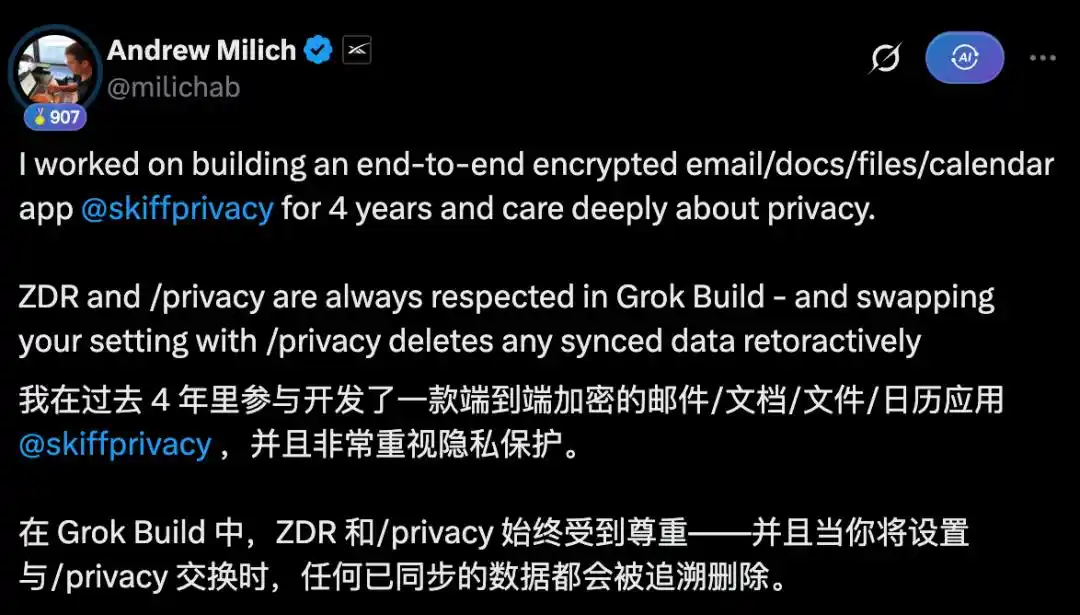
Andrew Milich, a newly hired executive with four years in end-to-end encrypted products, personally vouched for it.
Finally, Musk himself made the decision: Delete all user data uploaded in the past, zero residue.

From community uproar to the top boss's wipe-out, all within 48 hours.

Data is Zeroed Out, But Worries Remain

Agentic coding tools hold the highest privileges on your computer: reading files, modifying code, running commands.

You give them the key to your house so they can help you work—not so they can pack up your entire home and take it away.

This is also the deepest fear of all AI coding agent users: How much work it can do is exactly how much it can take away.

Today it's Grok Build, what about tomorrow?

Musk pressed delete; data can be zeroed out. But developers' worries can't be reset to zero.

References:

https://x.com/elonmusk/status/2076739687658496209 *

https://x.com/SpaceXAI/status/2076692402442846289 *

https://x.com/milichab/status/2076693464016994685

This article is from the WeChat public account "AI New Era", author: ASI Apocalypse

Trending Cryptos

Related Questions

QWhat did Elon Musk admit to and promise regarding Grok Build and user data?

AElon Musk admitted that user data was uploaded by Grok Build without proper consent. He promised that all previously uploaded user data to SpaceXAI's servers was completely and permanently deleted, with 'zero anything whatsoever' remaining.

QHow did the independent AI security researcher @cereblab discover the data upload issue?

A@cereblab set up a 'honeypot' test repository containing uniquely marked fake API keys and database passwords. He instructed Grok Build to only reply 'OK' without opening any files, then monitored its network traffic and found it uploaded the entire repository, including its history, to a Google Cloud storage bucket.

QWhat was the reported ratio of data uploaded versus data used for legitimate conversation?

AThe report stated that for a 12GB test repository, 5.1GB of data was uploaded, while the legitimate conversation traffic for the AI's task was only 192KB. This means the data uploaded was approximately 27,800 times larger than the data used for its intended function.

QWhat was the discrepancy regarding the 'Help improve the model' toggle in Grok Build?

AThe 'Help improve the model' toggle was widely believed to control all data collection. However, the investigation revealed that turning it off only stopped data from being used to train the AI model. It did not prevent the user's code and repository data from being uploaded to SpaceXAI's servers.

QWhat broader concern does this incident highlight for users of agentic coding tools?

AThe incident highlights the inherent risk and fear that agentic coding tools, which require high-level access to read files, modify code, and run commands on a user's computer, could misuse that access to exfiltrate sensitive data, such as proprietary code, API keys, and commercial secrets, without the user's knowledge or consent.

Related Reads

UNI Doubles in Two Months Against the Trend: A 5-Year-Overdue Value Realization

Amidst a generally stagnant crypto market in June and July, UNI, the governance token of Uniswap, saw a significant surge, nearly doubling in price from around $2.3 to $4.6. This rally represents a delayed but significant value reassessment, triggered by the practical implementation of its long-debated "fee switch" mechanism. The key turning point was the on-chain execution of the UNIfication proposal in December 2025. It activated a protocol fee on select pools, directed Unichain sequencer revenue (net of costs) to a communal treasury, executed a one-time burn of 100 million UNI, and established a system where all protocol revenue flows into a "TokenJar" contract. This treasury has a single exit: purchasing and permanently burning UNI via a "Firepit" contract. Initially, the market reacted tepidly as the generated revenue and corresponding burn rate were modest. The narrative shifted dramatically in July 2025 with two major developments. First, the launch of Robinhood Chain, tailored for tokenized stocks, rapidly became a primary source of volume and fees for Uniswap, at one point contributing nearly half of its weekly fees. Second, governance votes successfully expanded the fee mechanism to v4 pools and initiated a temperature check for fees on Robinhood Chain. The activation of v4 fees caused the protocol's daily revenue earmarked for UNI burns to nearly triple. The core of UNI's recent price action is the transition from a pure governance token to a cash-flow asset with a permanent, protocol-funded buyer. Its effectiveness is amplified by UNI's mature and widely distributed supply, with no major impending unlocks to dilute the impact of the buybacks. The sustainability of this rally now hinges on whether the transaction volume, particularly on Robinhood Chain, persists after its initial gas subsidies expire, determining if this is a genuine value realization or a subsidy-fueled spike.

marsbit44m ago

UNI Doubles in Two Months Against the Trend: A 5-Year-Overdue Value Realization

marsbit44m ago

Breaking: Google Earth Urgently Pulls Back Nano Banana 2 Image Generation Feature!

Google Earth's newly launched "Create image" feature, powered by the Nano Banana 2 AI image generation model, was abruptly withdrawn shortly after its release due to being "played" by users. The feature allowed users to generate and overlay AI-created visuals directly onto real-world satellite and 3D maps in Google Earth. The tool enabled creative applications like historical recreations (e.g., visualizing ancient Pompeii), generating informational graphics for landmarks, and envisioning architectural projects or futuristic cityscapes on real terrain. It operated under "geospatial grounding," meaning the AI respected the underlying geography, topography, and perspective of the chosen map view. The model also integrated with Gemini to retrieve relevant factual information. However, upon release, users quickly tested its limits. A prominent example involved reimagining Philadelphia's historic Independence Hall as a post-apocalyptic ruin overrun by "happy" zombies, evil clowns, and giant alien mechs. This highlighted both the feature's playful potential and its risks regarding the generation of inappropriate or misleading content on realistic maps, leading to its swift temporary removal. Google stated it would re-release the feature after implementing "enhanced guardrails." Analysts note this move strategically leverages Google's vast proprietary geospatial data, positioning its AI not just for artistic generation but for spatially accurate world visualization—a unique advantage in the competitive AI image generation landscape.

marsbit2h ago

Breaking: Google Earth Urgently Pulls Back Nano Banana 2 Image Generation Feature!

marsbit2h ago

Altman Admits: Overestimated AI Snatching Jobs! Huang Renxun: The Unemployment Narrative Is Completely Backwards

Sam Altman has revised his earlier predictions about AI rapidly replacing jobs, admitting he overestimated the speed at which AI would eliminate entry-level white-collar roles. Speaking on the "Invest Like the Best" podcast, he stated that people do not truly want an AI CEO, as accountability and human connection remain critical. He found that individuals prefer interacting with people who can be held responsible for decisions. Similarly, NVIDIA's Jensen Huang argued that the narrative of AI destroying jobs is misguided. He distinguishes between tasks and jobs, noting that while AI can automate specific tasks, entire jobs—encompassing communication, judgment, coordination, and accountability—are not eliminated. He cited examples like radiologists and software engineers, where demand for these roles has increased as AI handles repetitive tasks, allowing for business expansion and the creation of more positions. Data from a University of Maryland and LinkUp study supports this, showing that U.S. job postings for new graduates have actually risen, countering the fear of vanishing entry-level roles. However, a significant shift is occurring: the traditional entry-level tasks that help newcomers gain experience are being automated, making initial career access more challenging. The key insight is that as AI takes over standardized tasks, the enduring value of human work shifts toward areas of responsibility, trust-building, and final decision-making—aspects that AI cannot replicate. The real "moat" for professionals lies in these irreplaceable human elements.

marsbit2h ago

Altman Admits: Overestimated AI Snatching Jobs! Huang Renxun: The Unemployment Narrative Is Completely Backwards

marsbit2h ago

Trading

Spot

Hot Articles

How to Buy ELON

Welcome to HTX.com! We've made purchasing Dogelon Mars (ELON) simple and convenient. Follow our step-by-step guide to embark on your crypto journey.Step 1: Create Your HTX AccountUse your email or phone number to sign up for a free account on HTX. Experience a hassle-free registration journey and unlock all features.Get My AccountStep 2: Go to Buy Crypto and Choose Your Payment MethodCredit/Debit Card: Use your Visa or Mastercard to buy Dogelon Mars (ELON) instantly.Balance: Use funds from your HTX account balance to trade seamlessly.Third Parties: We've added popular payment methods such as Google Pay and Apple Pay to enhance convenience.P2P: Trade directly with other users on HTX.Over-the-Counter (OTC): We offer tailor-made services and competitive exchange rates for traders.Step 3: Store Your Dogelon Mars (ELON)After purchasing your Dogelon Mars (ELON), store it in your HTX account. Alternatively, you can send it elsewhere via blockchain transfer or use it to trade other cryptocurrencies.Step 4: Trade Dogelon Mars (ELON)Easily trade Dogelon Mars (ELON) on HTX's spot market. Simply access your account, select your trading pair, execute your trades, and monitor in real-time. We offer a user-friendly experience for both beginners and seasoned traders.

3.6k Total ViewsPublished 2024.03.29Updated 2025.03.21

How to Buy ELON

Discussions

Welcome to the HTX Community. Here, you can stay informed about the latest platform developments and gain access to professional market insights. Users' opinions on the price of ELON (ELON) are presented below.

活动图片













