Velvet crypto slides 75% in a week – Why bulls aren’t giving up yet

ambcryptoPublished on 2026-07-09Last updated on 2026-07-09

Abstract

Velvet (VELVET) has plummeted 75% in a week, with an additional 16% drop in the last 24 hours due to intense selling pressure. This bearish trend is reflected in a Taker Buy Sell Ratio below 1 and a 28% decline in Open Interest, indicating capital withdrawal from the perpetual market. Despite the sell-off, traders maintain a net long position, as shown by a positive Funding Rate. Their conviction is supported by Velvet's significant gains of 59% over the past month and 533% over the quarter. However, recent liquidations have favored short positions. Crucially, spot investors are accumulating, with $1.58 million in net purchases this week, nearly half in the last 48 hours, suggesting they view the price drop as a buying opportunity for a potential near-term rebound.

Velvet [VELVET] has fallen 75% over the past week, with losses continuing as bearish pressure intensifies. At press time, the asset had dropped another 16% in the last 24 hours under the same selling pressure.

The intriguing dynamic beneath the decline is that traders across both the spot and perpetual markets are holding buy-side positions, committing capital against the current tide for Velvet.

Velvet buckles under mounting sell pressure

Velvet is absorbing heavier selling pressure and bearish sentiment, a shift visible in the asset’s trading volume and the shrinking capital base across its perpetual market.

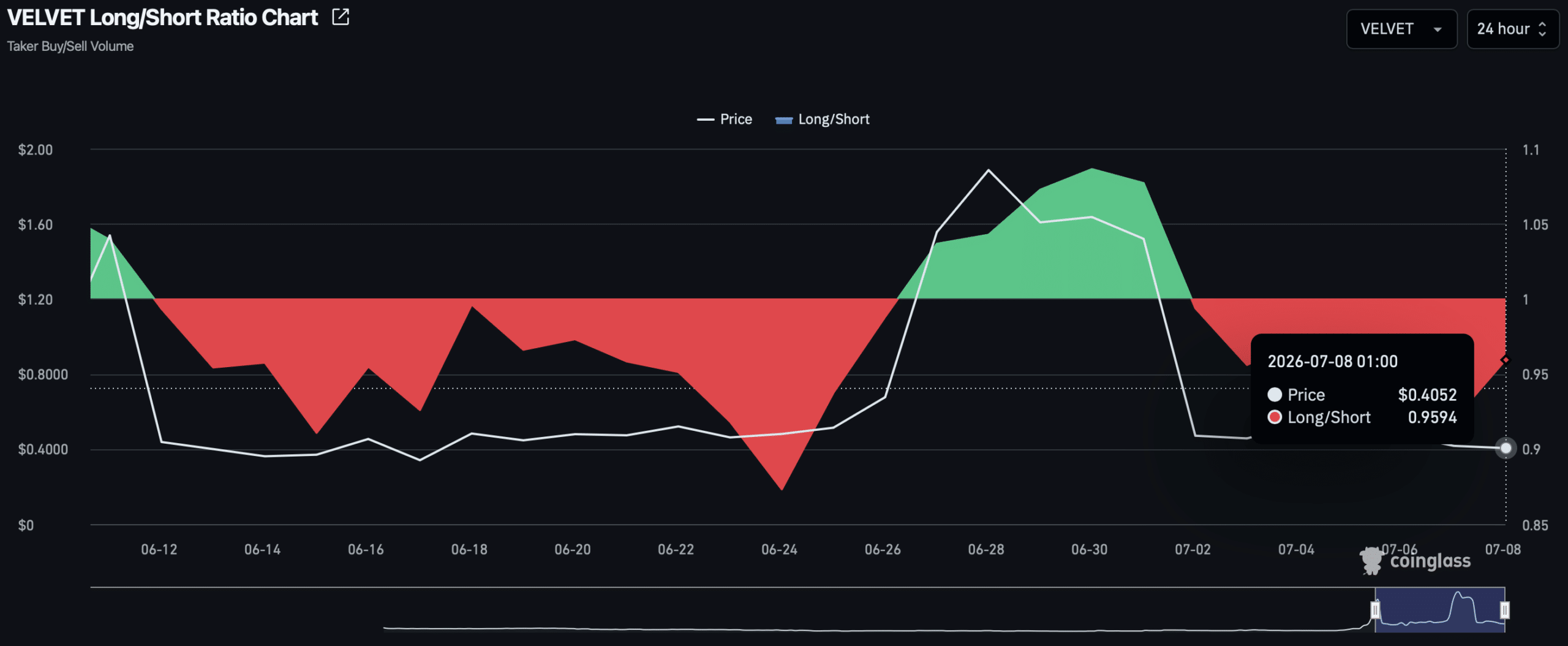
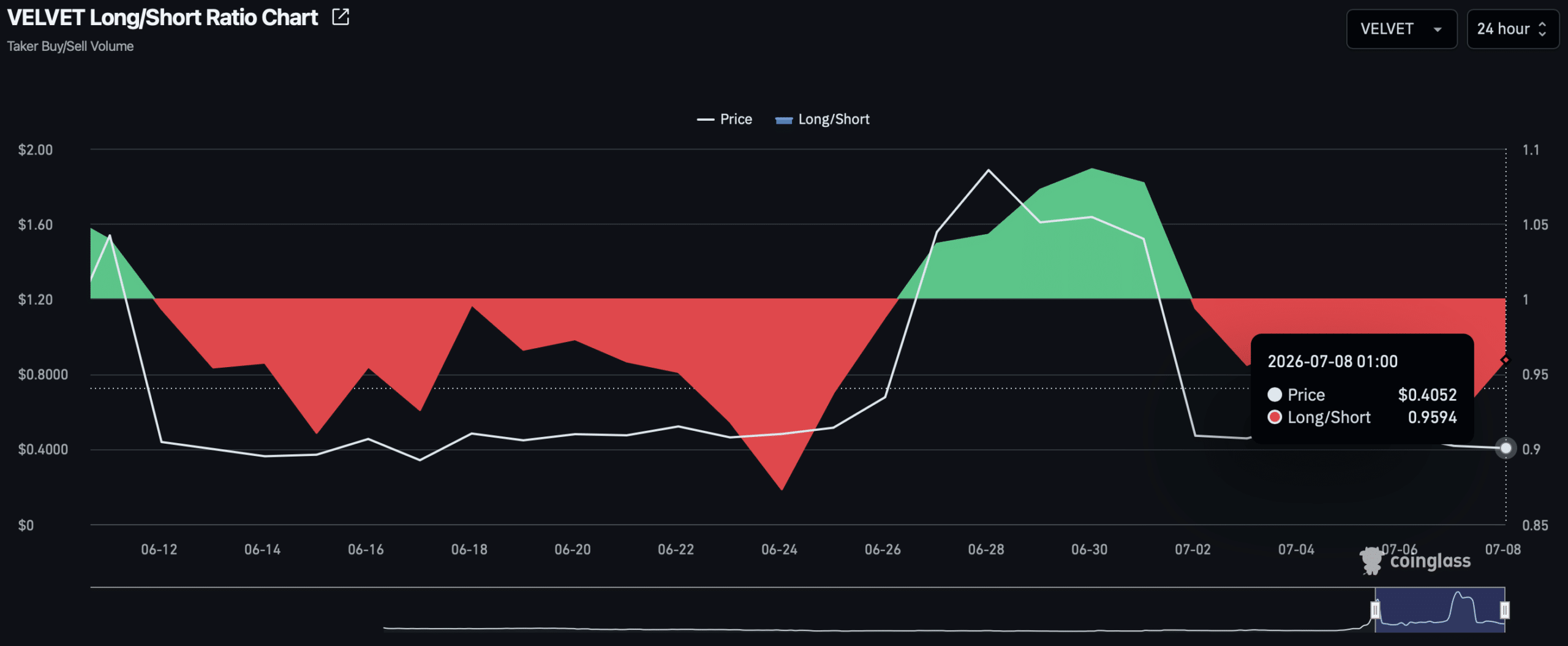
The Taker Buy Sell Ratio, which measures long trading volume against short trading volume in the perpetual market, has tilted toward the sell side as the reading slips to 0.95 as of writing.
Source: CoinGlass

A ratio below 1 signals that sellers are dominating volume across multiple accounts. The sell volume isn’t heavily exaggerated, though, since the figure sits only slightly beneath the 1 mark on the chart. That selling has coincided with a contracting capital base for Velvet in the perpetual market, as investors withdraw funds over concerns about high volatility.

CoinGlass data showed that Open interest, which tracks capital movement in the perpetual market, plunged from $29.36 million to $21.07 million, a 28% decline across the period.

Traders hold net long through the sell-off

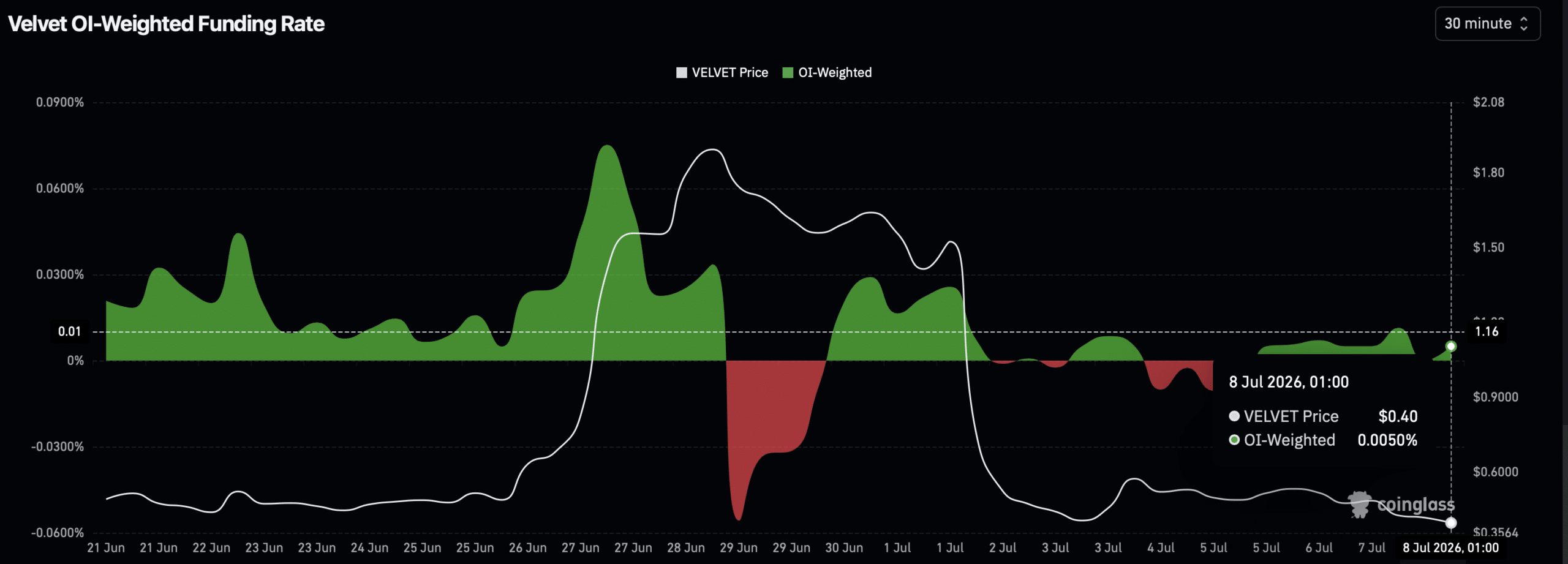
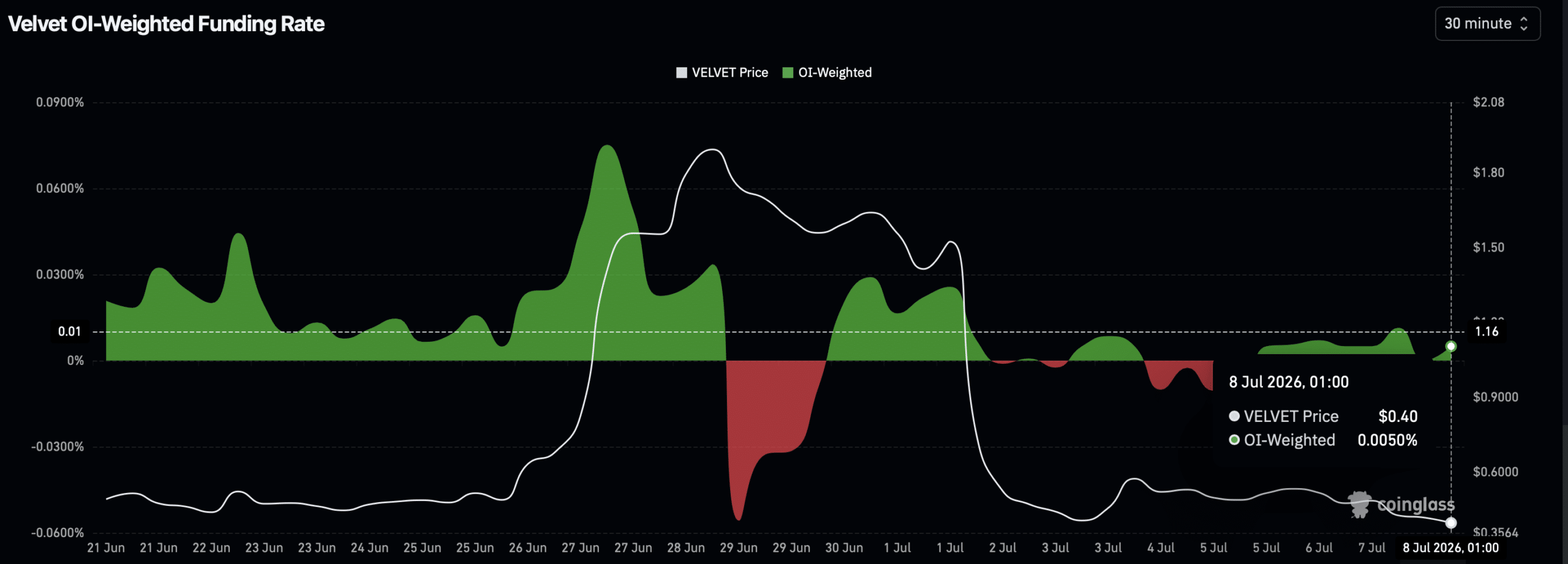
The compelling part of this picture is that trader positioning remains net long despite the rising sell volume and the capital contraction. The Funding Rate, which reflects whether market positioning favors buyers through long trades or sellers through short trades, printed a reading of 0.0050%.

A positive reading, as in this case and only mildly so, indicates that traders are still positioned net long ahead of an upward move ahead.
Source: CoinGlass

However, over a longer horizon, they have reason for conviction in an upswing, as Velvet has surged 59% over the past thirty days and climbed 533% across a quarter, nearly ten times the monthly figure.

The short-term conviction stays questionable, though, since longs have lost more than shorts, with the past 24 hours as the reference.

Total liquidations reached $558,320 over that stretch, and long liquidations constituted the majority at $490,520, an outcome that has made shorting Velvet more profitable than going long.

Spot buyers accumulate through the decline

Spot investors keep reinforcing the broader market narrative as their buying activity climbs.

At the time of analysis, total purchases from spot investors reached $1.58 million this week alone. Nearly half of that has arrived in the past 48 hours, with $781,000 worth of Velvet in netflow backing the buy side.

When netflow confirms stronger net buying in the spot market, it often suggests investors view the recent decline as a discount and an opportunity to accumulate. A continuation of this buying trend would hand Velvet a solid base for a rebound in the near term.


Final Summary

  • Velvet has dropped 75% over the past week and another 16% in a day, with traders pulling money out of the market as selling picks up.
  • Spot buyers have put $1.58 million into Velvet this week, betting the lower price is a chance to buy in before a possible recovery.


Trending Cryptos

Related Questions

QWhat has been the recent price performance of Velvet (VELVET)?

AVelvet (VELVET) has fallen by 75% over the past week. In the last 24 hours alone, it dropped another 16% due to intensifying selling pressure.

QDespite the price drop, what does the Funding Rate data suggest about trader positioning?

AThe Funding Rate for Velvet's perpetual market is positive at 0.0050%. This indicates that traders, on net, are still holding long positions, expecting an upward move in the future.

QWhat is the Taker Buy Sell Ratio, and what does its current reading for Velvet indicate?

AThe Taker Buy Sell Ratio measures long trading volume against short trading volume in the perpetual market. For Velvet, the ratio is 0.95, which is slightly below 1. This signals that sellers are currently dominating the trading volume.

QHow have spot market investors reacted to Velvet's price decline according to the article?

ASpot market investors have been accumulating Velvet during its decline. Their total purchases reached $1.58 million this week, with nearly half ($781,000) coming in the past 48 hours. This suggests they view the lower price as a buying opportunity.

QWhat is the trend in Open Interest for Velvet, and what might it imply?

AOpen Interest for Velvet in the perpetual market has plunged by 28%, from $29.36 million to $21.07 million. This decline indicates a contraction in the capital base, as investors withdraw funds likely due to concerns over high volatility and the ongoing sell-off.

Related Reads

ChatGPT Finally Can 'Search Itself': Nearly Four Years of Conversations, Retrieved with One Click

ChatGPT, nearly four years old, has long lacked a functional way for users to search their own accumulated history. This changed on July 14th, when OpenAI launched a comprehensive "Unified Search" feature across all platforms and plans. This new search allows users to find and instantly access past conversations, uploaded documents, generated images, and projects within their own ChatGPT account, all from a single sidebar entry. This update signifies a major shift in ChatGPT's role, transforming it from a transient chat tool into a personal knowledge base or "file system" for users' AI-generated content. It completes a critical missing piece as OpenAI expands ChatGPT's capabilities with features like Projects, Memory, Work, and Sites, aiming to make it a central hub for work and creativity. The ability to easily retrieve years of personal data makes that data more valuable as a unique, irreplaceable asset in the AI era. However, it also highlights the increasing weight and potential sensitivity of this data, given default settings that allow conversations to be used for model training and legal precedents involving user logs. While a significant improvement over the previous ineffective search, this move is seen as addressing an industry-wide oversight. As the competition between AI assistants (ChatGPT, Gemini, Claude) moves beyond raw model power, the new battleground is becoming which platform can best organize, retain, and leverage the valuable data co-created by users and AI.

marsbit9m ago

ChatGPT Finally Can 'Search Itself': Nearly Four Years of Conversations, Retrieved with One Click

marsbit9m ago

7-Year-Olds Starting Companies? 9-Year-Olds Making Movies? Post-90s Parents Are Raising 'AI Prodigies'

"AI Genius Kids: A New Wave or a Parental Anxiety Trap?" The article examines the recent surge in AI-focused educational camps and programs in China, heavily marketed to parents of young children with sensational claims like "7-year-olds start companies" and "9-year-olds make movies." These programs promise rapid, practical AI skills—from creating agents and business plans to generating content—often for significant fees, capitalizing on parental anxieties about the AI-dominated future. It contrasts this trend with earlier, more foundational AI education, arguing current offerings prioritize superficial, immediate application over deep learning. The author critiques this approach as premature for children still in basic education, suggesting it fosters a shortcut mentality and may even teach improper use, like using AI to cheat on homework. The driving force behind this trend is identified as the profound anxiety of the current generation of parents—largely professionals in tech or related fields—who are witnessing firsthand how AI disrupts and replaces jobs. This workplace fear translates into a desperate desire to equip their children with perceived competitive advantages from an extremely young age, viewing AI proficiency as a magical key to success. The piece also casts a skeptical eye on the phenomenon of real "AI child prodigies," citing examples like Australian teen Alby Churven, whose ventures attract media buzz but little serious investment. It suggests that beyond the hype, the business world remains wary of child-led enterprises. True advancement, the article implies, still relies on solid, traditional education and foundational knowledge, not just early exposure to tools. Ultimately, it frames the AI camp boom less as a legitimate educational movement and more as a reflection of societal pressure and a potentially expensive exploitation of parental fears in a rapidly changing technological landscape.

marsbit13m ago

7-Year-Olds Starting Companies? 9-Year-Olds Making Movies? Post-90s Parents Are Raising 'AI Prodigies'

marsbit13m ago

Wintermute: What Is Left to Build in Crypto?

The article argues that the foundational question for crypto has shifted. Instead of asking "what else can crypto do?", the real question is "why will the real world need crypto next?" The author's answer is the emerging **Machine Economy** – where autonomous agents and robots act as independent economic participants, making decisions, executing transactions, and initiating actions in both digital and physical worlds. Three key recent developments make this shift plausible: 1) AI models are now capable and cheap enough for autonomous, persistent action; 2) Open standards (e.g., stablecoins, Agent payment protocols) allow for composability; 3) Agents can now operate with context over long periods, changing the scale of automated activity. Crypto's core strengths—programmability, permissionlessness, fast settlement, and auditability—align well with the needs of autonomous systems, which don't fit traditional human-centric financial rails. Major platforms like Coinbase and Robinhood are already building infrastructure for Agent-based activity. However, challenges remain, primarily around **Security** (e.g., prompt injection attacks on Agent wallets) and **Attribution/Accountability** when AI-assisted systems fail. The most promising opportunities lie not in crowded foundational layers (L1s, models, exchanges) but in the connective tissue for the Machine Economy: **1) An economic layer for Agents** (handling authorization, risk, identity), **2) Physical AI** (enabling robots in structured environments like warehouses to transact), and **3) Machine-led discovery systems** (e.g., in autonomous scientific research).

marsbit35m ago

Wintermute: What Is Left to Build in Crypto?

marsbit35m ago

Trading

Spot

Hot Articles

How to Buy T

Welcome to HTX.com! We've made purchasing Threshold Network Token (T) simple and convenient. Follow our step-by-step guide to embark on your crypto journey.Step 1: Create Your HTX AccountUse your email or phone number to sign up for a free account on HTX. Experience a hassle-free registration journey and unlock all features.Get My AccountStep 2: Go to Buy Crypto and Choose Your Payment MethodCredit/Debit Card: Use your Visa or Mastercard to buy Threshold Network Token (T) instantly.Balance: Use funds from your HTX account balance to trade seamlessly.Third Parties: We've added popular payment methods such as Google Pay and Apple Pay to enhance convenience.P2P: Trade directly with other users on HTX.Over-the-Counter (OTC): We offer tailor-made services and competitive exchange rates for traders.Step 3: Store Your Threshold Network Token (T)After purchasing your Threshold Network Token (T), store it in your HTX account. Alternatively, you can send it elsewhere via blockchain transfer or use it to trade other cryptocurrencies.Step 4: Trade Threshold Network Token (T)Easily trade Threshold Network Token (T) on HTX's spot market. Simply access your account, select your trading pair, execute your trades, and monitor in real-time. We offer a user-friendly experience for both beginners and seasoned traders.

12.5k Total ViewsPublished 2024.03.29Updated 2026.06.02

How to Buy T

Discussions

Welcome to the HTX Community. Here, you can stay informed about the latest platform developments and gain access to professional market insights. Users' opinions on the price of T (T) are presented below.

活动图片