Decoding 2026 altcoin cycle: Is capital rotating away from high-caps?

ambcryptoPubblicato 2026-07-08Pubblicato ultima volta 2026-07-08

Introduzione

Capital rotation shows no clear signs of leading into a broad altcoin cycle, with altcoins experiencing their worst underperformance against Bitcoin on record. While the total altcoin market cap is up 4% in Q3, 40% of altcoins still trade below all-time highs, indicating liquidity is concentrated in a few high-conviction sectors rather than spreading market-wide. Ethereum has shown relative strength against Bitcoin, with its dominance rising over 4% in Q3, which historically can signal an altcoin cycle. However, major high-cap assets like Ethereum and Solana remain significantly down from their peaks, and on-chain data suggests ETH's move may be more technical than fundamental. Analysts warn investors to be selective, as capital inflows are favoring specific narratives—evidenced by Robinhood Chain's TVL surging over 150% to a record $108 million—while TVL in many major high-cap ecosystems stays low. The cycle appears different, with liquidity flowing selectively and potentially leaving high-cap altcoins under continued pressure.

Capital rotation shows no clear signs of leading into a broader altcoin cycle.

However, this cycle looks different. On-chain data shows that altcoins are seeing their worst underperformance against Bitcoin [BTC] on record. This suggests that liquidity is not spreading across the altcoin market but instead rotating into a few high-conviction sectors while most assets continue to lag BTC.

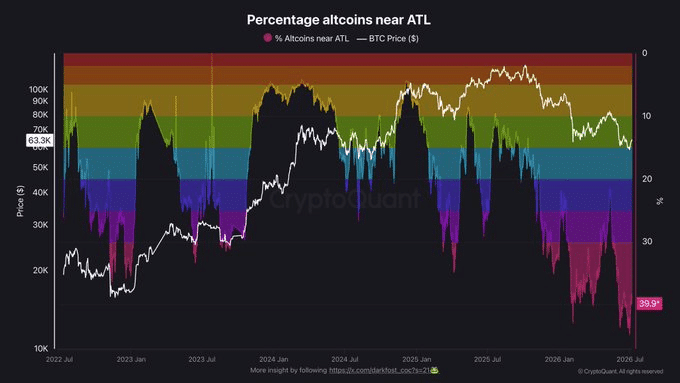
To put this into perspective, the total altcoin market cap currently sits around $870 billion, up 4% so far in Q3. However, a recent CryptoQuant report shows that 40% of altcoins are still trading below their all-time highs, showing that many assets have failed to recover even as some parts of the market continue to rally.
Source: CryptoQuant

Looking at it from a different angle, 60% of altcoins are still holding above their previous highs, suggesting that strength remains in specific sectors and assets rather than across the broader altcoin market.

From a technical perspective, Ethereum [ETH] dominance has started Q3 on a strong note, rising over 4%, while Bitcoin dominance has increased by only 0.7%. As the largest altcoin, ETH’s stronger capital inflows compared to BTC suggest that investors are beginning to rotate into altcoins.

Historically, a rising ETH/BTC ratio during a volatile market is often viewed as an early signal of an altcoin cycle starting to take shape. However, altcoins are still seeing their biggest underperformance against Bitcoin on record, raising the question: Is this cycle different, with liquidity flowing into only a few major assets and ETH struggling to trigger a broader altcoin cycle?

Why sector-based altcoin rallies could leave high-caps behind

Analysts are flagging warning signs across the market.

This follows the recent CryptoQuant report, where analysts urged investors to be more “selective” as altcoins face their strongest underperformance against Bitcoin on record. Going forward, the key question is whether investors regain the risk appetite to move back into altcoins, especially high-cap assets.

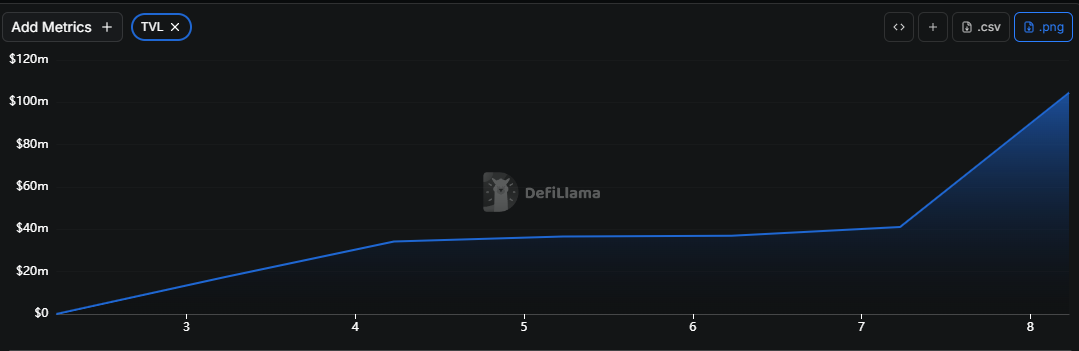
From a technical perspective, major high-cap assets are still trading well below their all-time highs. Ethereum, for example, remains down over 60%, while Solana is down more than 70%, showing that even leading altcoins have yet to fully recover. Meanwhile, TVL on Robinhood Chain has jumped over 150% in the past 24 hours to a record $108 million.
Source: DeFiLlama

By comparison, TVL across many major high-cap ecosystems remains near multi-month lows, showing where liquidity is actually flowing. More importantly, these inflows have come alongside ROBIN’s 30%+ rally so far in Q3, reinforcing the view that investors are rotating into high-conviction narratives.

That naturally puts Ethereum’s recent strength in focus.

While ETH has shown relative strength against Bitcoin, its on-chain fundamentals remain soft, suggesting the move may be more technical than structural. If capital continues flowing into selective altcoin narratives, pressure on major high-cap altcoins could keep building through the rest of H2.


Final Summary

  • Capital is flowing selectively, while many high-cap altcoins continue to lag behind.
  • Ethereum is showing technical strength, but high-caps could still face pressure if liquidity remains selective.


Domande pertinenti

QWhat is the main observation regarding capital rotation in the current altcoin market according to the article?

AThe article states that capital rotation shows no clear signs of leading into a broader altcoin cycle. Instead, on-chain data indicates liquidity is not spreading across the altcoin market but rotating into a few high-conviction sectors, with most altcoins underperforming Bitcoin at record levels.

QWhat percentage of altcoins are still trading below their all-time highs, and what does this suggest?

AA recent CryptoQuant report shows that 40% of altcoins are still trading below their all-time highs. This suggests that many assets have failed to recover from previous downturns even as some parts of the market rally.

QWhat is the significance of the recent movement in the Ethereum/Bitcoin (ETH/BTC) ratio mentioned in the article?

AThe article notes that Ethereum dominance has risen more than Bitcoin's in Q3. Historically, a rising ETH/BTC ratio during volatile markets is seen as an early signal of a potential altcoin cycle. However, the current context is different as altcoins are still severely underperforming Bitcoin.

QWhat example does the article provide to show where investor liquidity is actually flowing, as opposed to major high-cap ecosystems?

AThe article highlights Robinhood Chain (ROBIN), where Total Value Locked (TVL) jumped over 150% in 24 hours to a record $108 million, alongside ROBIN's price rally. In contrast, TVL across many major high-cap ecosystems remains near multi-month lows, indicating selective capital flows into specific narratives.

QWhat is the article's final conclusion regarding the pressure on major high-capitalization altcoins like Ethereum?

AThe article concludes that while Ethereum is showing technical strength, its on-chain fundamentals remain soft. If capital continues to flow selectively into specific altcoin narratives rather than broadly, major high-cap altcoins could face increasing pressure for the rest of the second half of the year.

Letture associate

Yen Hits 40-Year Low, What Will Japan Use to Price in Shorts?

The Japanese yen is hovering near a 40-year low against the U.S. dollar, with the USD/JPY pair approaching 164 in July. Japanese Finance Minister Shunichi Suzuki has issued stern warnings of potential "bold" action to counter disorderly market movements, placing the 163-165 range in focus as a key policy test zone for authorities. The yen's weakness extends beyond dollar strength, as evidenced by its low trade-weighted index, which pressures import costs and inflation—particularly with elevated oil prices. This dynamic increases the likelihood of further Bank of Japan (BoJ) rate hikes. The Ministry of Finance is first aiming to raise the cost for yen short-sellers through verbal intervention and the threat of action, rather than immediately altering fundamentals. While direct FX intervention remains a high-barrier option, slower-moving factors like potential BoJ rate hikes and asset rebalancing by Japan's Government Pension Investment Fund (GPIF) could provide more sustained support for the yen. The core risk for carry trades—which involve borrowing low-yielding yen to invest in higher-yielding assets—is not an imminent unwind but a sudden spike in yen volatility. As policymakers deploy a mix of warnings, rate hike expectations, and potential fund flows, the cost and risk of shorting the yen are increasing. The 163-165 zone is becoming an area where policy responses could trigger a broader repricing, making the yen a more critical variable for global risk asset leverage.

marsbit13 min fa

Yen Hits 40-Year Low, What Will Japan Use to Price in Shorts?

marsbit13 min fa

In the Second Half of 2026, Commodities Enter an Era of 'High-Frequency Black Swans'

Heading into the second half of 2026, Citigroup warns that the commodities market is entering an era of "High-Frequency Black Swans," where extreme, paradigm-shifting events are becoming increasingly common. The report outlines major tail-risk scenarios beyond its baseline forecasts. The highest-impact scenario is a prolonged US-Iran conflict disrupting Gulf energy infrastructure and key shipping chokepoints, potentially causing a sustained 5-10 million barrel per day oil supply deficit and pushing crude prices above $200/barrel. Other geopolitical risks include stricter sanctions on Russian energy, which would hit gas markets harder than oil, particularly liquefied natural gas (LNG). A high-probability risk is a global scramble by governments to stockpile critical minerals. Large-scale strategic buying, particularly of copper, could drive prices above $20,000/ton. For gold, Citigroup sees near-term downside risk towards $3,800/ounce before a potential long-term rally to $6,000/ounce, supported by central bank demand and de-dollarization trends. An extreme El Niño weather pattern poses a medium-probability, high-impact threat to agriculture, potentially sending cocoa prices back to $10,000/ton and sugar above 20 cents/pound. The AI boom presents a dual-sided risk: a bust would hurt metals and power demand, while sustained growth would exacerbate structural deficits in copper and aluminum. Two other significant scenarios are the finalization of Russia's Power of Siberia 2 gas pipeline to China, which could depress Asian LNG prices to $5-6/MMBtu in the 2030s, and an extreme application of the Monroe Doctrine blocking Americas oil exports, which could create a price split with global benchmarks soaring above $100/barrel while regional benchmarks crash. The overarching conclusion is that traditional supply-demand analysis may fail in a market where such high-impact, interconnected shocks are becoming more frequent.

marsbit13 min fa

In the Second Half of 2026, Commodities Enter an Era of 'High-Frequency Black Swans'

marsbit13 min fa

Trading

Spot
活动图片